Kinsale without Sunshine

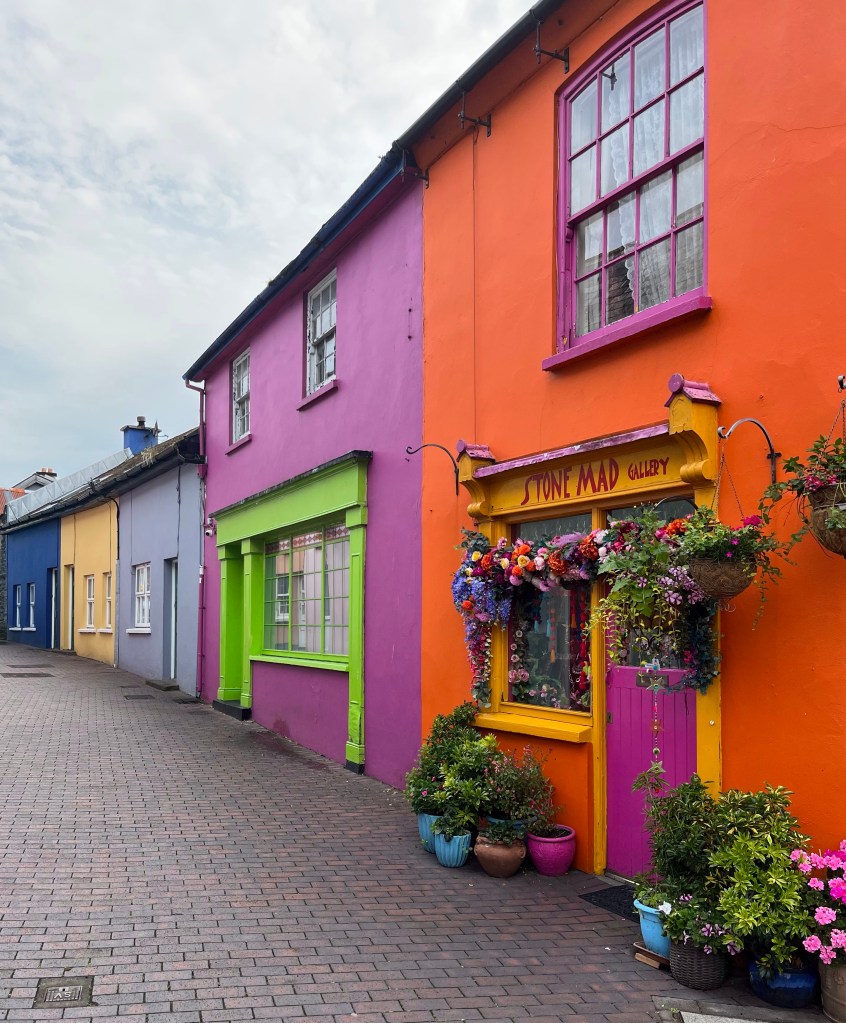
Our refrain has been for three days, “that would be a gorgeous view if the sun would just pop out for a minute.” And “that would be a fun walk if the rain would stop.” Kinsale has a lot to offer even on a very wet June weekend. In the sunshine it would be hard to beat!

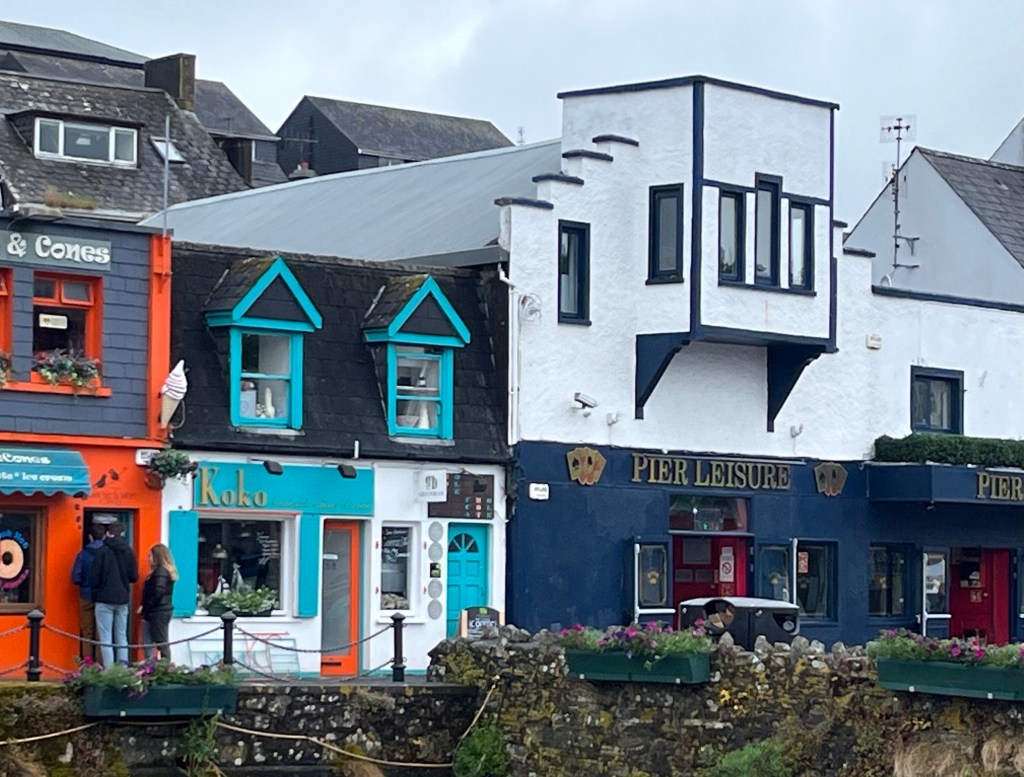
A medieval town, with bits of the original wall still standing, Kinsale is a touch point in Irish (and British) history. Walking the town you can hardly walk a short block without encountering a historical reference. A small pocket park marks the site memorializing the famine. Another has a monument to the War of Independence. And another to the maritime history of the town. Today it is filled with colorful shops and restaurants catering to tourists.

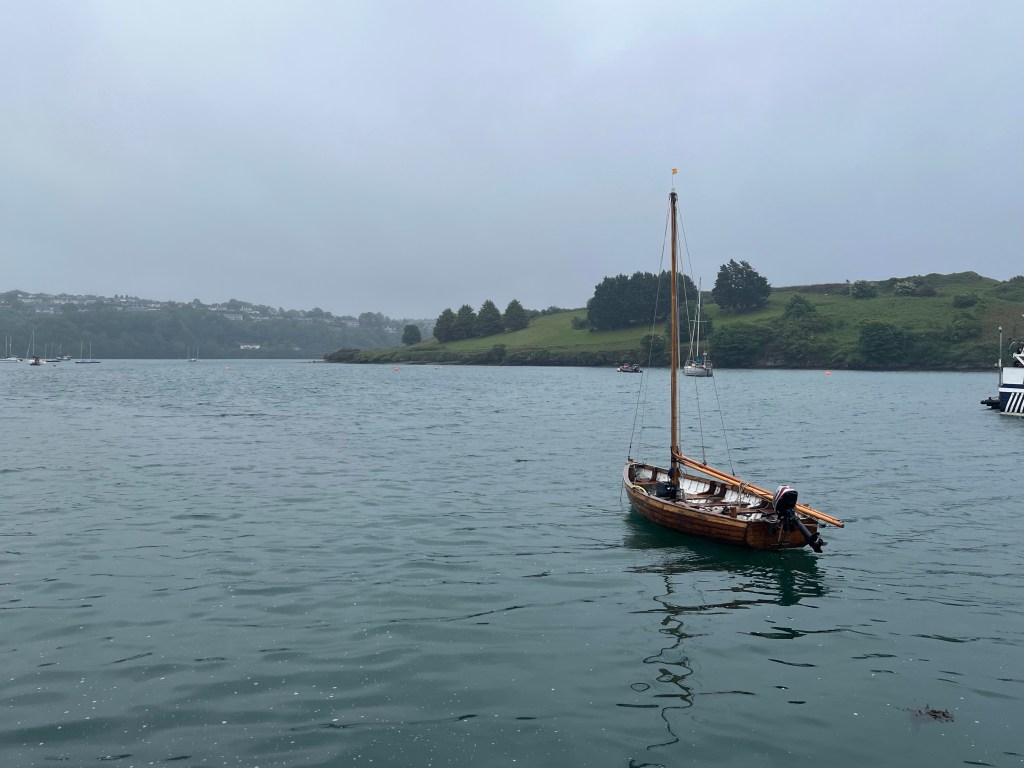
Situated near the entrance to a long, narrow bay, Kinsale is dominated by its harbor, its fishing fleet and pleasure boats. Working fishing boats still are tied up to the docks (and local restaurants brag about their fresh seafood) Lobster pots set alongside the boats. As we said, it would be incredibly picturesque if the sun were shining.

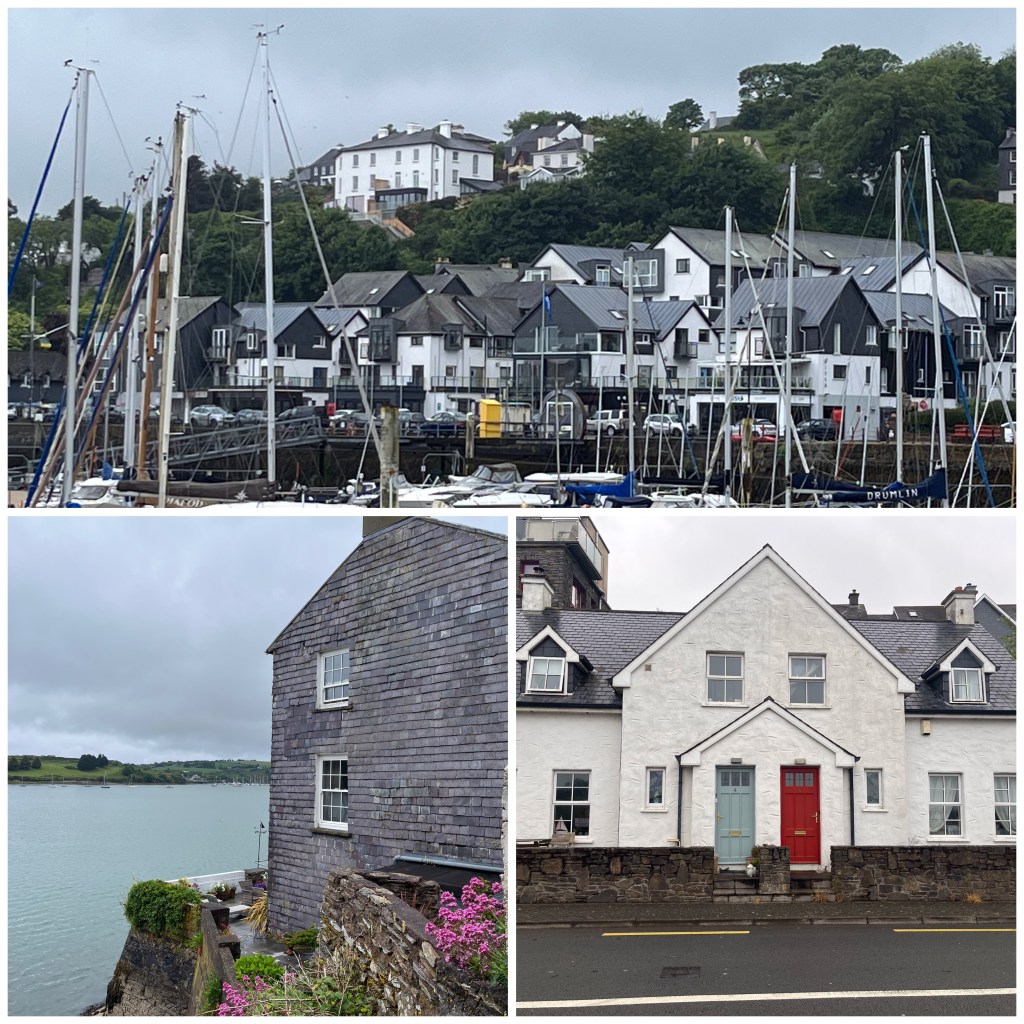
There are great walks to the north and south of town. The path along the south side of the harbor leaves town, climbs a bit past a group of homes (some quite modern and elegant) and becomes a pedestrian walking path out to Fort Charles. Between the slated-sided and typical whitewashed house, there’s a great view back at the condos lining Pier Road and the Kinsale Yacht Club.

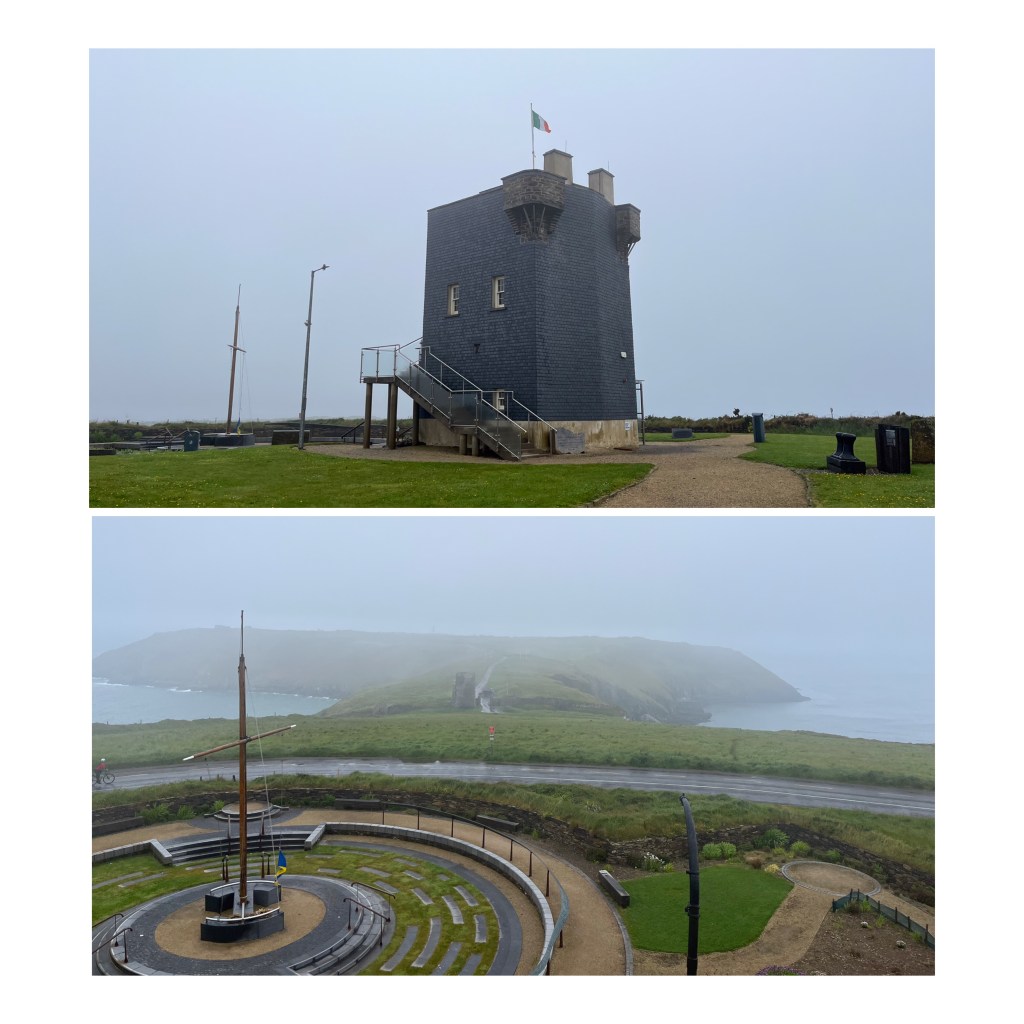
A few kilometers from Kinsale is the Lusitania Museum and Old Head Signal Tower. The tower was built as part of an early warning system up the eastern coast of Ireland built to announce any potential invasion by Napoleonic forces in the early 1800’s and has been rebuilt and restored. Today the site also serves as a memorial to the sinking of the Lusitania in 1915 and the interior of the tower is a small museum. Ships from Kinsale were among the first to the scene after the attack and rescued many of the survivors. The names of those lost are listed around the memorial. On a clear day you can see for miles from the top of the tower. We were a bit surprised the best views and a historic lighthouse are off limits as part of a private golf course. Obviously the tradition here does not match Scotland where even St. Andrews Golf Course was open to non-golfing walkers one day a week.

We kept waiting for the clouds to lift and see the Kinsale in sun light. Never happened, unfortunately. Maybe next time?

A Walk in the Wolds

Several years ago while in Scotland we met some folks who were hiking, pub to pub, through a section of Scotland. The idea intrigued us— slowing down the travel time, spending some time walking through the villages, meeting up with local walkers. But carrying a backpack with all our possessions? No way. Then a friend took a long walk through England and told about a local company that carried her bags from place to place and made lodging arrangements, leaving her just to lug a day pack. That we could manage!
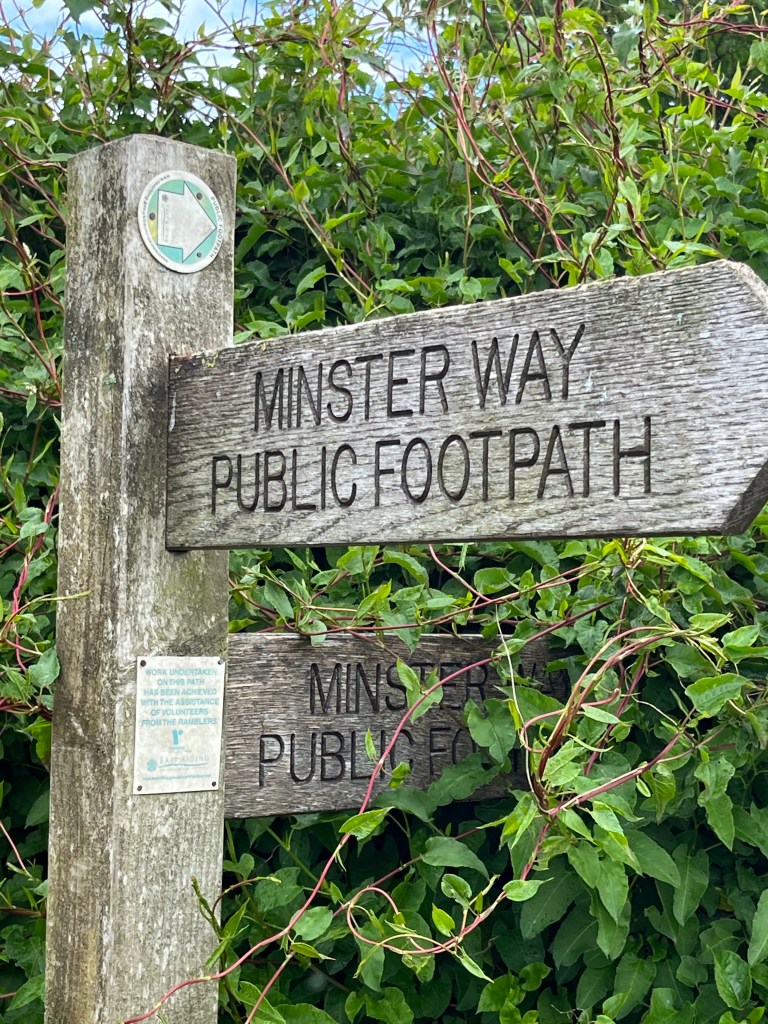
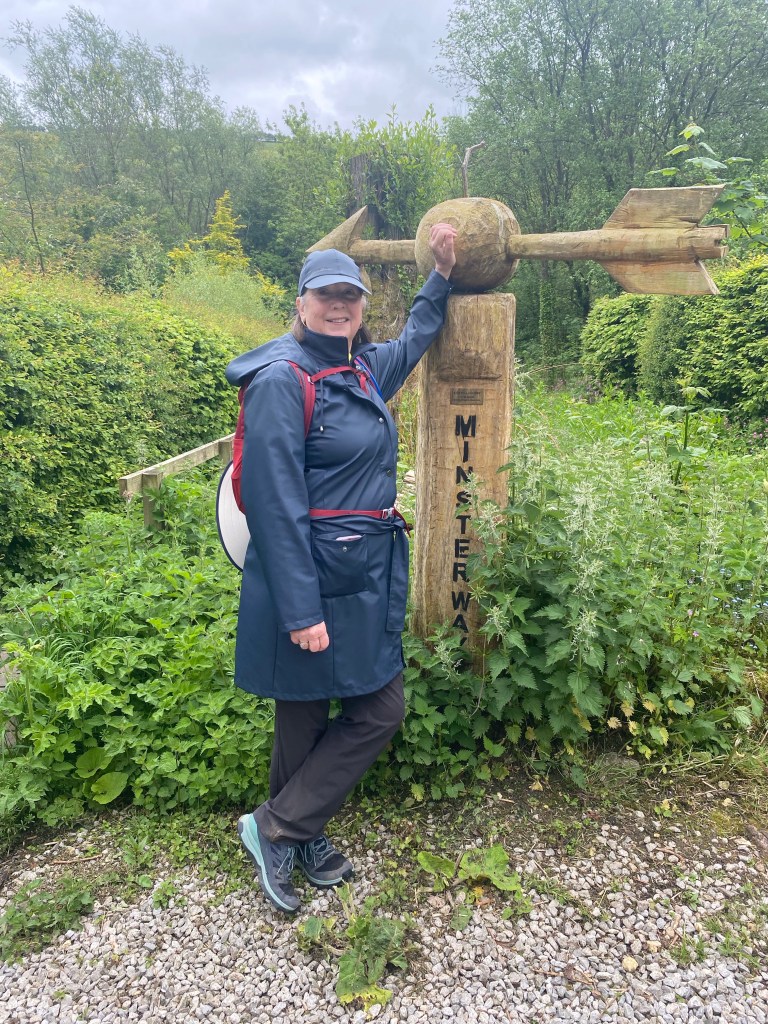
We had never been to York and thought we wanted to walk for three or four days. We checked with one of many different companies that support this kind of independent walking trips and picked a 50 mile walk out of York — The Minster Way — a ramble from the Beverley Minster to the grand York Minster through the East Yorkshire Wolds. We signed up, booked our tickets and then Covid hit. Two and a half years later we boarded our flight.

The actual walk began in Beverley. We were loaded with information — two published narratives, describing the walk. Four actual topographical maps charting our walk plus all the others in the area. One electronic version of a topographical map and, of course, Google maps. All were insufficient to get us out of Beverley. We were finally guided out by a kind gentleman walking his dog in suburban Beverley. A small celebration when we finally found the first of the signs directing the way.

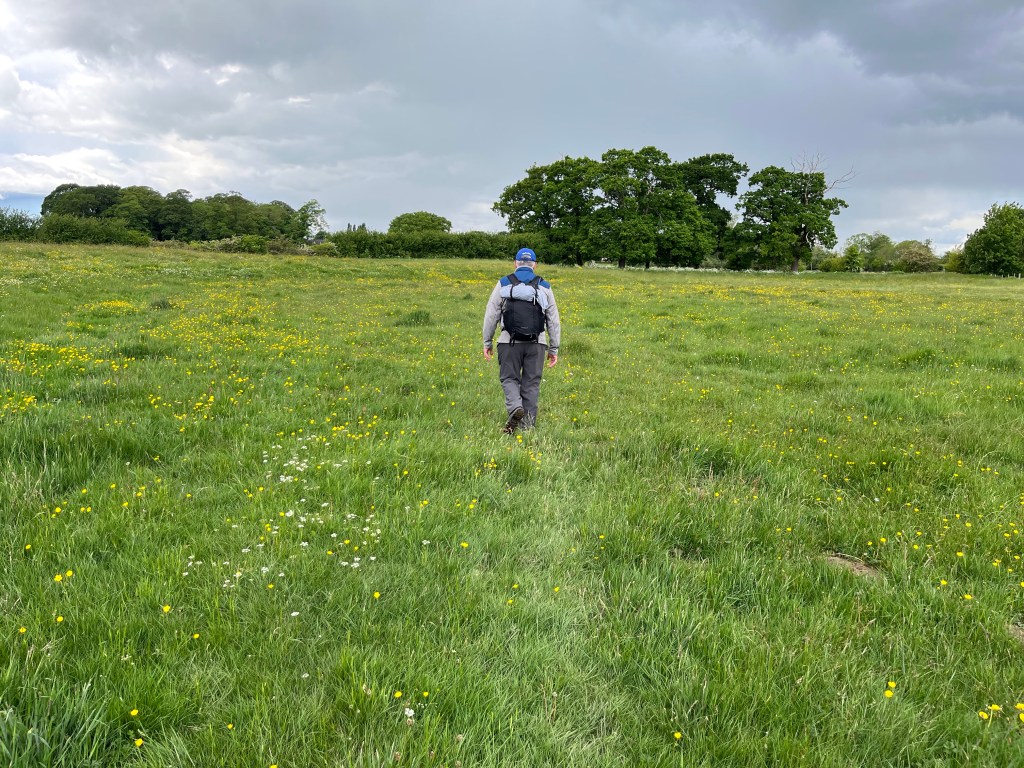
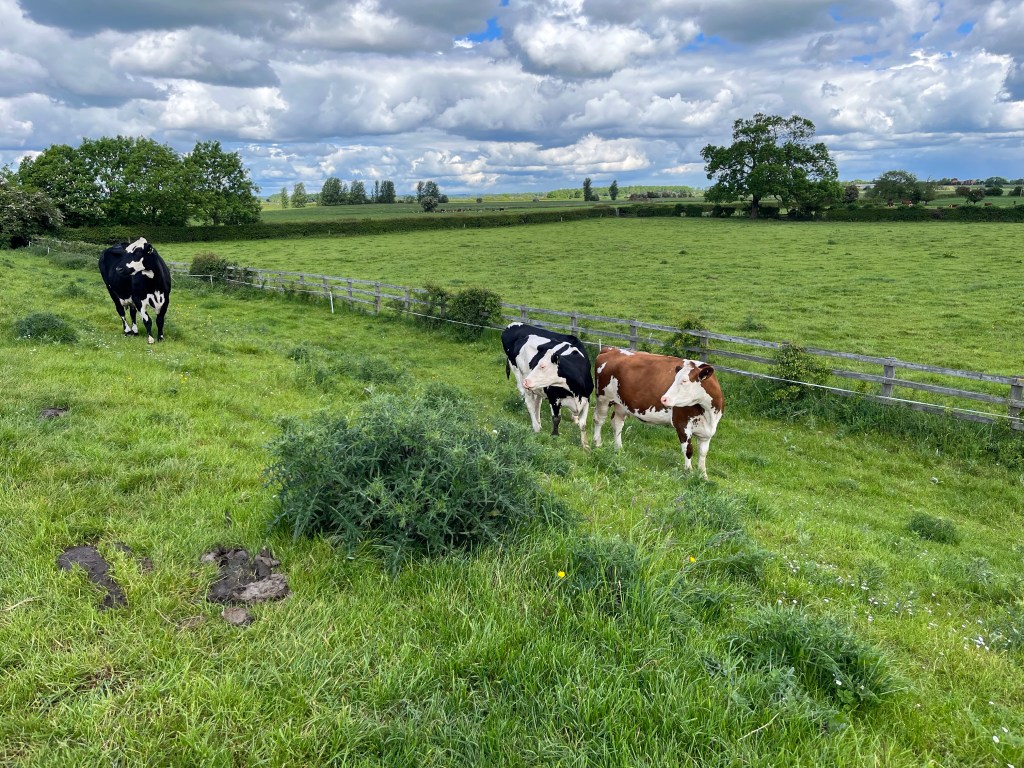
At first it was a bit disconcerting to weave through a gate, reading the signs warning of bulls in the pastures, but they seemed pretty accustomed to the occasional walker to be even be bored by our appearance. That is, except for one group of young bulls, that began to run as we got close. Then they stopped about 20 yards ahead on the path, turned to look if we were still coming and would set off again. Eventually they turned and at a safe distance thundered past us. Soon walking among the animals didn’t cause us a second’s pause. Often despite the warnings, the pastures were empty.

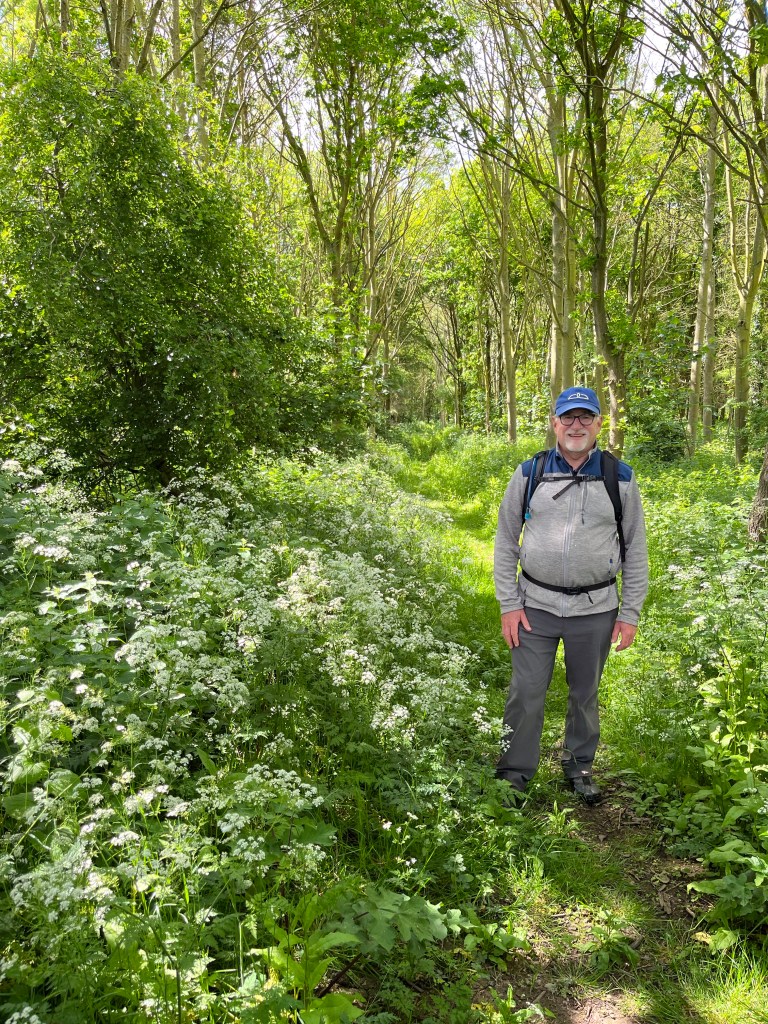
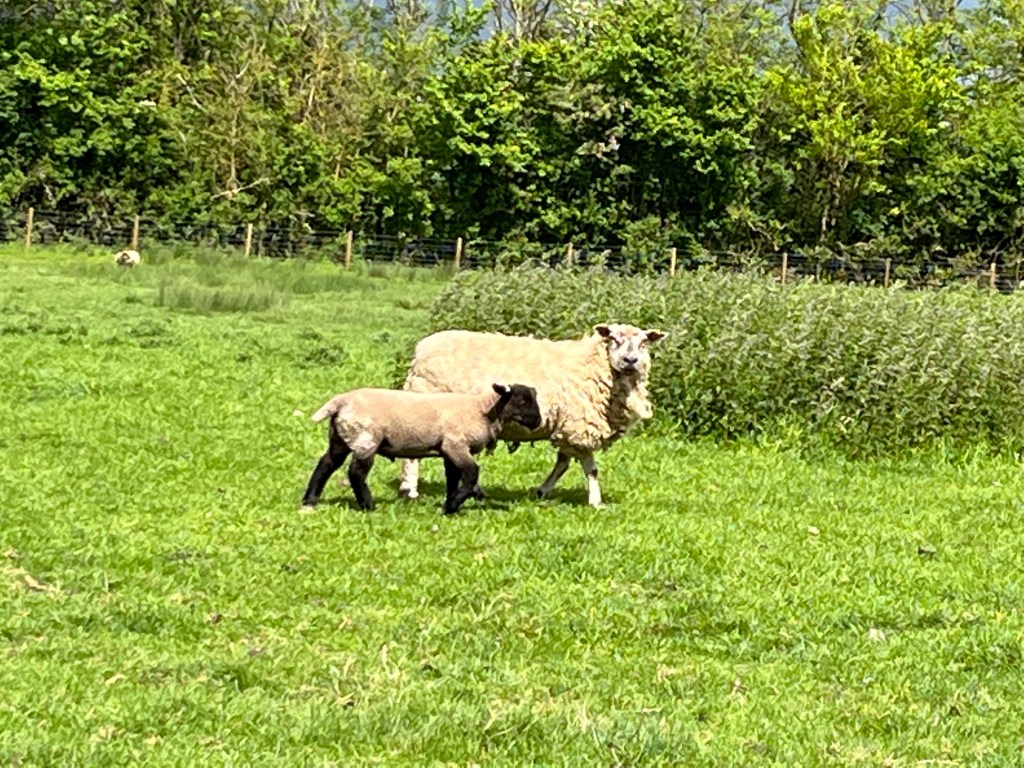
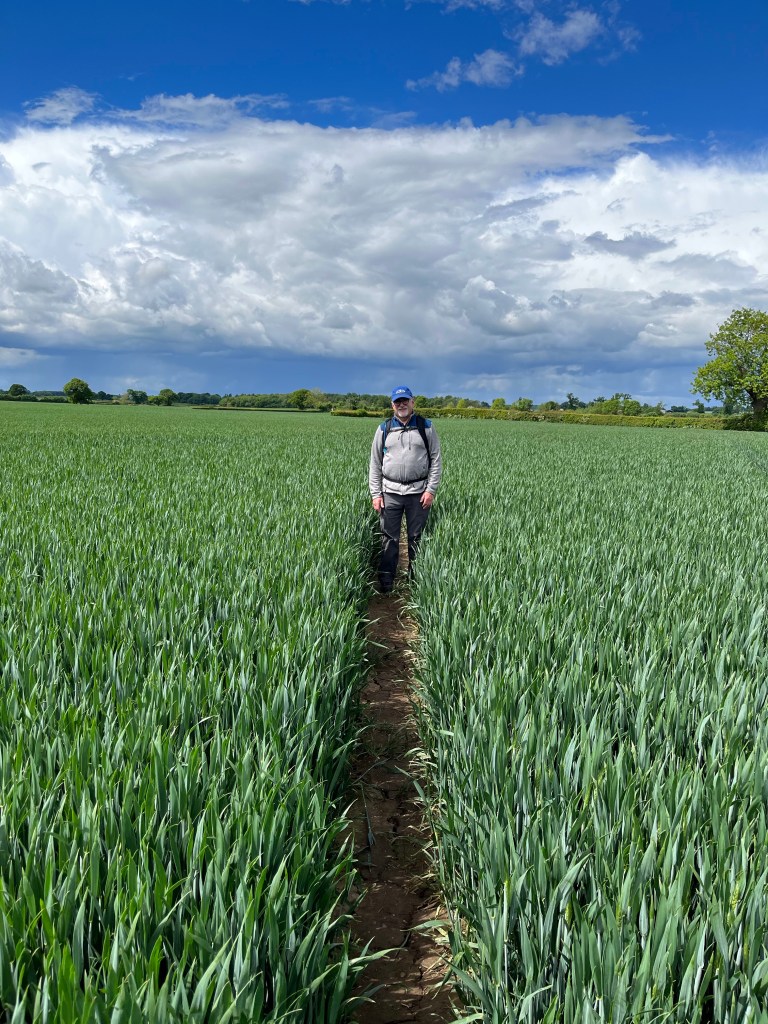
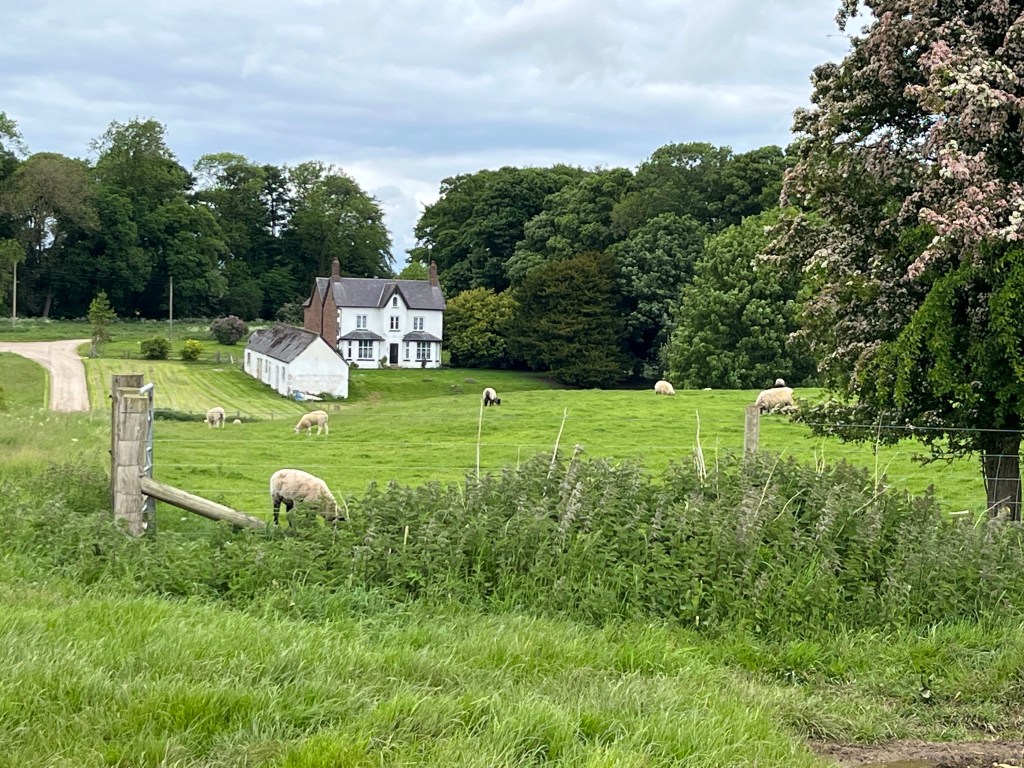
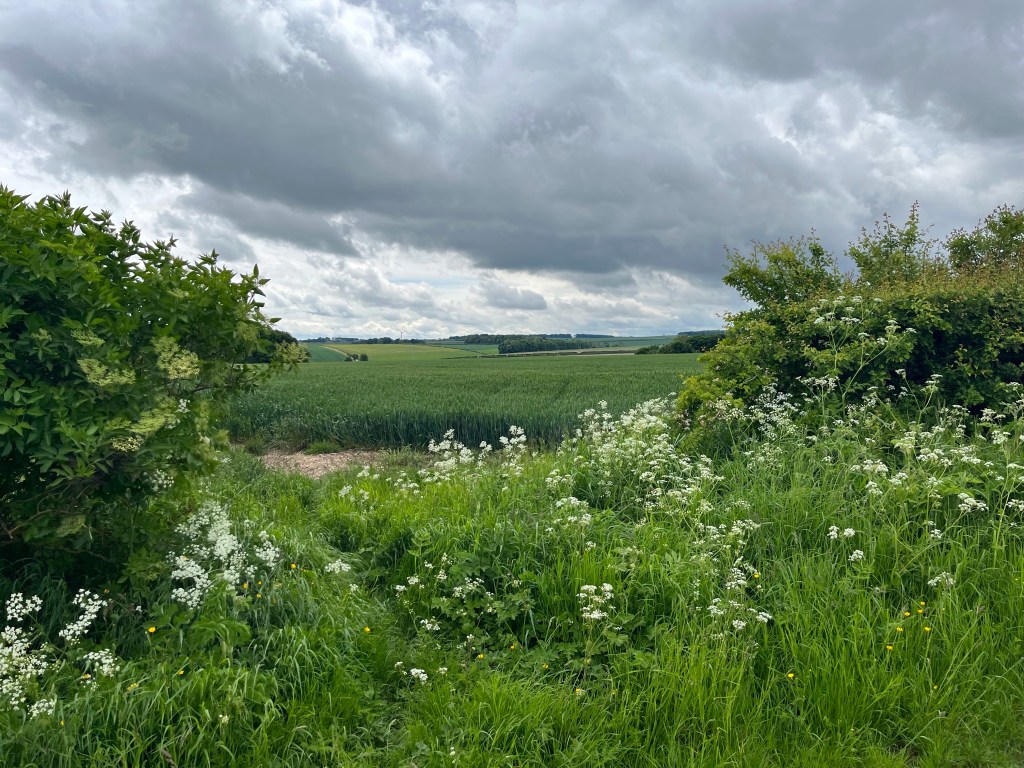
The first two days took us through fairly flat, agricultural land — huge fields of wheat, rye and other grains plus pasture of caws and pens of sheep. Interspersed among the fields were small patches of trees and an occasional road or track for farm equipment.

Most of the path went right through the planted fields and up close and personal with the animals and around outbuildings for farms.

At one point the path led us into a field of wheat and appeared to stop. A couple in the distance waved us forward and with some trepidation for stomping on valuable wheat we proceeded. Turns out the couple was out weeding their field by hand, removing a noxious weed that is impervious to herbicides, or at least those that could be used in a wheat field.

We also ran into the estate manager for a large operation. He explained that much of the rye in the area could be sold at about $100 more a ton if used in energy conversion plants which operated in the area. And while potatoes were also grown in the region, the chalky soil spoiled their looks so they were only used for seed.

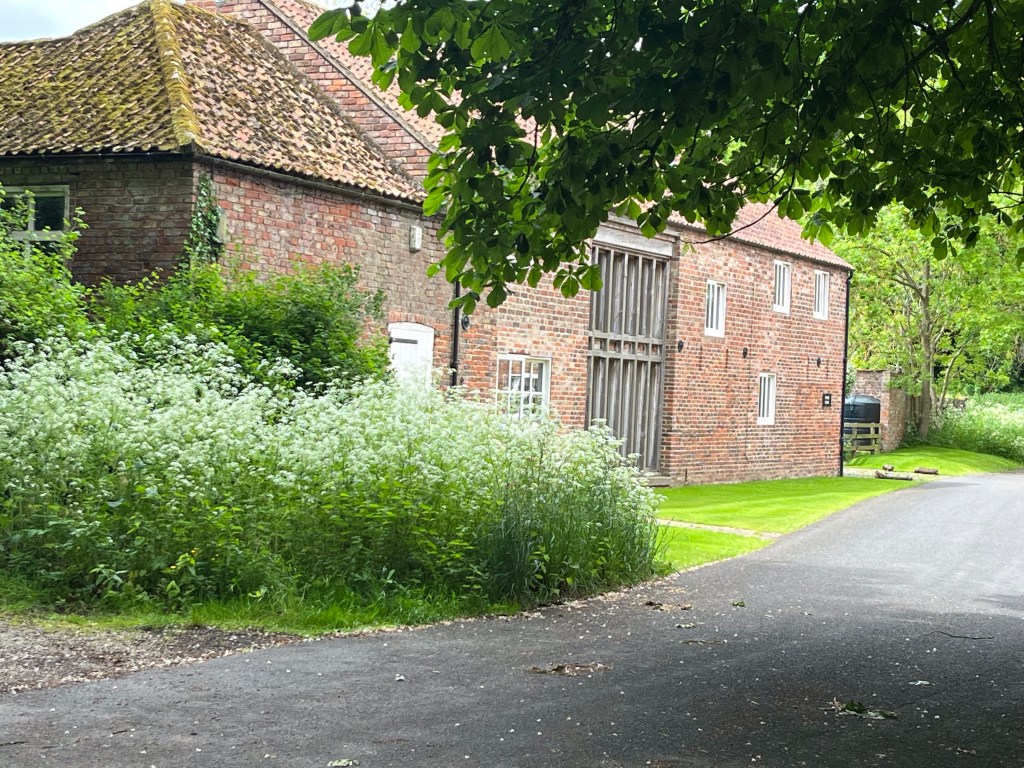
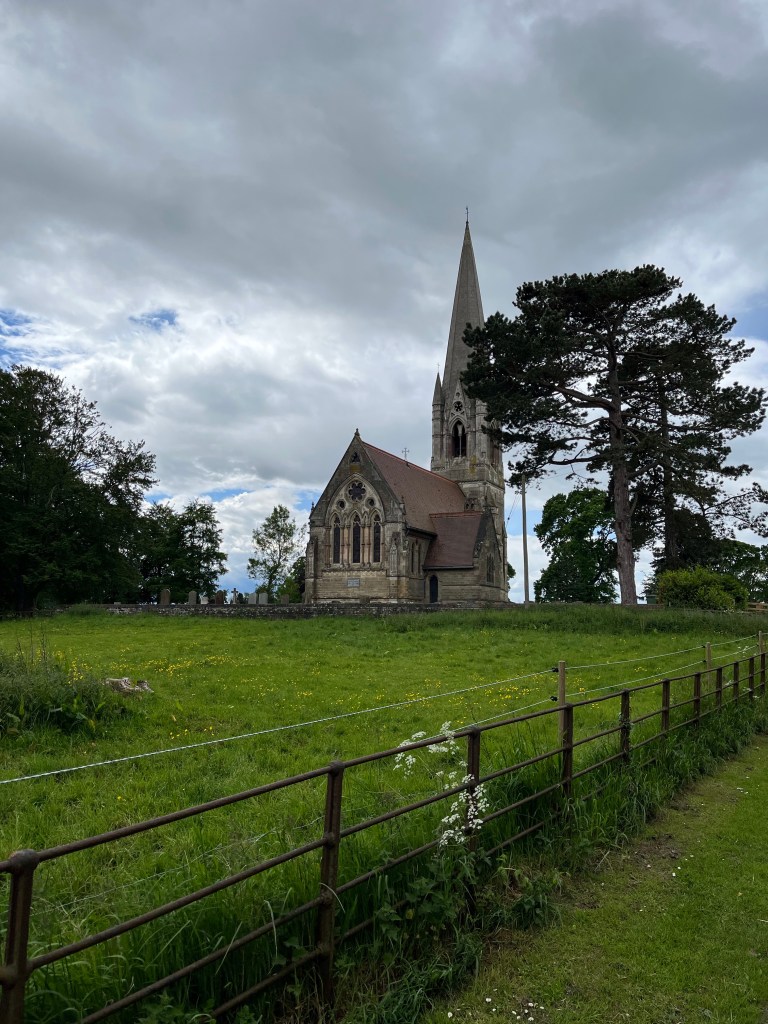
But these two encounters were the exception in the first 25 miles. Mostly we walked alone, not seeing a business, a cafe, a pub or any commercial business in any of the tiny hamlets we walked through until the end of the second day. We did pass through small villages, usually a collection of homes, farm buildings and a church.

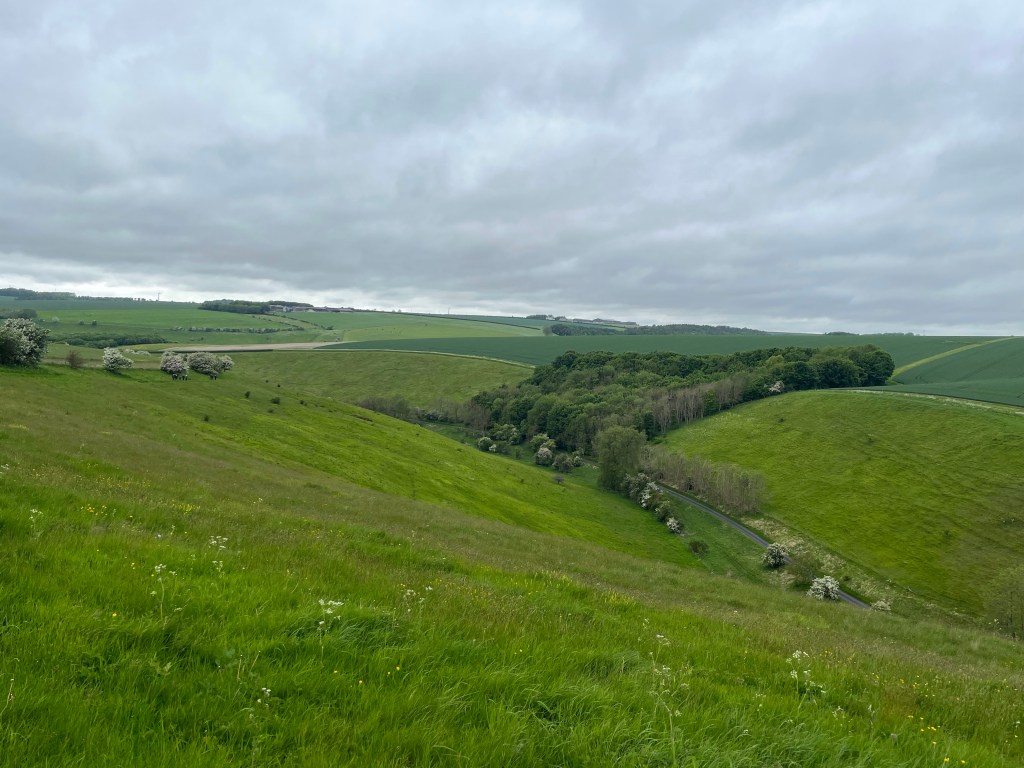
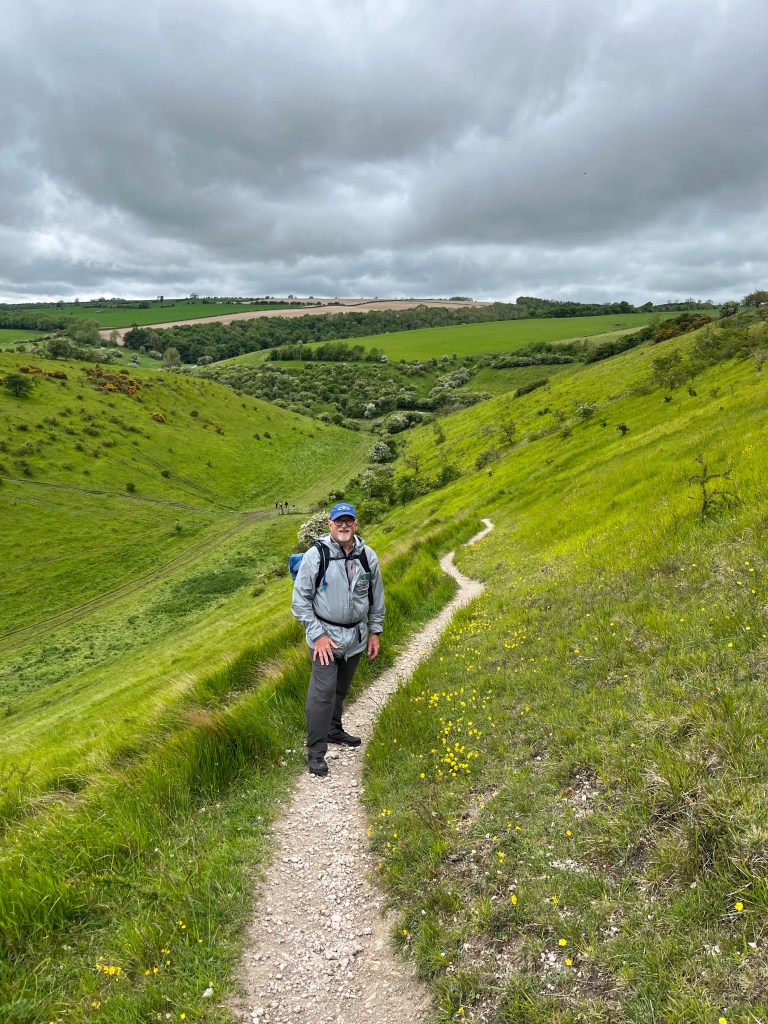
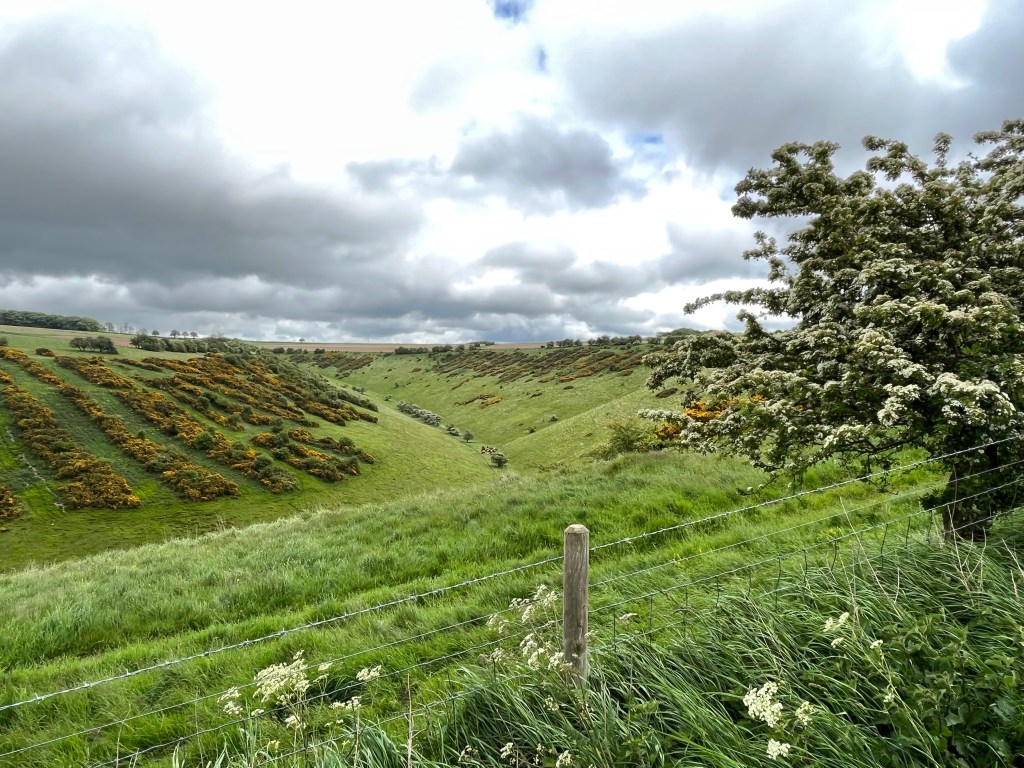
That changed on the third day as we entered the most hilly and scenic part of the trail. Suddenly we started meeting groups of walkers. We all praised the weather (cool and mostly dry), agreed the sights were spectacular and lightly complained about the rigor of going up and down the hills. The complaints were warranted. Apparently, no one here believes in switchbacks so trails go pretty much straight up and straight down. A challenge for the knees, for sure.

It wasn’t all bucolic, however. While the trail was generally well marked, we did manage to get lost — twice. The first time was sheer stupidity. We had a visual image of our B&B for the night and manage to walk right past the place because the building closest to the road did not match our picture, despite the signage. Once again it was the kindness of strangers that got us back on track — this time a man out to get his day’s exercise on his bike. He pointed us in the correct direction with clear landmarks to watch for.

The second time we got lost was really not out fault. Our host at the previous night’s B&B dropped us off at the trailhead. Unfortunately she left us at the wrong trailhead and it took two hours and four miles of map checking, walking, head scratching and googling to find out where we were. At which point we abandoned the trail we had planned to walk and simply took the trail in front of us. The two trails intersected a few miles down the way, according to the maps. Crisis managed!

What were the highs and lows? The biggest problem was our own fault. We did not do enough research on the walk itself. Not until after we had booked the walk and been given the list of our lodgings did we realize how remote the Minster Way route was. We were booked into four places — a glamping site (turned out to be delightful) a Farm B&B (better suited for country house party than sweaty walkers carrying a bit of animal dung on their boots) a quintessential pub and a suburban home with a spare room. When we asked for some modifications in the accommodations, we were told that was all there was along the trail. After walking it, we believe it! One or two other pubs that might have been options went under during the pandemic.

Secondly, we had forgotten how tiresome it is to unpack each evening and repack each day. It is really a drag to live out of a suitcase, even if someone else delivers your bag to you. There’s a reason why we aren’t backpackers at home,

What did we love? The flip side of the remoteness was also a plus. When we paused in our walking, often the only sound to be heard were the birds in the hedgerows. A Northern Lapwing flew overhead and we could hear the wing beats. As casual birders we added nearly a dozen birds to our life list. The quiet, the peacefulness, time alone.

The landscapes seemed so vivid, often picturesque and sometime just plain stunning. As a fans of the new version of All Creatures Great and Small, we could easily envision James Herriot driving around there hills.

Would we do it again? Yep, but differently. Maybe pick a single place to do multiple day hikes out of over several days. Maybe rely upon buses or trains to move us through the less visually rich sections. (In East Yorkshire, taxis have become an endangered species since the pandemic and too scarce to rely upon). But our first taste of long walks in the British Isles definitely left us wanting more.

A Practice Run

Like so many people, for the last two years we hunkered down, stayed in our bubble and only ventured out for short, regional car trips. All that changed when we boarded the plane nearly a month ago for Costa Rica.

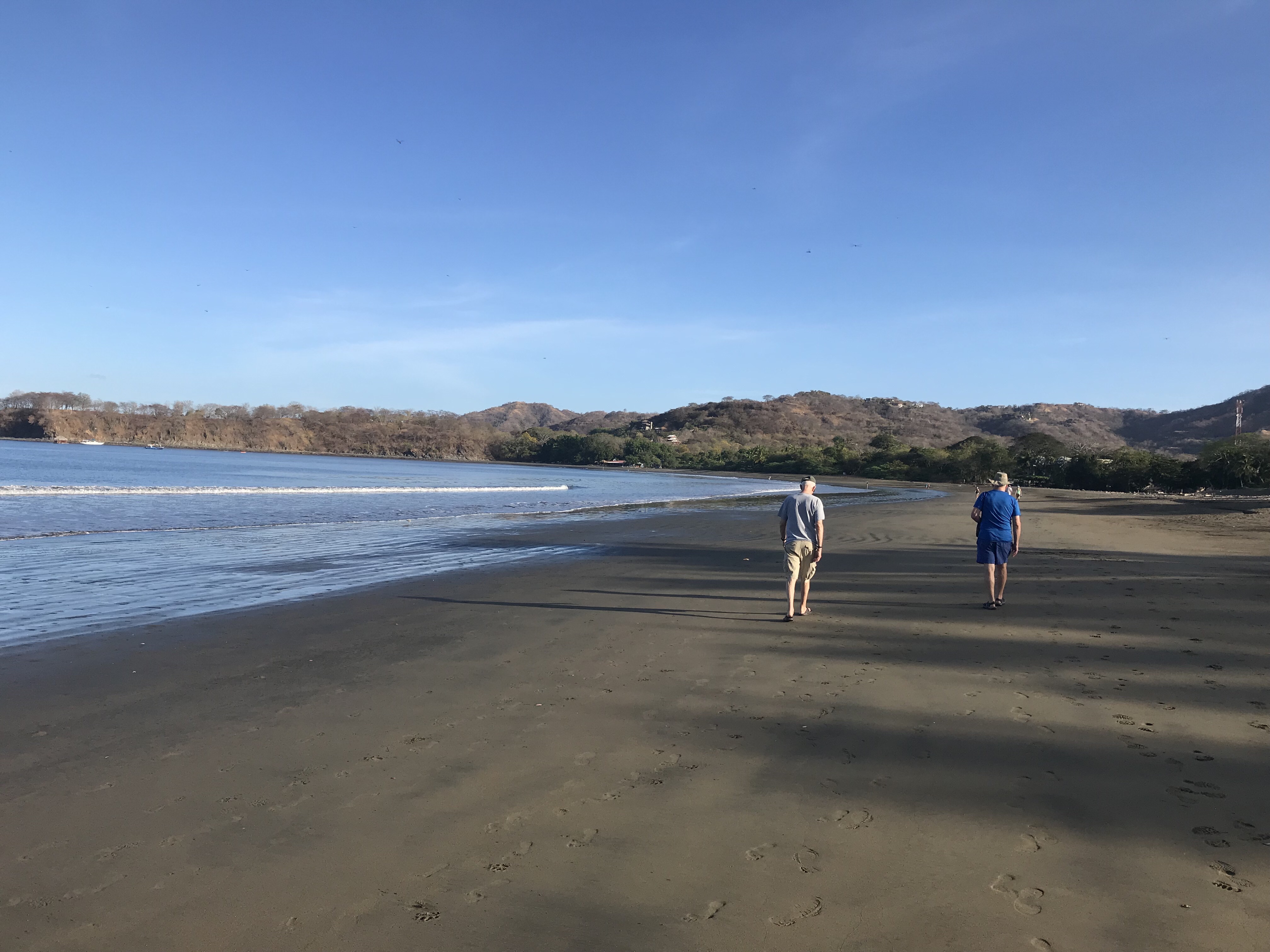
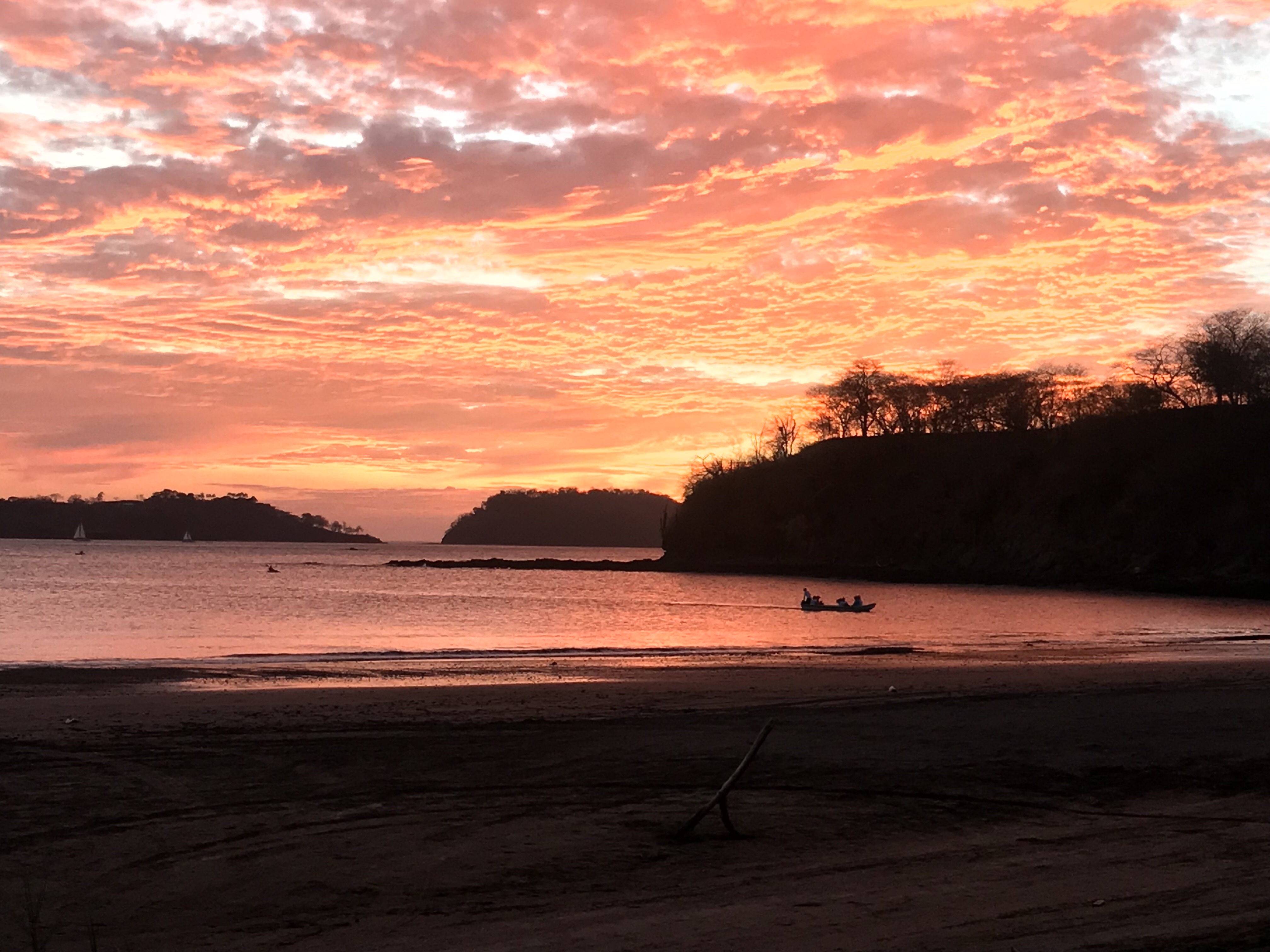
Playa Potrero

We had traveled to CR five years ago and spent a couple weeks before hopping on an adventure cruise —a few days in San Jose, then some time near Monteverde and finally a week in Potrero on the Nicoya Penensula. Definitely whetted our appetite for more Pura Vida. So back we came.

While it was a return trip, it was also a chance to exercise our flabby travel muscles. In two years we had forgotten a lot and some of those automatic responses to travel challenges had faded.

What did we re-learn?

We tend to be independent travelers, charting our own route, picking our own accommodations (generally various vacation rentals online), driving our own car and making our own discoveries — both good and not-so-good. Nonetheless, there are times to turn to the experts. A good reminder.

Talk to the locals and the local ex-pats. From them we learned the best day trips, a reliable fish vendor, and where we could hire a boat and guide for kayaking. They tipped us off to good restaurants, beaches for body surfing or walking.

Talk to your fellow travelers. We had forgotten how much you can learn from them. As our trip wore on, we remembered the value of asking them questions about what they’ve done and seen and where they were going next? Next to locals, ex-pats and or a concierge, they can be sources of great information. Who knows! You may end up making new friends. So bring some business cards so you can share them and stay in touch. We forgot that, much to our regret after we met some great people.

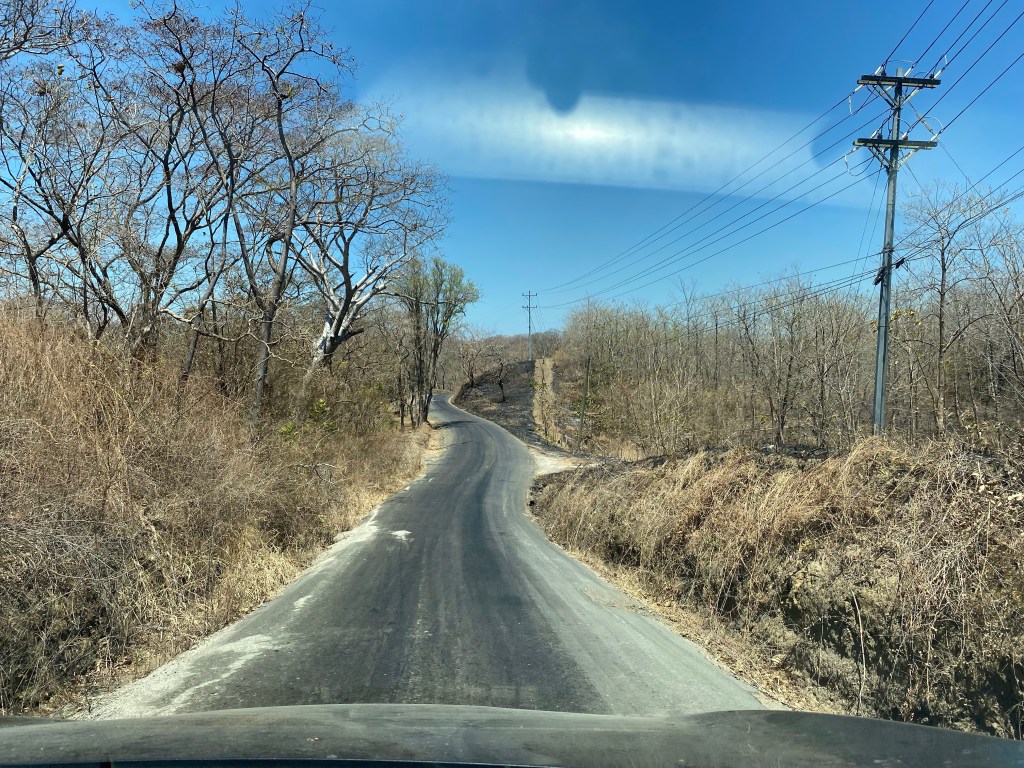
Sure guidebooks often have some of this info, but they are always at least a year or two out of date. Case in point: a guidebook published three months before our trip said to never under any circumstances drive the short cut over the Monkey Trail from Liberia to Potrero. Forging a river and 11 kilometers of a rutted dirt rollercoaster road with steep cliffs was not advisable, the guidebook said. We heeded that warning and took the “safe” 90 minute drive. When we asked an ex-pat about that, he laughed. Maybe during the rainy season you might want to avoid the road, but not during the dry winter months. Maybe if you had a low-slung fancy sports car. We drove it. It was now paved.

Entirely paved. At time rather steep, frequently marked with potholes and narrow, but also scenic and cut the drive to Liberia in half. That river? Hardly a trickle.

Ex-pats and locals know their neighborhoods!

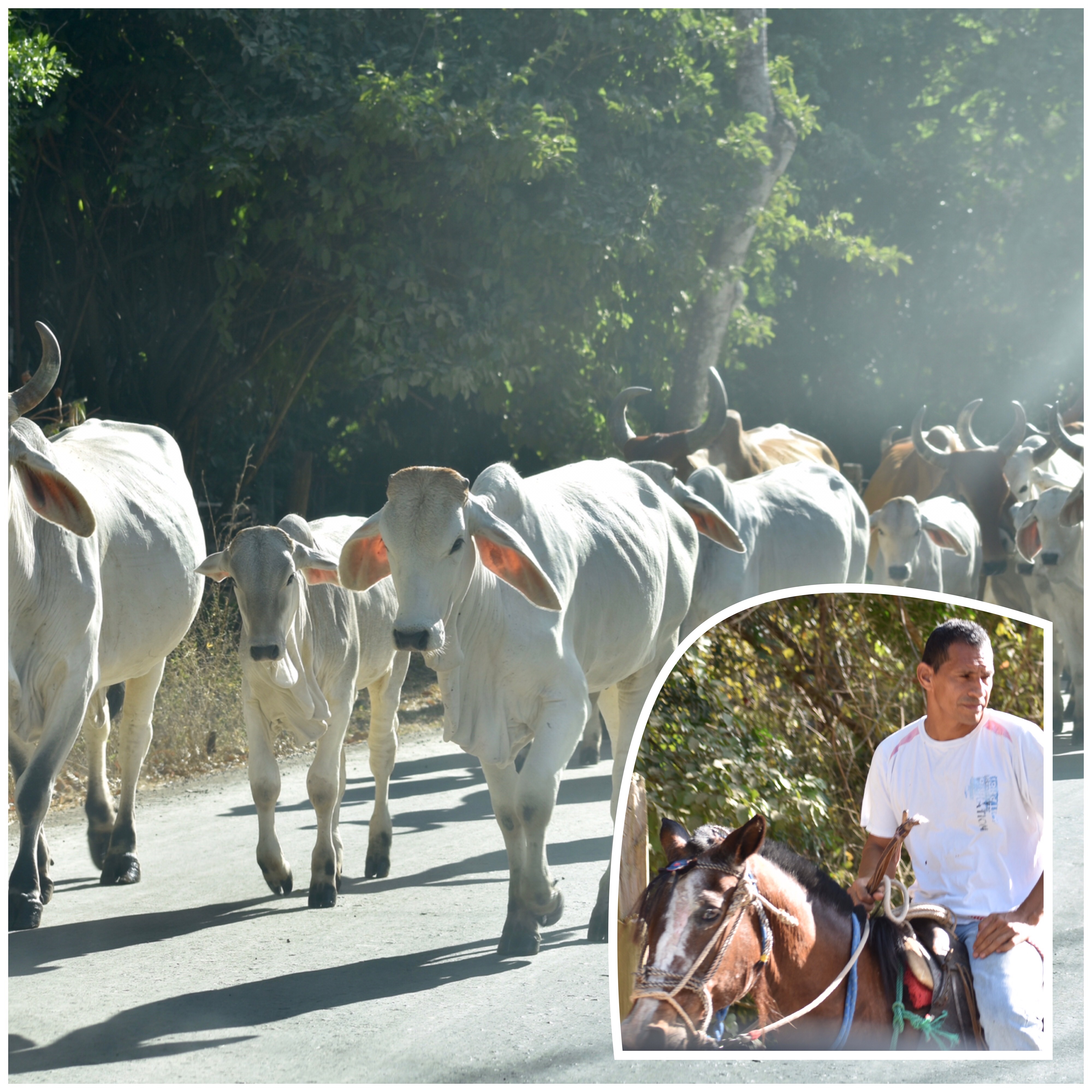
We did run into a small herd of cattle and their sabanero (cowboy) at the end of the trip, but by the end of our month driving around cows on the roadway felt pretty ho-hum.

Find a concierge or local fixer. Many of the vacation rentals are managed by a local person or a company who can provide services well beyond fixing broken showers. Someone who acts as a concierge can help you avoid mistakes and connect you with the right people for what you want to do. This trip our “concierge” ended up being an ex-pat who rented us our golf cart (http://rentagolfcartcostarica.com/). She became our go-to person when we wanted to go kayaking, needed a guide for birding as well as a list of good restaurants, and explained the process for getting the required COVID tests to return to the USA. And when we needed a medical clinic, she was there to guide us (that’s a story for another day).

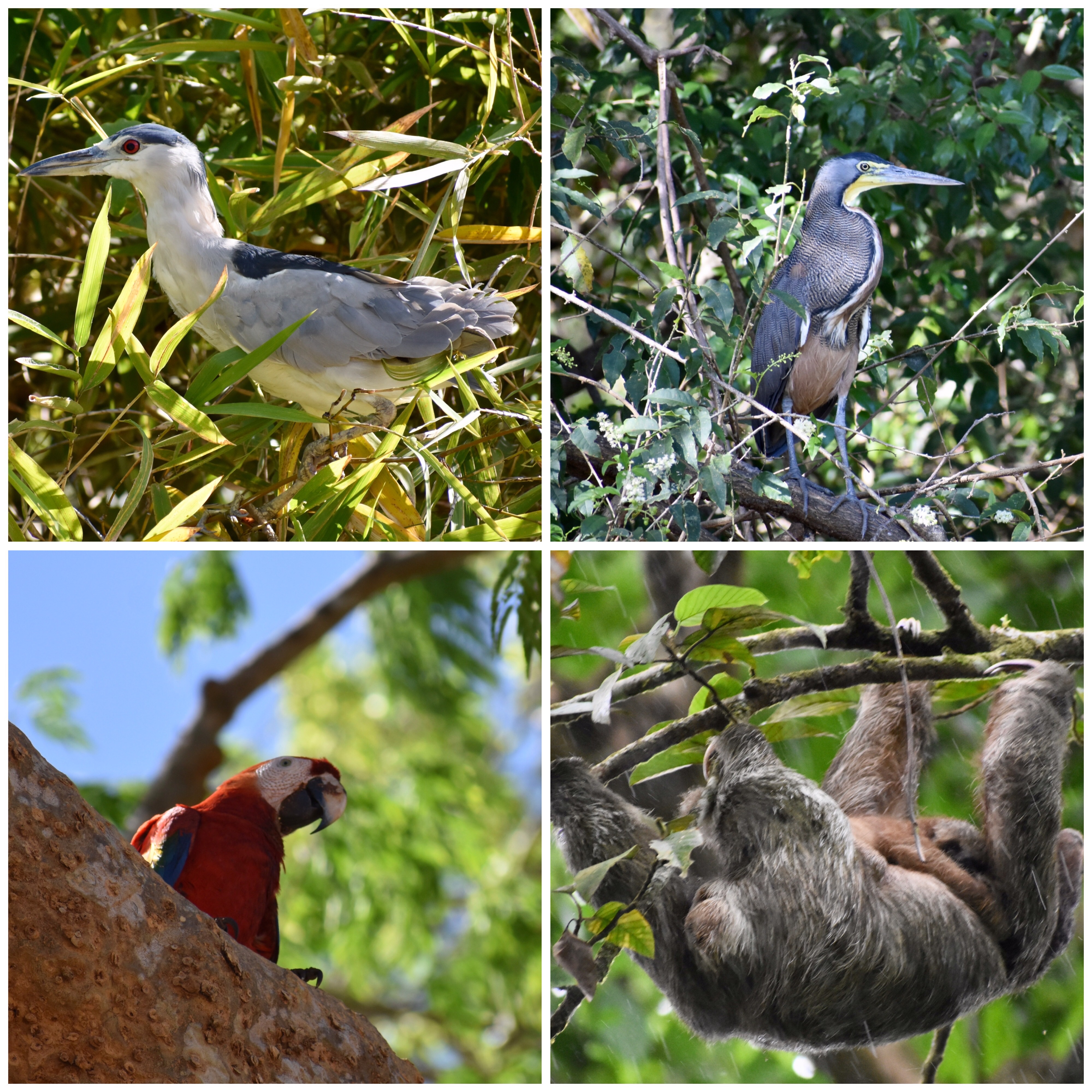
In Costa Rica, the guides are trained (minimally a two year college program) and speak excellent English. Our guide, Gravin, was a jewel. He took us on two birding trips — one up the Tempisque River estuary and to a private nature preserve, Bijagua Ranas, between the Miravallas and Tenorio Volcanoes. Both were stunning trips made even better by his connection to the uber-local guides he regularly worked with.

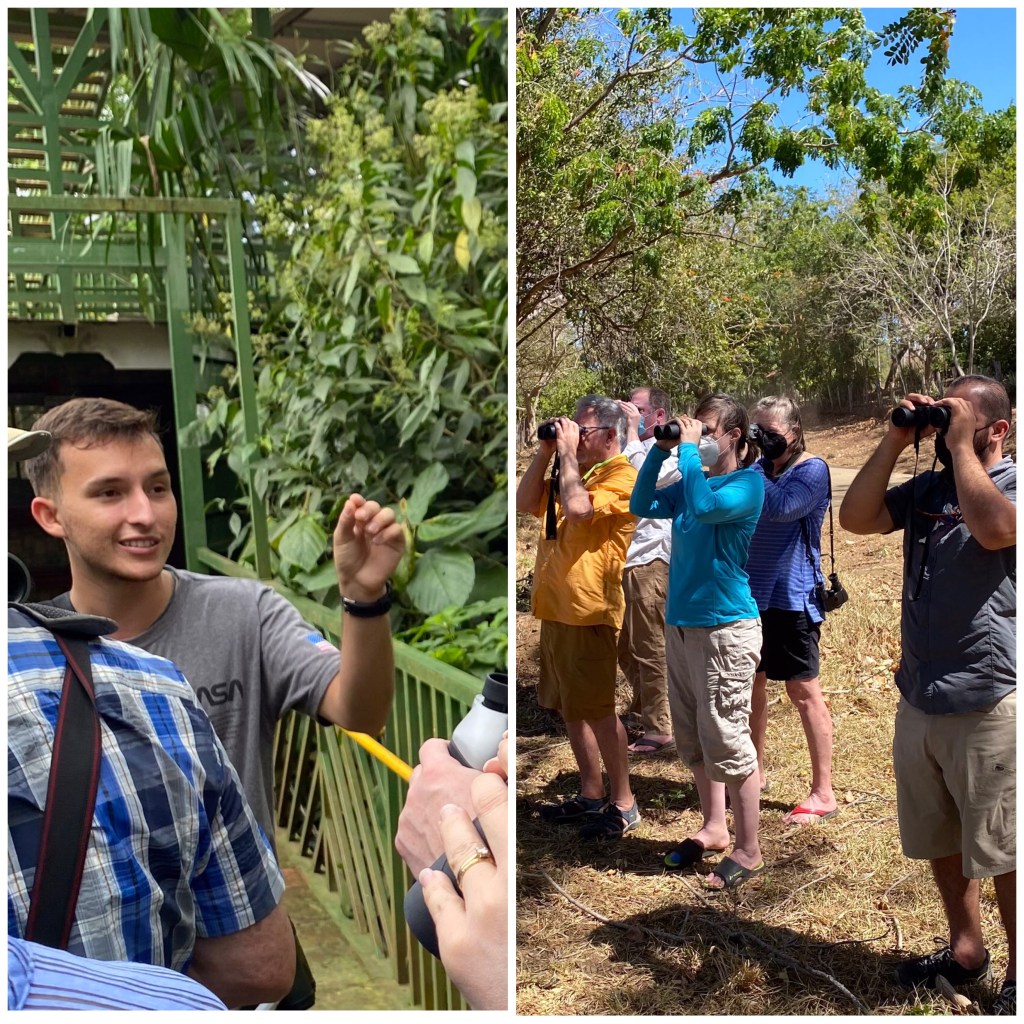
The Bijagua Rangas volunteer guide, Ishmael, on the far left and our regular guide, Gravin on the far right
While we are pretty casual birders, we have to admit we probably wouldn’t have seen most of the fifty different species of birds we saw in Costa Rica without our guides. They are worth what they charge plus a generous tip!

Those packing lists? Revise them. Add masks. And hand sanitizer. In Costa Rica you are expected to wear a mask indoors and everyone does. You are asked to wash your hands or use sanitizer before entering a store or restaurant and most people do. Not a bad idea where ever we are traveling these days.

Even the hardware store had hand sanitizers!

Remember the stores back home aren’t the only ones experiencing shortages. And some items are much harder to find outside of the US. We packed back-up batteries and memory cards for our cameras, but forgot about the flashlight and other little electronics that might need new batteries during a month long trip. AA and AAA batteries were available in grocery stores, but that was about it in Costa Rica. We never did find one battery we needed.

And pack less. Be brutal, particularly if you are staying in vacation rentals with washing machines. We will be returning with a couple things we never wore. We had forgotten how few things you actually need and how great it is to travel light. And depending upon where you are going, plan on buying some common things locally. Going to a hot, sunny and heavily touristed area, we chose to buy most of our sun block there. (We’ve gone through two good sized bottles in a month.). Beside, shopping for the mundane is exotic in a different country and part of the fun.

We’re heading home shortly, but ready and better prepared for our next adventure now that the pandemic seems to be a bit under control or at least manageable with some common sense precautions.

Bon Appétit in Provence

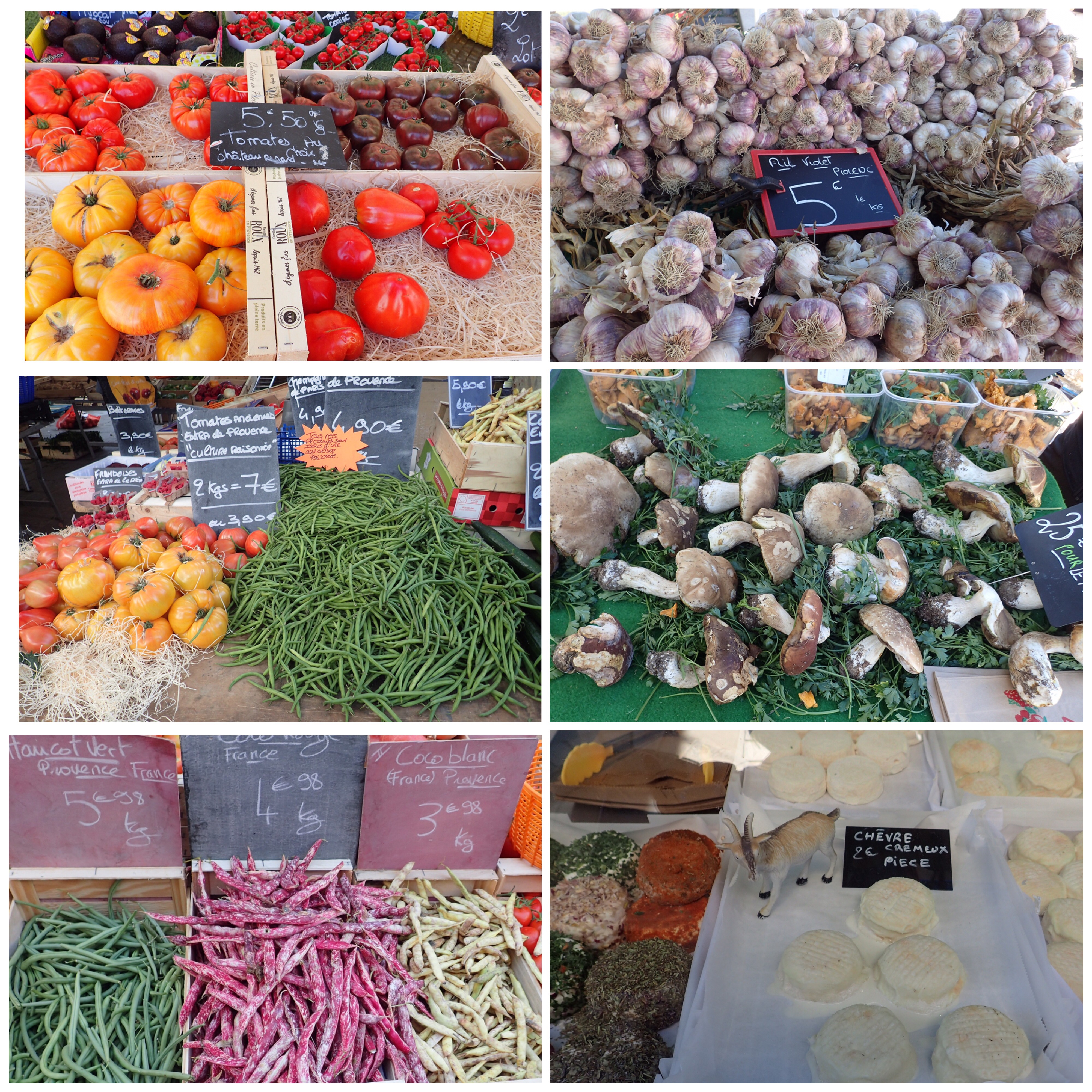
For too many years on various trips to the south of France and parts of Italy, we were frustrated by seeing the tempting food in the markets and having no place to cook. Not to mention in France, the wonderful boulangeries, boucheries, fromageries, charcuteries, poissoneries, and pâstisseries. We remedied that by staying in vacation rentals and Airbnb’s with well supplied kitchens. But this time in the south of France, we decided to up the ante and take a cooking class. What could be more fun? Fall’s bounty in the markets, picking up some tips from a local expert, and topped off by eating a great lunch we had made.

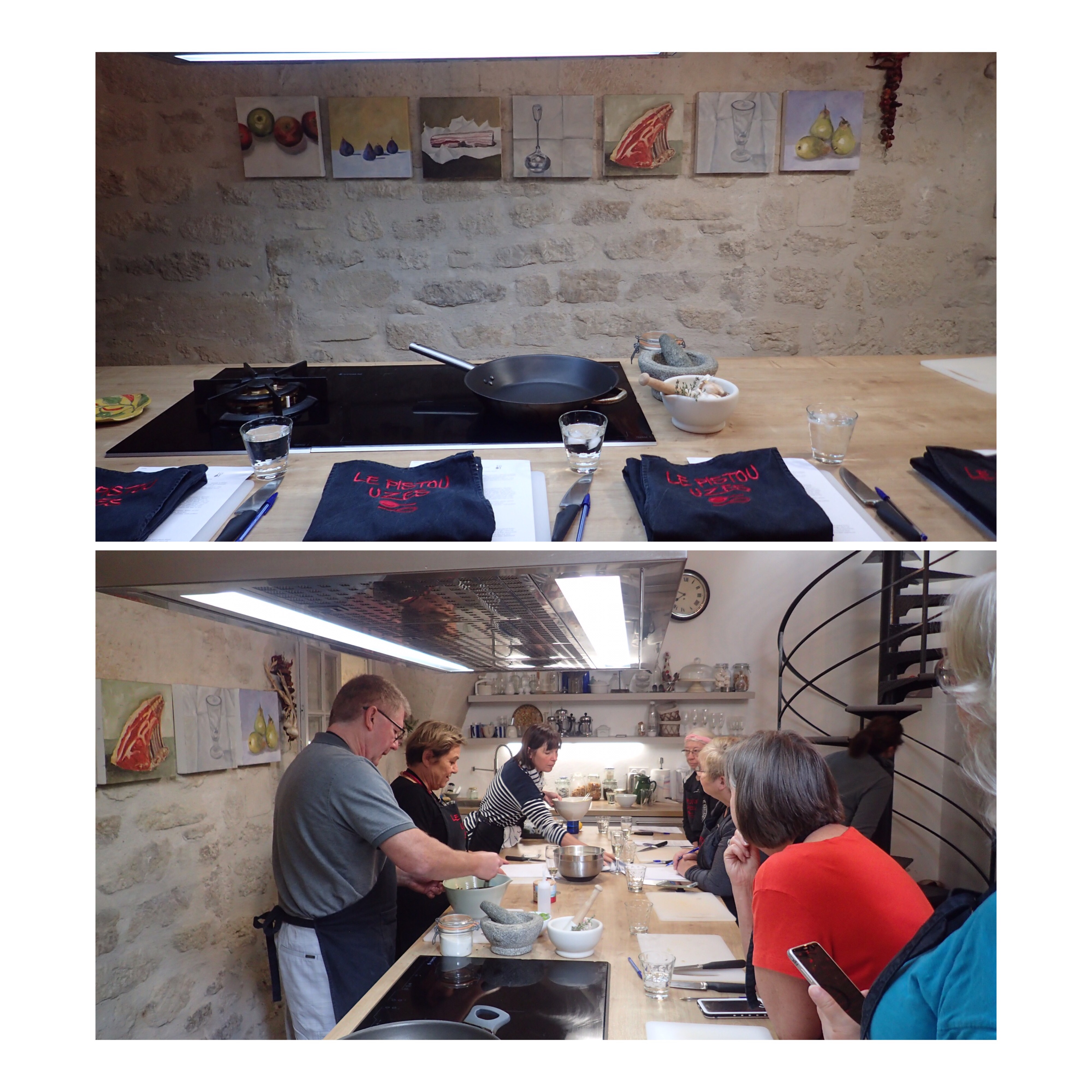
So Peter did some research and found a Irish woman, Petra Carter, who runs a small cooking school, Le Pistou, in Uzes near where we were staying for ten days. A former B&B owner and a sixteen year resident of France, she was a wealth of local knowledge. She taught a variety of classes. Foods of the south of France for tourists, and Lebanese or Indian for the locals in the winter months! Apparently, the locals get enough of Provençal food at home and in the restaurants and are desperately looking for some variety.

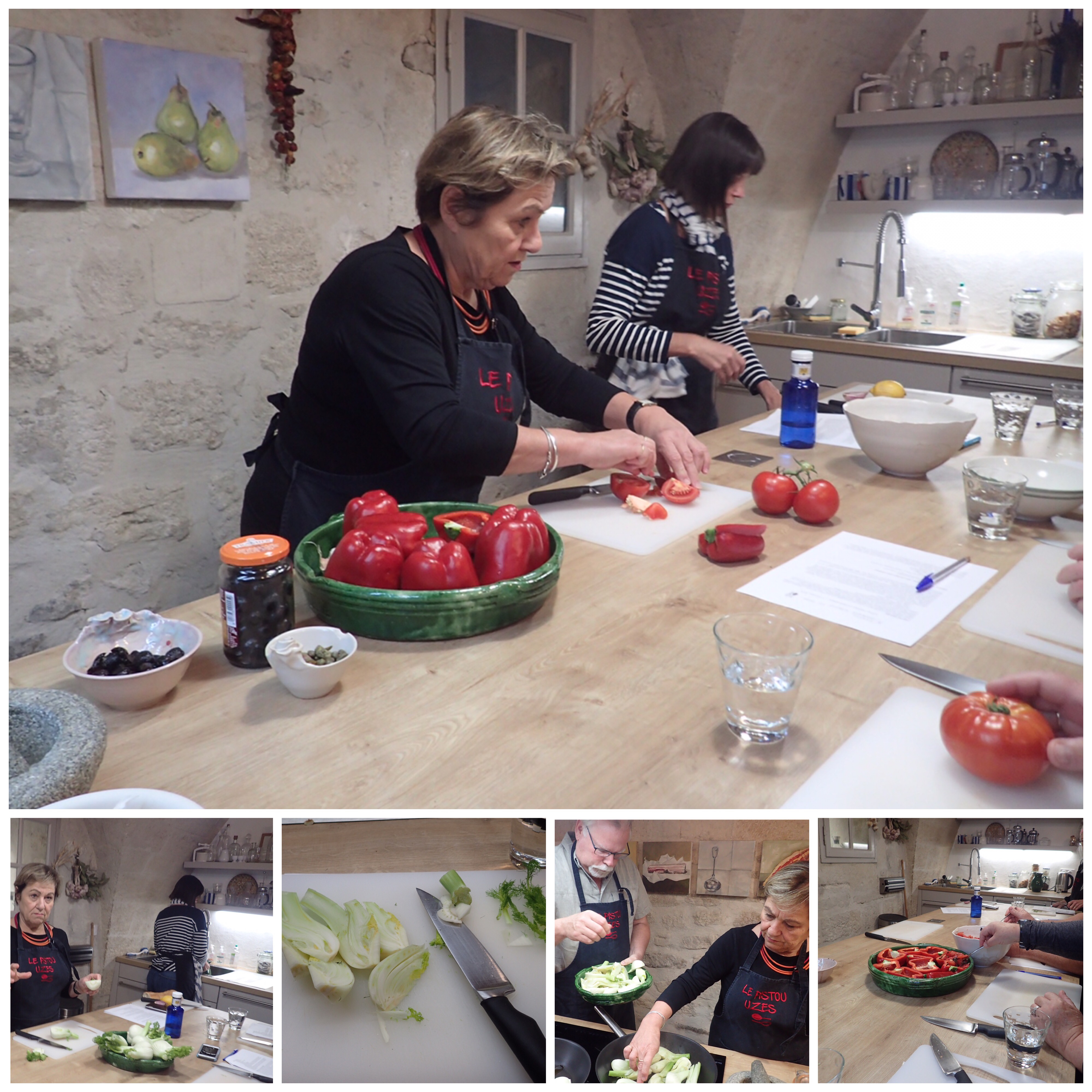
Our group of four arrived promptly at 9:30am, and we met the four other students—a couple from Canada, a woman from Australia, and a woman from Alaska. Petra acted more as a hostess at a dinner party than a teacher or task master. She carefully introduced each of us to the others, and to her assistant, and generally chatted us up. Lots of laughter. Introductions complete, we put on the aprons and took our seats along a long stone counter.

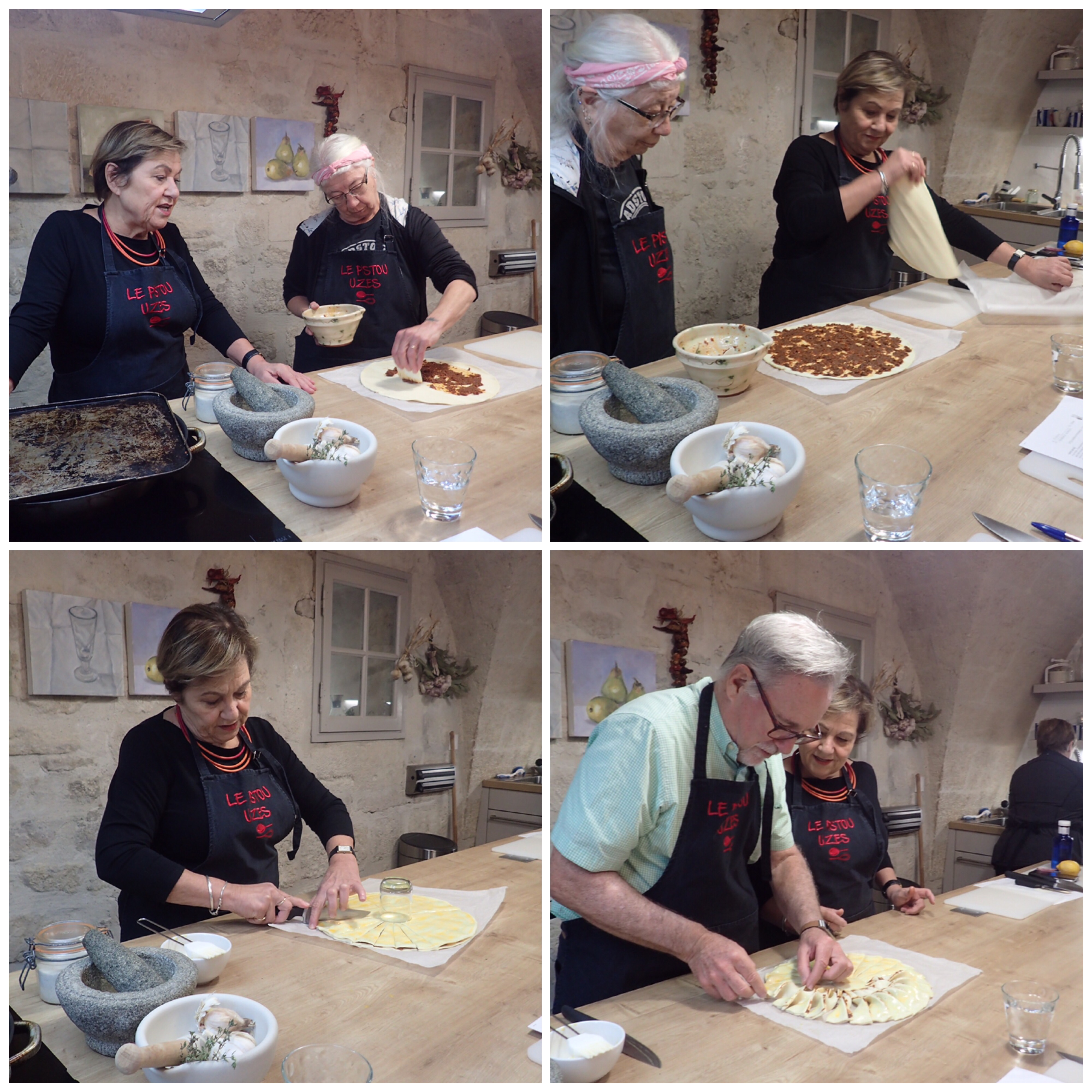
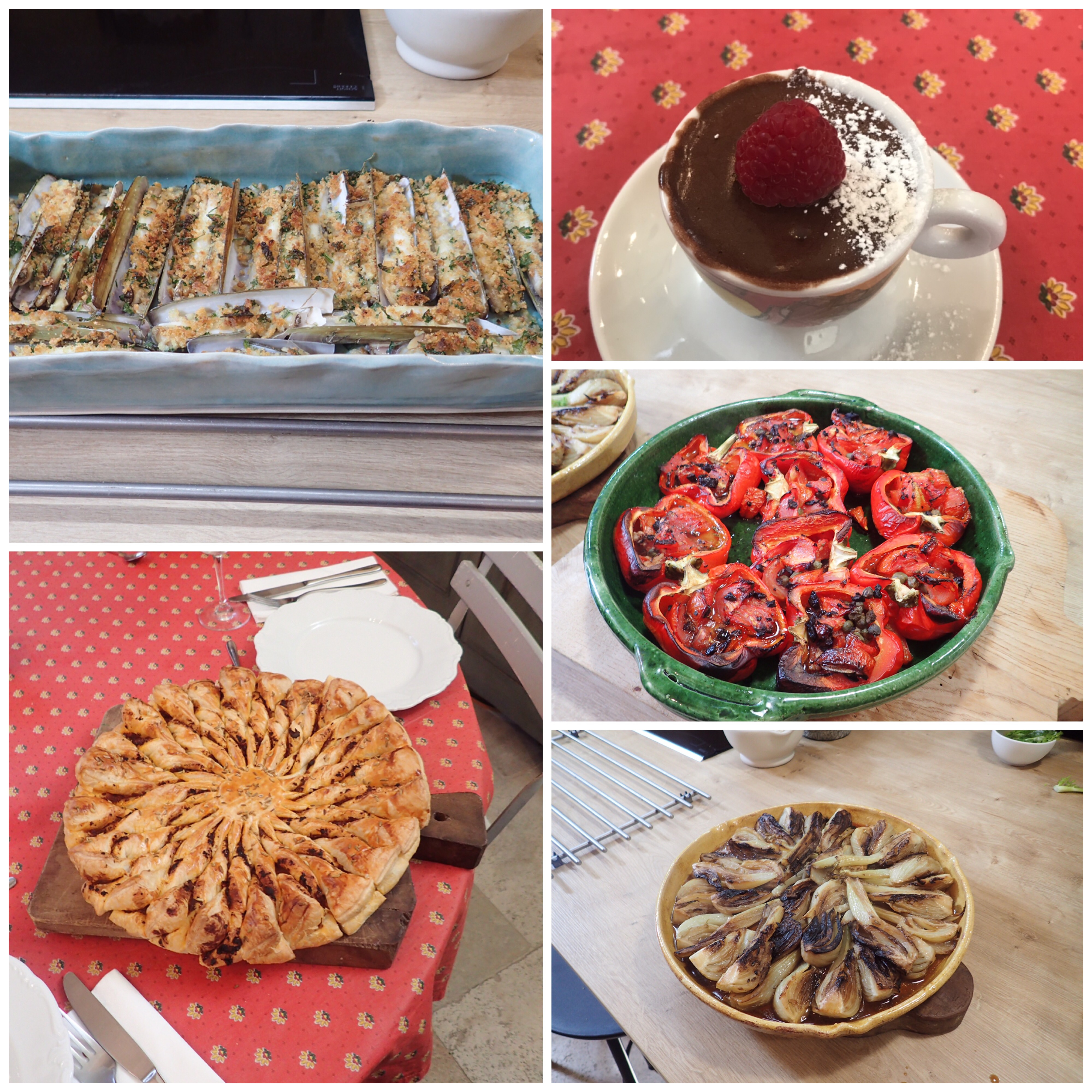
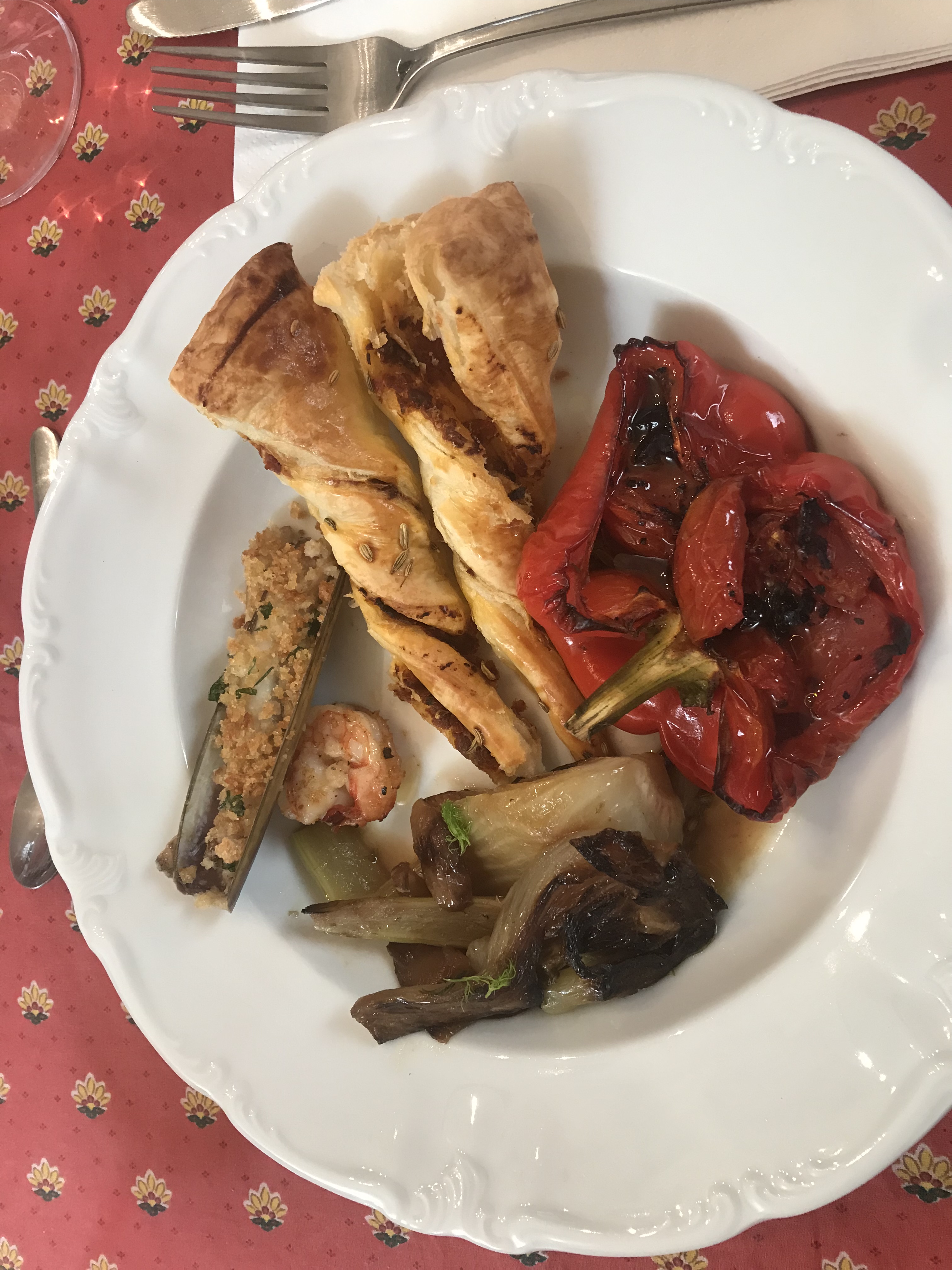
First on the cooking agenda was a twisted tart of sun dried tomatoes and fennel seed. The French do have the best pastry in the stores’ refrigerator cases. Nothing like the tubes of Pillsbury dough we see at home or the frozen rectangles of Pepperidge Farm puff pastry. The array of choices in France is inspiring — all butter, whole wheat, gluten-free, low-fat or whatever. One variety is appropriate for pizza crusts, another for a sweet tart and some are more like puff pastry. I was familiar with the options from our previous trip to Provence and had made an open face tart our first night in Uzes with some creamy goat cheese and zucchini. Petra’s version was something else, using an all butter round puff pastry. One student spread the topping of sun dried tomatoes blended with a bit of olive oil and bit of minced garlic on the bottom crust that sat on a piece of parchment paper. Then, after laying the top round in place, our instructor carefully sliced the tart and showed us a technique for twisting it to create a fancy shape—like a sun with radiating rays. No surprise—the French name: Tart du Soliel. Given the quality of the pastry in France, we were told home cooks often make a variation on a tart for a light meal or with a sweet filling for dessert. All in all, a pretty easy and impressive dish once you know the techniques. Of course, the challenge at home will be getting the pastry.

With one appetizer in the oven, the vegetables for our lunch were next. A pile of unblemished, fat fennel bulbs. Bright red peppers with some slight scarring from the summer winds. A bowl of big red tomatoes, the kind we can only get from our own gardens or in the farmers’ markets. She demonstrated the technique for cutting each. Fennel bulb in thin wedges, being careful to keep a good bit of the core in each wedge to keep it intact. Cutting the red peppers through the stem but leaving it in place so the pepper won’t collapse during roasting. Tomatoes cut and seeded, as Petra didn’t want too much liquid in the final dish. And then she turned to vegetables over to us to replicate her example.

As we chopped away, Petra gave us a history lesson on the cuisine of southern France. Not surprisingly, it was largely dictated by the warm weather crops that grew well here— tomatoes, peppers, summer squash, olives. (Many would say more Italian than French.) Not much butter or cream or rich sauces we associated with the French high cuisine. The big meal of the day was lunch. Without ovens in their homes, women cooked the family meal in the ovens of the boulangerie after the bread for the day was done. (And the men, our host noted, usually sat around drinking Pastis, the anise flavored liquor of the region). So the backbone of Provençal meals was slow cooked and oven roasted foods. Salads only arrived with the tourist onslaught.

The fennel wedges were tossed in a single layer into a sauté pan with a good drizzle of olive oil to brown. No salt. A little pepper. And then arranged in a circular pattern in a shallow baking dish. Topped with a bit of fennel seed and more olive oil and popped into the oven, to be garnished with bits of fresh fennel fronds when it came out. The halves of peppers were placed in a deeper dish. The tomatoes was tossed with olive oil, capers, some pepper, Herbes de Provençe, and spooned into each pepper. Then a teaspoon (or a bit more) of home made red wine vinegar was added to each pepper. And it, too, went into the same oven with the fennel.

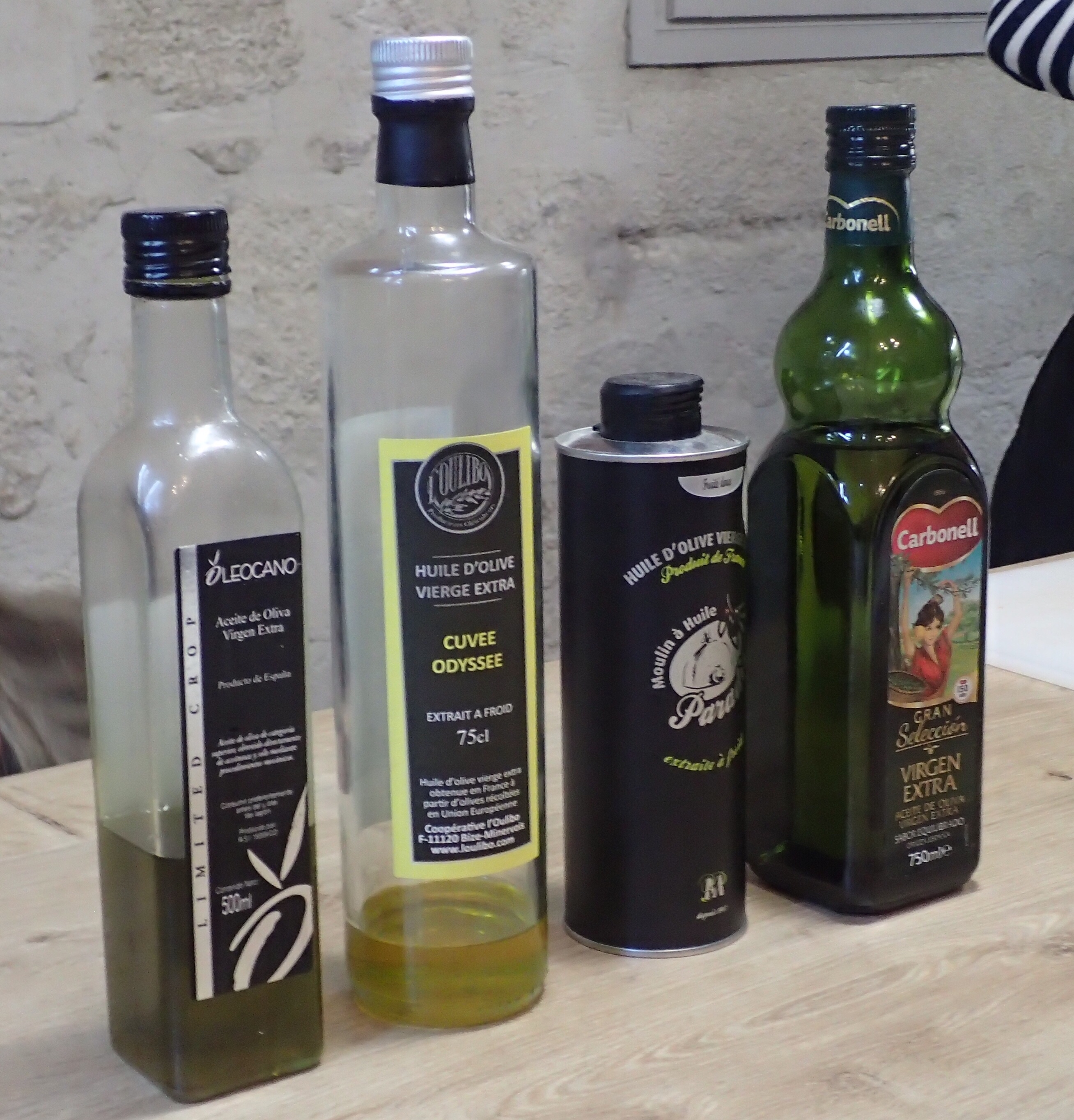
A question about her favorite olive oil led to an impromptu tasting. She brought out four bottles. Poured a bit of each in small bowls and asked us to taste. The flavors ranged from light and subtle to peppery or vegetal. And prices ranged from 7€ to 15€. Her advice? Buy to best you can for cooking (be a bit extravagant) and a little better for finishing. And the olive oil tasting led to an olive tasting and a lecture about those canned black olives that kids put on the end of the fingers. They may be forever banished from our house after Petra explained how they are made — picked unripened & very green, pitted, bathed in lye and soaked in rusty water! Yes, rusty water, to turn them black. Delightful, heh!? No more black olives on my pizzas!

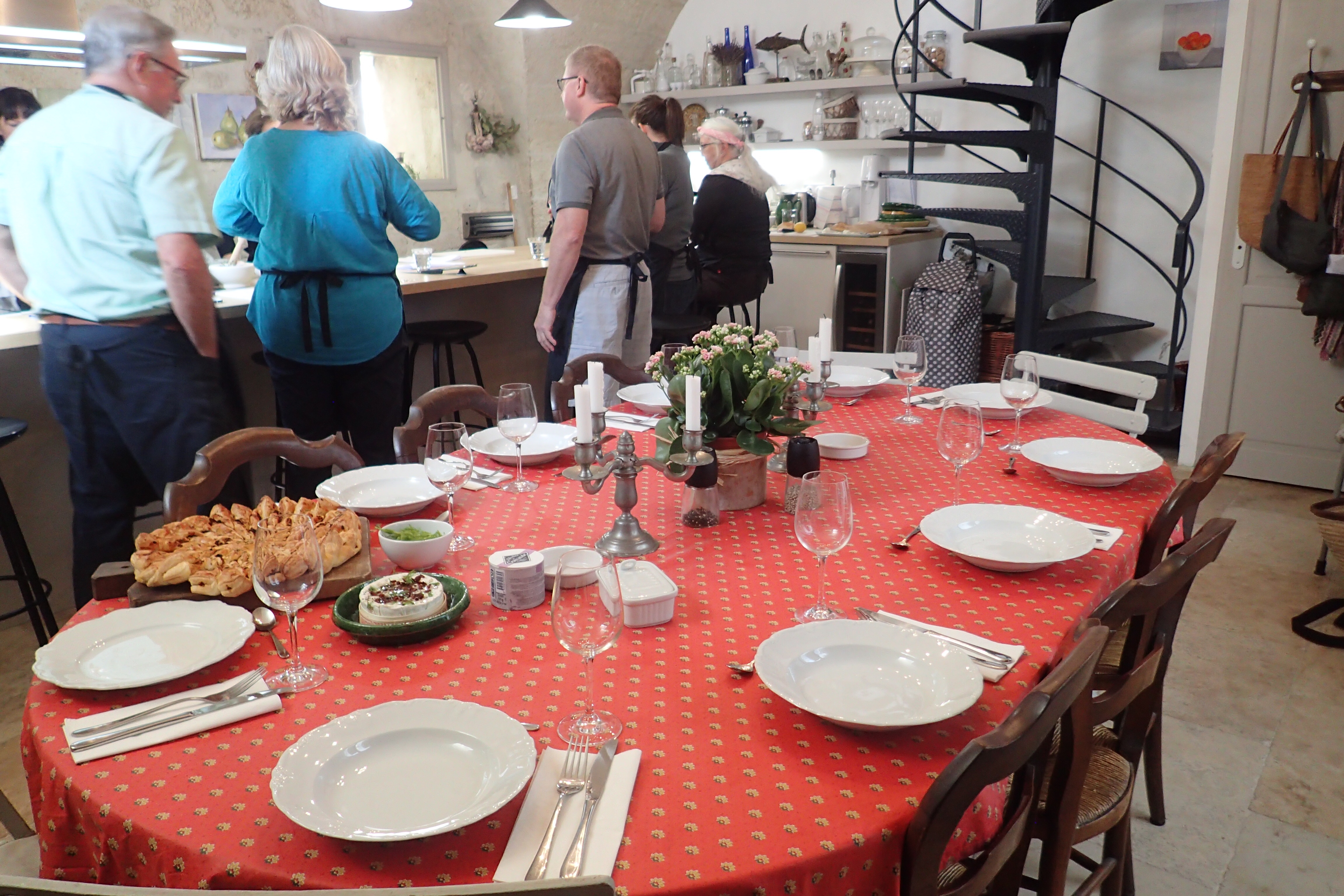
And of course there was a cheese dish — in fact, three. Midway through our cooking, out came some cheese Petra had made. One was a simple spread of strained yogurt to which she had added pink peppercorns and cardamon. She had a second variation with cumin and coriander. Both served on slices of baguettes. She showed us her collection of vintage molds for the cheese (which set us out on a mission to find one to take home) but confessed to generally just using wire mesh strainers. As we munched away and sipped champagne, she demonstrated how to marinate aged goat cheese rounds in olive oil and spices. And she told us that the best and cheapest containers come from Ikea, no less.

The final cheese dish was only slightly more complicated—a round of Camembert (a cow cheese from the north of France—the local cheese is either sheep or goat) placed in its original wooden round box with the lid used underneath for more support. She cautioned us to make only shallow slices in the top of the cheese before turning the task over to one of us. Her intention had been to top the cheese with a liqueur, hazelnuts and honey but then remembered one of us was allergic to nuts. No problem! The recipe was altered. A splash of kirsch, sprinkle some barberries, a bit of honey and fennel seeds on top and bake that little treasure in its wooden box. Word of warning. For this recipe only use the wooden rounds that have staples in them; glued ones will fall apart.

All three of the cheese recipes were more about a technique which you could vary either the herbs, the spices, add nuts or honey and just enjoy.

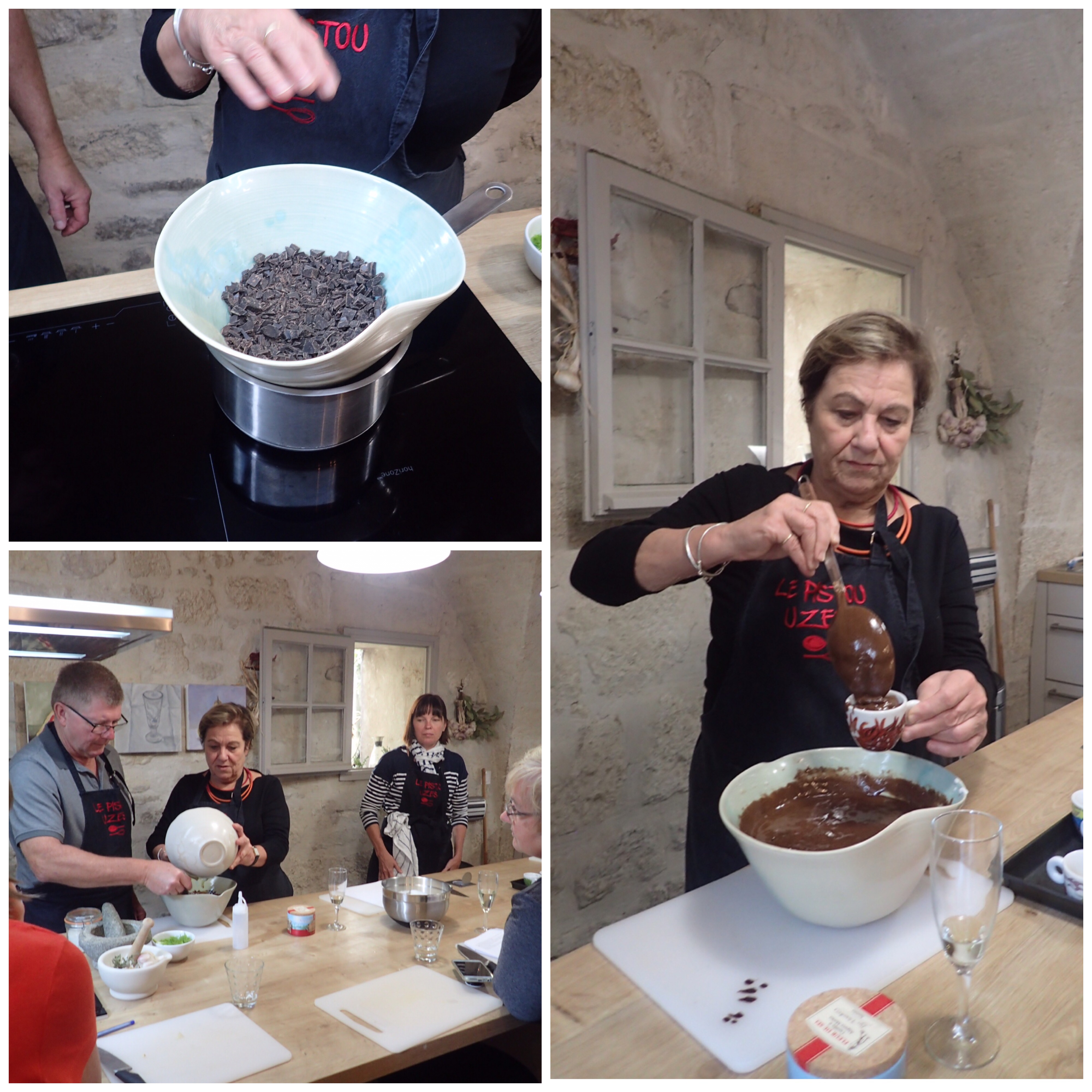
The surprise of the day was the dessert — an olive oil chocolate mousse. Yes, olive oil. Dairy free and absolutely silky. The technique was similar to a standard mousse. Separating eggs, carefully adding the yolks to melted chocolate and the olive oil, whipping the whites and folding them into the chocolate. In a twist on flavoring the chocolate with a bit of vanilla or a liqueur, she had us grate a tonka seed (reputedly a hallucinogen in larger quantities) into the mixture. Subtle and delicious. Spooned into tiny demitasse cups.

And meal was rounded out by flambéd prawns and grilled razor clams with garlic crumbs. We were each given a handful of prawns and told to remove both veins. Petra fussed about the quality of the shellfish, not sure it was as fresh as she would have preferred. She showed us how to loosen the long narrow razor clam from its shell and open the shell up so it could be filled with bread crumbs tossed with garlic and olive oil. While the clams went under the broiler, she quickly sautéed the prawns and then taught one of the least experienced cooks how to flambé using Pastis. Frankly after tasting the prawns, her concerns about their freshness was unfounded, and it was the best use of Pastis ever! Only a subtle licorice flavor permeated the prawns.

And after all the food was prepared, laid out on a buffet, the plates were filled and wine glasses topped off, we sat around the table for more than an hour and half, eating, sharing travel and food stories, learning more about the politics and real estate of Uzes. We left with cheek kisses all around almost six hours after we started.

By the way, Petra made sure we did the cheek kisses the right way, but also cautioned us, hugging in France between friends is just not done. All the kissy-kissy stuff is fine, but bodies should never touch. Good to know.

Ah, la belle France.

None for the Road: wines of Châteauneuf-du-Pape

Sometime it is best to leave the driving to someone else. And probably a day centered around tasting the wines of Châteauneuf-du-Pape is one of those occasions. So we hired a guide we found online (after doing our due diligence of reading reviews, studying the website and cross checking on other sites) for a day, roughly seven hours, including a lunch break.

There was a time when we would have eschewed hiring a guide, figuring a good map (or navigation system) and a good guide book were enough. Then a friend and fellow traveler bought us a food tour as a present when we were in Aix-in-Provence. A couple hours with an American expat convinced us there was more to see than we were aware or that guidebooks could provide. And since then we have hired guides for a specific purpose at different points in different trips. And always it was been a good value.

In Paris we not only tasted the baguettes, fromage and pátê, but learned the etiquette of these specialties and where to find some of the best in a city that sometimes considers tourists fair game. It was a no brainer to hire a guide to kayak through the Sian Ka’an Biospere in Yucatán; it was the only way to see the area. When we didn’t rent a car in Cape Town, South Africa, our options to tour the region was a big tour bus or a guide. Not a difficult choice at all.

We told our guide Alain we wanted to focus in on Châteauneuf-du-Pape, and maybe a winery specializing in rosé, if time allowed. In the summer some of the wineries are open to tourists, but we were tasting in the fall when some of the smaller wineries shut down so all hands could focus on the harvest. Having a bilingual guide also meant we had a translator when the wine maker’s English was limited. And perhaps most importantly, we could taste wine without worrying about driving; we left the driving to Alain!

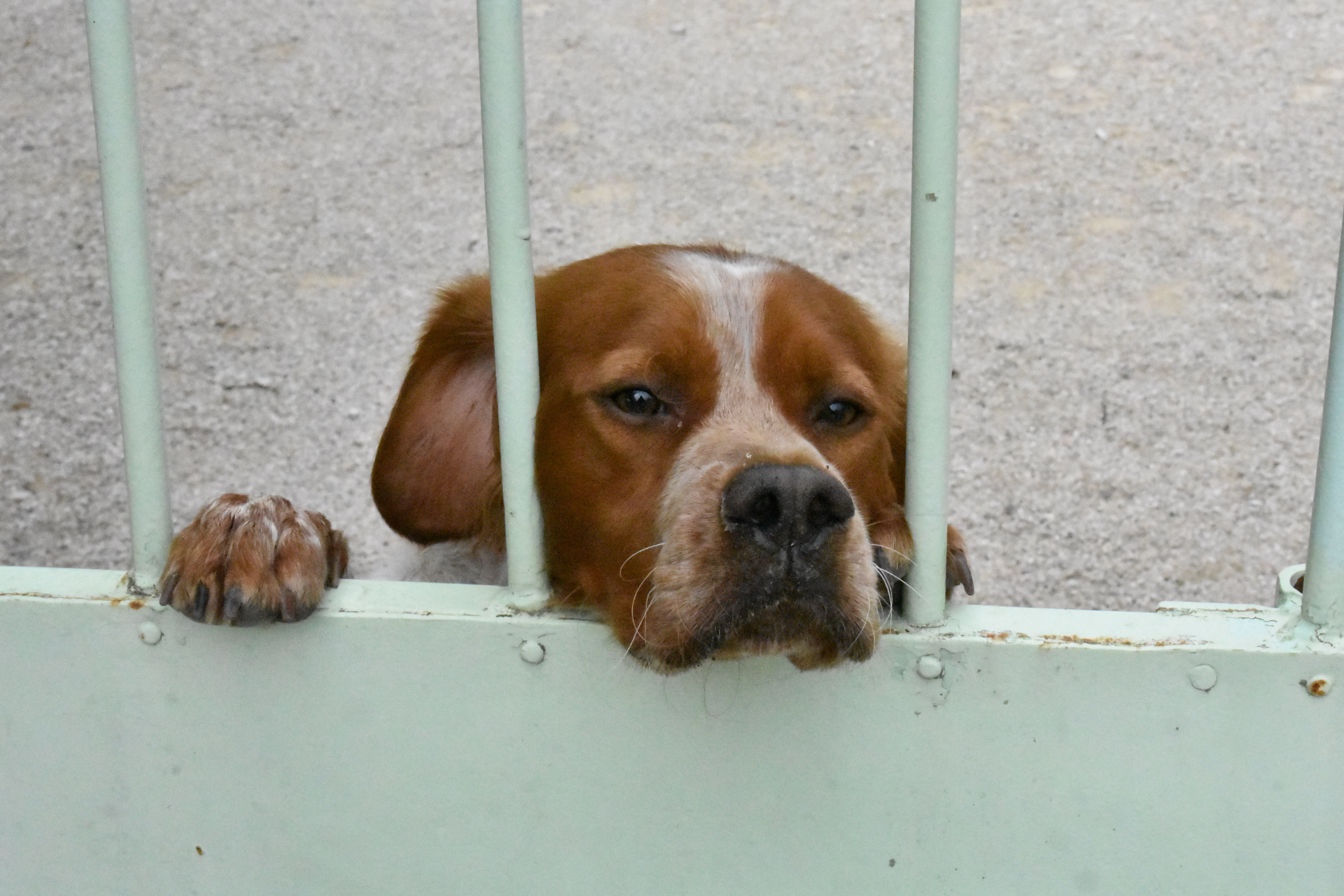
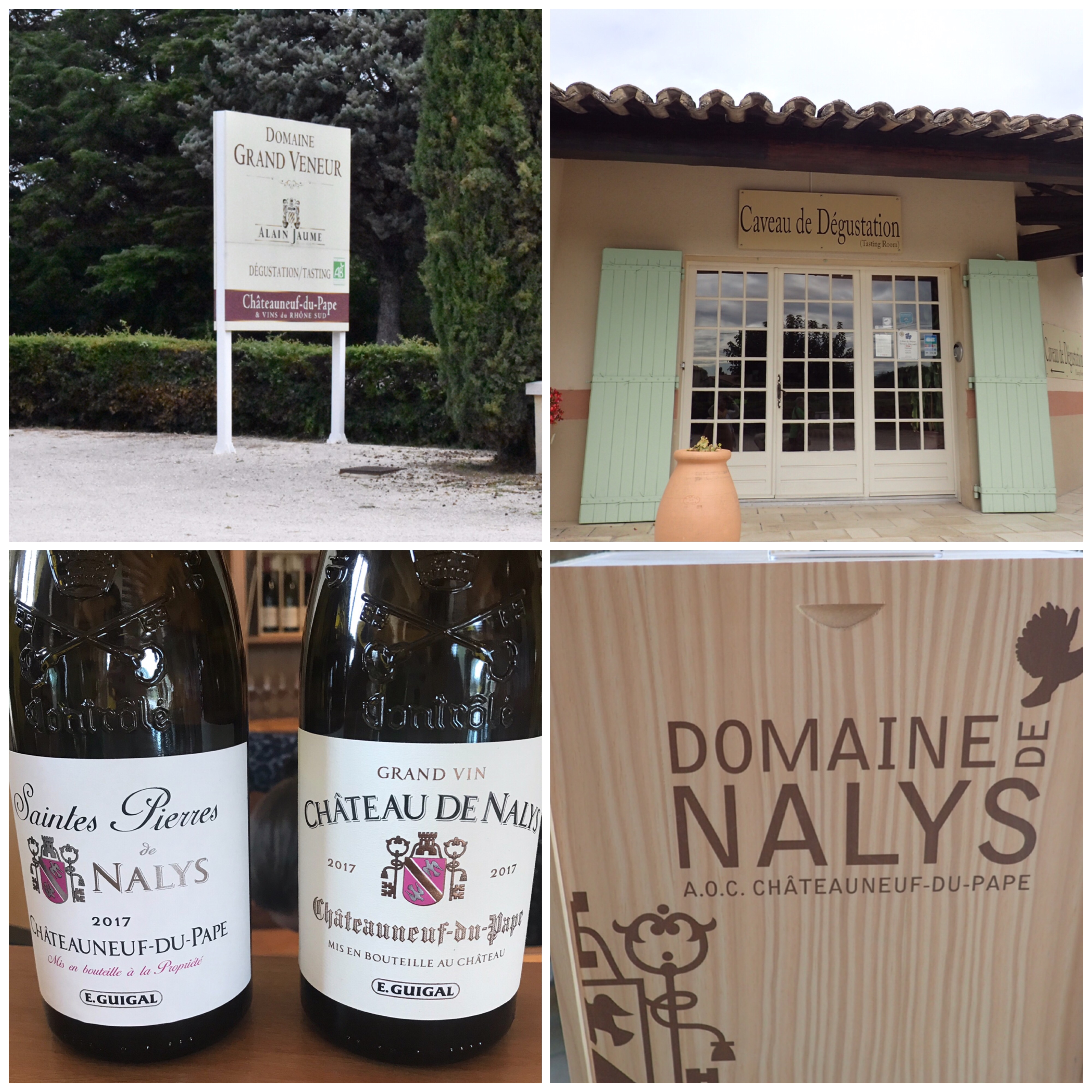
Alain picked us up at our temporary home and off we went to visit three different wineries — a large operation that fits your mental image of a French winery, a smaller winery that had recently been acquired by E. Guigal and then a real “mom and pop” operation. At each stop we were largely the only ones there — we saw only two or three other visitors all day, and a couple of very cute dogs.

Our first stop was a small winery that offered both white and red Châteauneuf-du-Pape. We really enjoyed the Viognier, and that was the first — but not the last — bottle we bought to enjoy over the next week.

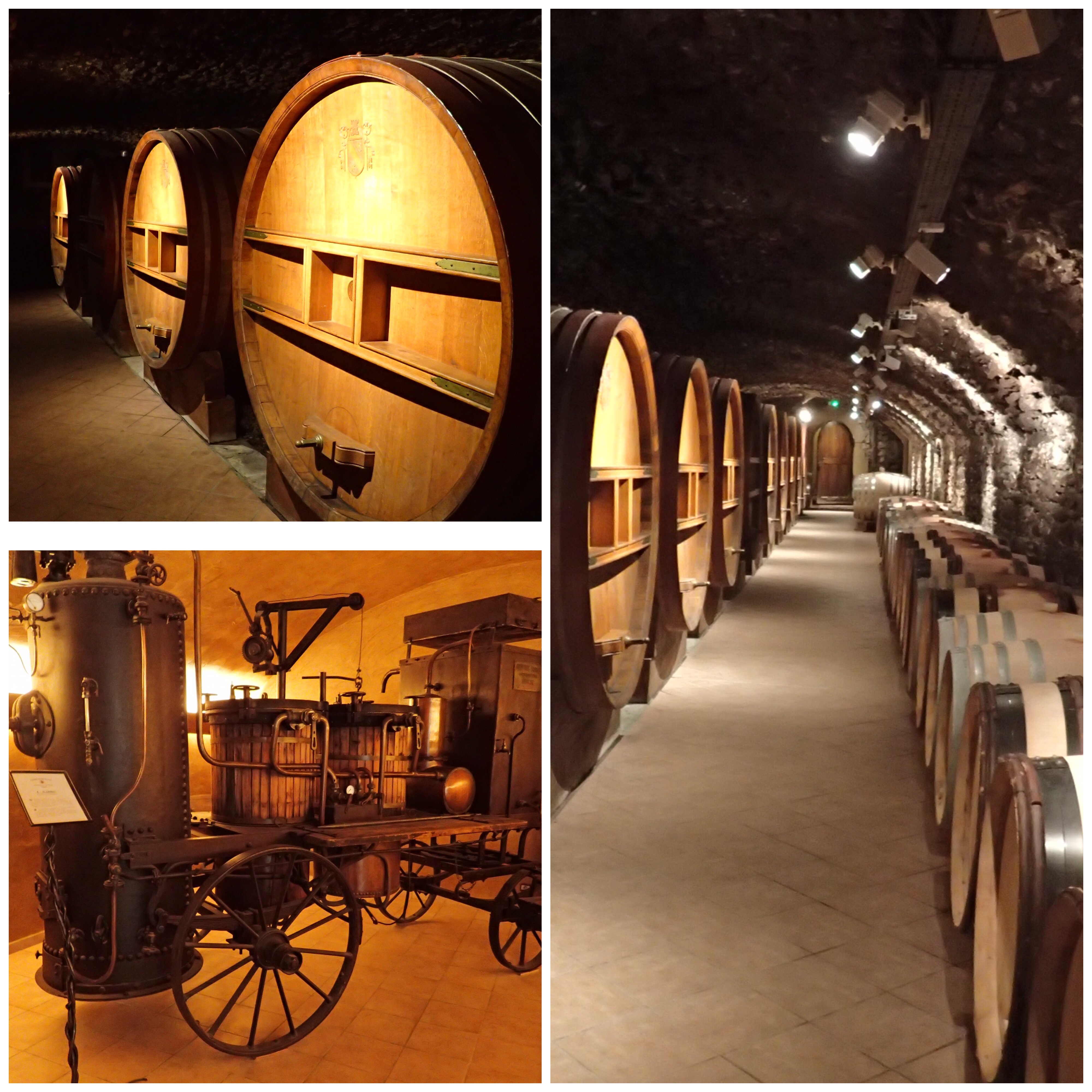
The second winery, the largest, grew all of the thirteen grapes that may be included in a Châteauneuf-du-Pape blend. Before tasting we walked among the barrels and learned a bit about some of the older machinery that years ago was pulled from vineyards to vineyard to bottle the wine.
We were able to walk among the vineyards in front, just a few acres which produced one of the bottles we bought. The pickers were just finishing for the day. Our guide told us most of the pickers in this region are Spaniards who come to France for the higher wage (9€ an hour) while still retaining their health care and social security benefits which are universal through the EU. The inferior grapes (which looked fine to our untrained eyes) were left on the ground as only the best grapes made it into the baskets. The vines were picked clean and had been pruned earlier in the year to produce a smaller quantity of higher quality grapes.

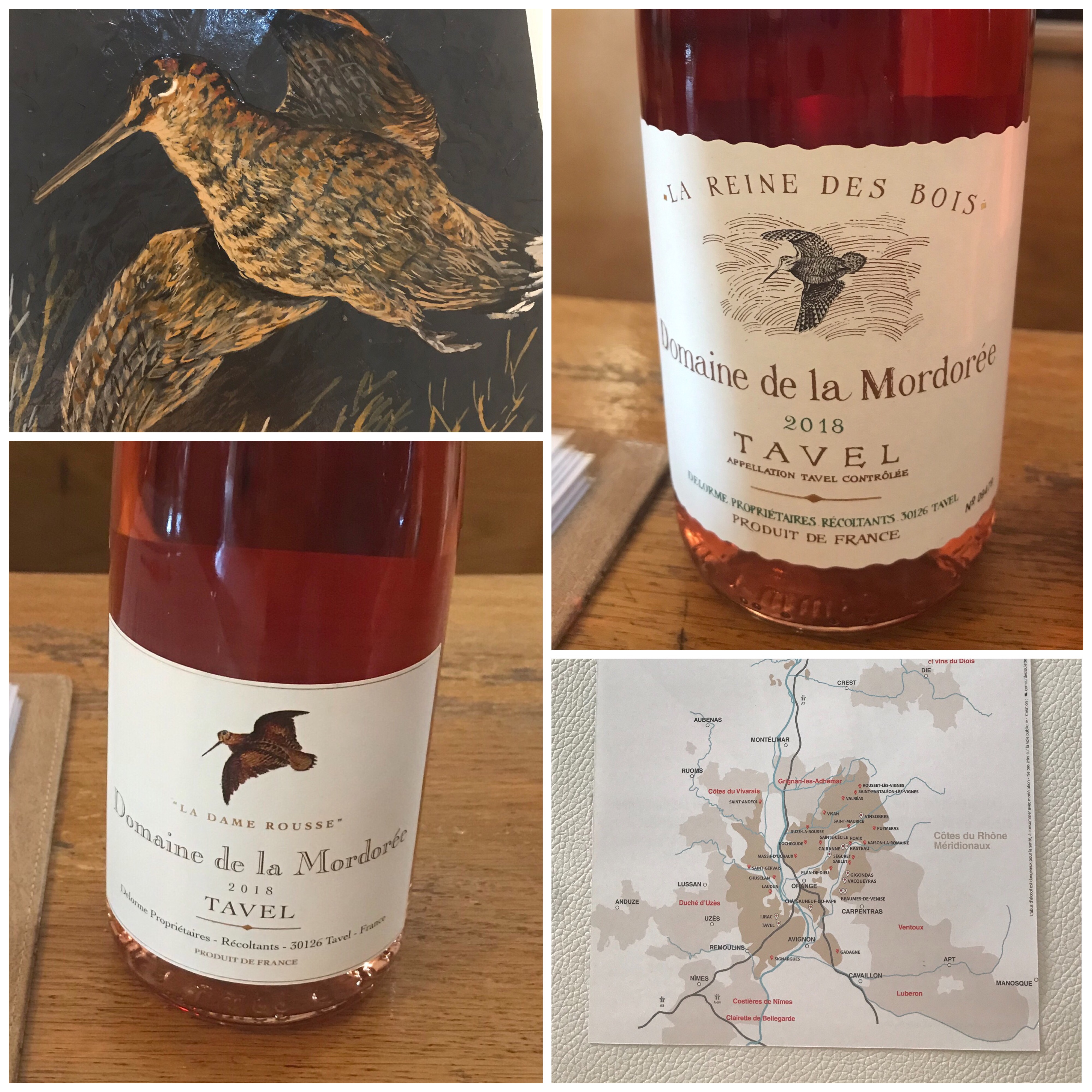
Our final stop was the most modest winery, Tavel, specializing in rosé. The motif was a woodcock, a local game bird that the founder of the winery had enjoyed hunting. Now too elderly to be actively engaged, the operation of the winery had been left to his daughter-in-law and granddaughter after his son had passed away. And it was quite good, definitely better than their other wines.

Part of the challenge of wine tasting in this part of France is the tradition of lunch being the major meal of the day. And since most of the wineries would be closed from noon to 2:00 or 2:30, we had to pause in midday to do the same. Our guide asked what kind of lunch we wanted and delivered us to a lovely place in the shadow of the Avignon’s Popes’ summer castle. After all, the region derived its name from being the Summer home of the Pope!

Between winery stops, Alain gave us a bit of history of the region, recommended other villages to visit that were not typically on the tourist route and provider some insider tips on the area. Although I think he might have been a bit surprised at how taken we were at the first winery with the resident dog.

Earlier in our trip we had met a young couple from Manhattan who were driving themselves and tasting wines along the way. They had booked most of their visits in advance and were on a tight time schedule. They probably tasted far more wines than we did, but maybe they missed much of the French experience of savoring the good things in life.

Budget Business class?

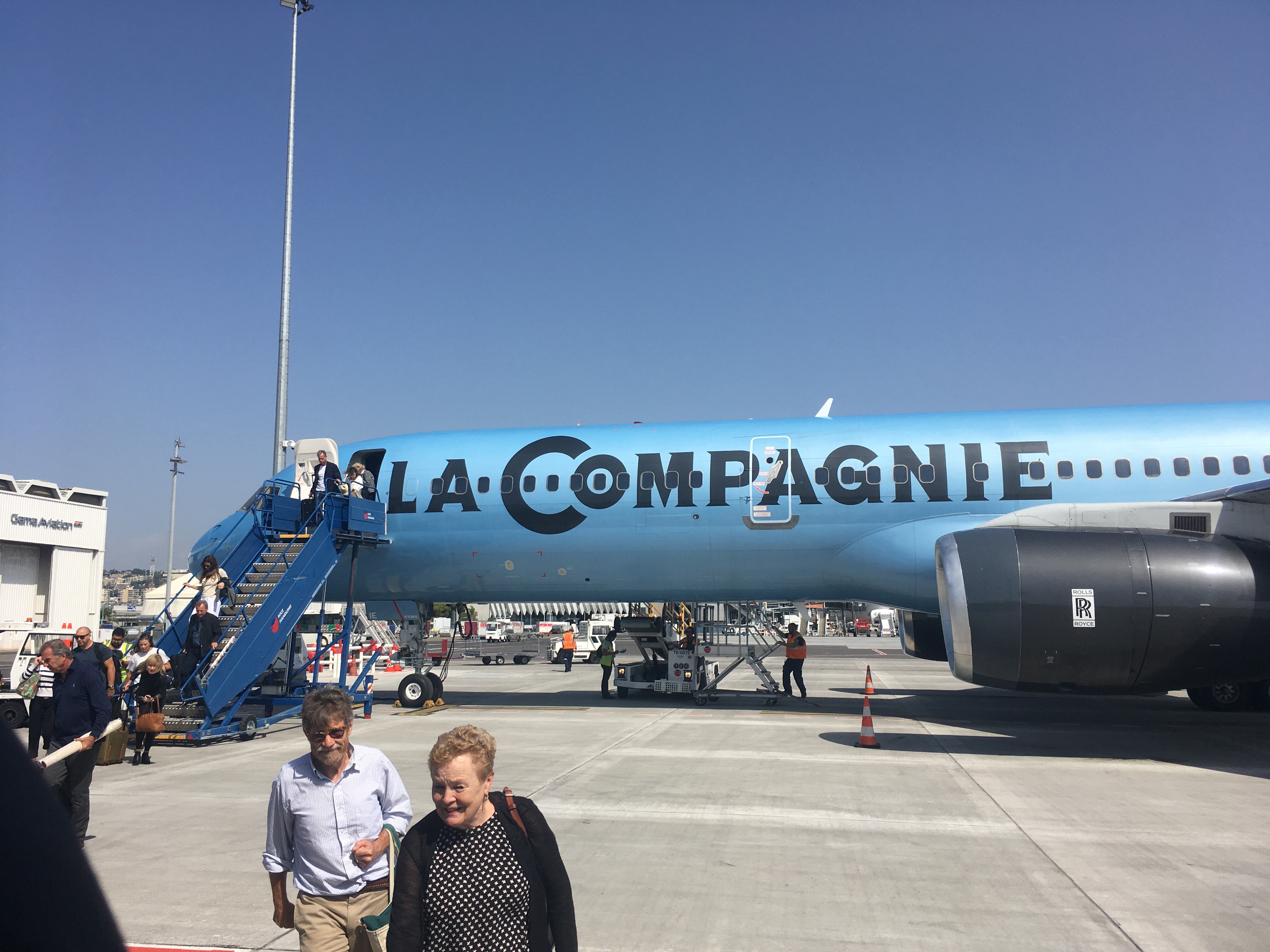
Who doesn’t want to sleep on those long overnight flights to Europe? As we’ve gotten older and more spoilt, we’ve tried with mixed results to use miles to get to Europe in comfort. And it seemed to be getting harder to reclaim those miles for international trips. So we jumped at the chance to buy a business class ticket on La Compagnie.

La Compagnie advertises itself as a “boutique” airlines. In their terms “boutique” means small (70 passengers total), great service (one flight attendant for every ten rows), but not all of the amenities of a big, swanky outfit. The airline has been operating for a few years, mainly a Newark to Paris flight. We heard a Newark to London flight had been abandoned, but that a new flight to Nice was just starting up. For about $1200 each we booked two tickets in mid-September, 2019.

The 11:30 pm departure wasn’t a problem and meant we could have flown in to Newark the day of our departure. Instead we opted for a weekend in NYC, got a late checkout from the hotel, had quick bite to eat in the theater district, saw Broadway matinee performance, 6:30 dinner reservation, picked up bags at hotel and took Lyft to the Newark Airport ($75). Got to the airport around 9:30 pm. The airline said we could have checked in as early as 9:00 but that we had to be checked in 50 minutes before the flight.

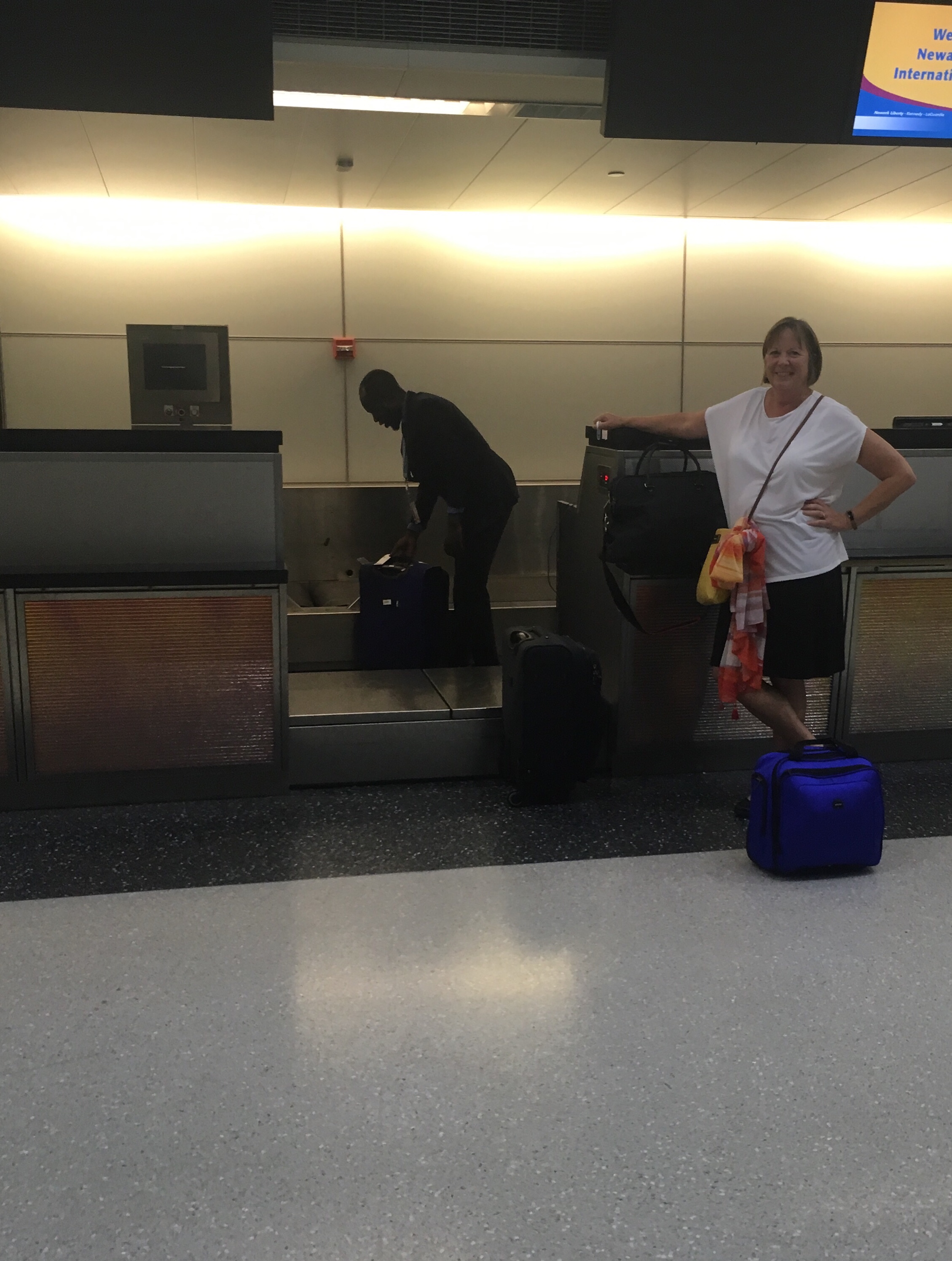
Check in was really really easy…no one else there at all. Not a person. Two staff to check us in And they directed us to the Art Lounge, a facility they share.

The Art Lounge is a little shabby if you are used to the ones the big international carriers have. The furniture definitely needs updating. The lounge is small but a major part is sectioned off for La Compagnie. We had our choice of seats, and plenty of room to spread out. The food options were decent — a couple hot dishes, cheese and crackers, basic booze options. Nothing to compare to the top of line lounges but more than adequate for an hour or two wait.

The lounge sits outside of security! But that’s not a problem since you get to use the priority line. Good thing, as the regular security line was immense. They announced in the lounge when it was time to go to the gate, about a half an hour before boarding. We went to the gate at about 10:20 which turned out to be way too early since we didn’t actually board until 11:10.

The international departures area in Newark is a total zoo—crowded beyond belief. The situation was complicated that evening because a Norwegian flight boarding next to us had been delayed and people were very cranky. And there was a British Airline flight delayed as well with people camped out on the floor.

However, the boarding was lightening fast. We were in the plane in what seemed like seconds and completed the boarding and closed the doors before I could put my things away. None of the usual people bumping into you as they they try to get by you. And before we were completely settled in our seats, the flight attendant came by with sparkling wine or juice.

The plane is great—-reasonably new, obviously modern, quite clean, very spacious. Much better aesthetically than the usual crowded business class sections on British or Air France. Seating is two and two. There are three sections with a lot of space between them. This flight was 2/3’s full so there were three flight attendants—one for every 15 passengers, all French, all very charming. There are three bathrooms, one in front, two in the middle, so you are never more 6 rows away. The entertainment system is definitely heads above other business class airlines. It is a very large, super light tablet that you can either have in front of you or slide out and set on your tray. Better noise cancelling headphones as well. The seats are a little smaller and perhaps a bit firmer than other business class seats, but still very nice. Not quite full flat beds, the seats reclined to about 175 degrees. A full size pillow and a very comfortable quilt made for a very pleasant, if short, night’s sleep. It was lights out with everyone fed just a bit more than an hour after takeoff.

The food options for our late dinner were a choice of salads — rare beef or a lobster — on a bed of greens with salad, a chocolate cake and a roll. And the drink choices were not as varied as the big airlines offer, but we were satisfied with our cognac. Breakfast options include an omelette or France toast with some very sweet, ripe fruit. And both meals were nicely presented.
Our arrival in Nice was as smooth as our departure. We whizzed through customs using the special lane for La Compagnie and elite class flyers (just had to present our boarding pass). There weren’t too many planes arriving when we did, so it wasn’t that big of a deal, but it could have been.
All in all, the experience was definitely worth the price. And we will be watching this airlines for future travel to Europe.

Hiking around Zion

We had been warned that the Zion National Park would be a zoo of people in the early summer months, but we our travel dates were hemmed in by the end school year and the beginning of the Fourth of July festivities. So we celebrated this year’s big birthdays — an eightieth, a seventieth and two fifties — over the last week in June. Warnings were well founded. Zion was a mob scene. And we discovered ways to escape the hordes.

We stayed an hour away in St. George and we arrived at the park later than we should have. By 9:00am the parking lot was nearly full and the line for the shuttles into the park were long. Very long. But the shuttle system is slick. Double buses run nonstop from the crack of dawn to sunset. No air conditioning, but good air flow, reasonably comfortable seats and a combination of taped recordings by naturalists or historians as well as the drivers commentary keep you informed about what you’re seeing.

The newsprint guide handed out at the entrance was great. It described the hikes in terms of ease but also with a stick figure falling to indicate the worst hikes for the acrophobes. As several in our group suffer from that fear, and given the age of our eldest, we opted for a moderate hike for our first effort, the Watchman Trail. It was one of the few trails accessible right from the parking lot, no shuttle needed.

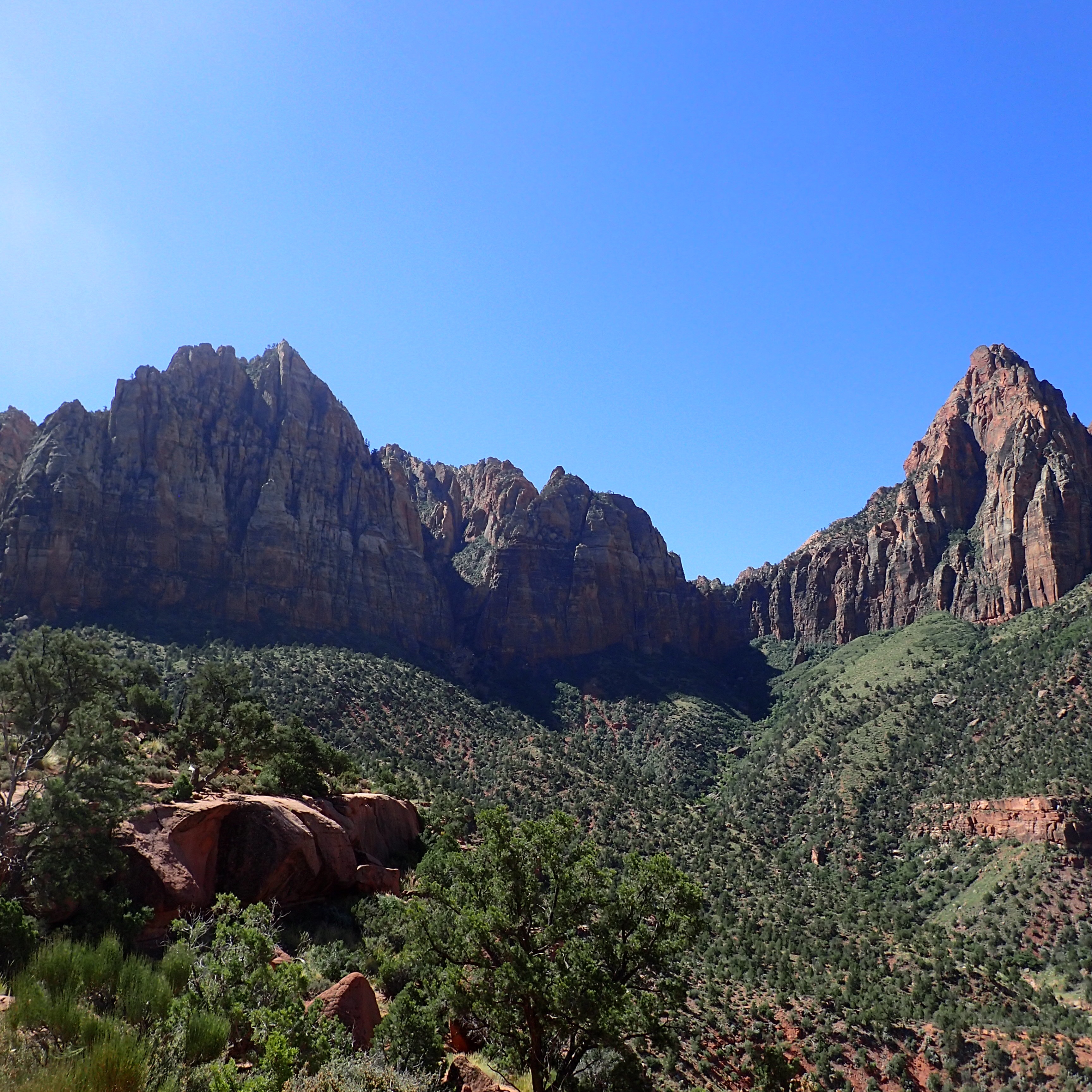
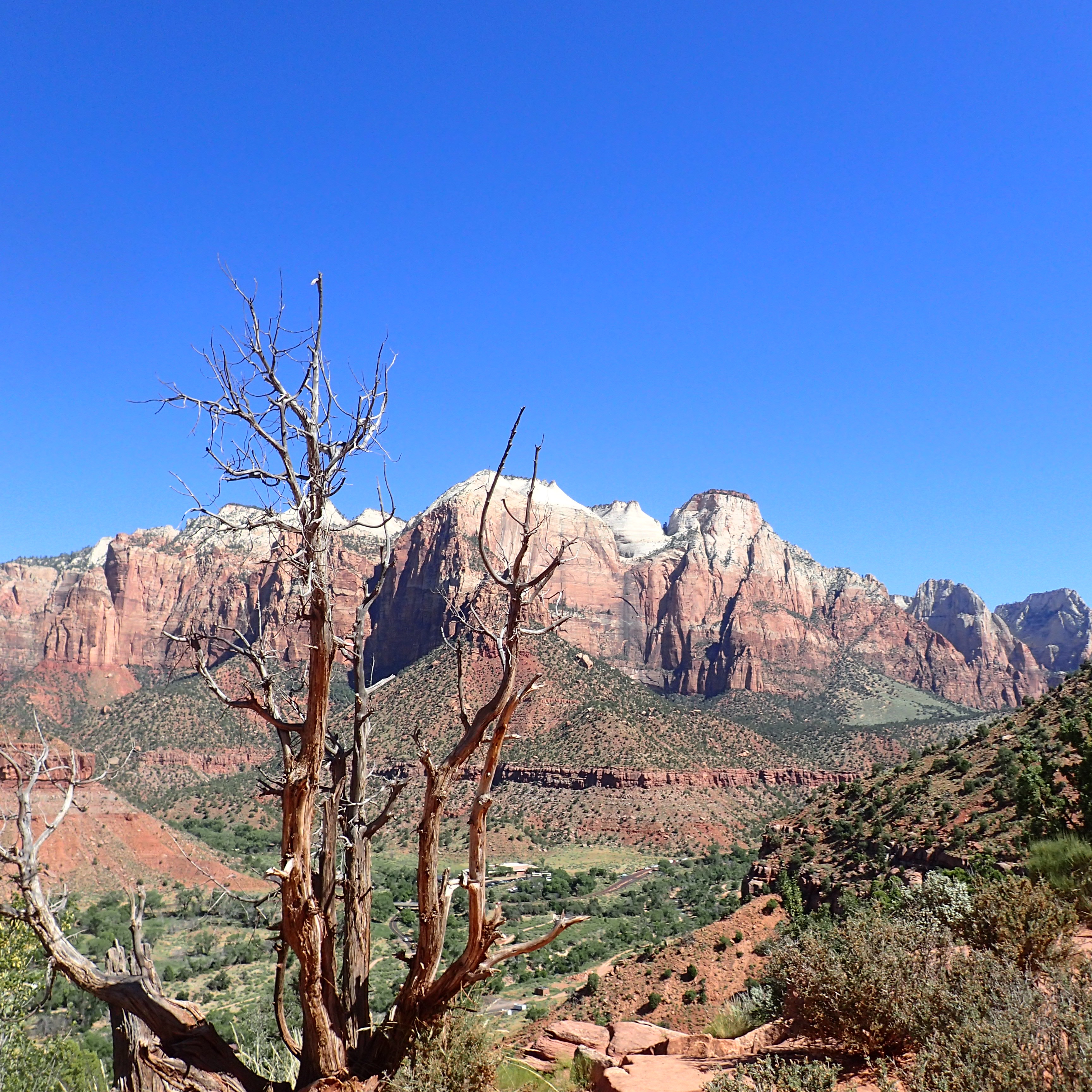
A quick walk along the Virgin River and then we followed a clear trail from the river up the into the canyon. At mid-morning much of the early part of the west facing trail was in the shade, but as we climbed and traversed the switchbacks, the path became more exposed. They aren’t kidding when they say take lots of water. We all went through several liters each! But the view from the top, across the Virgin River valley to the red rock faced walls stunned all of us.

The newsprint guide said the famous Narrows hike was closed — much to our disappointment — too much winter snow meant too much water in the Narrows. But lesson learned. Double check with the rangers. Turns out the trail had just opened and while the river was high, it was passable as long as you were willing to get wet. So off we went.

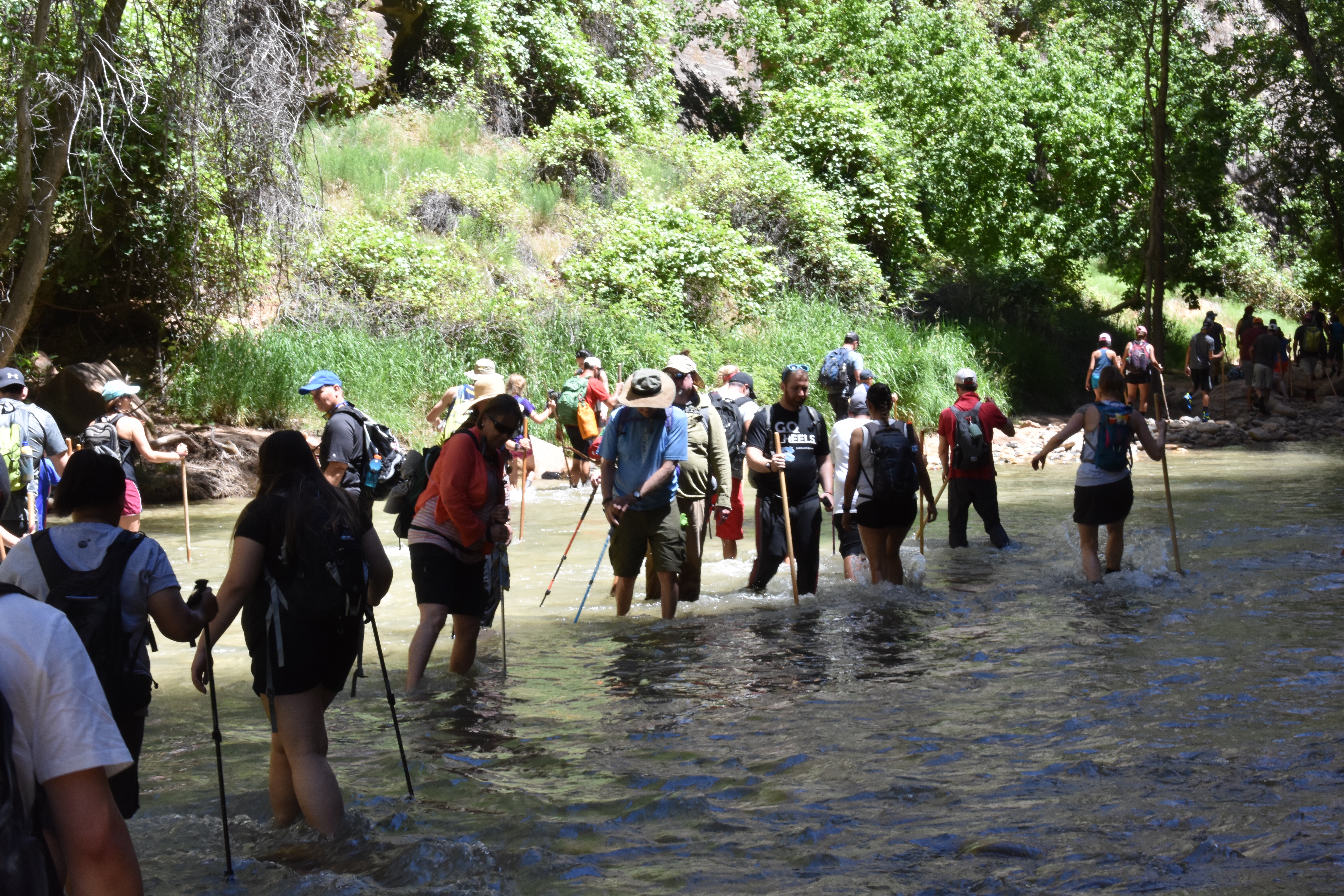
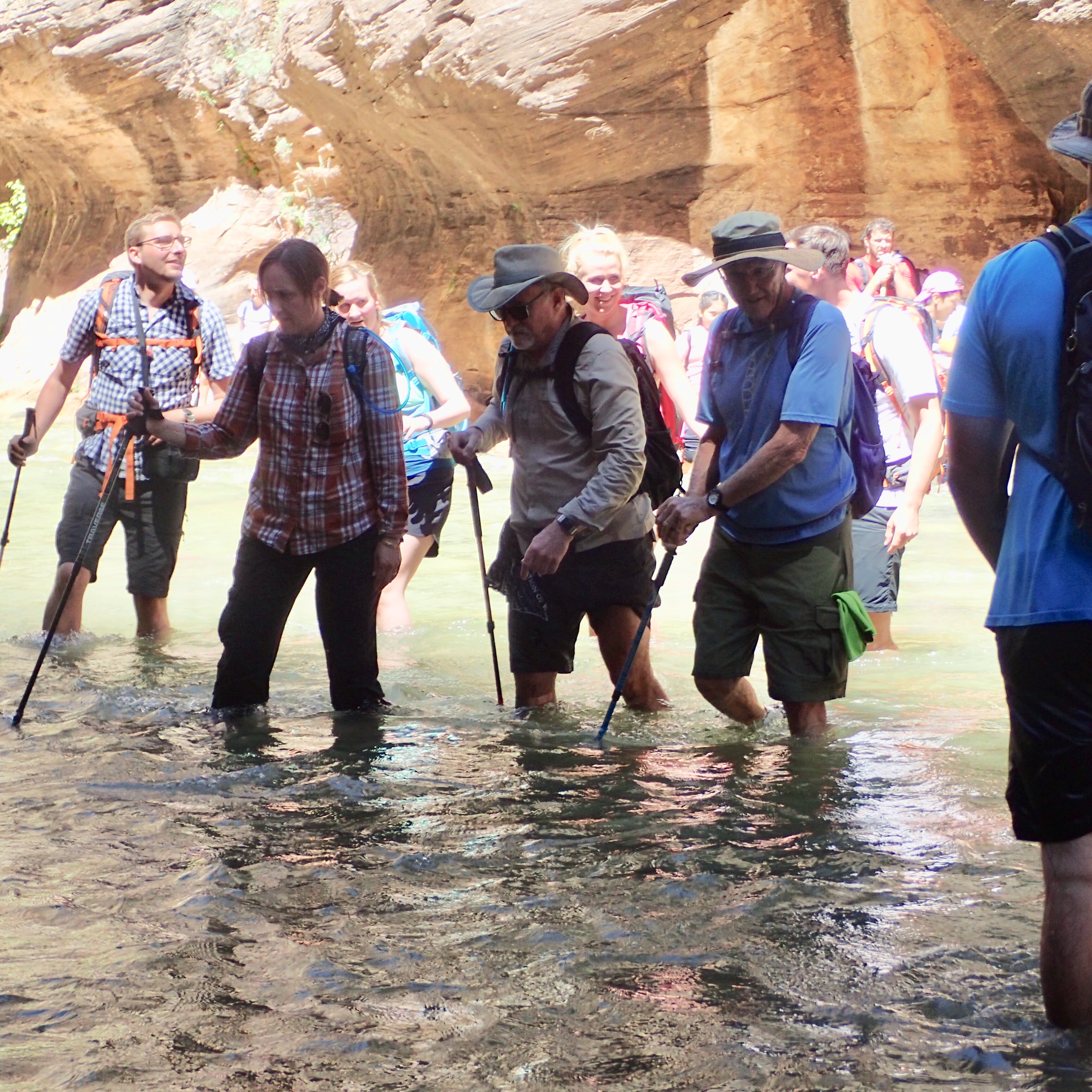
Do not be deterred by your first impression. The “trail” to the river is handicapped accessible, paved and so crowded you have to walk single file. It feels more like a walk in a crowded city park than a wilderness experience. And at the river’s edge the mob of people walking along the trail congregated. Felt like a party. We hesitated. Did we really want to wade in our hiking boots? Next time we all agreed we would bring sturdy running shoes and swap out our hiking boots. You can rent waterproof walking shoes and a wooden hiking staff for $25, although we all agreed the wooden staff would offer a heck of a lot of resistance in the fast moving river.

Our hiking sticks had been superfluous on the path to the river; once we started wading over large and slippery boulders in ankle to knee high swiftly moving water, we all relied upon those poles to keep two points of contact with the bottom. Even so we made slow progress. Very slow. It took major effort than you might think. When the water became crotch deep, we turned around while many went on. Anyone doing this needs a dry bag for valuables. But the few hundred yards we waded through was worth every sore muscle the next day!

We did talk with those who hiked the Angels Landing Trail. Twenty seven or some such switchbacks and holding on to a chain as you scale a narrow path with nothing between you and hundreds of feet of air, plus the fact that there is often a waiting line to begin the hike was definitively not for us.

Like many popular sites, they are popular for a very good reason. Zion is gorgeous, breath taking and unique and well worth suffering the crowds

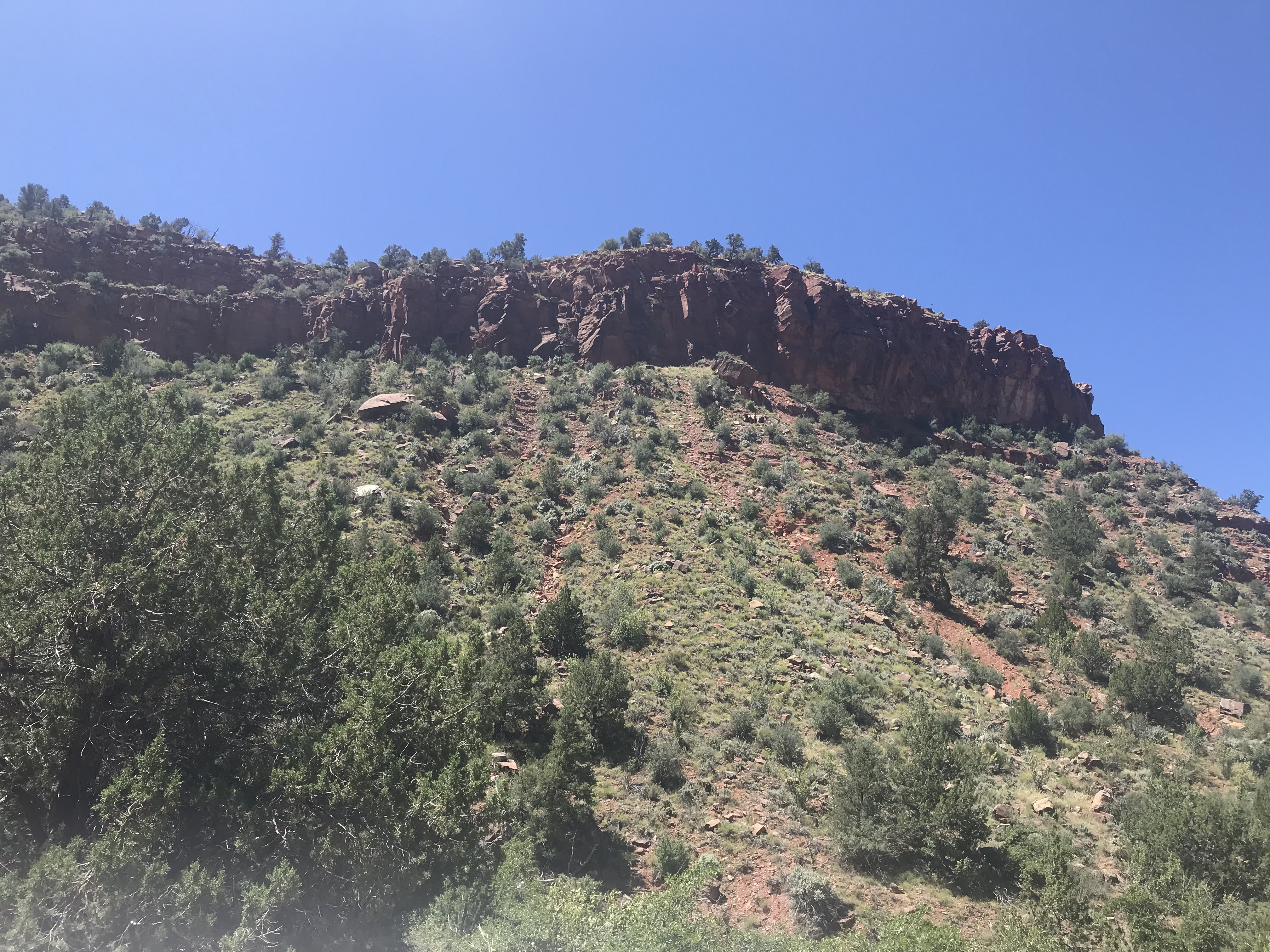
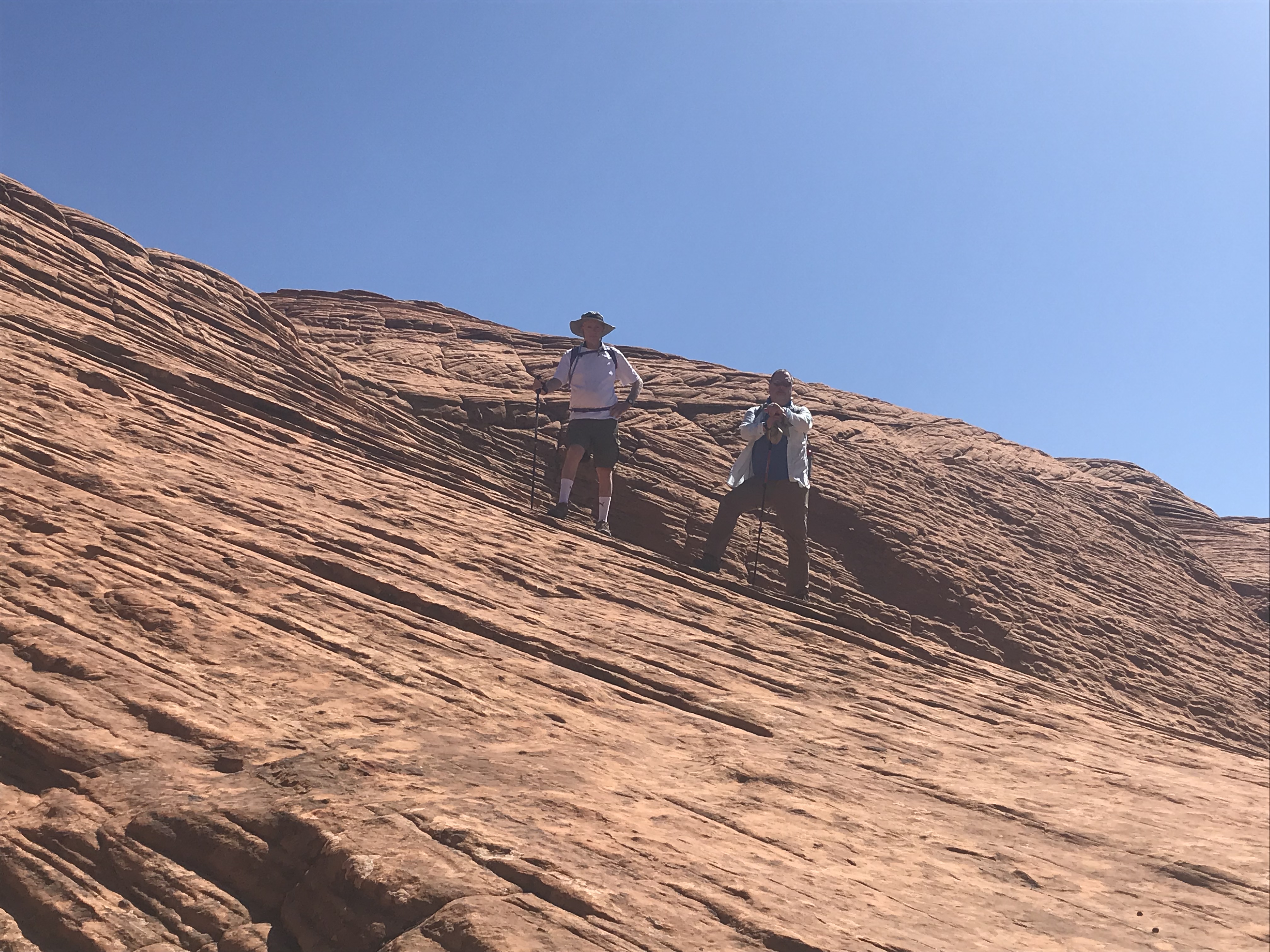
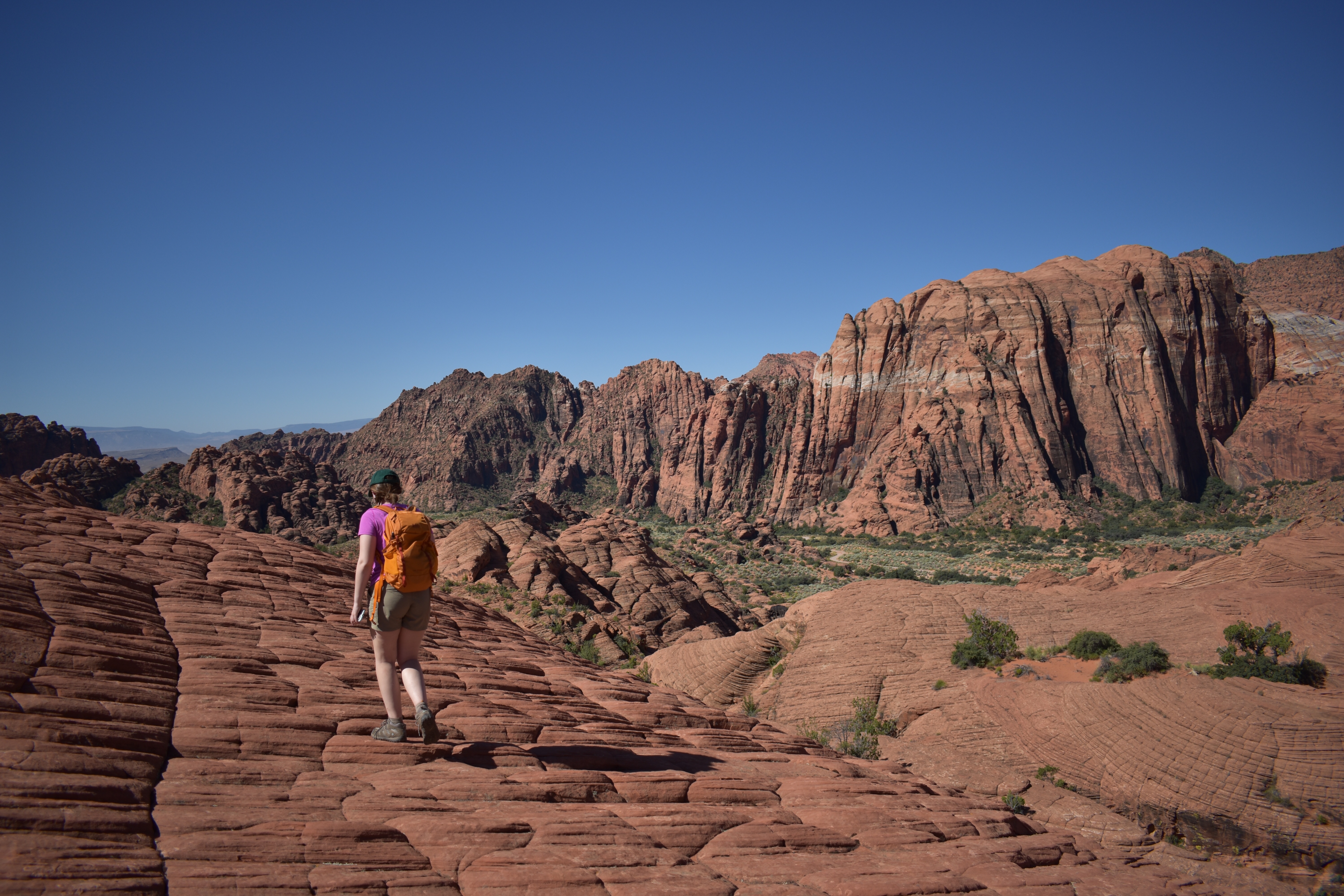
If the crowds of Zion get to you, try one of the state parks in the area. We spent one day hiking in the Snow Canyon State Park. An entirely different landscape than Zion. More desert and less green, but still eye popping with a whole lot fewer people. We took a quick walk up a slot canyon. And then spent several hours climbing upon petrified sand dunes.

And some amazing views

Snow Canyon is definitely worth a day, maybe two at the most. And while we ran into a handful of other hikers, we felt like we were far, far away from Zion’s mob scene.

More than a tropical rainstorm

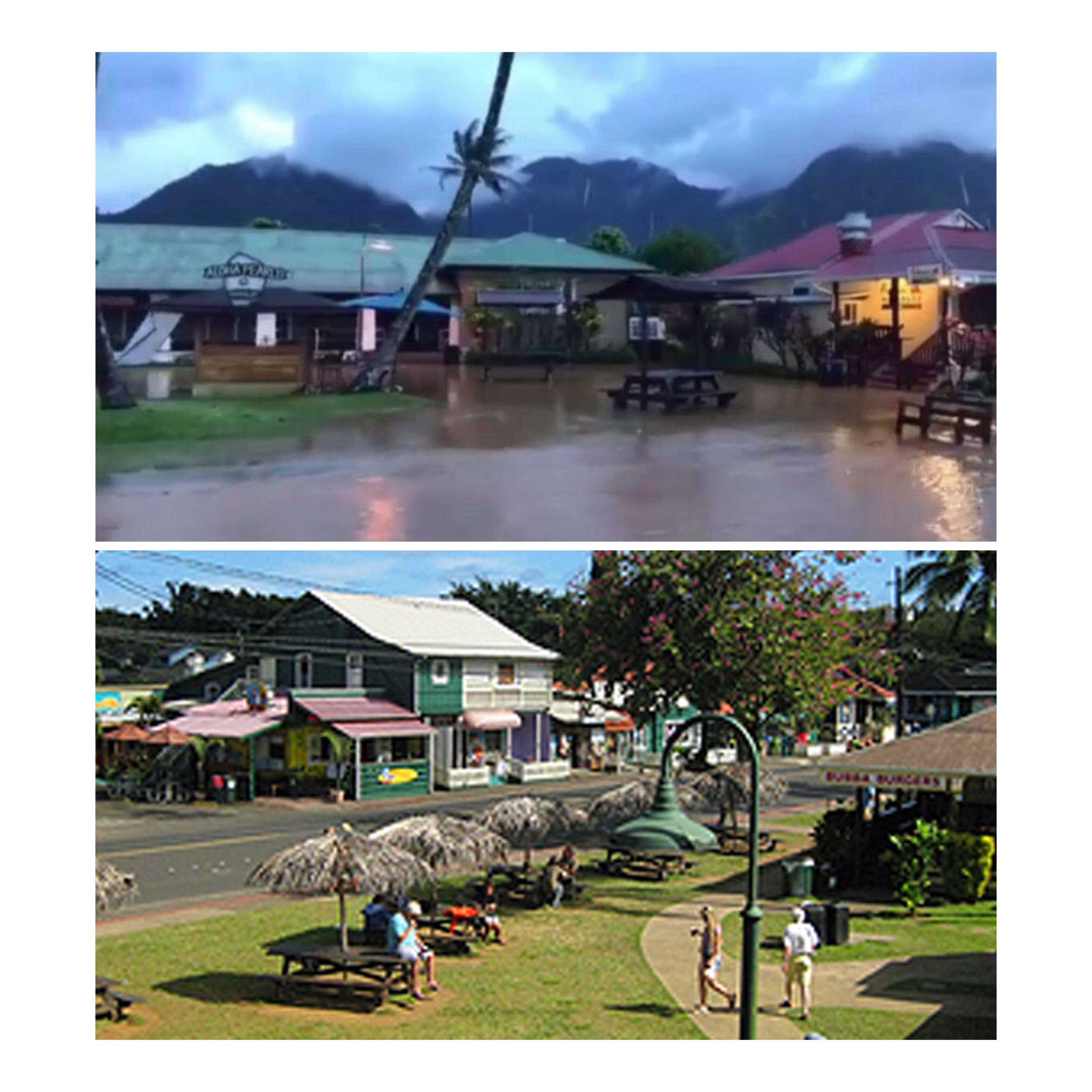
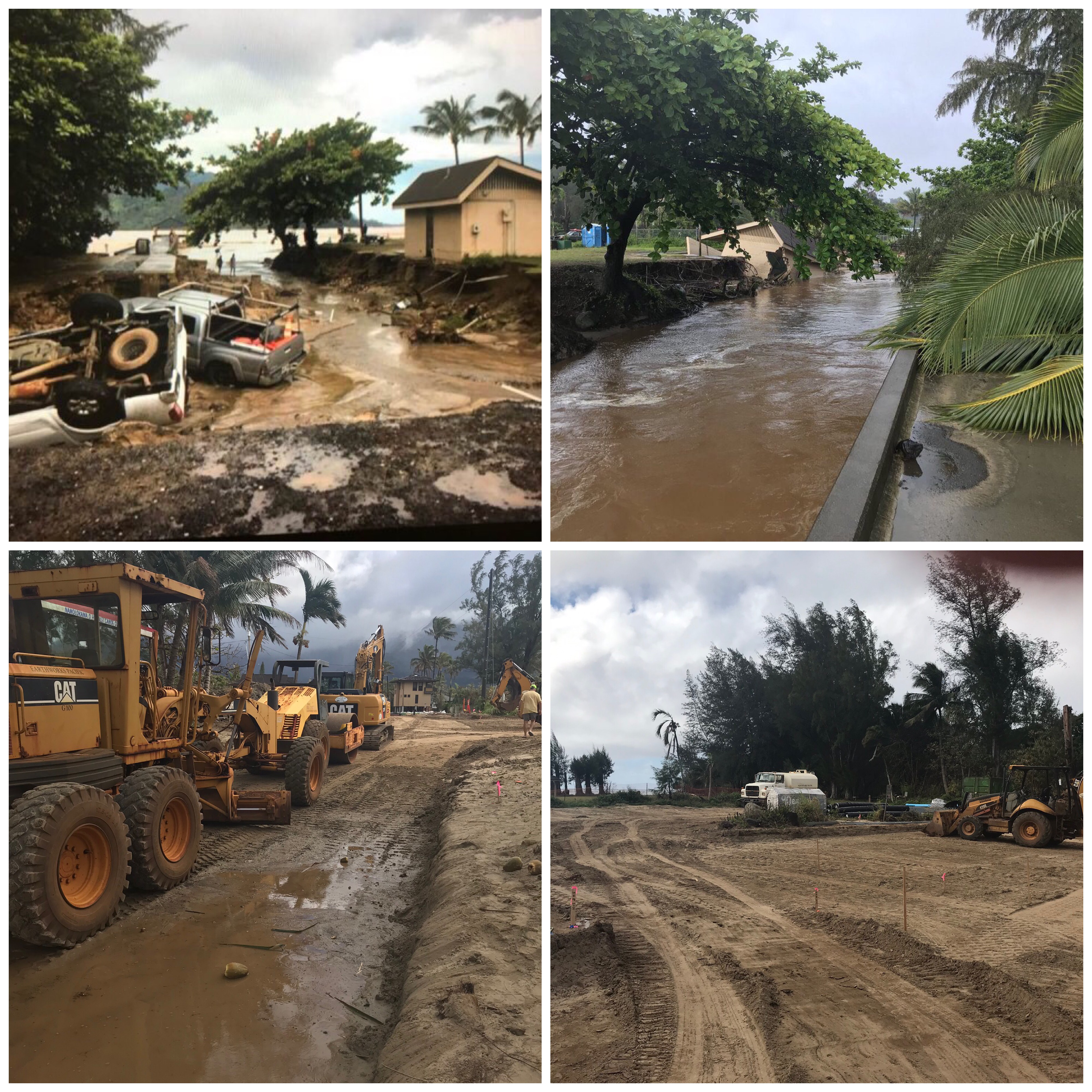
It was just a little bit more than a year ago, April 2018, that the first pictures showed up on Facebook and in the media. Hanalei Town, Kauai, under water. After nearly a month of prolonged rain (we spent most of that month inside our vacation rental looking at the rain) the north end of Kauai experienced the single highest 24 hour rainfall total on record anywhere in the United States–49 inches. And the Hanalei River could not be contained.

We returned to Hanalei this March, 2019, nearly a year later. We have been coming to the north end of Kauai for over a decade and know the area very well. Much changed because of the 24 hour deluge a year ago.

Recovery is slow. Very, very slow. While the main commercial areas are up and doing their usual brisk business, damaged roads and homes are much slower to bounce back. And we have to imagine that the cost of flood repairs to restaurants and shops, plus the reduction in tourism for much of last spring was a huge financial hit for the business community and the people who work there.

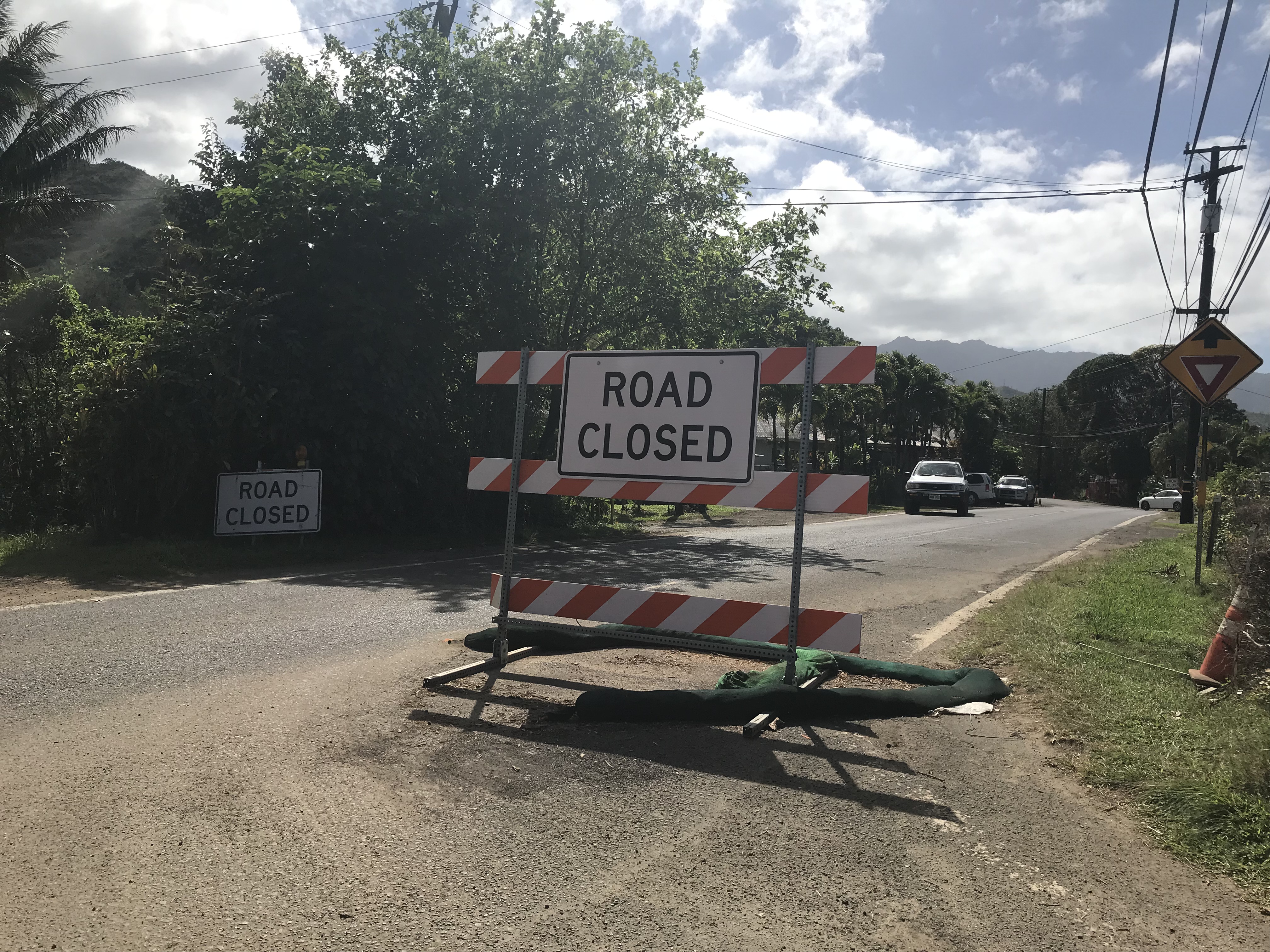
The road leading north out of Hanalei Town has been closed to all traffic except for repair crews and residents. It is the last 7 miles before you reach the impenetrable, spectacular Napali Coast with some of the most beautiful coastline, beaches, and mountain views in the world—Bali Hai of South Pacific fame, the Tunnels snorkeling and scuba diving reef, the gorgeous Ke’e beach beach, and the beginning of the breathtaking Kalalau hiking trail. Residents can only travel in escorted caravans. Job one is not yet completed — repairing the old one lane bridges so they can support the equipment needed to repair the roads. The damage was compounded in an August storm and a year later that task is yet to be finished. Meanwhile, we heard rumors of a controversy about whether or not tourist traffic should even be allowed to return (3,000 plus cars a day made the trip to the end of the road before the disaster)–parking was always a nightmare at the Kalalau trailhead. Some have suggested shuttles from Hanalei Town instead. But change comes slowly in this corner of the world.

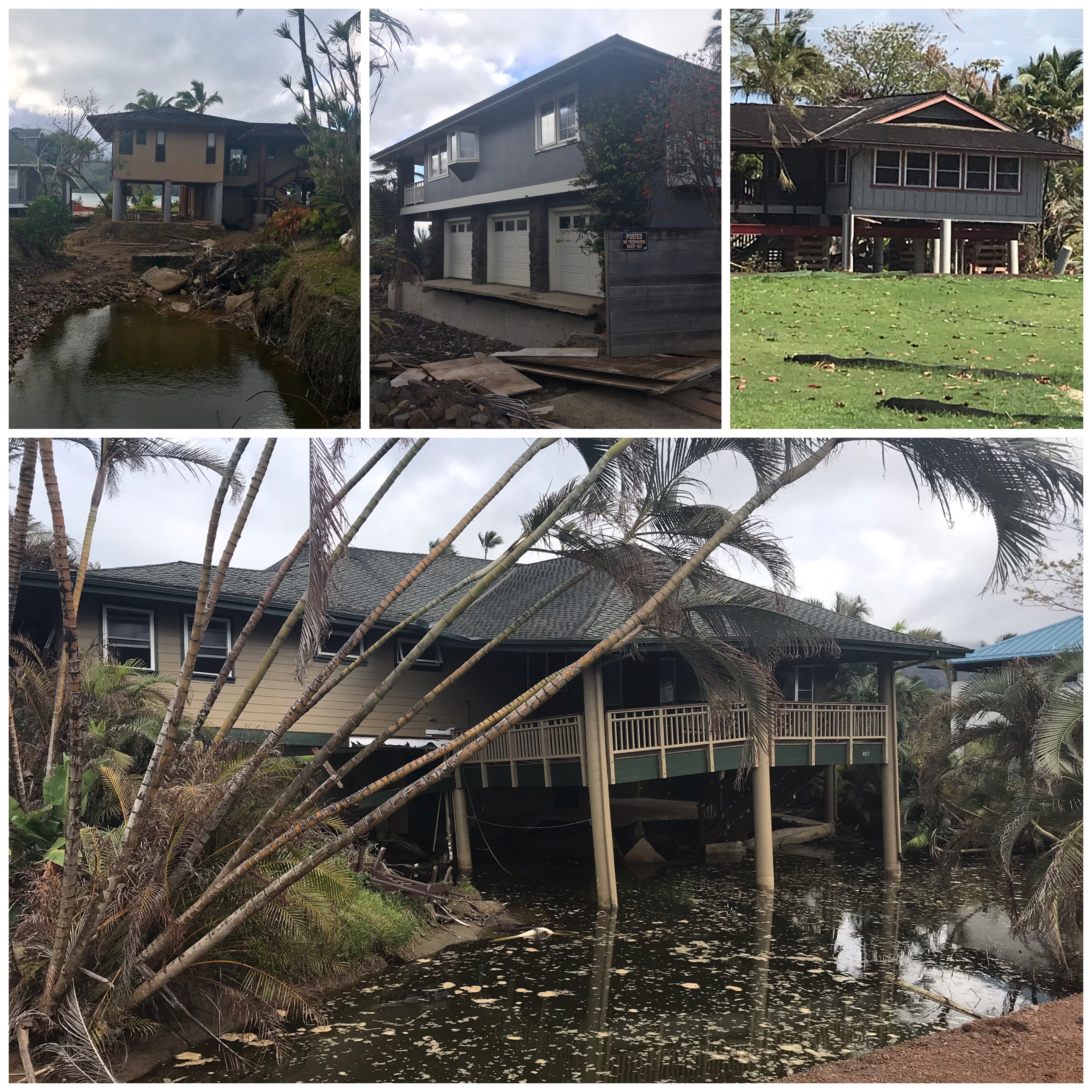
Repairs to the several homes undercut by the flooding on Hanalei Bay near the pier and Black Pot beach have become a tourist site. Nearly everyone walking down the beach stopped to watch the demolition work or take pictures of the repairs. We suspect the homeowners had always worried about water damage coming from the ocean during hurricanes or a tidal wave. Last spring it was the rain and river that got them when much of the valley flooded, creating a new, temporary river bed. The multi-million dollar homes in the path of that river were destroyed.

It is hard to conceive how these homes will be rebuilt. Would insurance even be available? As we walked the beach at high tide, strong northerly winds pushed the waves up into the channel created by flood waters a year ago. And once more, the house was surrounded.

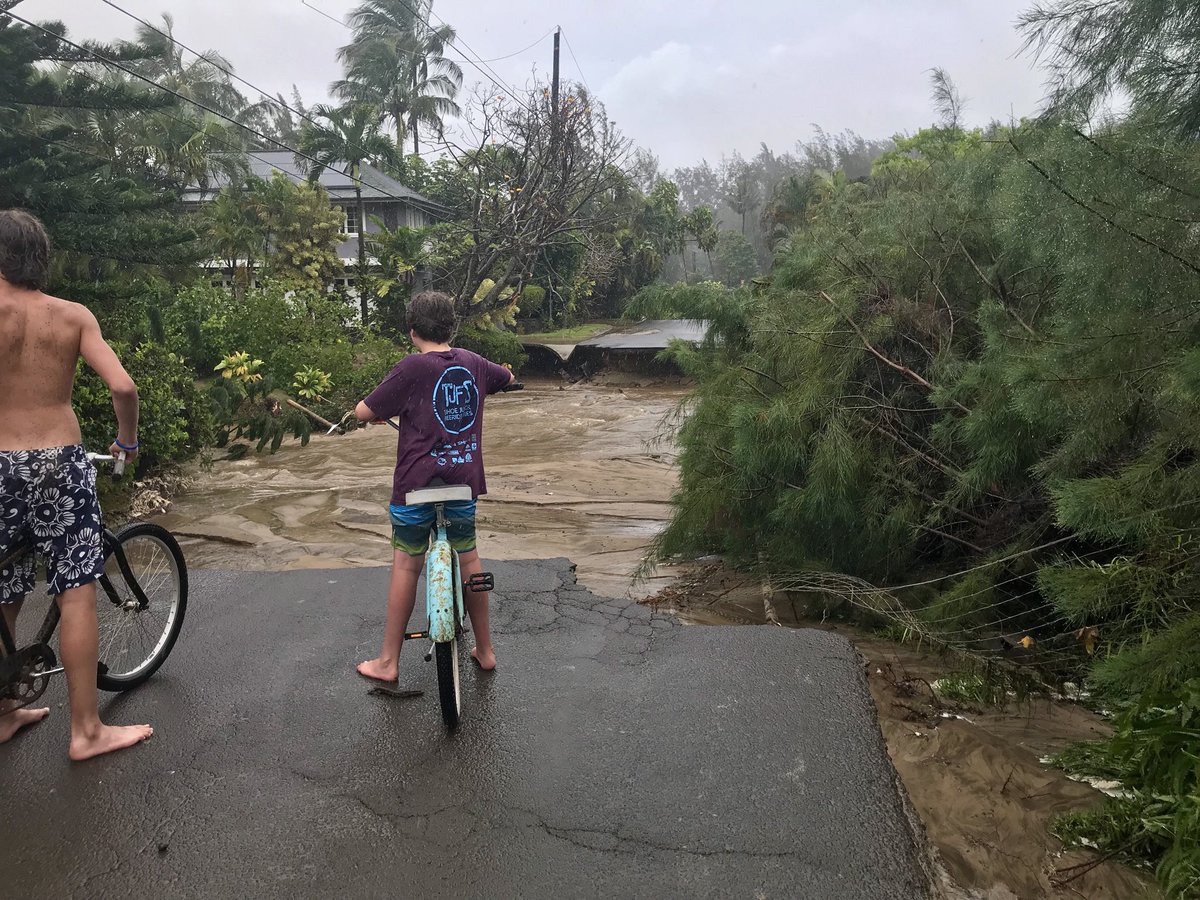
Weke Road to Black Pot, running parallel to the ocean remains closed south of the pavilion where much of the road was totally destroyed as this local newspaper photo shows from a year ago.

Repair efforts to homes along the road seem to be moving even more slowly than elsewhere. Signs warn that that water around these homes is still contaminated.

The waterfront homes familiar to many from the movie “The Descendents” seem just fine. George Clooney could still knock on the front door or jog down the beach in front of the homes as he did in the film.

The biggest impact to tourists (and locals seeking some beach time) is the lack of parking now that Black Pot beach is closed and the parking lot there is being rebuilt. Hanalei never had enough parking and now it is even worse.

Plus the beaches seem more crowded than ever. Is it because the beaches further west are inaccessible? And with less parking the sunbathing, surfing and swimming crowds pack the beach in front of the pavilion. Only a few hearty souls and surfing school students hike down to the pier.

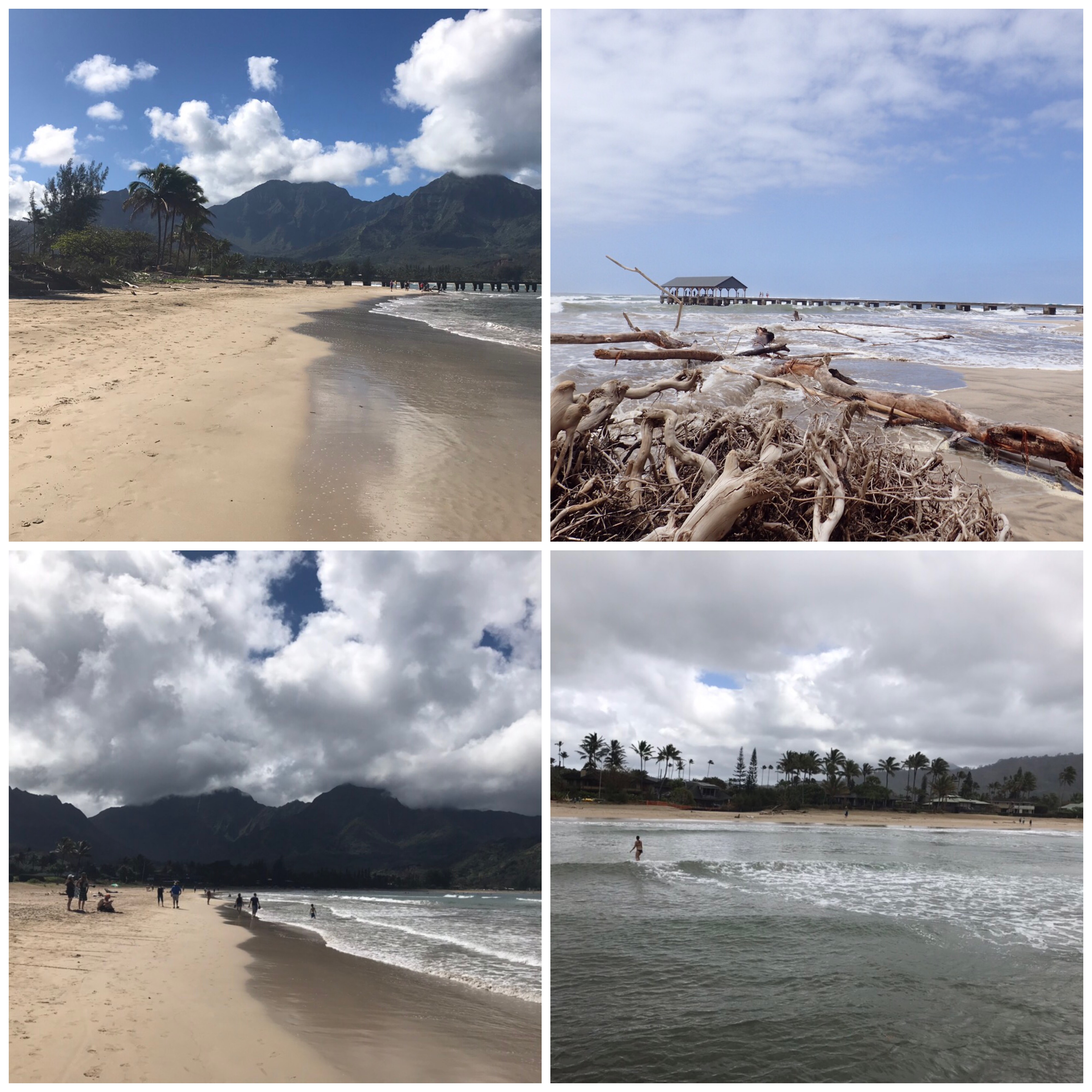
Nonetheless, the three mile arc of the bay remains as beautiful as always. And walking the beach still can’t be beat. Despite the weather trauma, Hanalei Bay endures.

Cozumel with an Open Mind

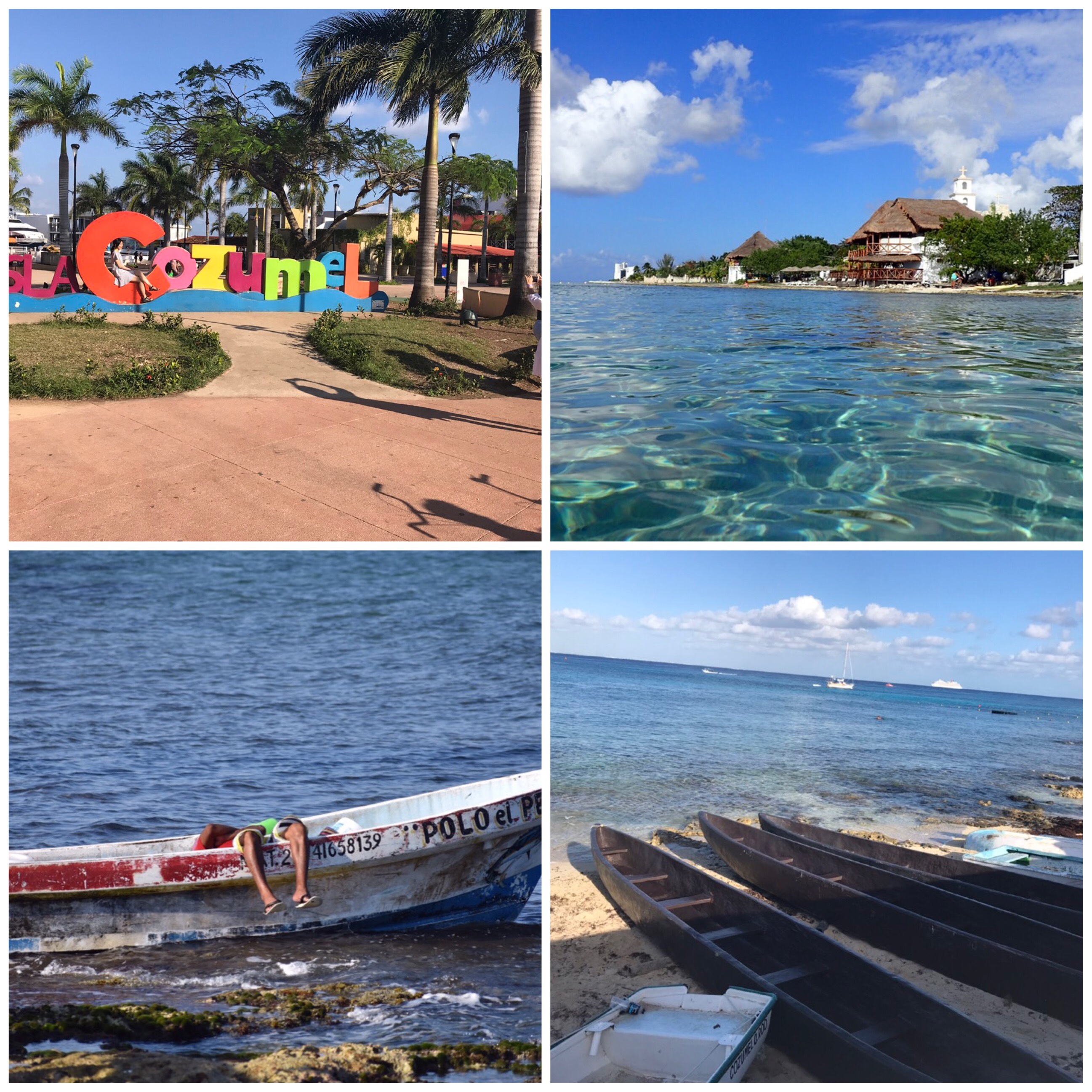
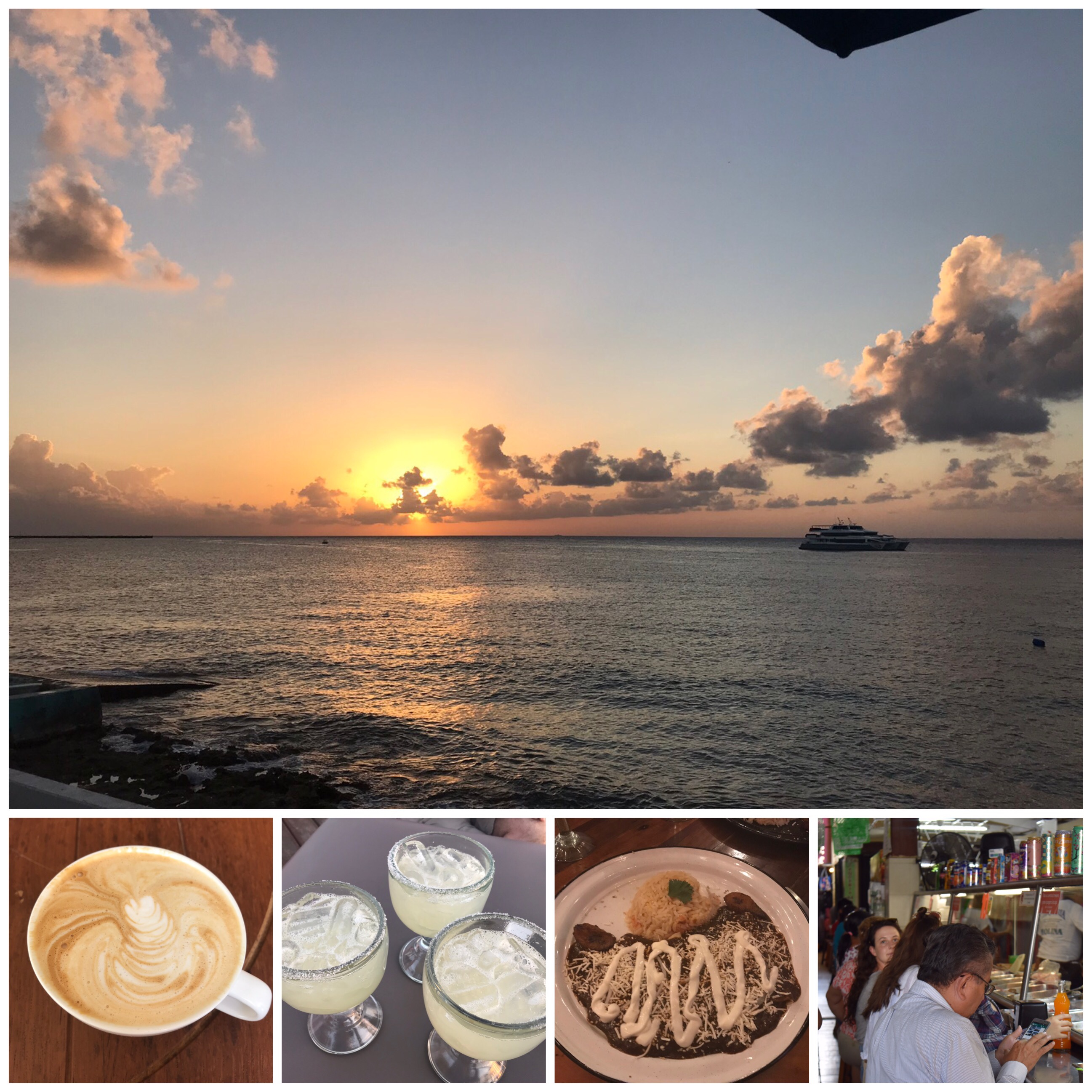
Surprise, surprise! We were convinced that 15,000 cruise ship passengers a day descending on tiny Cozumel would make it a very un-Mexican, tourist trap. We were coming here for the fantastic snorkeling and beautiful beaches, but didn’t expect much more. Yes, San Miguel de Cozumel (the only town on the island) does have its fair share of tacky souvenir shops, loud over-priced bars and restaurants playing American golden oldies, and street hustlers touting rental cars, scooters, jewelry, t-shirts, tequila tastings, and dirt bike tours. But walk five blocks from the town square and cruise ship docks, wait until 5 pm when the big boats start to depart, or spend a Sunday here when there are no cruise ships in port—you are in a different world. Mexican, local, real.

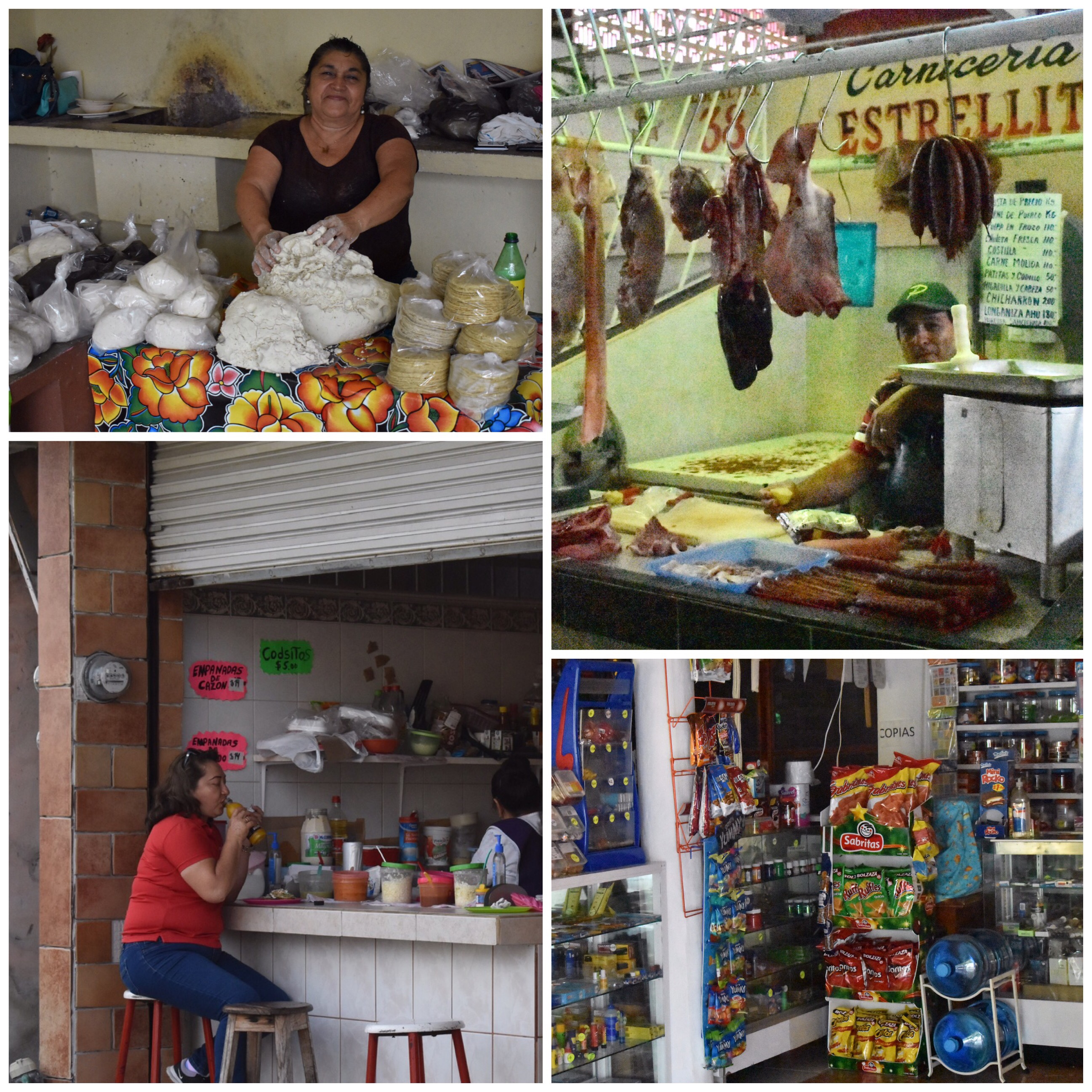
And despite our prejudices, mass tourism has its upsides. The cruise ship dollars make this island wealthier than most Mexican places we’ve visited—more opportunity for decent paying jobs, better infrastructure, less crime and poverty. And we benefitted as tourists too. We found a wide range of excellent, excellent restaurants—from the local, hole-in-the-wall taqueria to fancy seaside establishments with stunning views. Accommodations ranged from $18 a night rooms, backpacker hostels to all-inclusive resorts and beautiful villas on perfect beaches. There were three giant, modern supermarkets, but there were also mom and pop bodegas on every block and a large central market with stalls of fresh fish, live poultry and dozens small food stands.

But we did come for the drop dead gorgeous beaches and beautiful coral reefs that Cozumel is known for, and we weren’t disappointed.

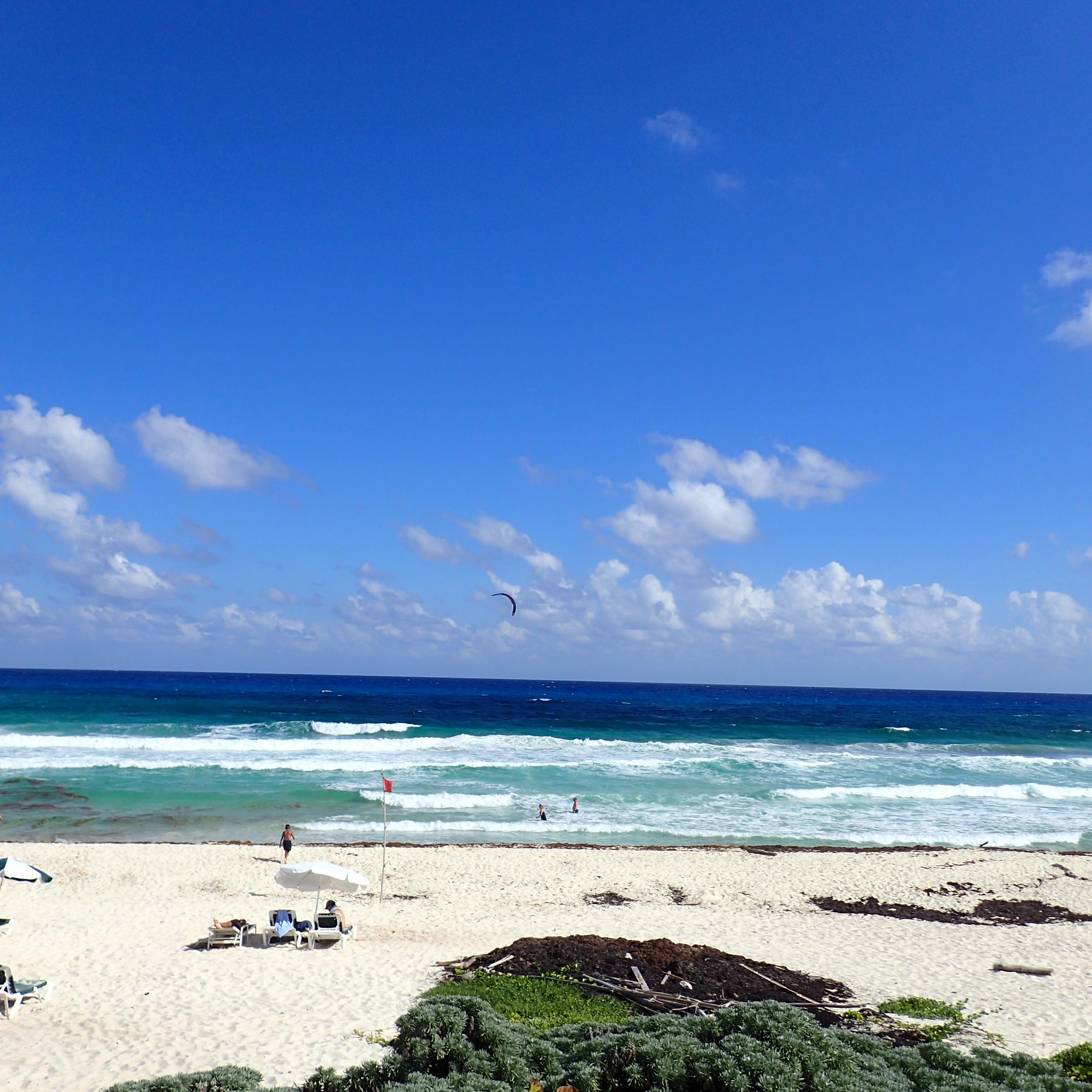
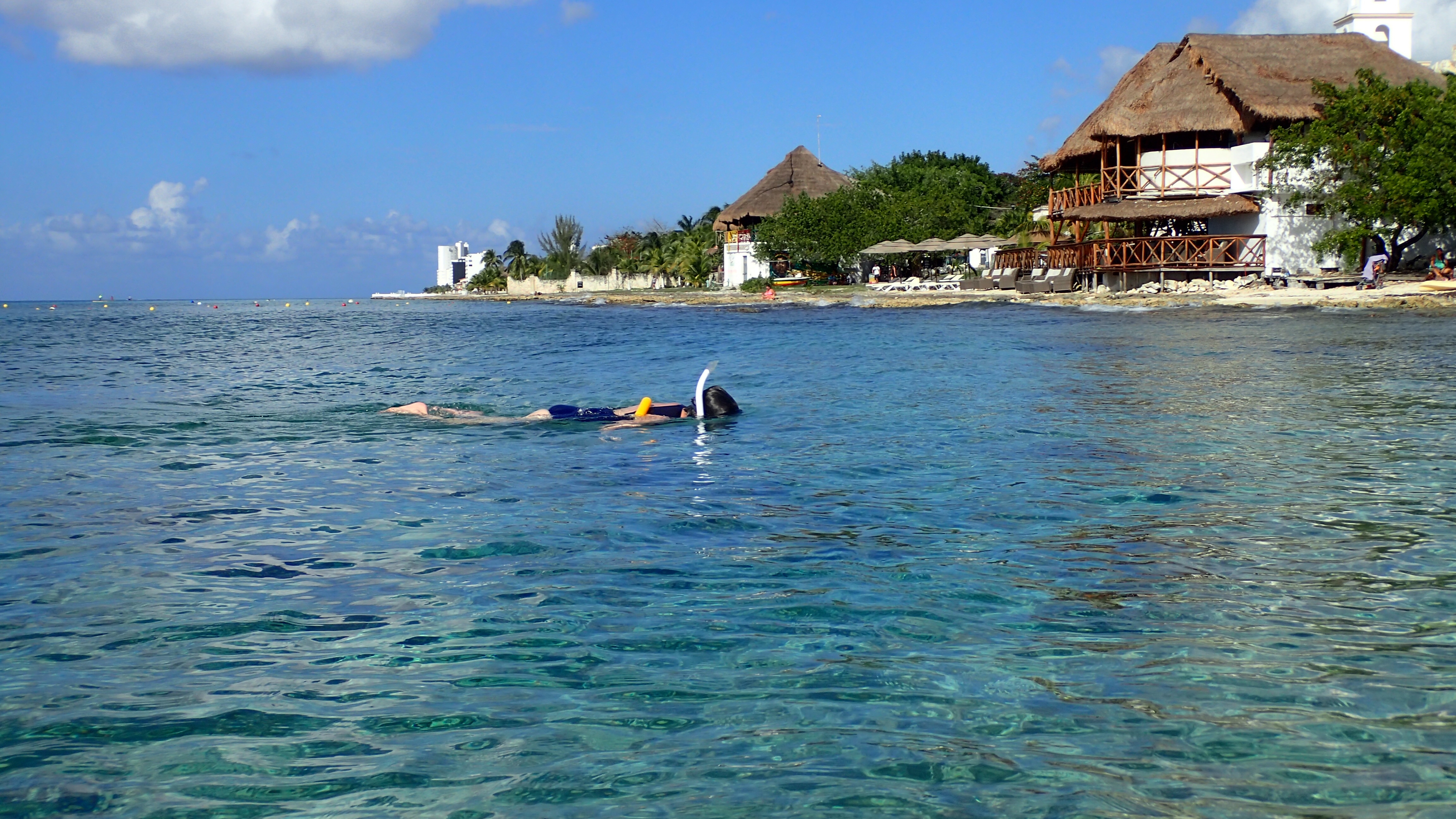
You do need to know that the island has two very distinct sides. The eastern shore facing the Caribbean is wild, virtually uninhabited with only a couple of small hotels and restaurants. The surf is high, the winds strong, and the shore is rocky. Great for kitesurfing, or sunbathing if the wind isn’t too bad, terrible for swimming or snorkeling. The western side, facing the Yucatan, is usually calm with crystal clear waters, barrier reefs and many idyllic sand beaches. The shore is dotted with beach clubs, restaurants, hotels, a mega resort or two, but also public beaches and small coves. This is one of the few places we’ve been where swimming is good almost in the town center! Cozumel is heaven for swimming, snorkeling and diving.

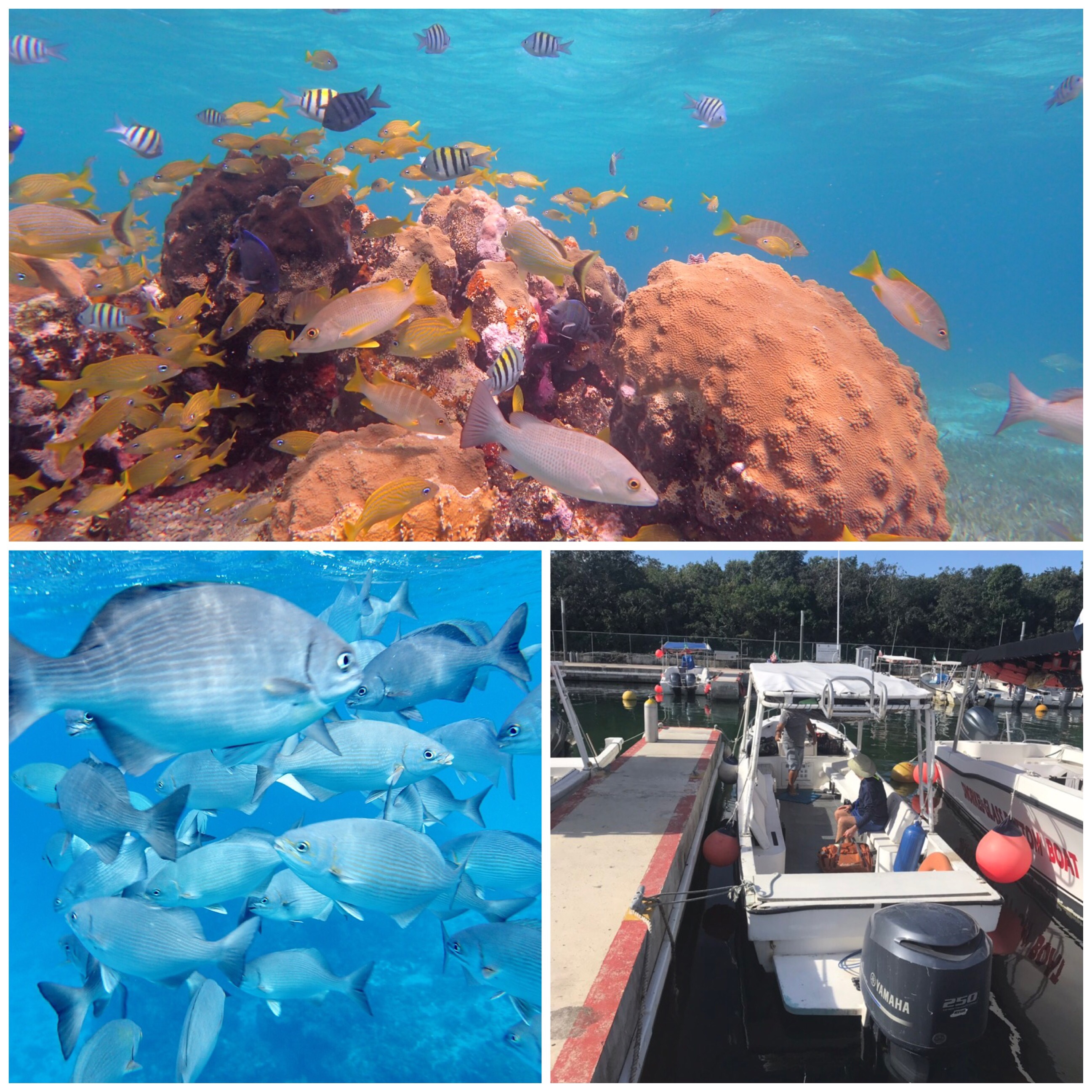
In our search for underwater adventure we stuck to the western shore and were given this bit of advice: sandy beaches typically mean terrible snorkeling and diving—little to see and often poor visibility; rocky beaches mean clear water, lots of fish, and often great coral formations. There are many places to snorkel from the beach—some very close to the San Miguel itself—but the best snorkeling is definitely from a boat. The reefs are well off shore and it would be very dangerous to swim out to them. We booked a four hour tour for $65 per person with a guide that took us to three reefs—Columbia, Palancar, Cielo. It was money well spent. And a bonus: it was Sunday when there wasn’t a cruise ship in town—no other snorkelers in sight and only two others on our boat—a dad and his 15 year old son. We saw rays, barracuda, jacks, and spectacular schools of colorful tropical fish. The water was crystal clear, warm, and ranged from brilliant aqua to deep blue—travel brochure quality.

Our meals in Cozumel, particularly dinner, ranged from simple tacos at a locals’ hangout to fine dining in luxurious patio gardens or beautiful seaside palapas. The price for dinner with drinks for three was never more $20 each, and usually much less. And we had to be careful of snap judgements—a seaside restaurant around the corner from us that during the week seemed like a classic tourist trap filled with bus loads of gringos caused us to walk on by. On Sunday, when many places were closed for lunch, we stopped in desperation and discovered the place packed almost exclusively with locals and their children enjoying a meal after church. We now know why—the food was excellent and prices very good.

So Cozumel maybe Mexico’s number one cruise ship destination, but please don’t let that keep you away.

Tale of Two Ancient Cities: Coba and Tulum

For many people hopping on a bike is a frequent occurrence. For us, not so much. But the size of the Coba Archaeological Zone almost requires riding a two wheeler. You could walk it, but the distances between sights can be several kilometers. A third option are the pedicabs, but those pedicab drivers were almost as scary as the crazy taxi drivers in Tulum. So for the first time in probably 30 years, we climbed on bikes. Word to the wise: check out your bike rental. Many are in sad states of disrepair. Make sure to get one that fits.

We peddled madly, if a little unsteadily, along the gravel and hard-packed path for a well over a kilometer. Parts of the path follow roads more than a thousand years old. Our goal was to get to the second tallest pyramid in the Yucatán, Nohoch Mul, or the Big Mound in English, before the tour buses arrived and before the heat of the day. It is one of the only remaining pyramids you can still climb and we were told that will end this year.

Hard to imagine as you wander in and around Tulum that the Yucatán Peninsula was once home to millions of Mayans living in a collection of cities where the jungle now grows. Nearly two thousand years ago, Coba had been one of the largest cities and the center of trade with a network of roads going out for miles to all directions.

Our first sight of Nohoch Mul was intimidating. It was big. Tall. Steep. Almost immediately we realized two of us were wearing flops, not the best decision since we had hiking shoes back at our vacation condo.

But the crowds were still sparse and a thick rope had been attached to the pyramid to aid our ascent. We knew going up would be the easy part. Coming down, another matter. When we reached the top, a stranger high-fived us in celebration. We understood why.

From the top, you could see places where the tree tops sat higher, almost like they grew out of small hills. In reality, each bump was another temple or pyramid that had been absorbed by the jungle.

All three of us made it back down safely with no misadventures. We over heard a guide explain the technique — go down backwards as you would on a ladder or side step your way down, or use your bum. Do not, she said, walk down, facing straight ahead as you would handle most stairs. We followed her advice, often with using the heavy rope for safety.

Mission accomplished!

We stood for a while at the base, watching the hordes arrive, feeling smug that by 9:40 am we had completed our primary goal. Now we could take a more leisurely tour of ancient Coba.

The site includes two ball courts for a Mayan game vaguely like basketball. Without using hands or feet, but instead using your hips, the object of the game is to get a large rubber ball through the hoops on either side of the court.

Outside of the archaeological zone, we found four men actually playing the game on the school courtyard.

We read that when the Mayans played, it was for very serious stakes–human sacrifice of the team members. It wasn’t clear to historians whether it was the winners or losers who died.

Coba is also known for two other main structures. A rare round, cone shaped structure, Xaibe, which may have been a watchtower or served a grander purpose, an observatory. Archeologists are unsure.

And the second tallest structure, La Iglesias (the church), where archeologists discovered jade figurines, ceramic vase and even pearls.

In several places, signs next to stellaes gave us an idea of what the carvings looked like a thousand years ago. Even so, it was hard to appreciate the carving.

The Tulum Archaeological Site offers a very different experience. A walled city built on the edge of the Caribbean, with well groomed open spaces and a park-like feel. And it is substantially newer, only 800 or so years old.

Few archaeological sites anywhere can complete with the setting and the views.

Tulum is a happening place — highly commercialized and packed with tourists. There aren’t too many other archeological sites where you can go for a swim, buy lunch and a beer and take in some history. Even with the views, the degree of commercialization can be a little disconcerting.

A couple of warnings for would-be visitors. For either site, arrive early. Crowds can be overwhelming.

While there are plenty of places to buy water at Tulum, Coba is a little more rustic. Bring water, and insect repellant. And keep your eyes open for critters.