We’ve had bacalao (reconstituted salted cod) in Lisbon, cassoulet in Carcassonne, haggis in Scotland, ratatouille in Provence, buckwheat crepes in Brittany, khachapuri in Tbilisi, sushi in Tokyo, bouillabaisse in Marseilles, sauerkraut soup in Slovenia, and many other local dishes in the their place of origin. Being foodies, we assume that locals know best and the place where the dish originated will make the best version. And in most cases, it’s true.
But sometimes, the authentic version disappoints. Not because of the quality of the food or preparation, but because our pre-conceived notions are wildly wrong. For us, the bouillabaisse in Marseilles, in one of the top bouillabaisse restaurants, Chez Fon Fon, was a case in point. We expected a San Francisco style cioppino (our ignorance) and got a strong, fishy, gray-brown broth as a first course and then the fish that was stewed in the broth for a second course, followed by the potatoes that had cooked with the fish. All served with a trio of mayonnaise based sauces on the side. The fish had been caught that morning and was presented to us before cooking to allow us to confirm its freshness. End result to our palates? Overly fishy, not particularly attractive in appearance. Glad we experienced the meal, but not our cup of tea.
So, in Spain, just outside of Valencia, on a huge freshwater lagoon, the L’Albufera, surrounded by rice paddies, is a small town—El Palmar. It is reputedly the birthplace of paella—the ubiquitous rice dish that can be found in food carts, public markets, restaurants and bars all over Europe. It is probably the only Spanish dish that most Americans can name. And yet just like barbecue purists might scoff at a Texas BBQ product in Anchorage, a restaurant we walked into in Madrid had big sign in English “This is Madrid! We do NOT have paella.” We’ve had so many bad versions of the dish (one in Barcelona allegedly at one of the top paella restaurants) we were worried about what we might get. We had also heard that paella in Spain is often mass produced, frozen, sent off to restaurants to be reheated. There are so many bastardized variants—we wouldn’t be surprised to find a pineapple and ham Hawaiiana version.
We made the foodie pilgrimage to El Palmar anyway. We had to know.
Driving in from the south, once we got off the A-7 freeway, and as we got close to El Palmar, rice paddies and irrigation canals everywhere. Promising.

El Palmar itself is not much—dusty, a bit run down, one long main street along a canal that empties into the L’Albufera, a few quaint old fishermans’ huts (A-frames with thatched roofs restored to add some small character to the town), and dozens of paella restaurants. And signs everywhere announcing Paseos de Barca—boat rides on the lagoon.
Yes, we did take a boat ride on the lagoon. We stumbled onto a small boat—there were 8 passengers and it was delightful. 5 euros a person. A steal.
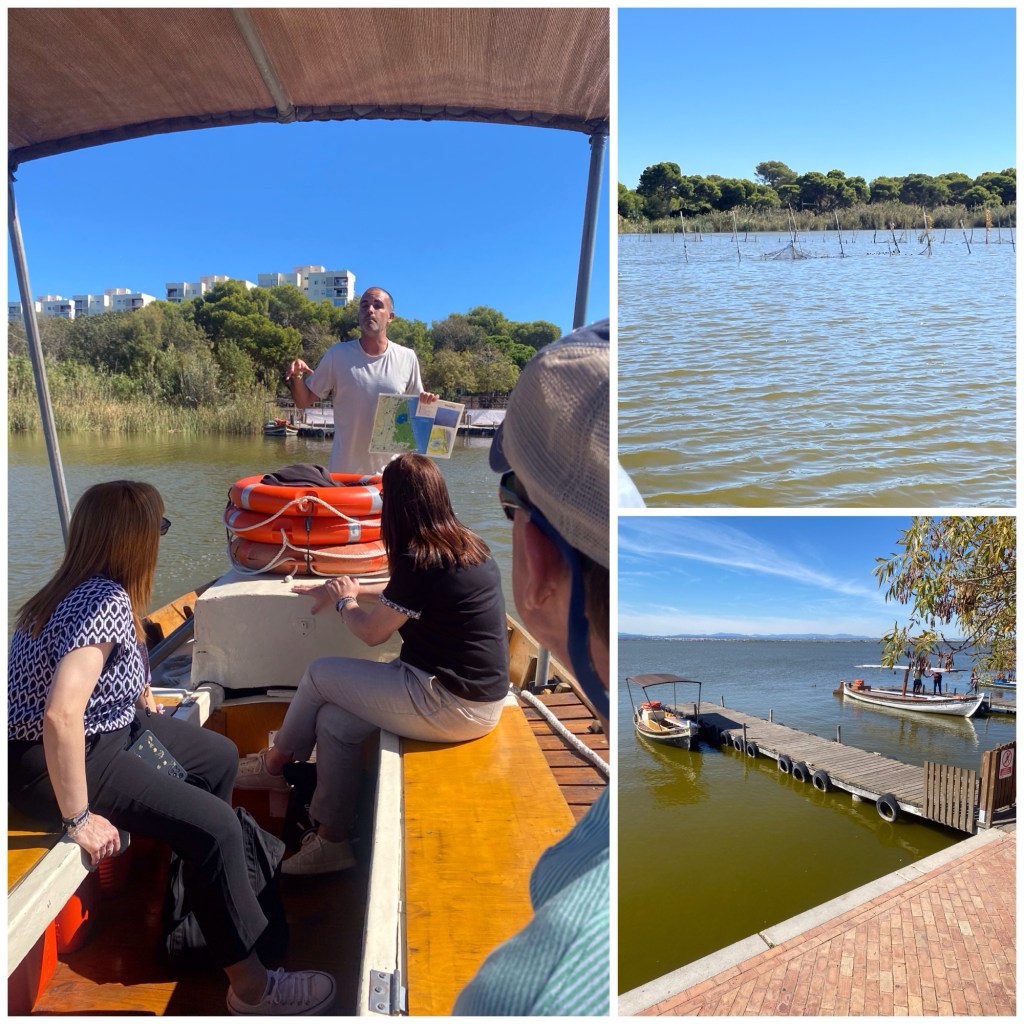
Lots of good information written in multiple languages. Our boatman also spoke English and told us the lagoon is now polluted even though fisherman still work the nets, it’s a meter deep, that it is flushed from time to time into the ocean. We wandered through narrow channel and chased the mallards and moorhens out of our way.

Then it was time. With some trepidation we led our friends to a restaurant with a good reputation and good reviews, El Rek. https://www.arroceriaelrek.com/ The sight of a bus load of tourists coming out of the huge restaurant as we went in was not encouraging. Uh-oh, tourist trap? Well, at least they were Spanish tourists.
Once in the restaurant we were encouraged to see several long tables of locals, dressed for a celebration, enjoying their meal. Very promising.
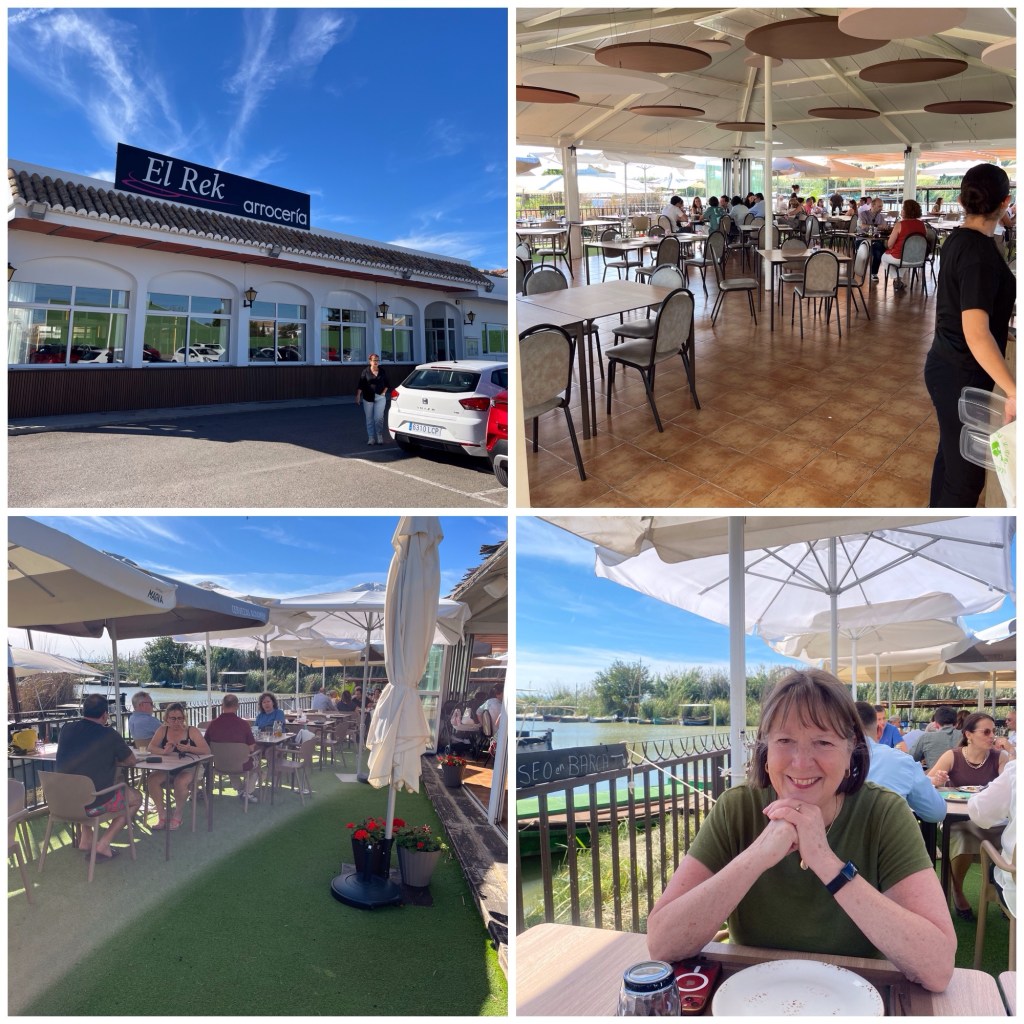
The waiter asked us as we walked in “Did we order the paella in advance.” “No.” I said. “No worries.” he said. When we looked at the menu, it said, in Spanish, “If not ordered in advance, the paella will take an hour.” Very, very promising.
When we looked at the menu (on our phones from a QR code like many restaurants we have been in here), the first paella listed was the traditional Valencia paella—rabbit and chicken. Yes, there were variants, including a version with local snails (not escargot) several seafood versions. The smallest size was for two people.
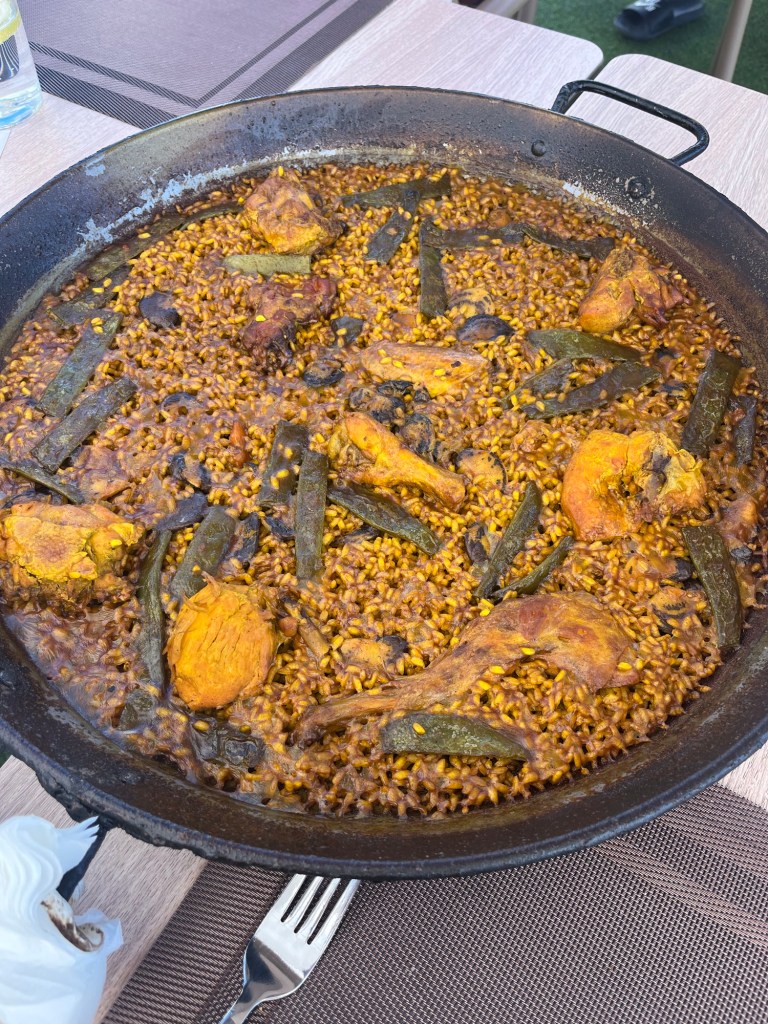
We ordered a bottle of white wine and the house green salad to sustain us as we waited the one hour for our traditional chicken and rabbit paella and the seafood in shells version. Maybe 45 minutes later the long-anticipated paellas were placed in front of us.
Paella is really all about the rice. The mark of a good paella, we have been told, is the crispy, deeply brown edges. And it is generally eaten communally, with a spoon from the cooking pan — in fact, paella means pan in Spanish — and we saw locals scraping every last morsel of rice from the pan. We opted for serving spoons and separate plates. American style, perhaps?
The chicken and rabbit version came with a few mature fava and romano beans. Less meat and fewer vegetables than what I have been served at home. Rice was cooked through, but not the least bit mushy, obviously enhanced by a very rich stock. No sweet red peppers, or chunks of ham, pork or decorative peas. But tasty. Very tasty.
The fish version fell into the same category as our first sample of authentic bouillabaisse. If you like canned sardines and anchovies, you might like it. A bit fishy for us. The shellfish was a bit overdone and underwhelming. However, we have to acknowledge, coming from the Pacific Northwest, catching our own crab, salmon, and shrimp, we’re spoiled when it comes to seafood.
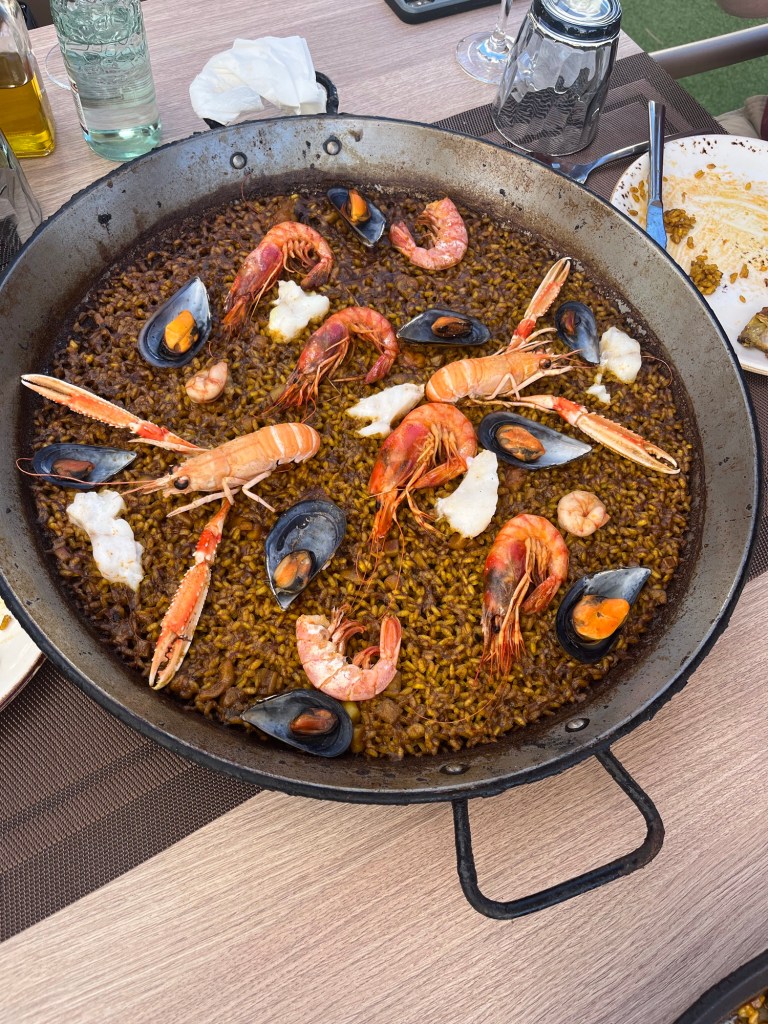
Still, we ate every bit. We concluded that traditional version is really the way to go.
And did the paella, prepared and served in the traditional way with the traditional ingredients using the locally grown rice in the town that originated the dish, live up to its reputation? The answer is a resounding “Si!”

 Chasing the Good Life
Fun and yum
Leslie
LikeLike
That pre-cooked seafood looks like a compromise to ease in mass production. As you know very well, adding the seafood near the end takes focus to not overcook. They have access to fresh, so can’t think of another reason to not cook it in the juices as they subside.
LikeLike