
A friend told us he and his partner, experienced travelers, no longer were interested in the “A” sights — sort of been there, done that. We agree. Generally major tourist sights are “A” listed for very good reasons — they are amazing and should be seen at least once. The Eiffel Tower, Big Ben, the Colosseum, the Great Wall, the Alhambra, the Kremlin or Sagrada Familia! And they are also usually mobbed with other tourists.

After visiting those gems, we now are looking for the quieter corners. Less visited, but special in a different way.
That’s why we chose the Valencia region of Spain. Lots of “B” sites, plenty of history, and beautiful country.
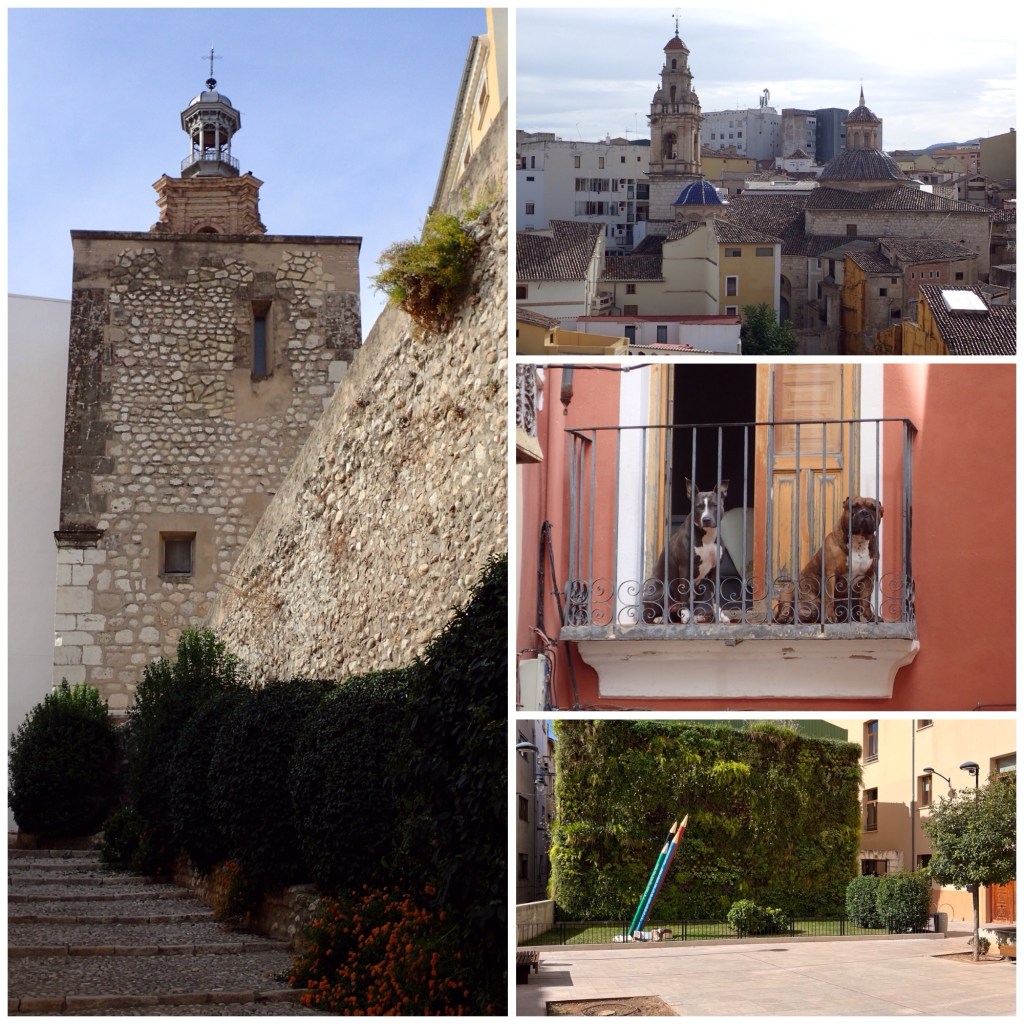
Case in point: Ontinyent (in Valencian) or Onteniente (in Spanish), our home town, in the midst of the La Valle d’Albraida, has a historic medieval quarter built on the streets created by the Moors. Narrow passage ways that bend and curve and end. A good morning walk.
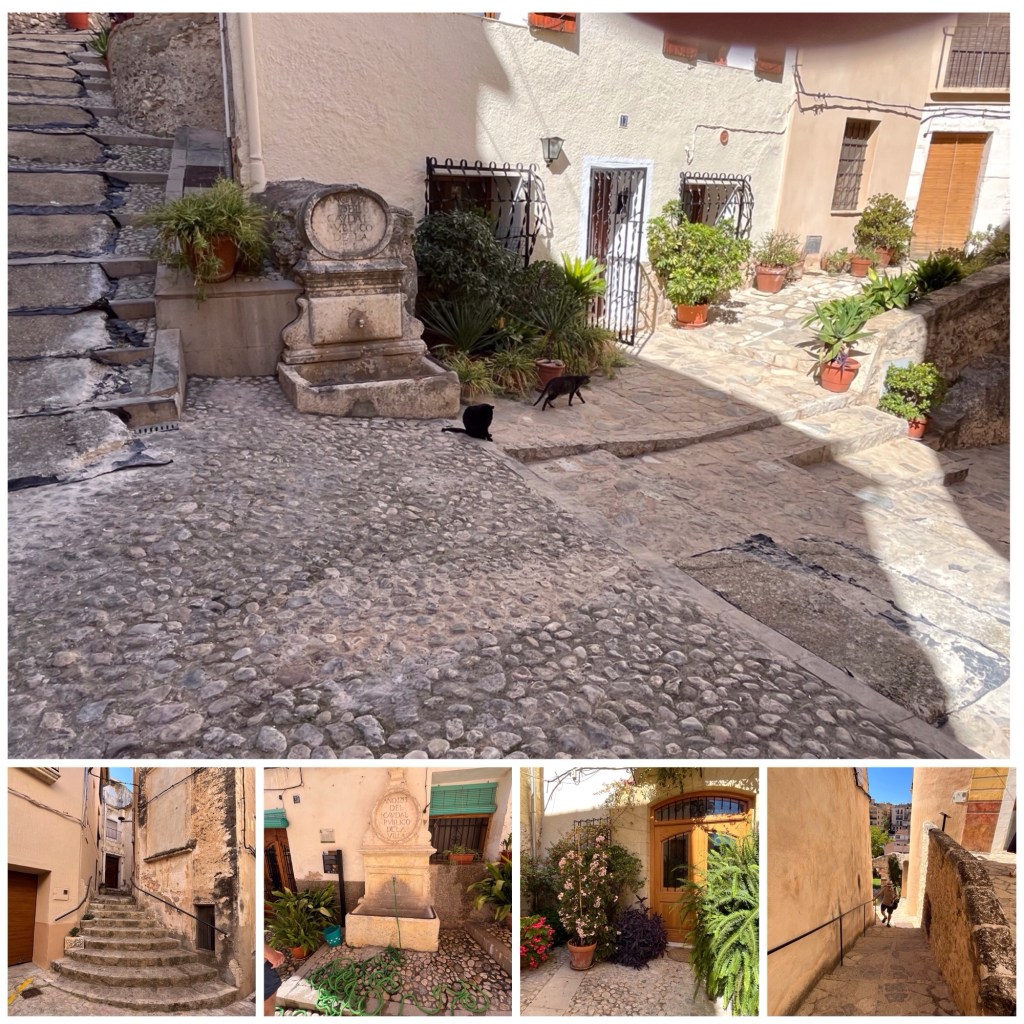
Maybe twenty minutes away is the small town of Bocairent. We walked the old quarter, following a map of late eighteenth century fountains. Many are still used today and most have a tile plaques providing details. Through the gaps between the buildings we could see into the valley and across to the caves. They were apparently used by Moors for storing grain centuries ago. We did not tour the caves as the tourist information official told us, we would have to “walk like cats and dogs” to see the caves.
Not much further away was the town of Requena, the heart of the local wine industry, primarily from a grape largely unknown at home, bobal. Wine has been grown in this region since the seventh century. We wound up at a winery recommended by a friend, Murviedro. A tasting there included a tour of the network of caves, used centuries ago for storing wine, olive oil and other goods. Once connected to houses above, when the houses were demolished to create a square, the caves were forgotten until recently rediscovered. It was an unusual setting for a wine tasting. We ended up with eight bottles of wine, including the four “young” bottles that were included in the price of the tasting (reservations recommended). All very drinkable.

Another nearby town, Villena, with its Atalaya Castle, made clear the Moorish influence on the region. Built in the Twelfth century as a fortress against the Christian invasion, it was used in subsequent centuries as a gift for royal favorites, a safe haven in times of turmoil, and ultimately a prison (complete with graffiti from priests, captured in the 18th and 19th century wars). Good information posted on each floor as we climbed to the top. Really well done. Today the town appears to be going through a renaissance with the old Moorish style homes being refurbished and jazzed up.

We saved the best for our last day in the region. We didn’t have a lot of time so we picked one of the closer towns, Albaida. We followed our GPS right to the main square in front of the church. It looked like a pretty sleepy place on the Day of Spain holiday.

Peter found an open door and was invited in. Turns out this was a school for the bell ringers. Kids as young as six began learning the craft and that’s part of the reason why bell ringing at Albaida’s church is a UNESCO Heritage activity, continuously practiced in the traditional way — by hand — for 800 years. Other towns may hand ring their bells on special occasions or mechanically mark the hours of the day. Not Albaida. Every day, every hour and every quarter hour from morning to night, they ring the bells by hand.
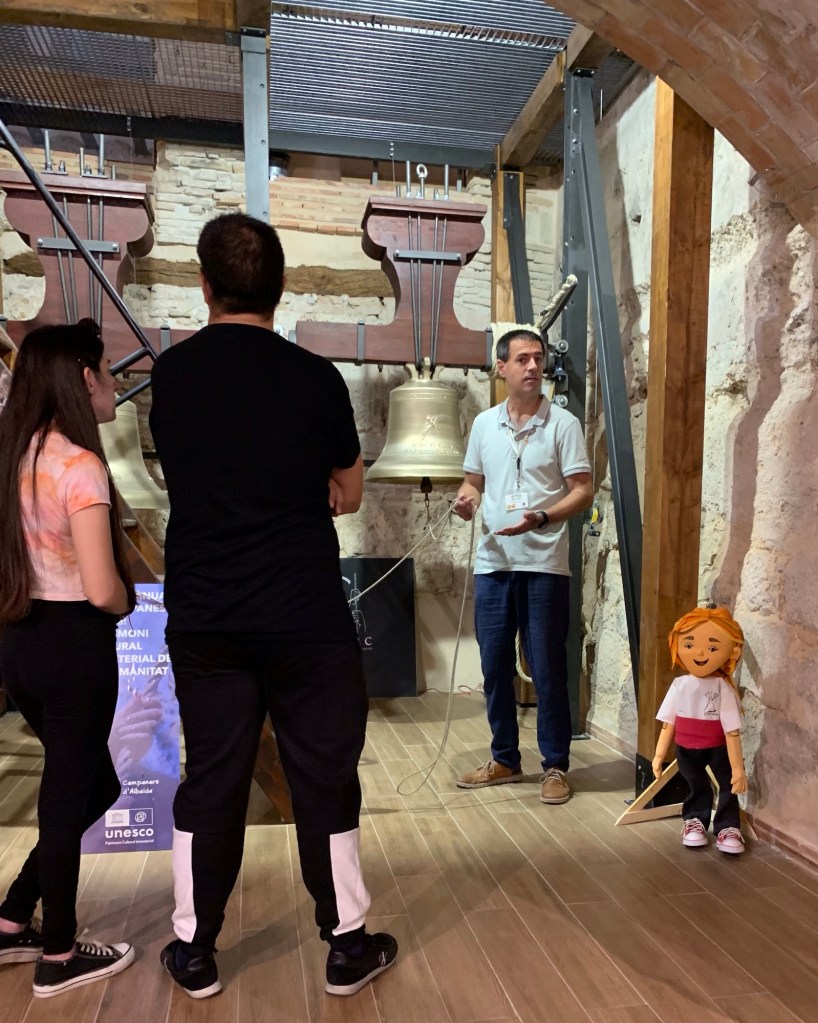
We were invited to try ringing the learner bells ourselves and then got to climb to the top of the tower to hear the real thing! I lost count of the steps — there were a lot. We — four Americans and a handful of locals — gathered beneath the bells and waited. One of the young men in the group, and a stylish grandmother both chipped into help the guide explain things in English to us Americans. Typical of the response we get from locals here — pleased to help us and slightly surprised we Americans chose their community for our holiday.
Finally, using the ropes that extended to the ground floor the bells began to move. Unbelievable sound! Three slow, loud gongs followed by a song of bells. We never saw the woman who rang the bells that day!
It’s these little things — finding hidden treasures that sometimes just locals know about, chance encounters with people who offer an insiders perspective, and a chance to see things seeing up close and personal. It keeps us coming back to the small places. Onteniente, Bocairent, Requena, Villena, Albaida—these are on no ones “A” list, but are still little gems.

 Chasing the Good Life
Indeed, the lesser sites offer such rich windows into the stories of people. How they have lived, and how they live today. What they have accomplished, and what they are doing now.
Y’all (vosotros en castellano) clearly were already well on your way to being B or C list travelers or explorers before my little tour. I am so delighted that you’ve shared these experiences as I haven’t yet made it to many of these delightful towns. As our man Rick Steves says, you are exploring Europe through the back door.
LikeLike
You really need to get down to that little corner of Valencia. And if you make it down there, please go for lunch at Casa de Tio David in Alfafarra (sp?). Mentioned in Michelin, deservedly so and just a charming family run place with some of the best food we have had. And thank you again for your company in Valencia and that wonderful tour. I do hope we can connect when you are in Seattle.
LikeLiked by 1 person
Well, I certainly need to visit a place called Tío David. 😂 Hope to see you in Seattle next month!
LikeLike