“That’s so Valencia!”

Almost two months into our stay here in Valencia, we’ve come across a few quirks or idiosyncrasies of the city.  Mostly small things but big surprises.  

Beer!  Despite being a huge wine producing region in a huge wine producing country,  Valencians drink beer.  Walk by any outdoor table on any afternoon or evening and you’ll see almost exclusively beer.  In bottles, in glasses, in mugs.  Yes, maybe a glass of wine or two, but beer is king.

Cooking in the streets! The city has hundreds of neighborhood social clubs (Falla clubs) that prepare all year for the March Fallas festival.  They each have a social hall that opens onto the street. Apparently, anything is an excuse to party and close off the street. 1/2 year to the next Fallas. Party.  Valencia Independence Day. Party. A local girl wins the Fallera beauty contest. Party.  Paella is required. It has to be cooked the traditional way—on an open wood fire in the middle of the street.  And snacks to nibble on?  Chips, olives, pickles.  And beer, of course. No fancy tapas here. 

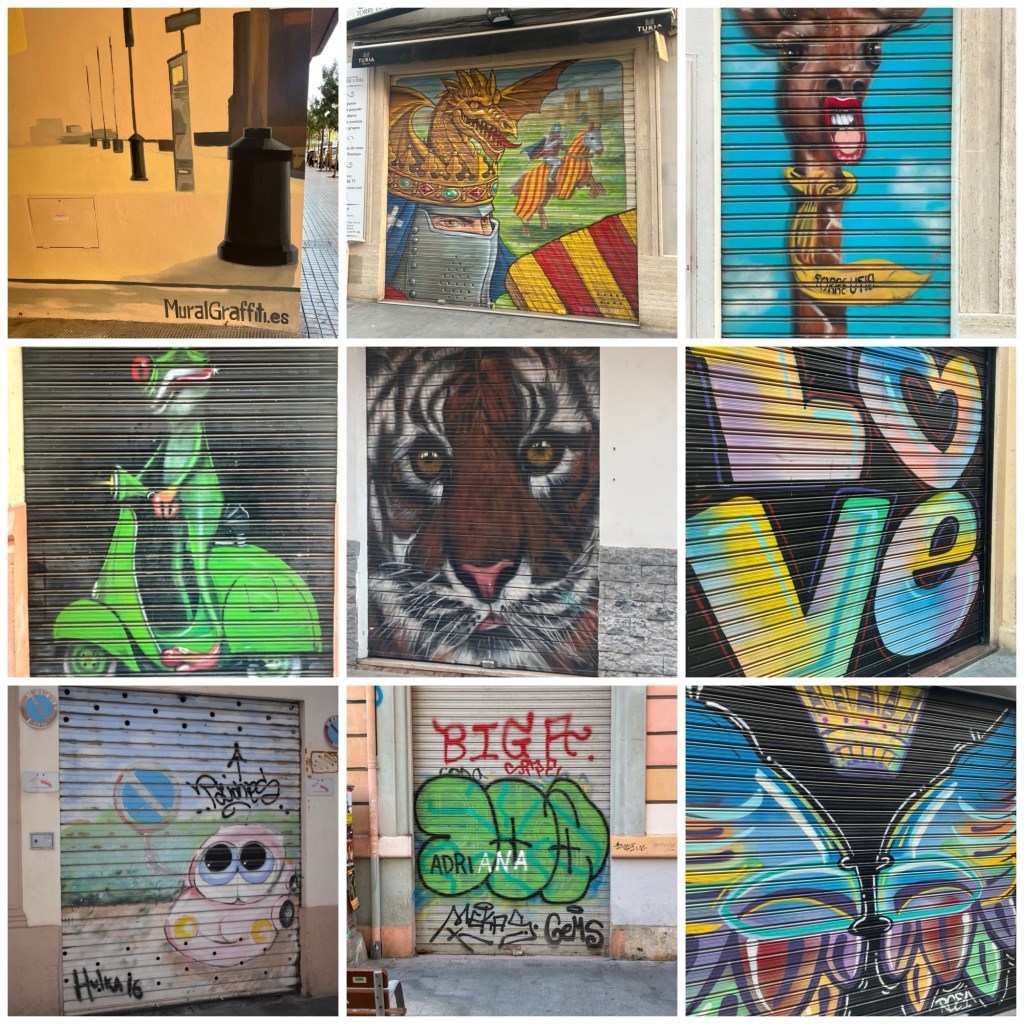
Grafitti doors!  Lots of grafitti on the metal pull down garage and store front doors.  Some are very artistic and beautiful—probably professionally done.  Others not so much.  But it’s on doors everywhere. And interestingly, very little graffiti anywhere else here in Ruzafa—although we have seen quite a bit in other neighborhoods (some called for provincial president’s resignation) and in the center of old town some anti-tourist grafitti.

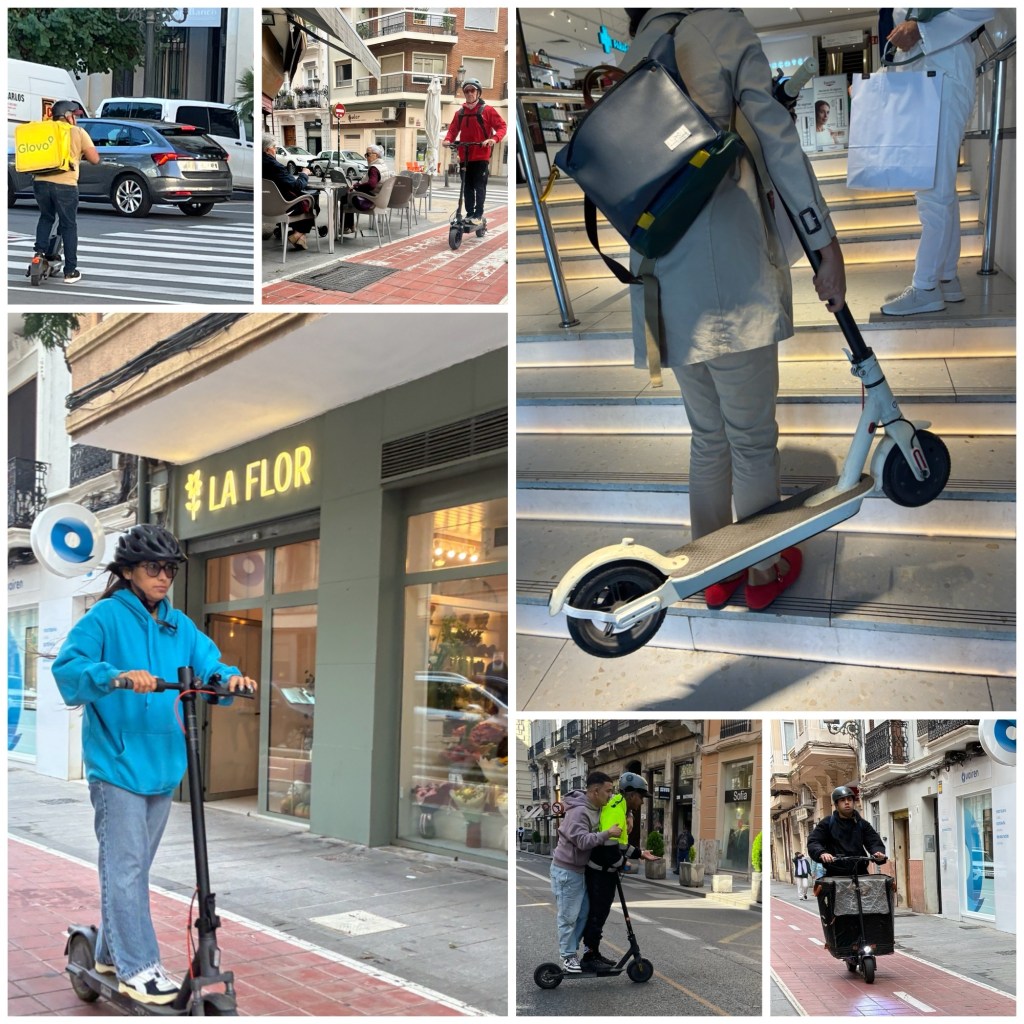
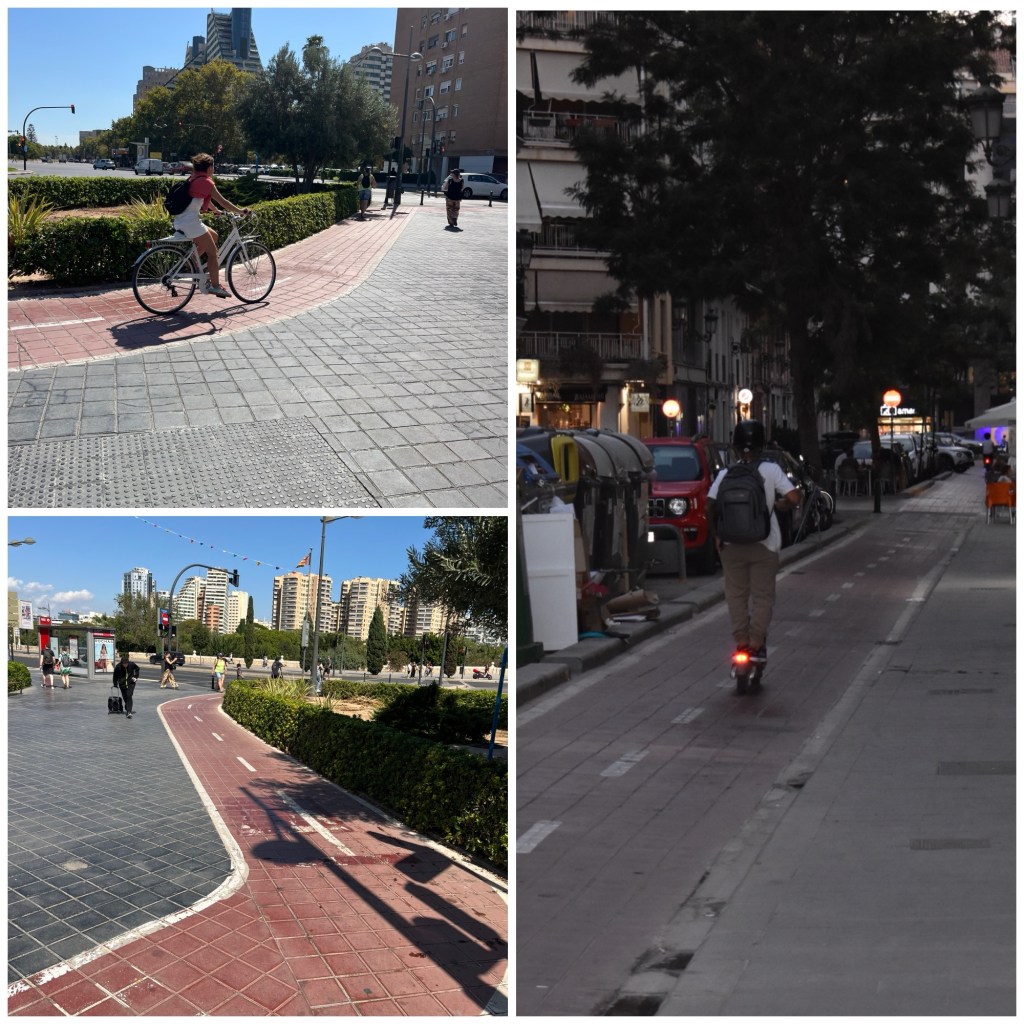
Scooters, skate boards, motorized unicycles!  They are a huge part of the transportation scene.  And all ages use them—not just young people.  The scooters travel quietly at warp speeds—they are a real menace for pedestrians.  The city is flat, very car unfriendly, has special red bike lanes everywhere (which the scooters use), and the weather is good all year long. So it’s a great, inexpensive (if dangerous) solution to getting around. We followed well dressed woman as she carried her scooter into the big department store. We watched a middle aged guy come out of his big yacht at the marina and fly off on his scooter.  Away he goes!  

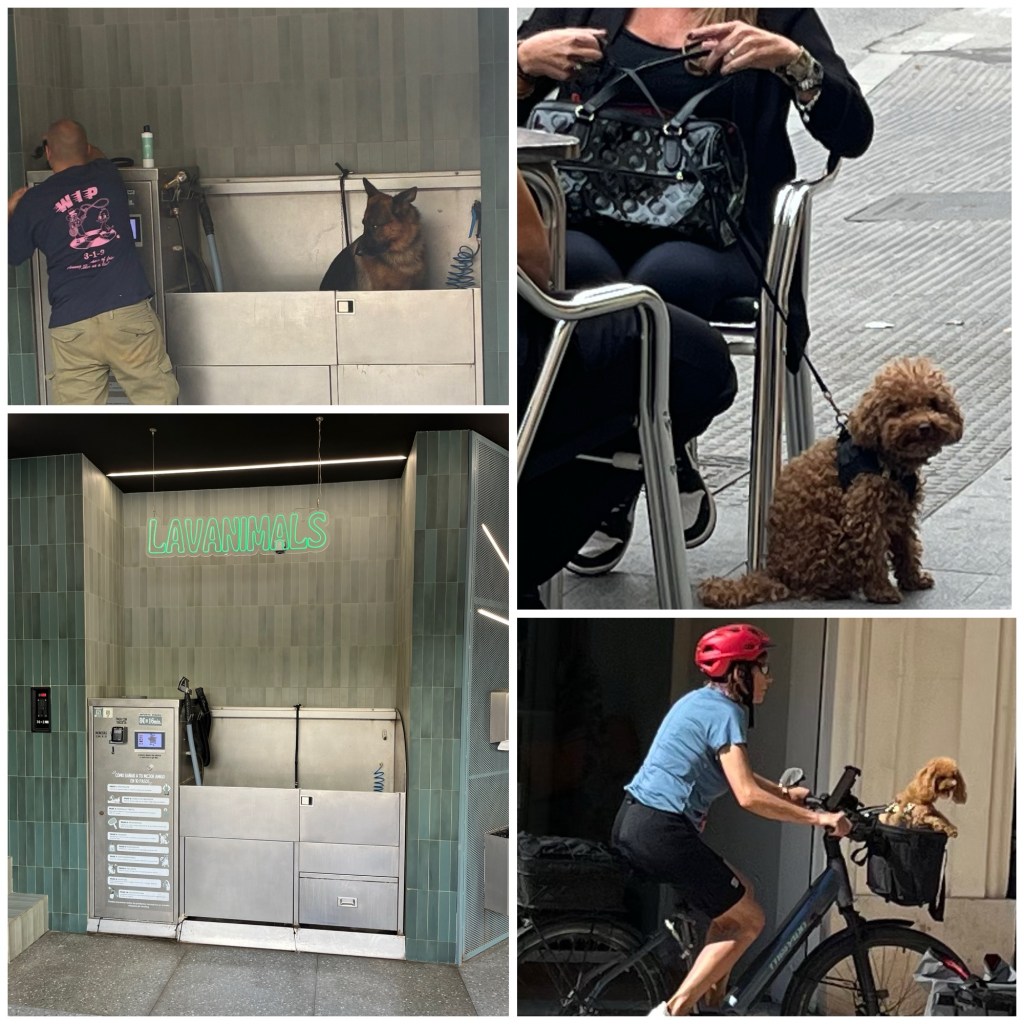
Dog washing laundromats! There are doggy laundromats for your dogs, your doggy blankets, and doggy paraphernalia.  It’s a good business  because everybody has a dog.  One of our first nights here we ate dinner with five dogs. One breed, a kind of miniature labradoodle, is Valencia’s  dog of choice. Cute little fellow seen everywhere.  

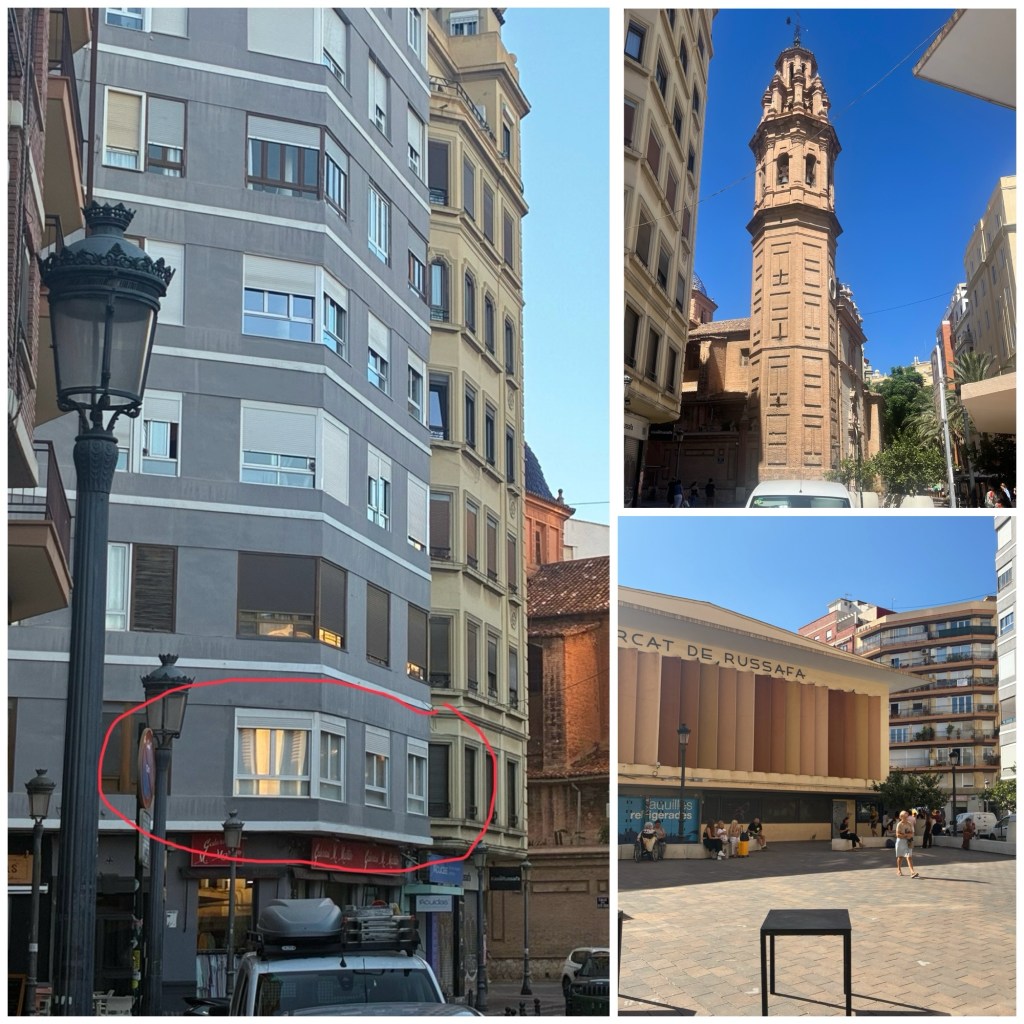
Street names! They usually change after three or four blocks. Very few names seem to last the entire length of a street.  We have friends who live on Literat Azorin which becomes Reina na Maria and finally Pere III el Gran.  The street is 12 blocks long. This is the case everywhere in the city. No wonder cabbies look at you quizzically when you give them a street name.  Better to use a landmark like a Mercado. 

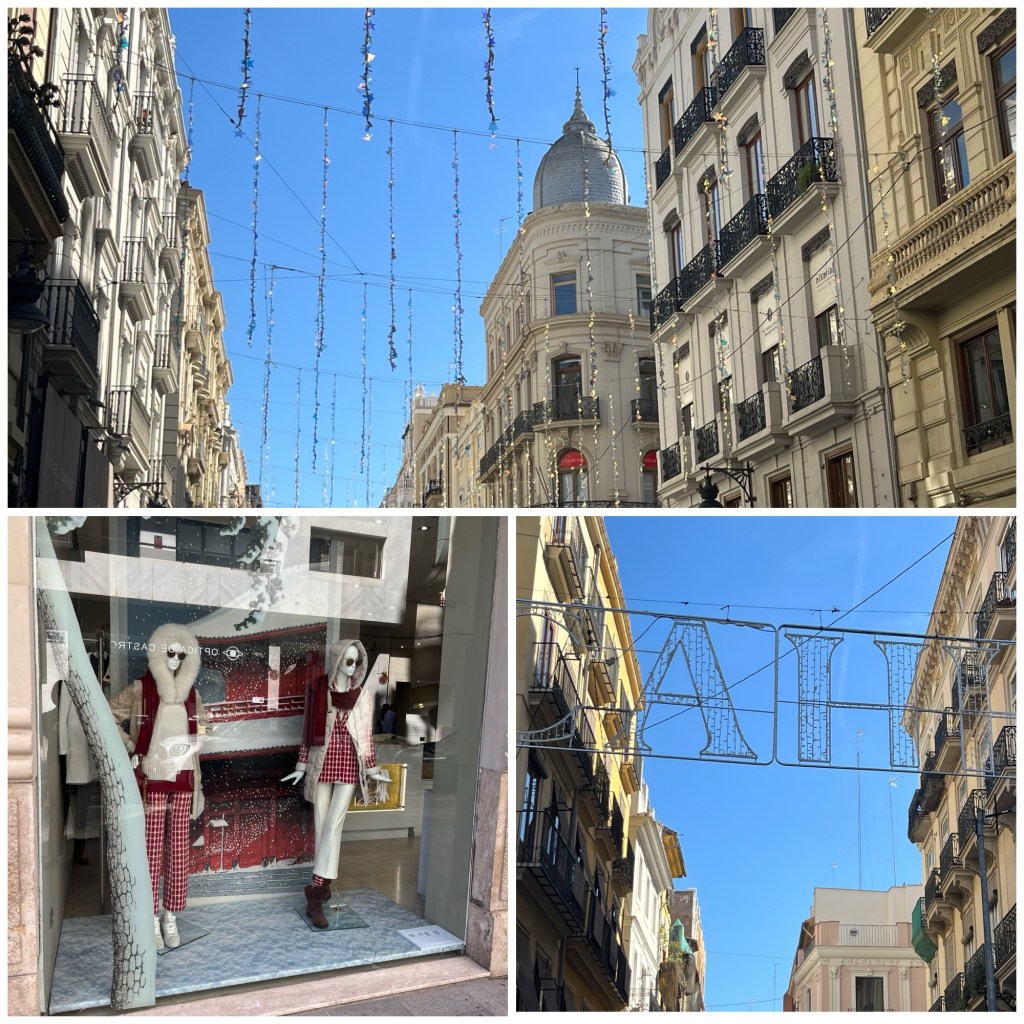
Merry Christmas! In the middle of October, the street decorations are starting to appear.  It’s not the retail shops because they still have up Halloween decorations. Christmas starts early, and ends 12 days after Christmas with the arrival by boat of the Three Kings.  That’s the big day! A present or two may be exchanged Christmas Day, but the real celebration comes on Three Kings day.  Just imagine!  The holiday season here spans nearly three months! American retailers—eat your hearts out.

Black Friday sales! But they are not necessarily on Friday.  And they happen frequently.  And there’s no Thanksgiving Day for the sale to follow.  Apparently Valencia has stolen the term and uses it indiscriminately to advertise big sales

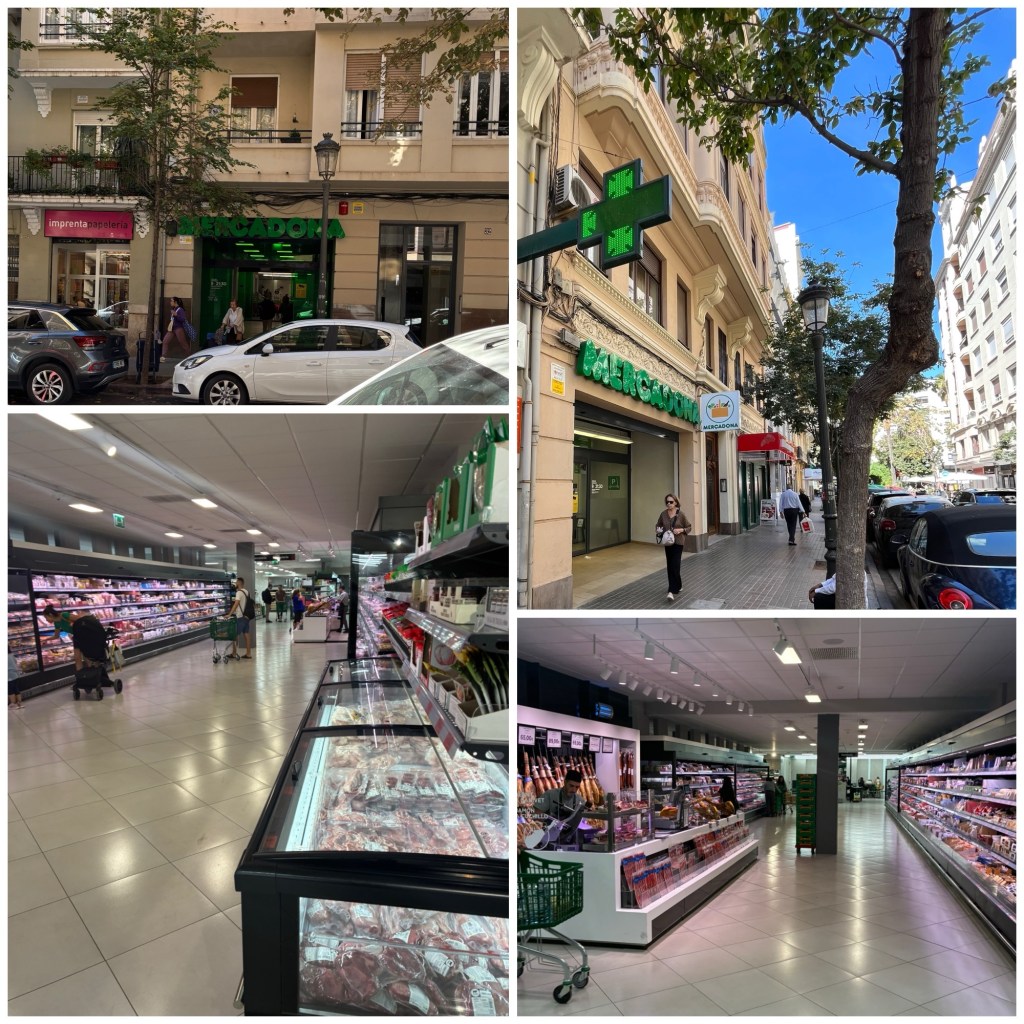
Small doors, big stores!  Our two largest supermarkets, comparable to big American supermarkets, have two small doors—one on either side of a city block.  A tiny sign over each entrance says Consum or Mercadona. Once you get in, the space is enormous and often snakes around in a warren of different halls and rooms.  The stores literally take up a good portion of the interior of the city block.  Usually there is underground parking as well.  But good luck finding it.
We’ve gotten used the these quirks.  And we suspect if we stayed here longer and were a bit less transient, we would find more.  As one of our local friends said when we were turned away from a government building when it was supposedly open, “That’s so Spanish.” We would add, “That’s so Valencia.”


Restaurant-topia!  

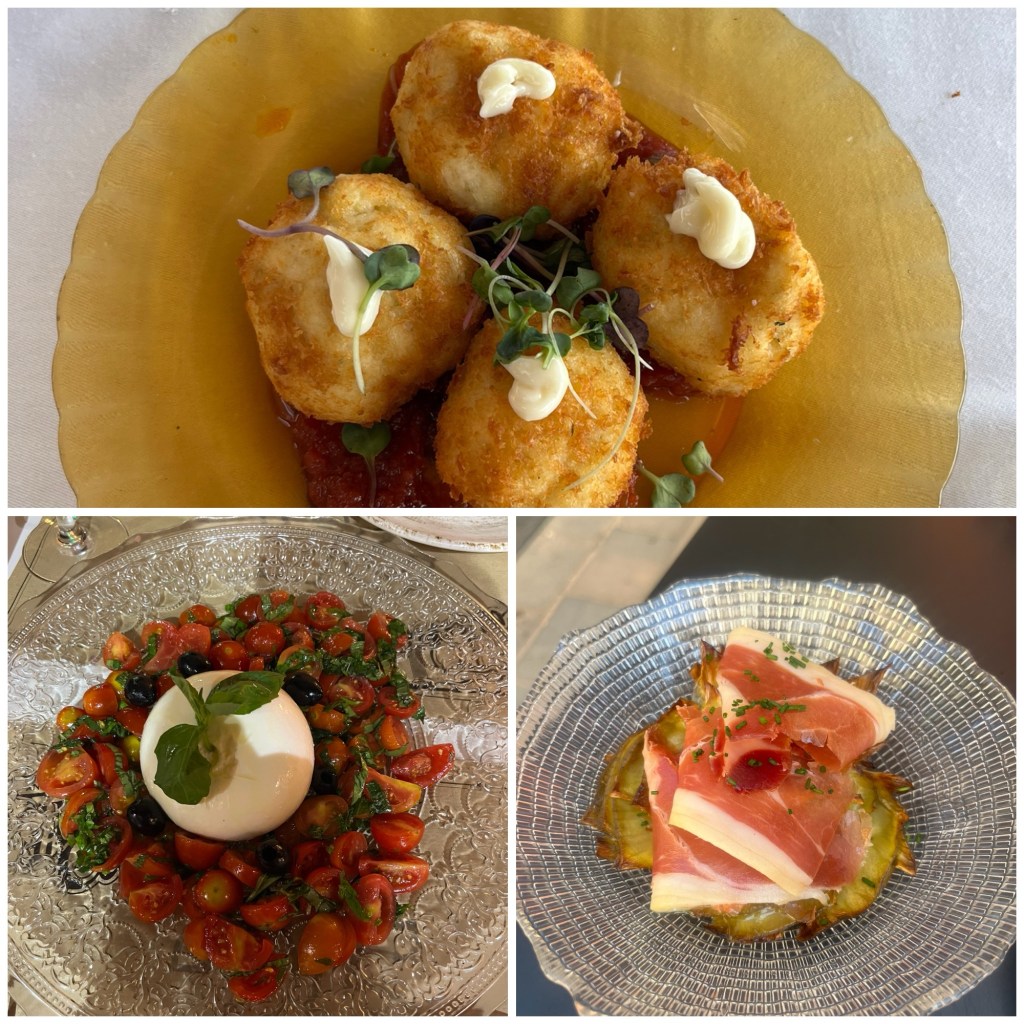
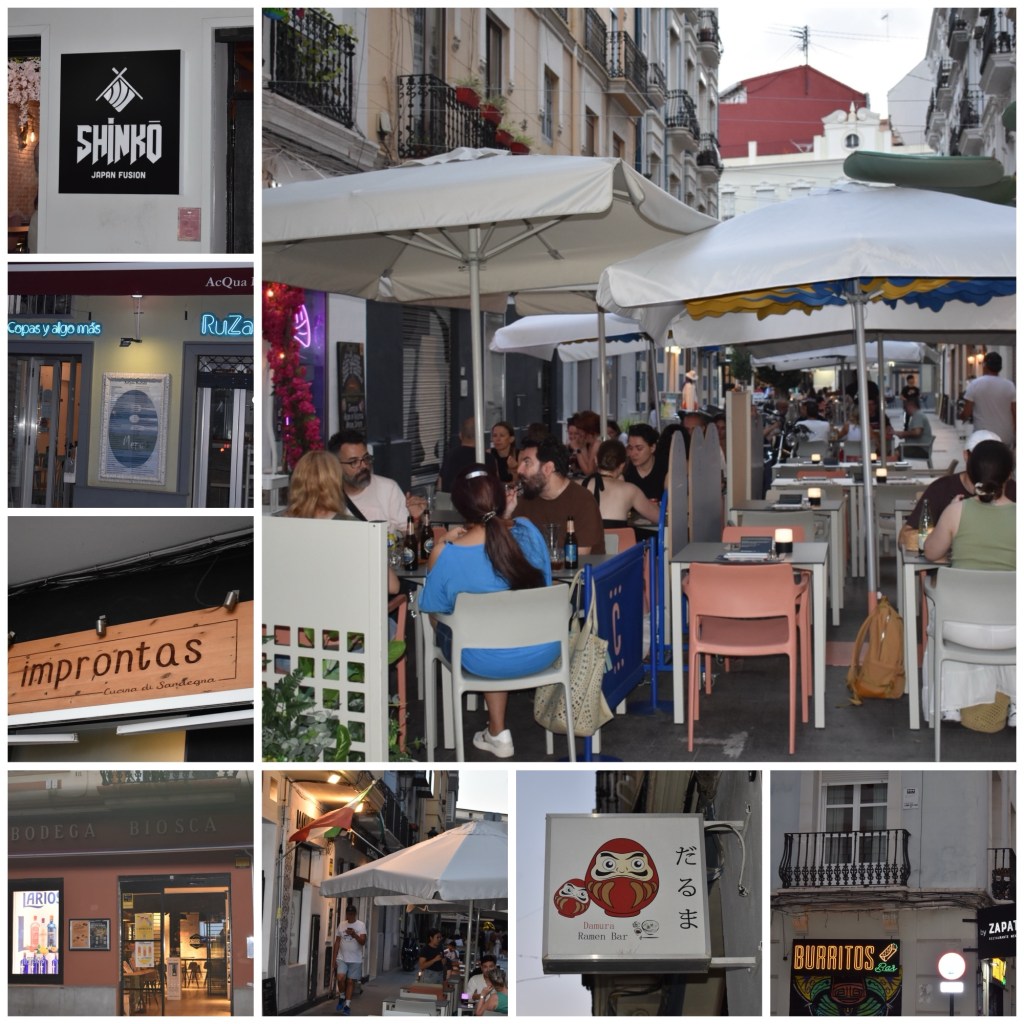
We are in a restaurant paradise. Ruzafa, Valencia.  Can’t think of a place we’ve been that has a better variety and greater density of eating places.  Nothing we’ve experienced compares to this place for sheer volume, quality and price. In an unremarkable stretch of three blocks near our apartment, we counted twenty-five restaurants and bars. And the variety is crazy.  We’ve eaten Sardinian, Sicilian, generic Italian, Georgian (the country, not the state), Irish, Moroccan, French, Japanese, Asian fusion, Lebanese, Turkish.  And, of course, Spanish—Valencian, Basque, Andalusian, Galician, Castilian.

Sardinian prawns with arugula and a ravioli-like dumpling with sage

We could live in this neighborhood for ten years and not exhaust all our restaurant choices. At one naive moment we thought we would count all the restaurants in the Ruzafa — an area of about 3 square miles.  Foolish and impossible idea.  We do have a friend here who maintains an annotated map of her top restaurants in the neighborhood, currently at 37. We need to start our own list.

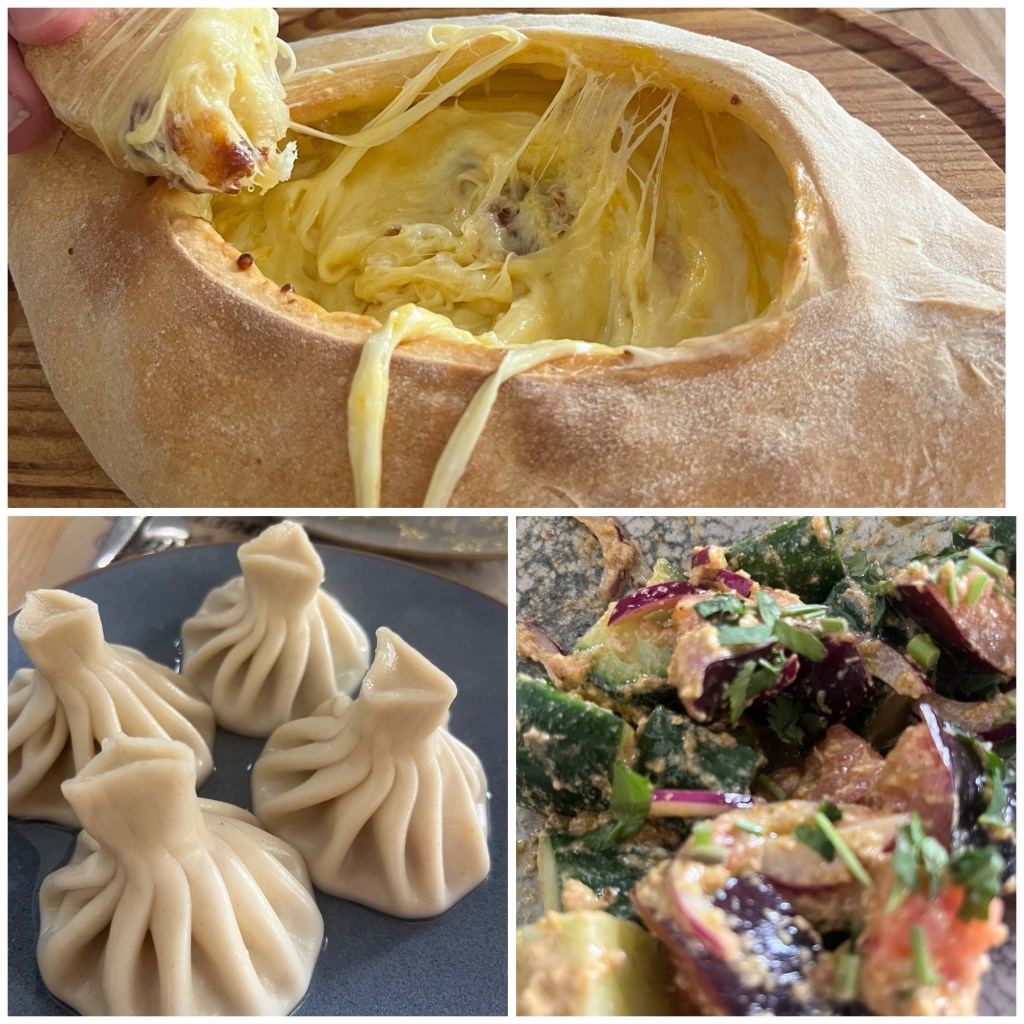
A Georgian meal at Batumi

So what’s the deal with all the restaurants?

What creates this incredible density of eating places?

We are trying to figure all this out. We have some thoughts.

Ruzafa is NOT tourist central.  There are tourist traps and international big name chains in the old historic part town where all the major sights are — McDonalds, Burger King, Starbucks and HardRock. In tourist central, the signs outside are often in English.  They hawk the Spanish tourist favorites—PAELLA, TAPAS, SANGRIA! But in Ruzafa, not so much. It’s not tourists that keep these restaurants hopping.  These are small, locally owned places. The restaurants depend on return customers, not volume, and the price has to be right. We’ve sung the praises of the prices here—everything is dirt cheap by comparison to the US and Northern Europe. A good red wine last night at an outstanding Moroccan restaurant was 2.50€ a glass. Crazy! And the quality has to be really good with so many options to choose from.

Ruzafa is also diverse with lots of immigrants and expats. So many nationalities. So many different cuisines. Another lure to diners.

A bit of Italian influence with pesto on baby squid

But still, why so many restaurants in such a small neighborhood?

Is it that Ruzafa is reputed to be “hip and trendy”? Attractive to those looking for a lively, fun area to dine. Near enough to historic center for those adventurous tourists willing to take a hike. And also walking distance from neighborhoods of upscale apartments and neighborhoods of hundreds, maybe thousands, of mid-century high rise apartments. That helps fill restaurant seats.

It’s also a real neighborhood where locals stay close to home to hang with their families and friends.  In Ruzafa itself, lots of street level space for restaurants and shops, and customers living in the apartments above.

Ruzafa was a run down neighborhood a few decades ago. In a pattern many cities have seen, in moved the artists looking for cheap space. The gay community found a home here, too. Pretty soon the bohemian vibe brought in small bars and restaurants. And “suddenly” it’s hip and trendy corner of Valencia. We’ve been told rents here for commercial properties remain relatively low. So the take-away kebab places stand next to Michelin star restaurants. Both benefitting from low rent. It’s definitely a mixed up jumble of high end, low brow and everything in between.

A pretty modest Peruvian restaurant — chicken and rice, fried fish with beans, a ceviche salad and Peruvian corn nuts

Like many European cities, particularly in the south, Valencia has an outdoor culture.  People live in the streets. And that is certainly apparent in Ruzafa.  The street corners are often cut-outs like in the L’Eixample in Barcelona, creating more space for outside dining. 

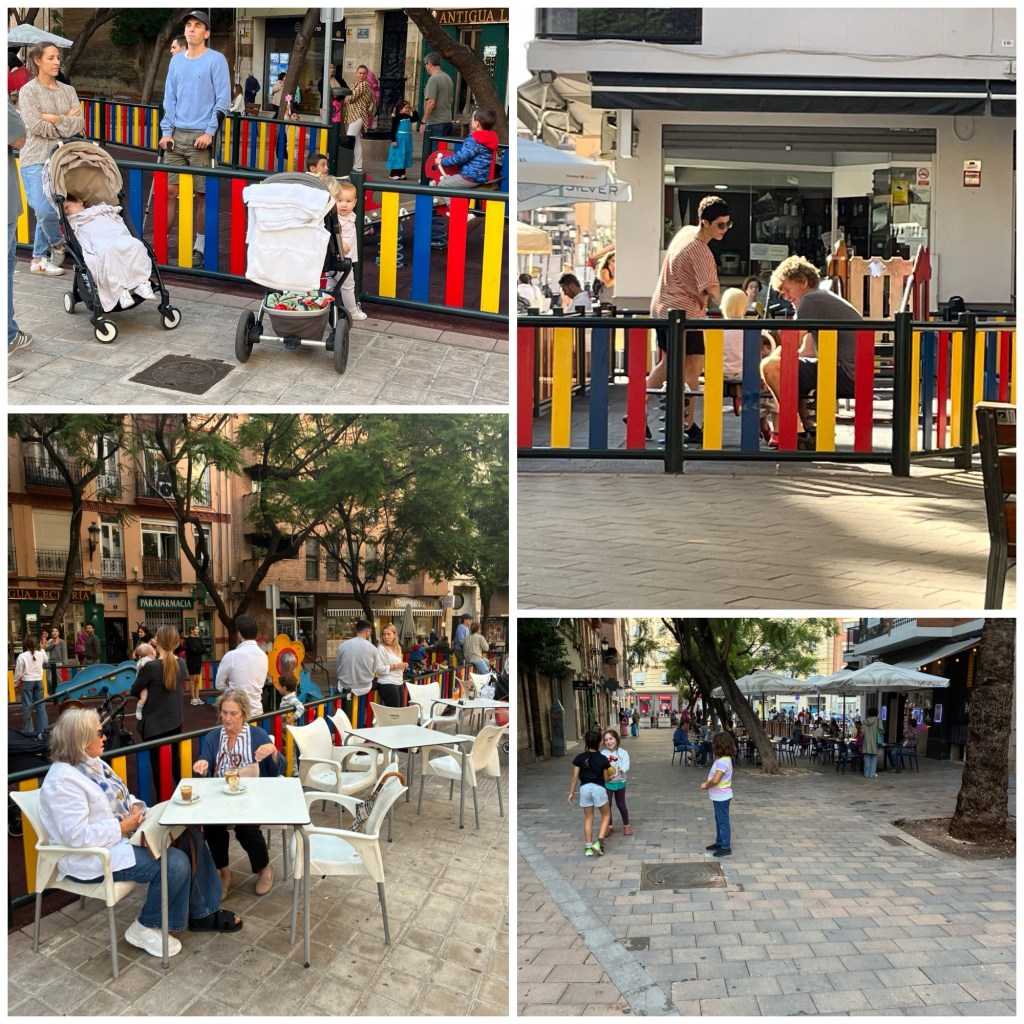
Many of the restaurants have only five or six tables inside and another five or six outside. Families or friends shove the tables together and hang out for hours, drinking beer, wine and spritzers — often with a play area for the kids in sight of the tables.

With only a few tables, one seating a night, you’d think these restaurants couldn’t possibly survive.  And yet they seem to flourish.  We thought when we first arrived and saw all the restaurants we could just wander out at night and grab a table.  Not so.  You need reservations almost anywhere other than the most casual places on a weekend night, and, by the way, the weekend here seems to include Thursdays and Sundays.

And then there is the quality of the food. Another draw. The restaurants rely on local ingredients.  A short bus ride outside the urban center takes you past small truck farms that nudge up against the city high rises. The government and to some extent the EU subsidize the local farmers keeping quality high and prices low.

An Asian fusion meal of noodles and dumplings

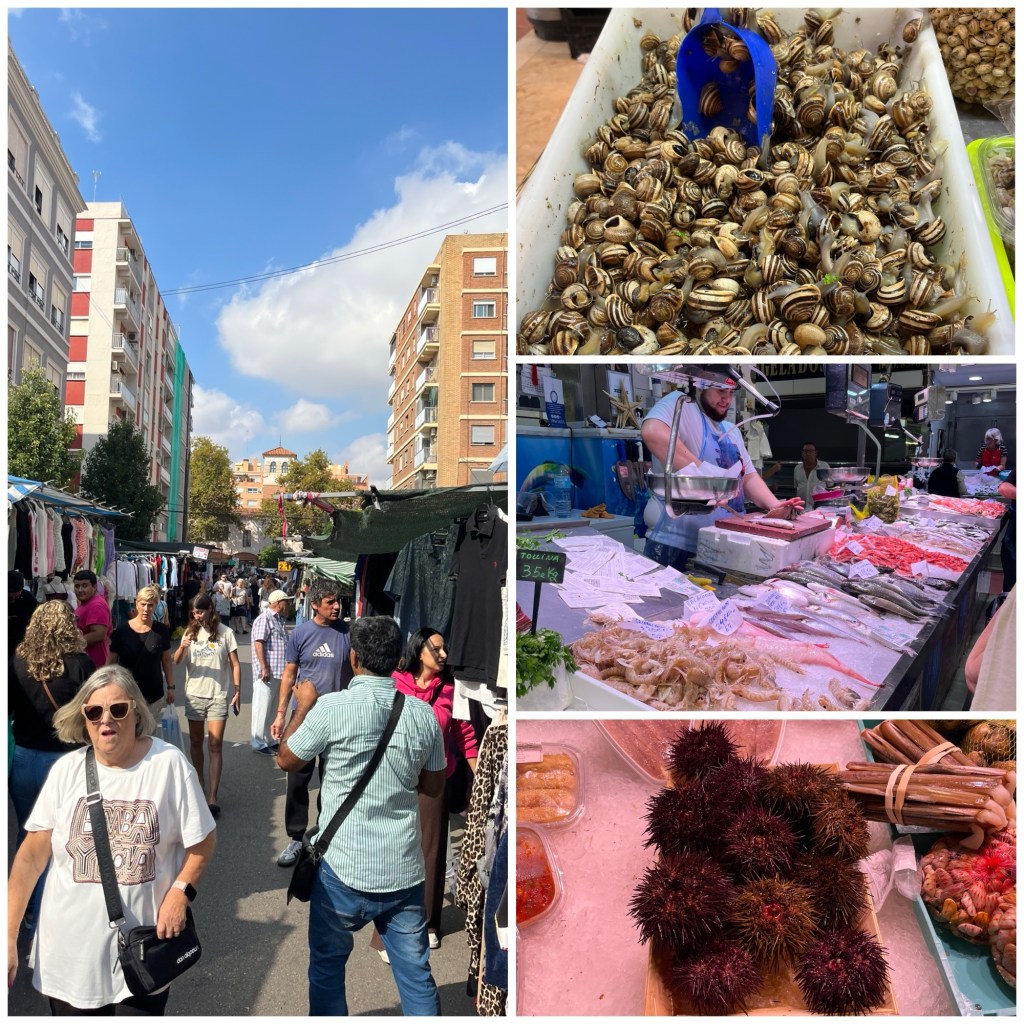
Across from our apartment in the Mercado, there are 29 butcher and charcuterie shops.  Twenty-nine!  19 fish stalls!  Everything is fresh.  We asked at one stall for oranges.  Come back in 10 days or two weeks and the local oranges will be in, the lady said.  Maybe that’s why most restaurants change their menus with the seasons. And, in some cases, like our local osteria, the menu changes every day depending on what the chef finds that day.

Does good seasonal food keep folks coming back? Is that enough to keep all these places going?

We don’t really know.  We’re here for two months, with several weeks to go.  So we still have time to try to answer the question, ask our expat friends for more information and formulate more theories.  In the meantime, we’ll enjoy another meal out.

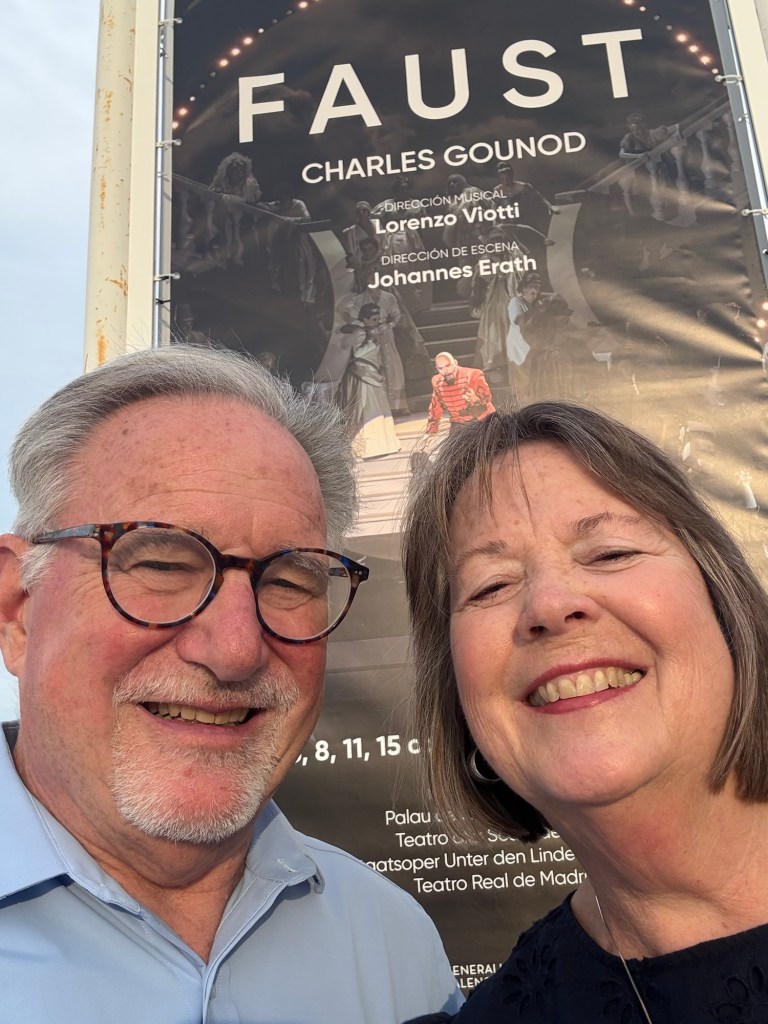
Crazy Ass Opera

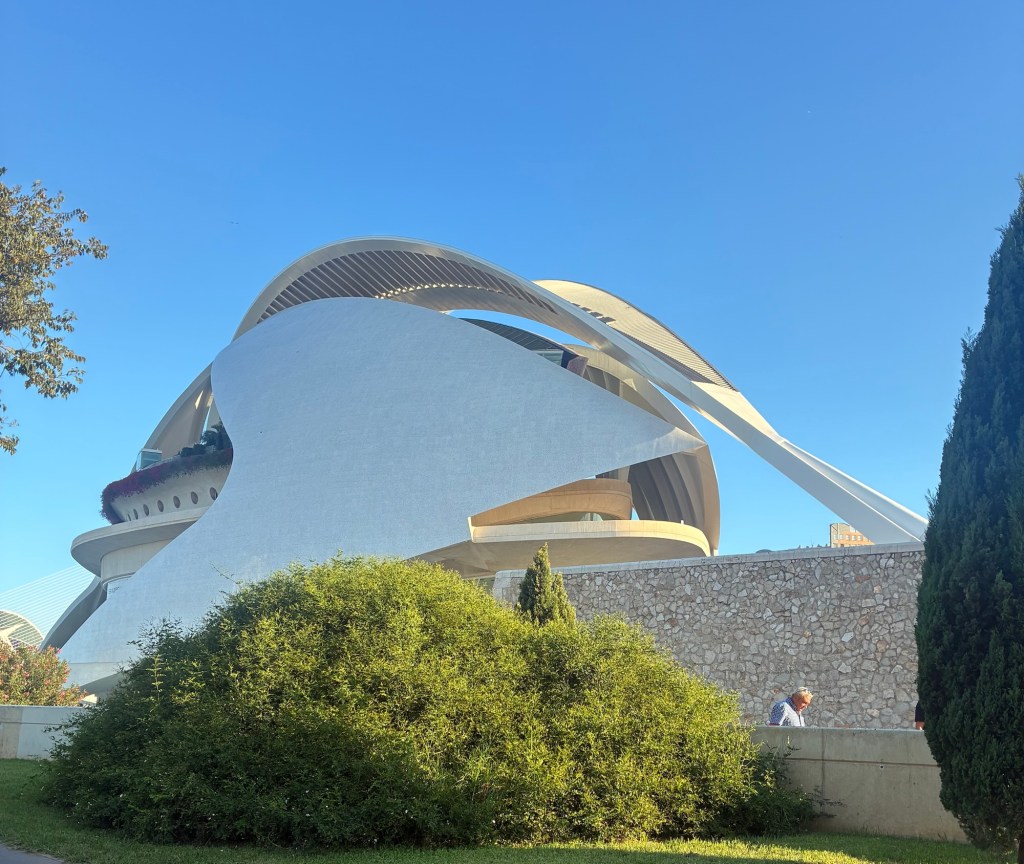
Valencia Opera House

OK. We’ve seen some weirdo versions of operas—“Carmen” with characters in 30’s Nazi outfits riding motorcycles, “Aida” where the triumphal march consisted of dozens trays of what looked like Oscars paraded around the stage, modern clothes and settings in Mozart operas, etc.  We understand the desire to make the old standards fresh and relevant.

But this version of “Faust” at the Valenica Opera House takes the cake. This “Faust”—the opera where Faust makes a pact with devil for youth and love — was absolutely bizarre. Beyond bizarre.

The set was largely made up of various circles ringed with flashing lights, images projected almost like holograms from time to time, boxes that moved from back of the stage. Lots of smoke machines, too. The colors were black and gray, mostly subdued with a few brightly lit objects like a staircase that appeared and disappeared.  Some of the effects were actually pretty amazing but we’re not sure how they tied into the opera.

Costuming, well, impossible  to say what the “era” was.  There was no “era”. Maybe lots of eras? A timeless setting? Perhaps. Lots of folks in whiteish outfits of various eras. Several of the female characters including Marguerite, the heroine, were dressed in white tutus and ballet slippers or wedding veils.  Faust wore a modified zoot suite most of the time.  Marte, the heroine’s neighbor and friend, appeared in what looked like a nun’s habit. Valentine, Marguerite’s brother, was in a white clown outfit complete with turned up slippers and a sequined cone shaped hat. 
Curtain call with “timeless” costuming, men on stilts and the lead singers!

The fair scene, Act II, took it to a new level of bizarre. Sequined people on stilts, circus barker outfits, lots of acrobats in gaudy tights somersaulting and back flipping around the stage.  There was a large wheel like those used in knife throwing carnival acts with doppelgänger of the heroine strapped to it.  From time to time, they spun it so she was upside down with her underwear showing under the tutu.

Then there were the flying tutu ladies suspended on trapezes in a later scene. And in another segment, giant black top hats appeared that covered all but the feet of the performers as they danced around. Why? Not clear. In the debauchery scene, suddenly three men in US navy outfits showed up to seduce the heroine.  Later they appeared with fake muscles tops to make them look sexier, we guess.  In the last act, Mephistopheles is dressed in a surgeon’s gown complete with bloody rubber gloves as a surgical gurney is rolled on to the stage with body on it.

If the costuming and sets weren’t enough, there was the over the top interpretation. Lots of apparently meaningful symbolism that was completely lost on us and maybe most of the audience. Maybe if we had program notes, or attended a pre-performance lecture, we might have had a better understanding.  Or not.  Of course, then there was the language barrier.  A Valencian production in a Spanish country of a French opera based on German play. What possibly could get lost in translation?

One character appeared on stage throughout the opera (he was actually sitting on stage before the opera started and the house lights dimmed)— but he never sang. He sat next to Faust during the opening scene.  Why?  Who knows.  Who was he? Who knows? In later scenes he died several times and literally lay there on the stage floor for long patches with the performers singing their arias while stepping over him or around him. He got a big applause at the curtain call.  

And then there were the doppelgängers.  The heroine and her brother, Valentine, had several performers dressed in exactly the same costumes who followed them around the stage—they weren’t singers—but you never knew who was actually singing. Sometimes they mouthed the arias with the singers. Why?  Who knows. But we’re sure it’s meaningful. 

And if this all wasn’t weird enough—the coup de grâce! At the end of Act IV, the building started shaking. There were huge, loud rumblings. We thought it was lightning storm.  There was no scheduled intermission but the house lights went on and the orchestra started to leave.  A terrorist attack?  People pushed through the closed house doors to get out.  What did they know that we didn’t?  

It was a huge, monster fireworks display right next to the Opera House. Enormous explosions. The Valencians are experts in fireworks. It is, after all, the home the Fallas festival where the town goes insane with fire and fireworks. The audience stood on the balconies and watched. Some went outside. Gunpowder smoke surrounded the opera house. Turns out it’s the city’s Oct 9 celebration, Valencian Independence Day. The fireworks were scheduled to go off at midnight but because of the predicted bad weather, officials moved it up to ten.  There was never any announcement.  After about 20 minutes of teeth rattling explosions, the ushers shooed us back in to finish the opera. There was a faint aroma of sulpher in the auditorium and visible smoke in the spotlights projecting onto the stage.  Seemed very appropriate for the last scene with Faust going off to hell. 

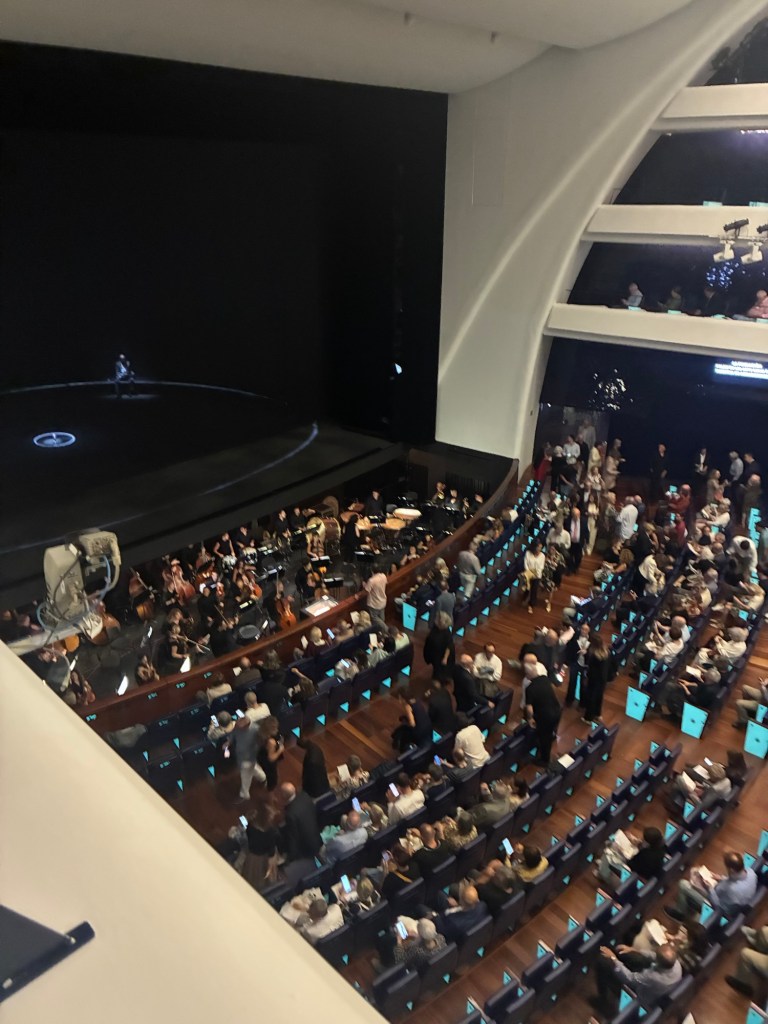
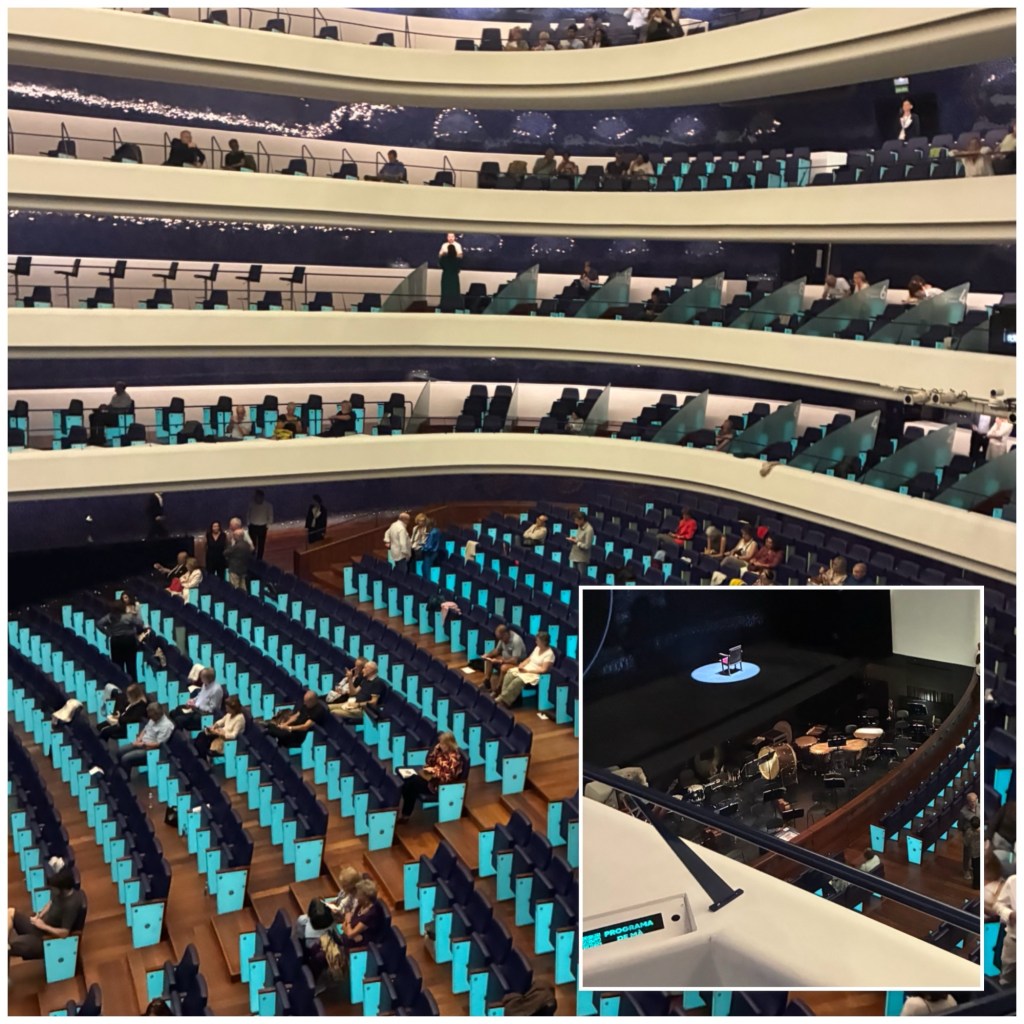
If you could get by all the craziness, we have to say the singing and music were absolutely superb.  The singers top rate.  The orchestra world class. The acoustics in the Opera House are out of this world.  And the building itself is an architectural masterpiece.  Worth the price of admission on its own.  Our seats had built in screens where you could follow the libretto in what ever language you chose. And tickets prices were half of what we might pay in our home town of Seattle. The crowd reflected that. Not quite the same as the wealthy gray haired set that dominate our local opera.

Inside Opera house where each seat shows a libretto in the language of your choice

Did we enjoy the opera?  Maybe not so much as a performance. But as an experience?  Yes!  Absolutely, yes! 

Mercado Mania

Location, location, location!

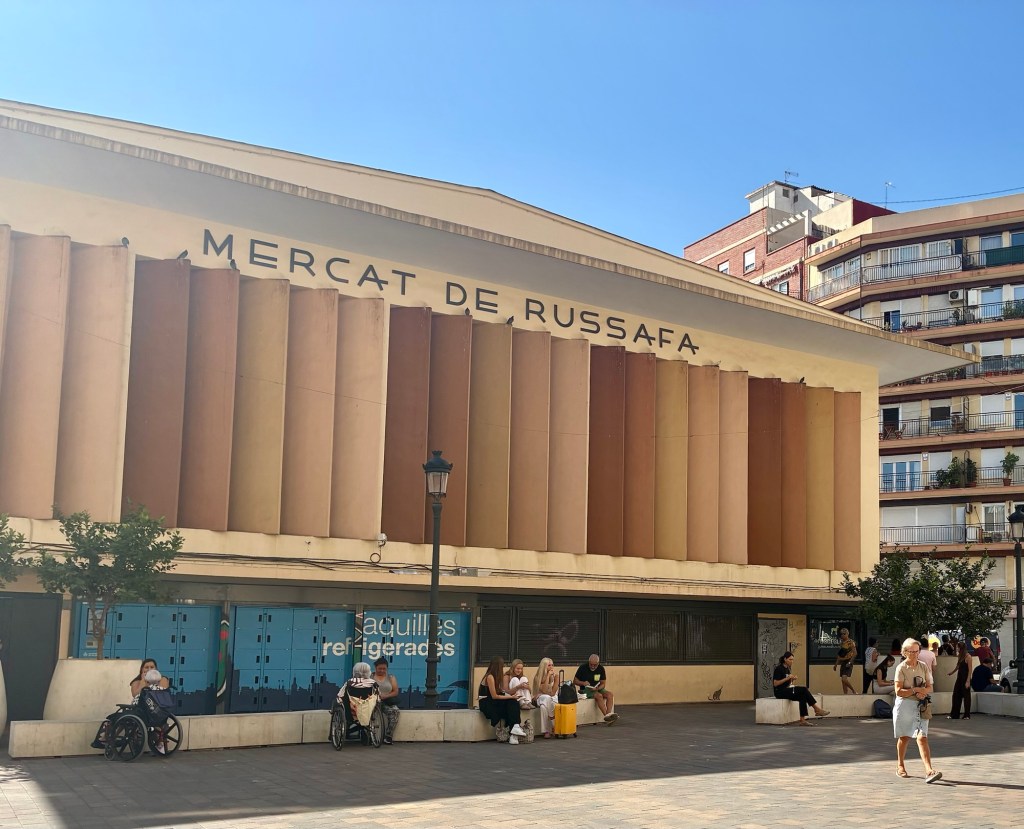
The view from our window says it all—a mercado, a public market!  It’s the Mercado de Ruzafa (Spanish) or Mercat de Russafa (Valencian). 

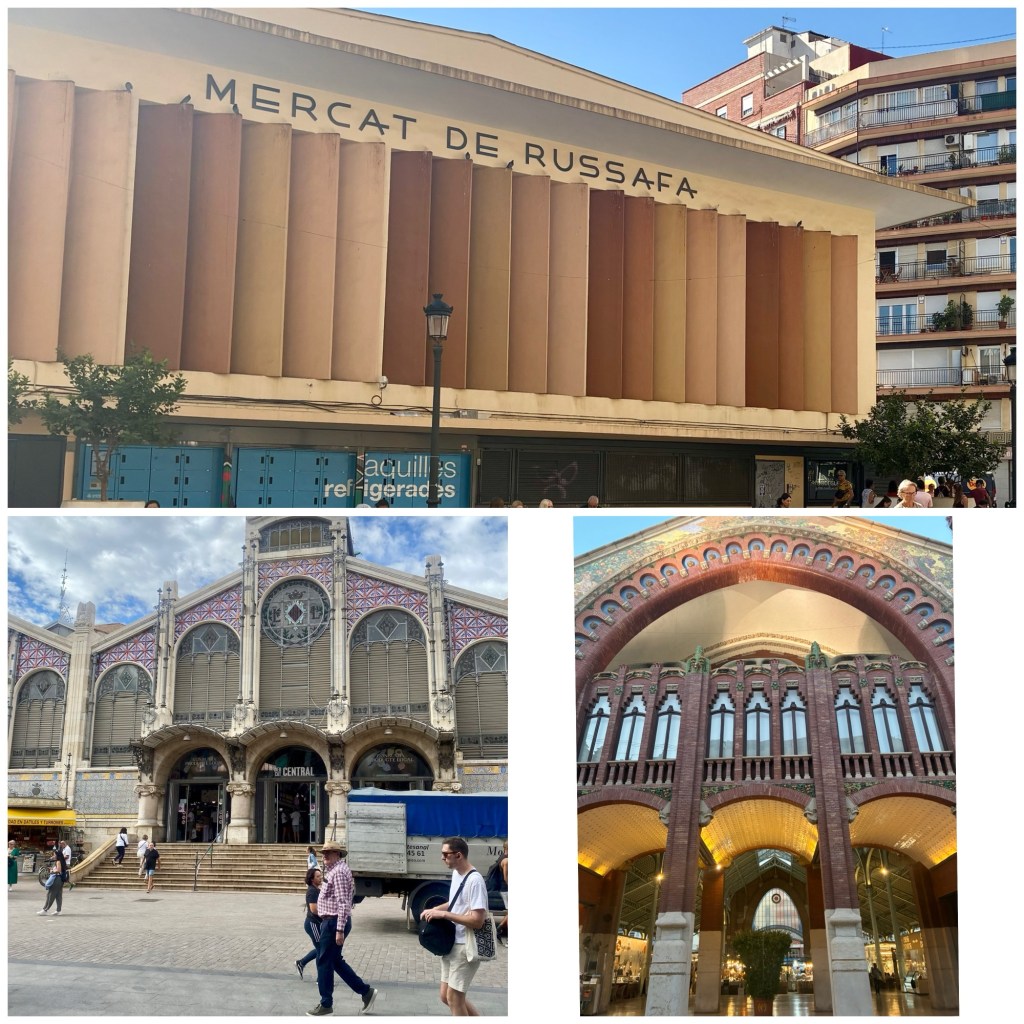
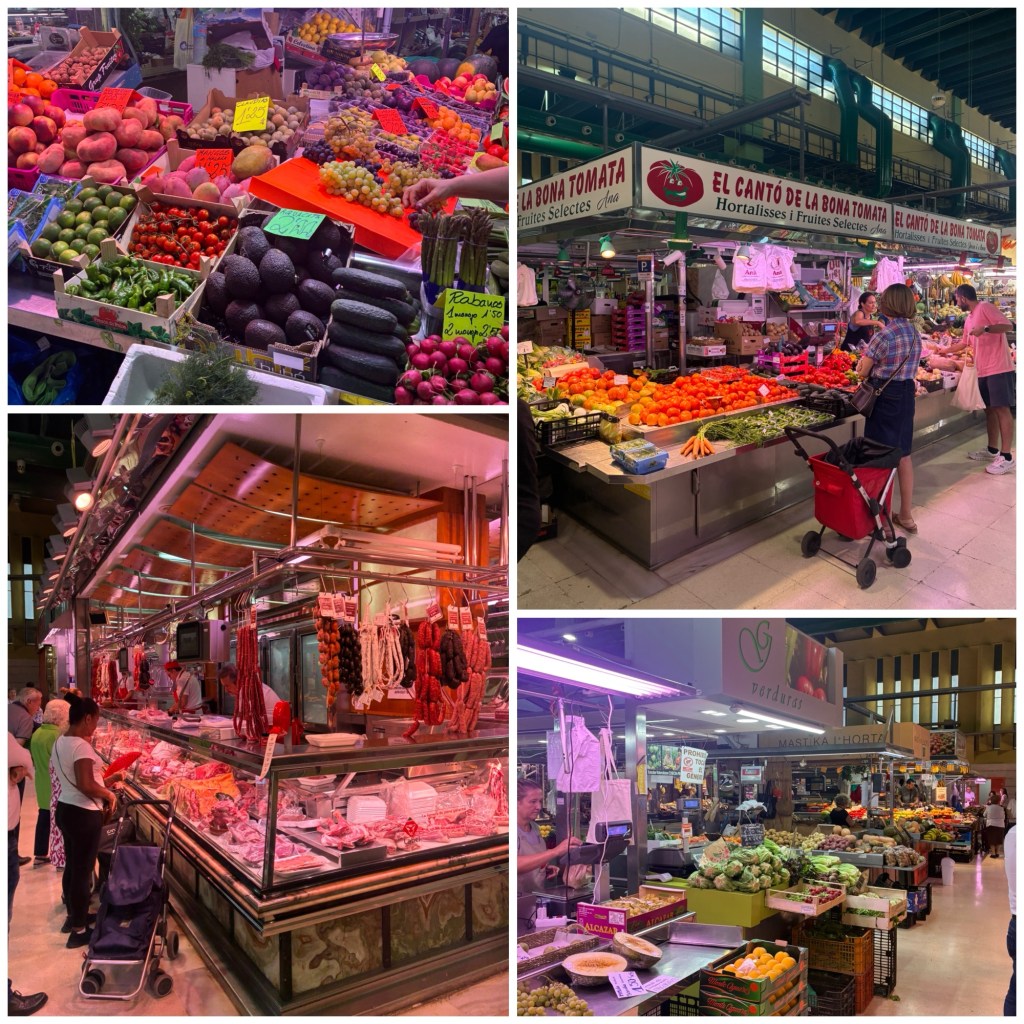
It’s in an ugly, ugly concrete building—no getting around that fact.  Even a little decorative paint can’t hide that. Not pretty like the spectacular art deco Mercado Central or the even fancier Mercado de Colon. But inside, wow!  Foodie heaven. A home cook’s paradise.  An ocean of food stalls!  

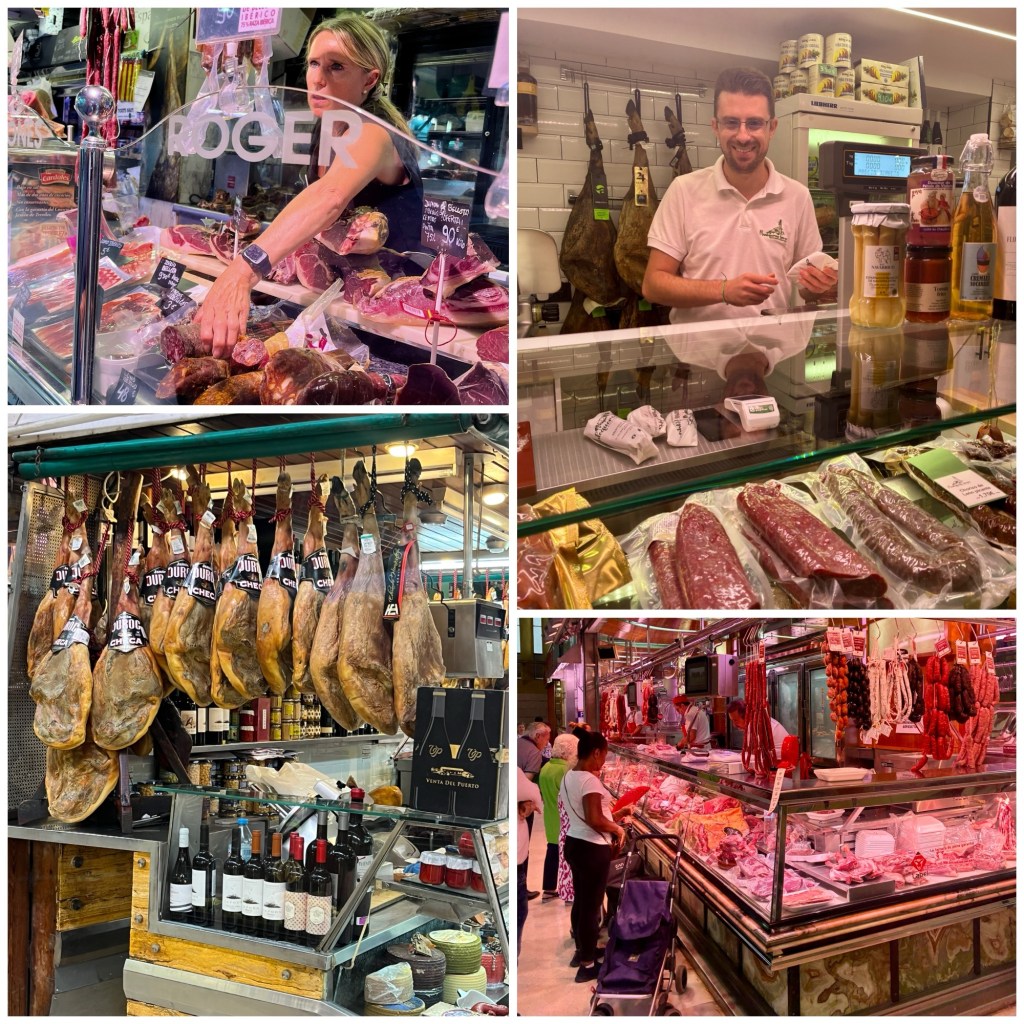
In our scientific count, we found 29 stalls selling either meat, poultry, or charcuterie.  Some even specialize—there are several pork only, a couple that specialize in just chicken, one guy sells only ground meats, a dozen selling jamon and charcuterie. 

Want a thick or thin chop — they cut your meat to order.  Our chicken folks are amazing—like samurai warriors. They cut and debone a whole chicken in seconds. You tell them exactly what you want. Knives flash and presto—a package of perfectly cut, trimmed and sliced whole chicken.  Bones saved for broth. Service and a show. 

There are 19 fish stalls housed in a separate wing of the market where the temperature is kept lower to help keep things fresh.  Most of the seafood is laid out artistically on beds of crushed ice. Fish sculpture extraordinaire.  

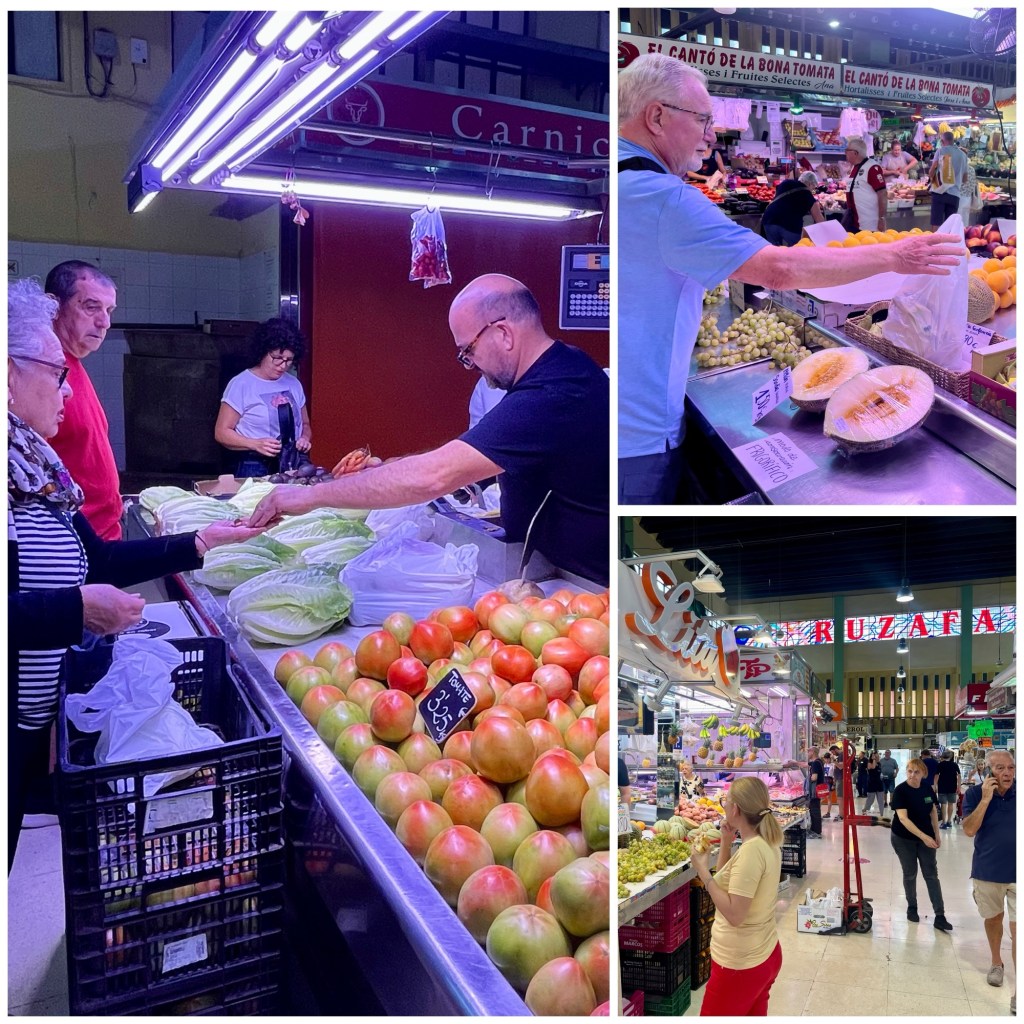
Of course, there are dozens of fruit and veggie stalls.  Most sell only seasonal produce. I asked one lady if she had oranges—it is, after all, Valencia.  She said not today but come back in 10 days—the fall crop will be in then. One stall offers the very best romaine lettuce. There is always a crowd as each customer buys a head plus whatever else looks good. You have to ask politely “Quien es ultimo?”  “Who is last?” in order to know where to stand. 

A few specialize in tropical or South American produce for the immigrants—clearly not seasonal and imported. But those stalls are the exceptions.

And there’s the rest, the other stalls—nuts and dried fruits, the egg lady, bakeries, prepared food take out, spices, olives, pastries, the mushroom guy, specialty stalls with Italian, Greek, South American, Mexican foods, dry goods, candy, wines and spirits, sushi, vermouths only, coffees only, even a tea only place.  We’ve found our favorite cheesemonger in one of the smaller stalls carries mostly Spanish varieties, and our young egg lady who has both regular eggs and eggs from pasture raised hens.  

There is, of course, a restaurant and bar where the locals and Mercado workers hang out. A little dark and dingy. But lively.  They all seem to start the day with a beer, vermouth, or a shot of something stronger. 

The public market in the marina district — no surprise — is known for seafood. The area used to be a small fishing village before Valencia absorbed it. But Thursday when we wandered out there it was also flea/street market day. Since Monday is our neighborhood’s street market, we thought we knew what to expect. Nope. This one was enormous—maybe five times size of ours in Ruzafa. It ran down the main street about 10 blocks to the public market and filled many side streets. Enough underwear, table clothes, shirts, kitchenware and used shoes for the entire planet.

Then we got to actual market — Mercado del Cabañal. Newer than many markets, and still filled with jamon, fresh meats and tons of vegetables as you would expect. But the seafood! Wow! Fish, and a particular shellfish is not cheap here, but the quality and variety is amazing. The legacy of the old fishing village.

What you don’t really have at the Mercado de Ruzafa or Mercado del Cabañal are tourists. Expats, yes, immigrants, yes, tourists, very few. A real contrast to the Mercado Central and the Mercado de Colon.

The grand Mercado Central in the old city isn’t entirely tourists—our Valencian  friends shop there.  But because of its beauty and its location close to so many historical sites, it is included in all the guide books and on all city tours.   Bottom line?  The locals definitely fight their way through the selfie shots and tour groups with barely enough room for their small shopping carts.

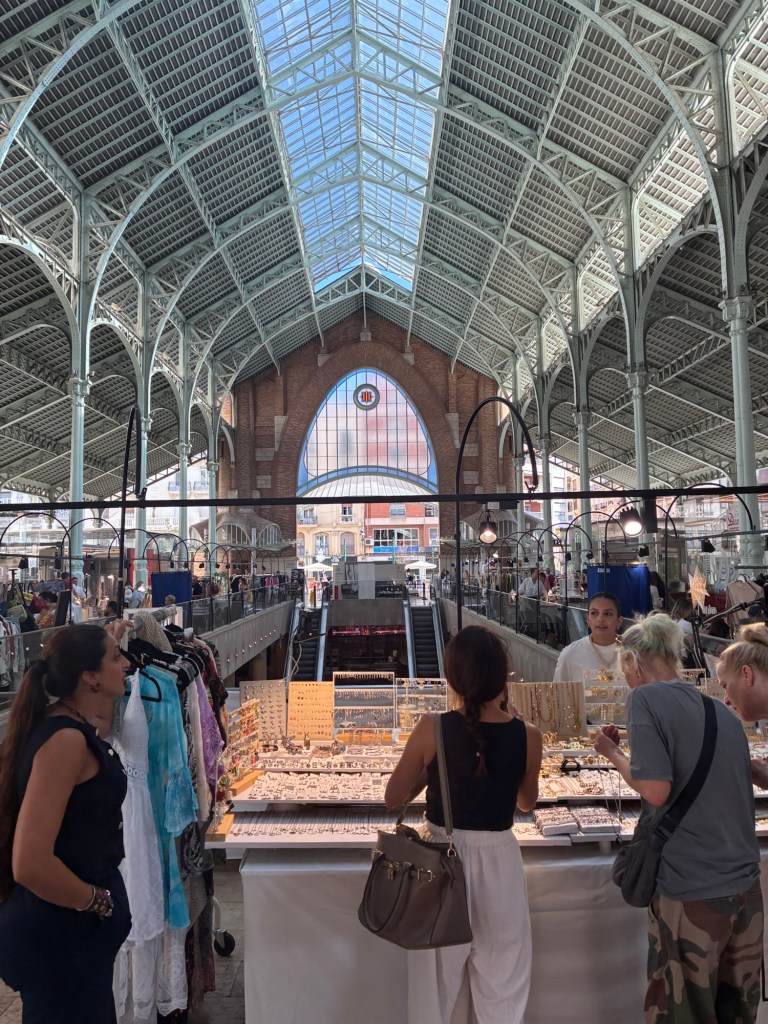
The Colon Market is a whole different vibe. Gorgeous building.  Built in 1916 as a market, it’s been extensively renovated, and beautifully maintained. Upscale restaurants and bars spread over two floors. It’s filled with little booths selling locally made fashion, artsy jewelry and pricey souvenirs. And only a few real food stalls—probably just so it could still call itself a mercado. 

Tourists, yes. Mobs. Many Spanish, but sitting down to a coffee, you’re just as likely to hear Dutch, German, British English, or American English.  

And dotted all around the city, there are many more neighborhood mercados, each with its own flavor. 

It’s our mission before we leave to visit as many as we can.  Mercado mania. 

But for now, and probably always, the Mercado de Ruzafa is our happy place.  

Getting to Know You, Valencia

It’s been a learning process, for sure.

Part of the challenge of living in Valencia for two months is that, yes, we are tourists and, no, we’re not quite tourists.  Staying in a long term rental means there are sheets to wash, sinks to clean, floors to mop and garbage to take out as well as sights to see. All part of the deal.

Valenica, like any major city, is so much more than the “must see” highlights in the old town center.  It has a huge variety of neighborhoods—swanky, working class, trendy, suburban, beachfront, and industrial. Places we would never see if we were here for just a few days or a week.

Some date back to the mid-nineteenth century and some to the post Franco era.  Valencia was the capital of the Republic during the civil war, 1936-39, and bombed extensively by the fascist Franco. Even the historical center has these stunning contrasts.

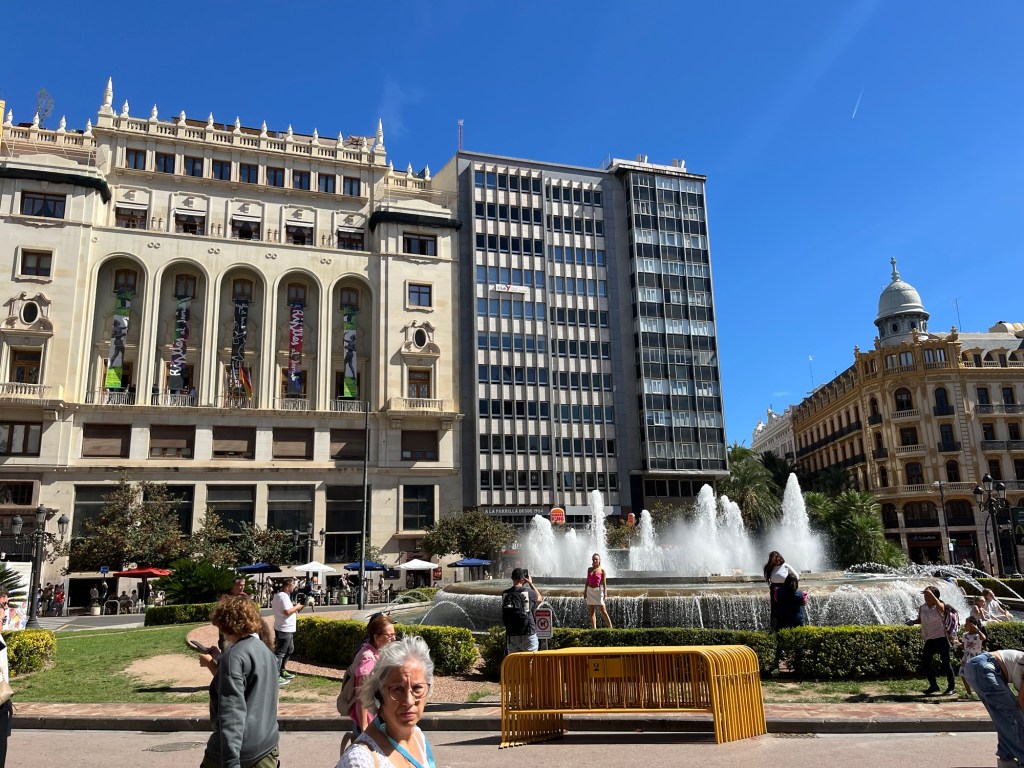
We’re living in the “trendy and hip” neighborhood of Ruzafa, a twenty minute walk from the city center. Endless restaurants, bars, nightclubs, tattoo parlors, and vintage clothing shops.  At night, the place is crazy.  And crazy loud.

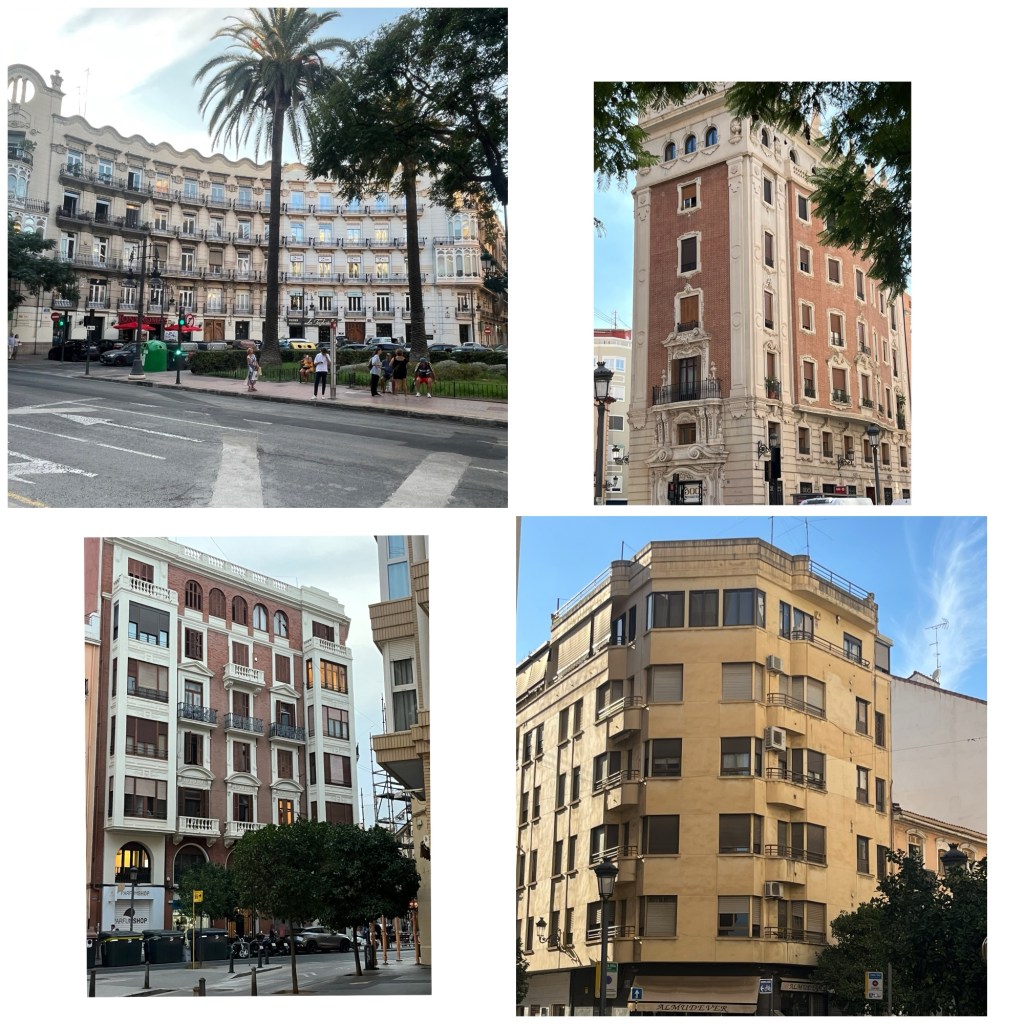
Still, people do actually live in Ruzafa. Lots and lots of them in four to six story apartment buildings ranging from grandiose and ornate to humble concrete boxes. 

During the day, we hear school children, see seniors strolling, watch dog walkers, and dodge business types off to work. Many of the residents do their daily or weekly shopping in the huge, concrete public market, Mercado de Ruzafa. 

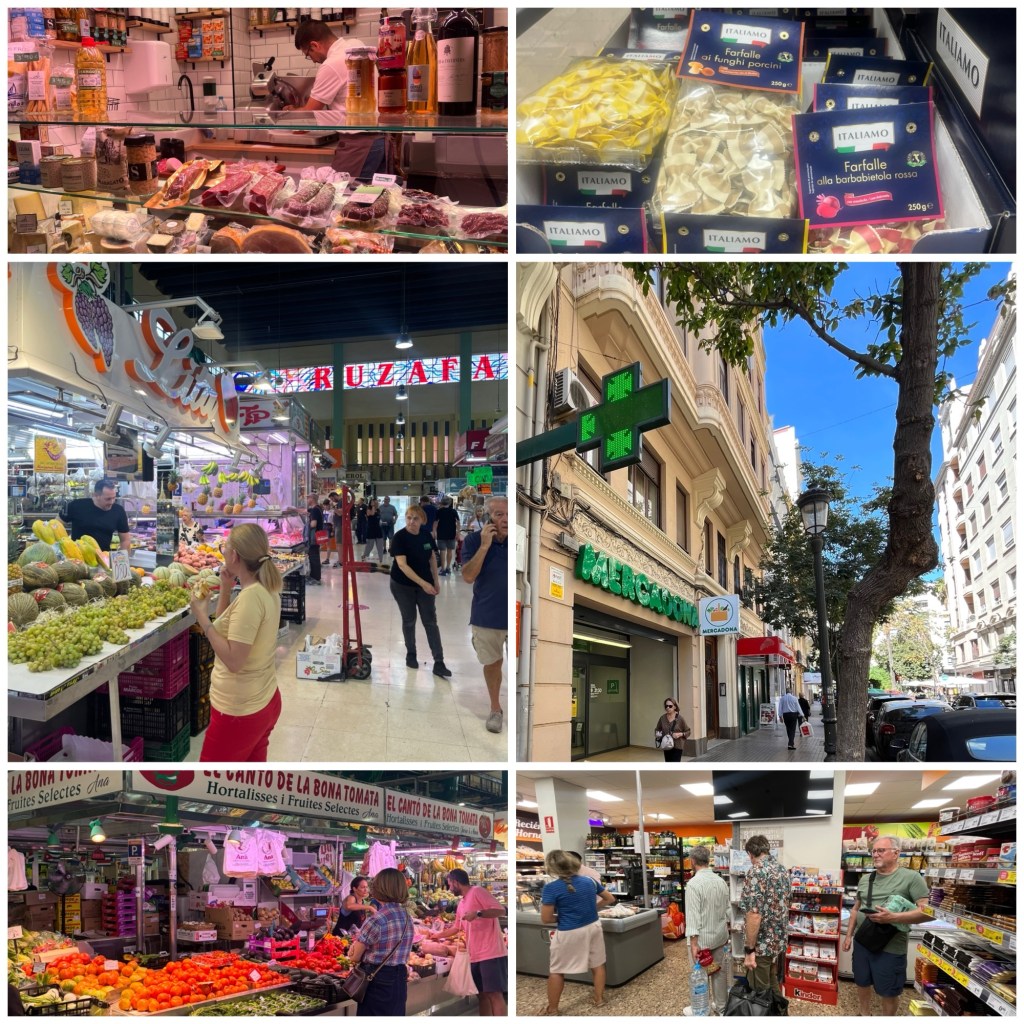
The Mercado on the left with hardly a tourist in sight and supermarket on right also without tourists.

But the same folks pack the giant American style supermarket, Mercadona—which by the way, you could easily miss since the entrance since it’s a nondescript single door amid all the others at street level.  Minimal signage.  And there are also dozens of mini-marts and fruit and vegetable stands that stay open well after the Mercado and Mercadona are closed.

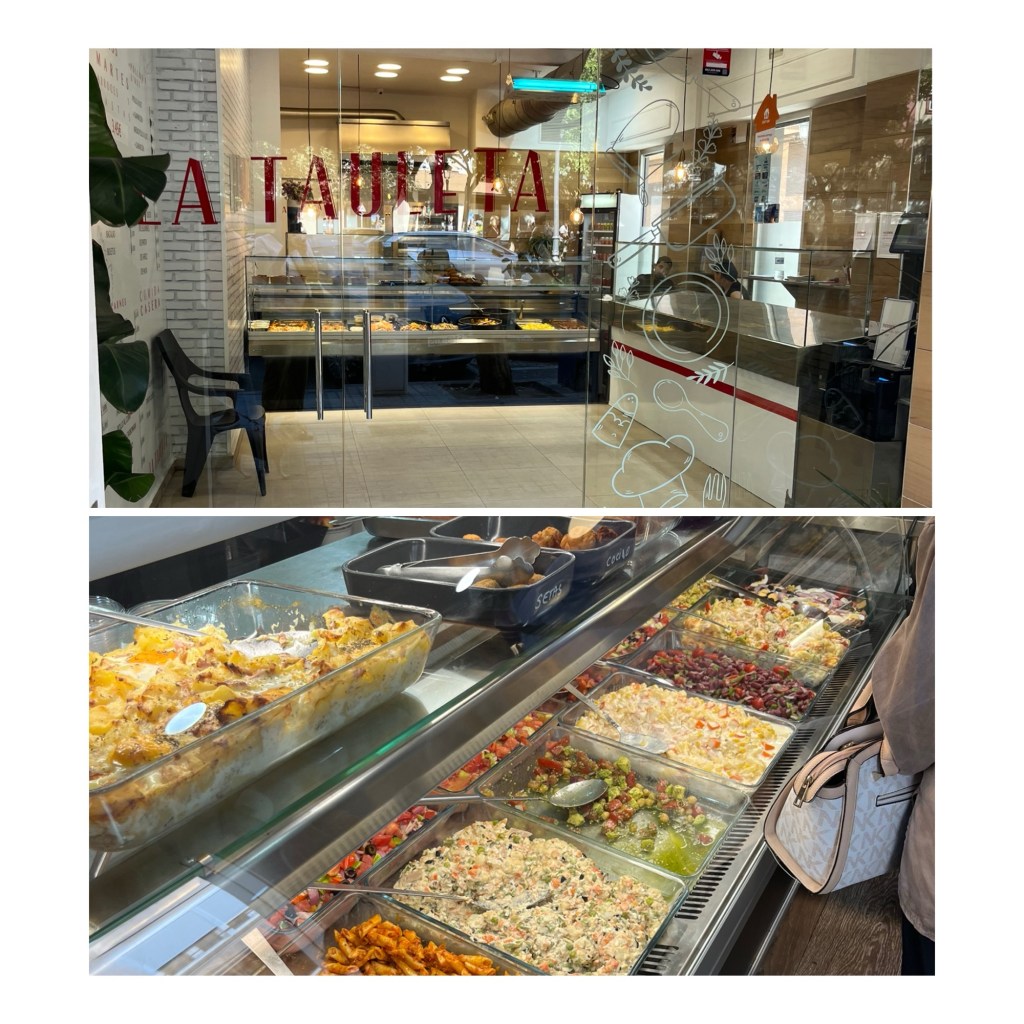
So living here we’ve learned to shop at both the Mercado and the Mercadona for our home cooked meals. We can’t eat every meal out—though it’s tempting.  We’ve also relied upon someone else to do the “home” cooking and  bought excellent prepared food at some of the specialty takeout stores.  A real lifesaver at times.

Lasagna, paella, roast chicken & or a variety of salads — lots of choices

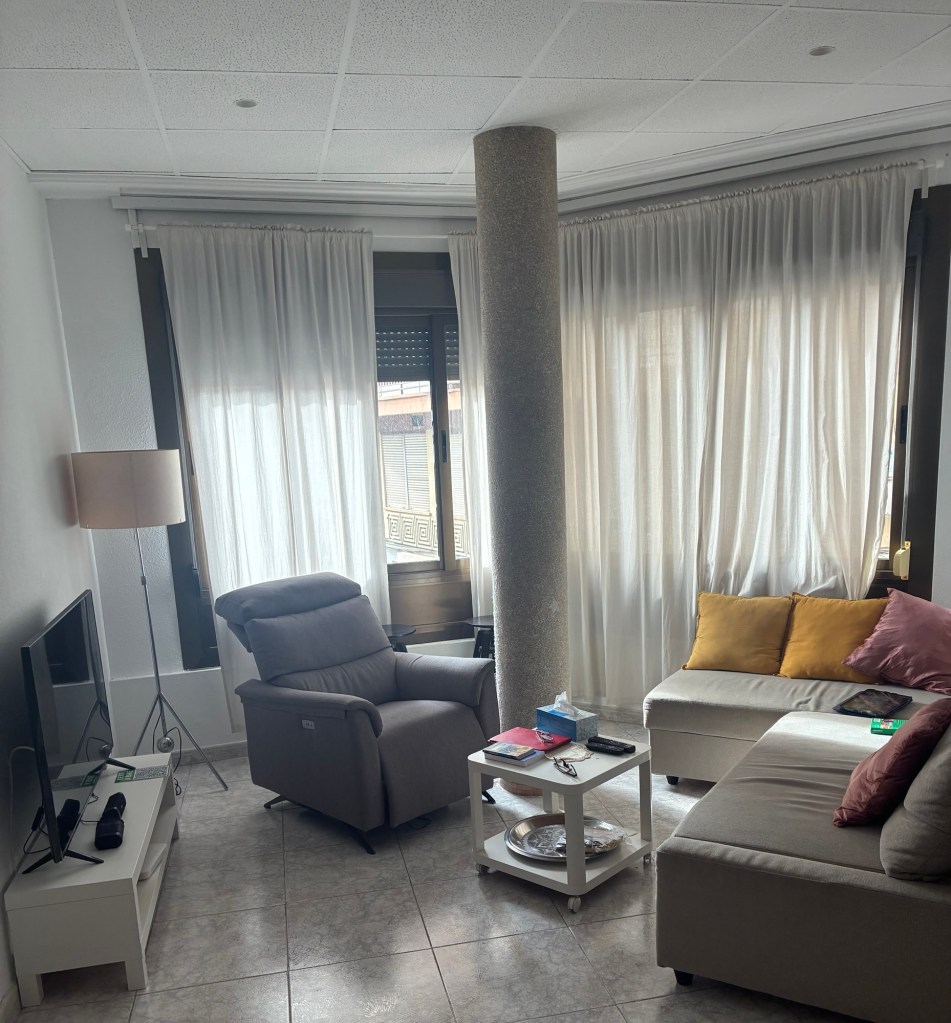
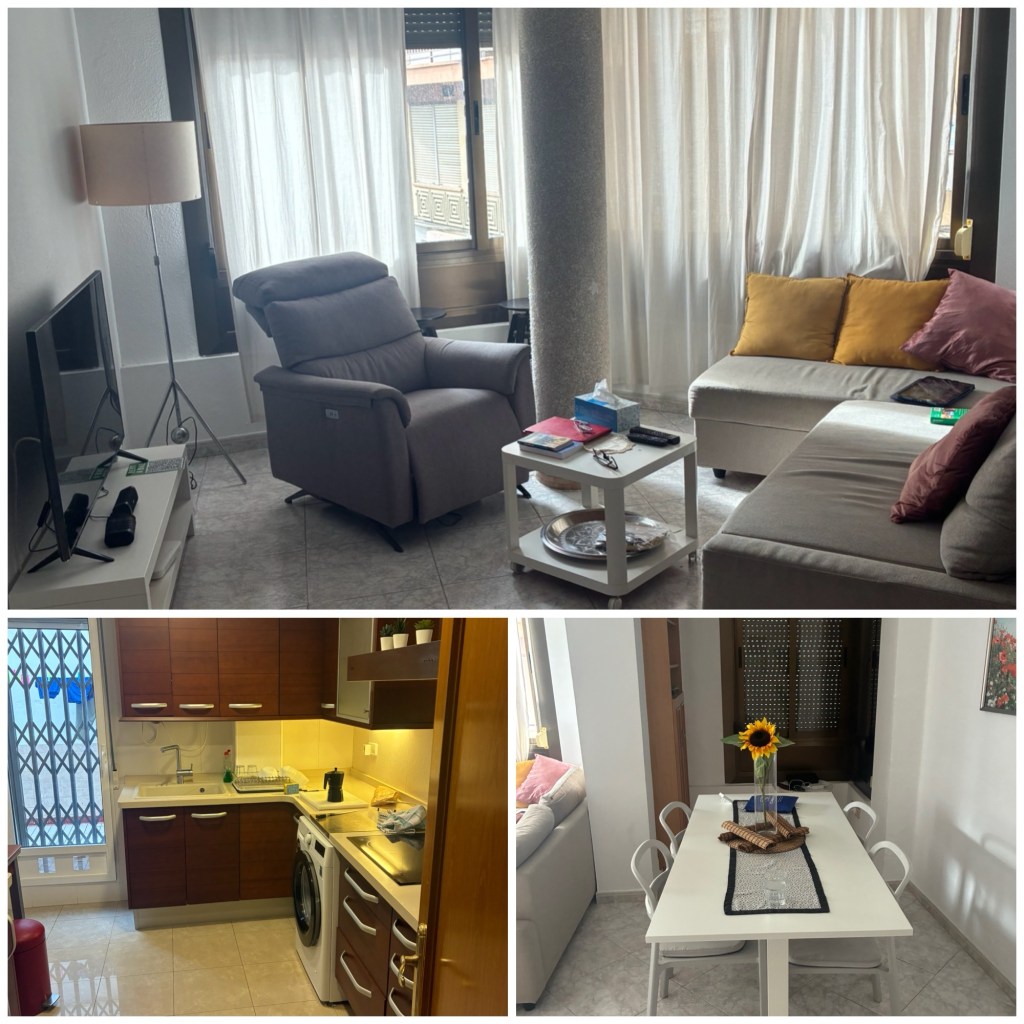
Another part of living here is that get togethers with friends often don’t take place at home.  Many apartments are tiny, not really suitable for even small gatherings. Like ours.

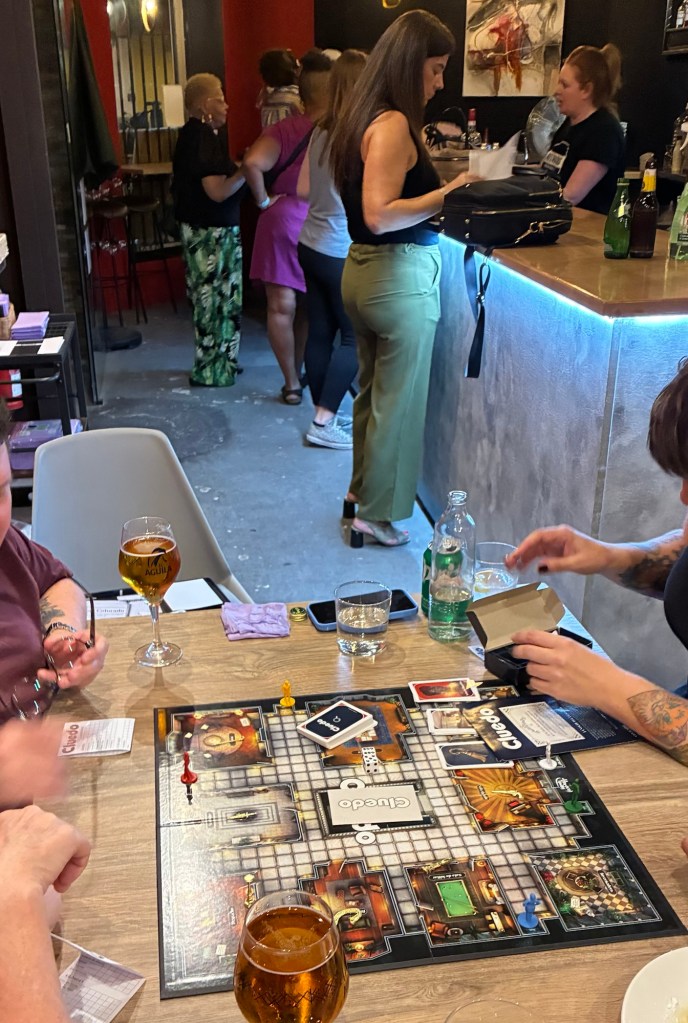
You meet at a restaurant or bar for the evening or for lunch and the table is your for as long as you like—often hours.  Our friends even invited us to a game night at a local Irish pub where different groups huddled around tables — ate, drank and played board games all evening.

And as for getting around, well, mastering public transit is a must—none of our Valencia friends have cars.  Cars are a luxury, parking impossible, and the traffic horrific. Getting a license is a linguistic and bureaucratic challenge.  The good news is that there’s a great transit system and it’s dirt cheap.  Clean subways and air conditioned buses!  We’re still struggling with bus routes that our friends know like the back of their hands. More good news—taxis are plentiful and inexpensive for those times you want a little more comfort. 

There’s adjusting to “Spanish time”.  Meals: lunch at 2:00, dinner at 10:00. Always check the hours and days for restaurants, stores, and museums. The 2-5 pm siesta still happens for many establishments, including museums in the heart of the tourist district.  Also, closing days wildly vary.  Seems each time we walk down a familiar street something new is open and something familiar is closed.  No rhyme or reason.  And in September we’re seeing signs hanging in windows saying “Closed for a vacation.” Four times so far this trip we found ourselves on the outside looking into a closed museum, closed store, or closed restaurant. 

Small things call for adjustments, too. In almost all bars, coffee shops, restaurants, the waiter will come to the table to take your order. It may take time, but they’ll get to you. On the other hand, if dining outside, you may need to go inside to the register to pay the bill. Almost always you have to ask for the check. We’ve been assured by our local friends that you rarely clear your own dishes, no matter how casual the bar or restaurant is. Tipping is not expected. Cash is almost non-existent. Everybody pays “con tarjeta”—with a phone or credit card.  And you can use a card for even the smallest transactions.  

Perhaps one of the hardest lessons has been to navigate the streets with bike lanes.   Very common throughout the city, they are usually painted red and sometimes run alongside the road, but also often merge onto the sidewalks so you’re never sure whether you’re in a bike lane or on a sidewalk. DO NOT WALK in the bike lanes!  The bikes and scooters barrel along at insane speeds and own those lanes. When you’re walking along, reading a map or looking at the sights, it’s way too easy to drift into the danger zone.

Drivers in cars, on the other hand, are generally courteous, stopping for any one standing at a cross walk.  Such courtesy takes a little getting used to although locals hardly look up from their phones when they hit a crosswalk without a light.  It’s different at stoplights.  There bicycles, and pedestrians, even moms pushing  strollers, ignore red  lights if there are no vehicles within striking distance.

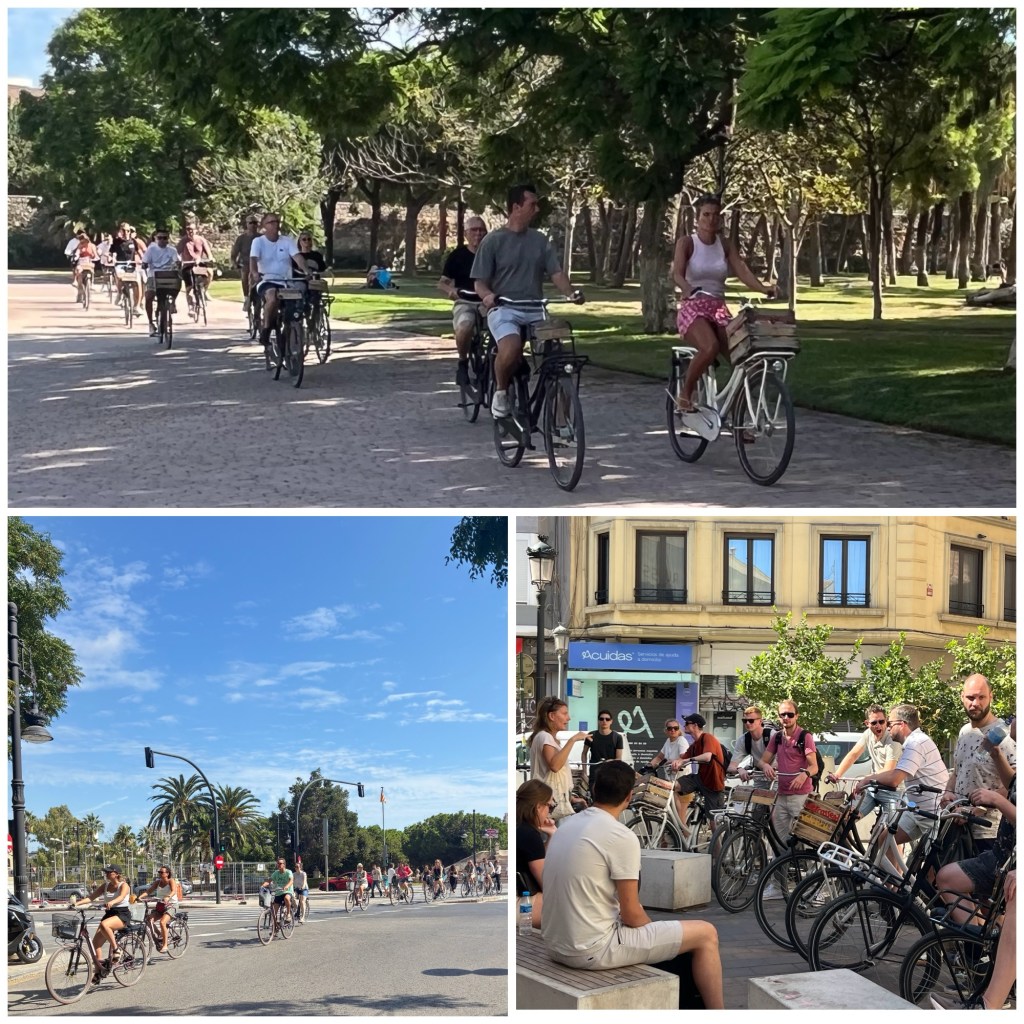
But there is even a worse danger. In the old city large groups of tourists get on bikes and ride around the major sights. Just imagine. 10-20 people who may not have ridden a bike for years trying to follow the guy with the bright baseball cap in front of the herd. It’s fairly benign in the city parks but around the historical sites just imagine those bikes wobbling through dozens of walkers, strollers and pedestrians. All because Valencia is a flat and “bike-able” city.  

These differences, especially the small ones, keep us on our toes as we try to make sense of it all. And that’s part of the adventure!

Yes, we’re starting to know you, Valencia, both as wide-eyed tourists and as everyday residents.  

The Slow Down on Valencia

Something new, something different for us.

And after many years of travel, we’ve seen most of the “must see” sights. We’ve done the mini-grand tours of Eastern Europe, Italy, France, Spain, and the UK, hopping from place to place over a couple weeks.  Having been teachers, we always had the luxury of time for summer travel—even if it was low budget.  You know—backpacks, picnic meals, and cheap rooms with bathrooms down the hall. Early, early Rick Steves.

But as we’ve aged and particularly after we retired, we have tried to spend more time in one location—finding a home base and using it for day trips and outings.  It worked spectacularly well in the Dordogne, Provence, Umbria, Portugal, and most recently in the Valencia province in Spain.  Our usual stay is about two or three weeks in one place and then move, minimizing the number of days on the road, packing and unpacking. It lets us get to know better a region, maybe meet some locals, enjoy the ambiance, and find the hidden gems. Slow down.

But this year, we decided to take it one step further.  And slow down even more.  

We are renting an apartment in Valencia, Spain, for two months. We went through a real rental agency, not a short-term vacation rental company like VRBO.  We signed a contract.  And moved in.

Our apartment above a Sardinian restaurant, the church at the end of the street and the public market across the road.

Of course, we had our share of worries.  Could we find enough to do for two months? What if the apartment was a dump? Could we adjust to the Spanish time for eating and sleeping? Would the language barrier be problem?  

All we had was the outline of a scheme.  Spend the first weeks digging more deeply into the third largest city in Spain.   Master public transportation for day trips to nearby sights. Take a few overnight train trips to other towns.  Maybe rent a car for further away places. At the price we’re paying for a two month rental (about what we would pay for two weeks in short-term vacation rental), we can afford to spend a few nights in other places. 

Early days yet — not quite a week — but everything is working out splendidly—so far plenty to do (we’ve even joined a local gym), the apartment is comfortable and perfectly located right across from Mercado de Ruzafa.

We are already on the Spanish schedule, and with tourist Spanish and English speakers everywhere, no real language issues.   Yes, we are getting used to the noise level in our hip and trendy neighborhood of Ruzafa—numerous restaurants on our street are open until around midnight.  But when you eat dinner at 9:30 pm go to bed at 1 am, and get up around 9 am, noise is not really a problem.  As we were told several years ago in Seville, Americans just need to move their clocks three hours.  Before lunch means any time up until 3 pm.  We’ve found a decent neighborhood espresso joint — not quite as easy to do here as in Italy or France — our favorite cheese guy, a grumpy fishmonger and a bakery.  Yep, we’re settling in.  Many, many restaurants within a five minute walk — Lebanese, lots of Italian options, a couple Mexican places and even sushi.  And we have barely explored beyond our neighborhood.

Part of the restaurant scene in the Russafa neighborhood

So why Valencia?  

Last year we visited the Valencia province for two weeks but the city itself for just three days.  We chose Valencia because of the city’s amazing sights and history, its lovely Mediterranean seaside location and its great food scene.  But more importantly, I had a former work colleague and good friend who moved there last year permanently with her husband, mother, and three dogs.  Valencia is her new life. 

We had two lovely, long lunches with her and her friends (all from our home town of Seattle) last year. Other than a wonderful morning tour led by one of her very knowledgeable friends, we didn’t get to see a lot of the city.  When asked what we did in Valencia, we said, “We ate lunch.”  

But that very, very brief encounter with Valencia the city convinced us we wanted more.  

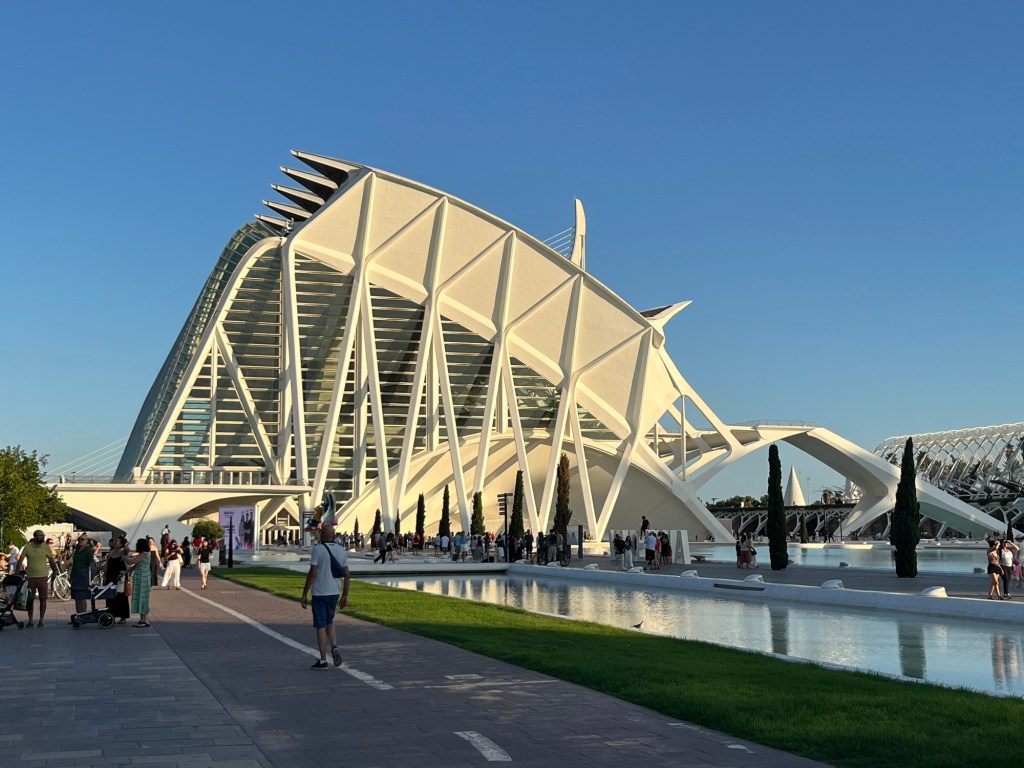
We have a long list of main tourist sights we missed last year on our “to see” list. We’ve already checked off the Turia river park, including sunset views of the City Arts and Sciences buildings. 

But there is so much more — several sights we’ve “seen” that we want to get back to and spend some time with — the National Ceramics Museum, the Valencia Catheral (with the Pope’s certified real holy grail), and a dozen more.  Plus on the “to do” list—shopping at the second hand stores and flea markets, eating at a vast variety of restaurants (from Michelin starred places to hole in the wall local joints), taking cooking classes and wine tastings, biking, swimming in the Mediterranean, and most importantly, spending time with our friends.

On advice from our local friends, we’ve already identified some day trips—Sagunto with its famous castle, Requena—the center of the local wine industry, Xativa—birthplace of the Borgia popes.  We also want to go back to a lovely rural restaurant we ate at twice an hour and half outside Valencia, El Casa Tio David, with our friends.

Yes, we think we’ve found the right place to test our new, slower, different approach to travel.

And from first impressions, we’re already beginning to ask ourselves “Will two months really be enough?”

PAELLA! PAELLA!

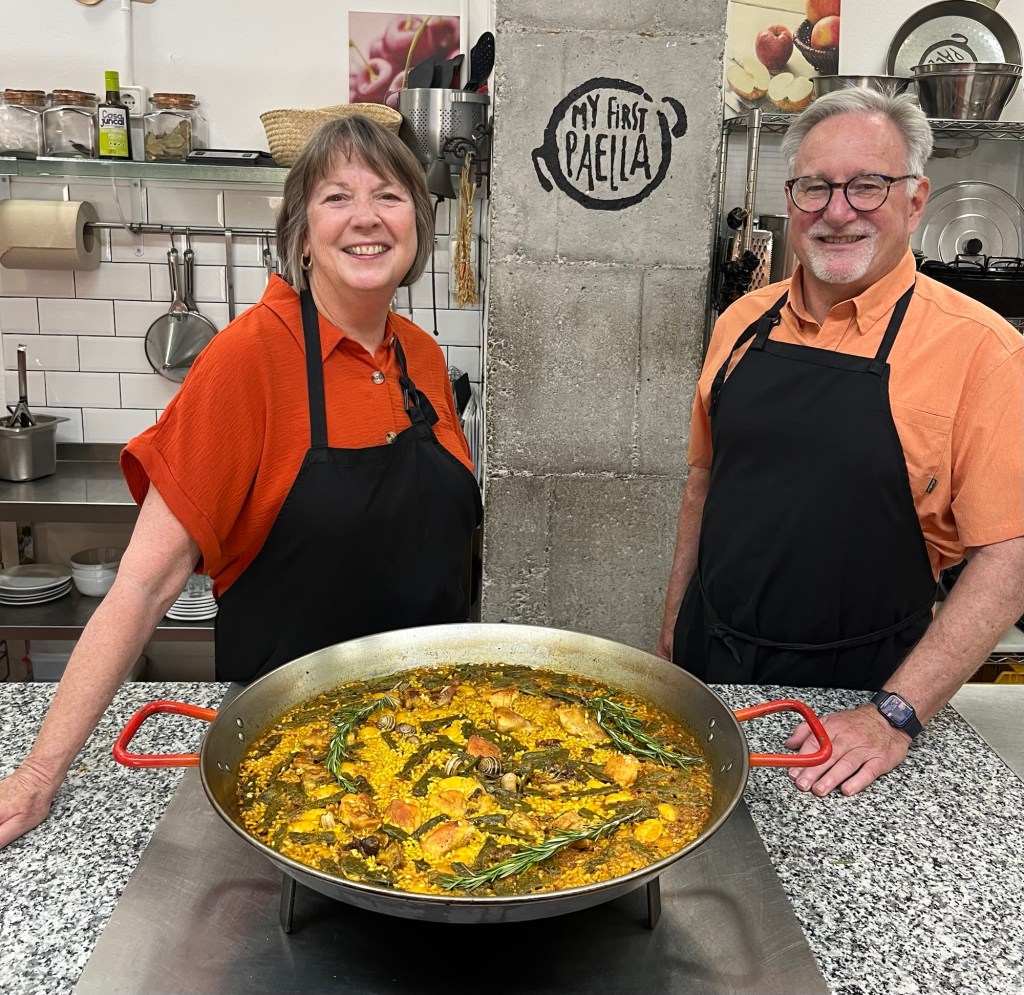
Our instructors

Anyone who knows us, knows we’re foodies. Some have even said we’re food obsessed. So it’s no surprise that one of the first things we did in Valencia — and just about the only thing we booked before our arrival — was to take a cooking class. We knew paella, a dish most people associate with Spain, properly should only be eaten in or near Valencia and only at lunch. We had eaten an authentic version a year ago so we knew what we commonly cook at home is really what our instructor called “rice with stuff.” We were ready to be educated on how to cook real paella.

Paella is a peasant dish and like most peasant dishes the authentic version is the one your grandmother learned to prepare using what was local, readily available and cheap. The word paella actually is the Valencian word for pan and paella is cooked in a specific pan that is round, shallow and slightly concave with two handles. By definition paella can’t be cooked in just any old pan.

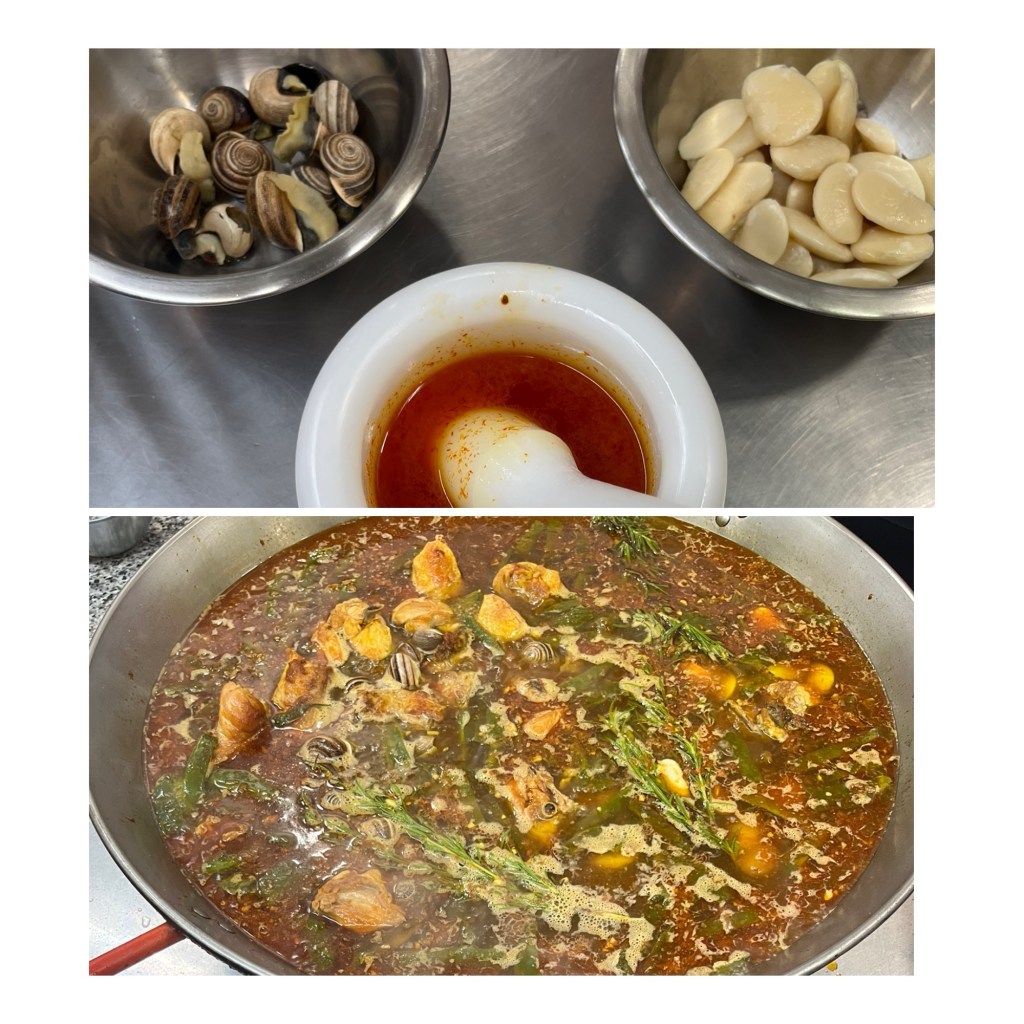
And the rules? Oh boy, there are lots of rules for cooking paella. According to our experts at myfirstpaella.com, never, ever, should seafood be mixed with chicken and/or rabbit paella. The Valencian style contains only chicken, rabbit and snails, and flat green beans. No onions, no red peppers, no peas. And no chorizo — that’s nearly a criminal offense! It is best cooked outside over a wood fire with just one cook (although many people may offer advice to that cook) and regardless of how many you’re serving it must all be cooked in one pan. Why?  Because people would argue which pan is best.

Our cooking lesson began at the local market, Mercat de Russafa (or Mercado de Ruzafa in Spanish). The word russafa is from Moorish times—garden. In other words “market in the garden”. Not quite a garden now—a giant concrete building but housing a very impressive collection of food stalls with darn few tourists in sight. This is where the fresh ingredients for our meal originated.

And we were given a very helpful tip—don’t order fish in restaurants in Valencia on Mondays because none of the fish stalls anywhere in the city are open. The fish will always be at least two days old (all markets are closed Sundays). Reminds us of Anthony Bourdain’s famous line from Kitchen Confidential “Never eat sushi on Monday.” 

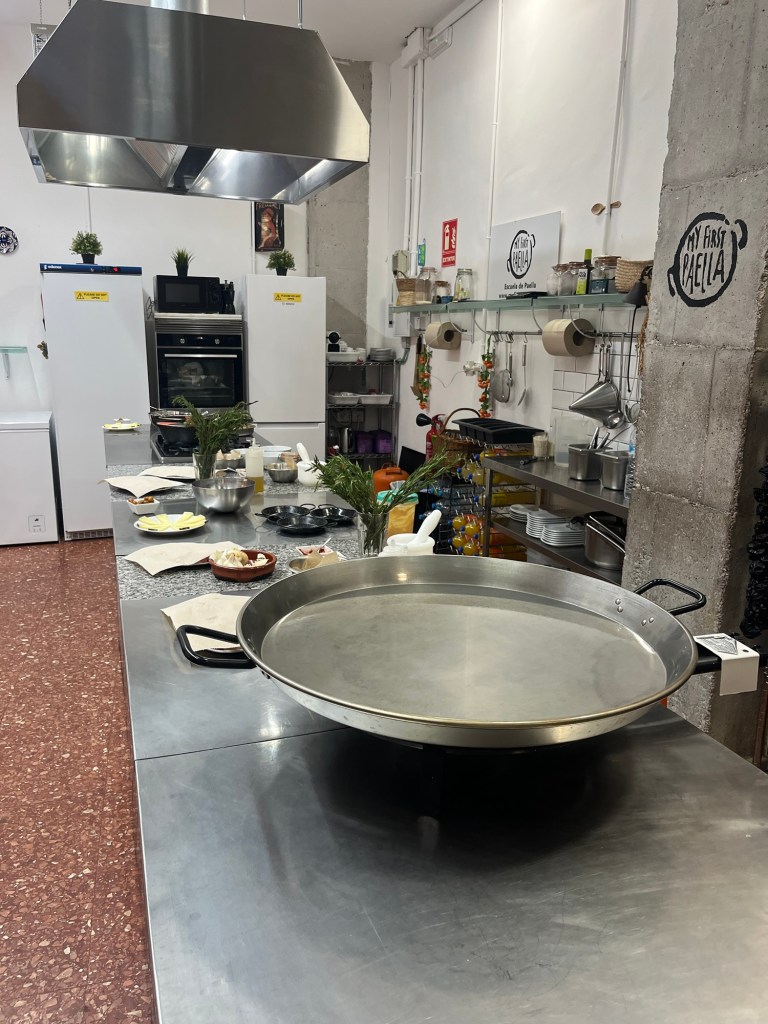
Once we arrived at the kitchen, a few blocks from the market, we were greeted by tapas —patatas bravas, jamon, manchego cheese, olives and mussels. And large water glass servings of Sangria (red wine, usually tempranillo, citrus slices, a bit of rum, a jigger of sweet vermouth, a spoonful of brown sugar and orange soda served over ice). Immediately I asked for the recipe for the potatoes — a dish served everywhere in Spain—often dreadful as we had in Madrid (French fries with pink gravy) or more commonly just ho-hum. This version was fabulous. Fried cubes of potatoes, served with a large scoop of a thick sauce of garlic, lemon, salt, paprika, olive oil and tofu (I suspect silken tofu). Outstanding.

So our lesson started almost immediately with a violation of the rules. We were using two pans. There were 13 of us — a group of eight traveling together from Detroit, and then a couple from the UK, a young professional from New York City and the two of us. We were divided into two groups — the Detroit crew and the rest of the enrollees. Let the fight begin!

First an enormous of amount of oil went into each pan and placed on large gas fired ring. The oil puddled in the center of the concave pan — we fried the small pieces of chicken and rabbit in the center with the delicate rabbit liver cooking slowly on the cooler edge. But before the meat went in, the oil was salted! As each new ingredient goes into the pan, we were told, it must be salted!  When the meat was well browned, we added torn (not cut) romano beans to the oil puddle as the meat was pushed to the edges. Once the beans blistered, we removed the rabbit liver and it was shared among the group — at least among those willing to try rabbit liver. Our instructor explained at home his family added several chicken or rabbit livers, maybe some kidneys and heart to the pan to be shared at this point. There were some very skeptical looks among our crowd.

The basic sauce for the paella included two kinds of paprika (a sweet version and a coarsely ground mild pepper version), finely minced garlic and grated Roma tomatoes. More salt. The sauce cooked until “pasty.” Then in went the lima beans. More salt. Then came the saffron (which had been pounded in a pestle, mixed with a bit of hot oil and a small amount of water). More salt.

And finally plain water – not chicken broth or anything fancy. “Be careful!” our instructor said “so there is no tsunami” as we poured the water to a depth of about a half inch—carefully measured by the instructor with a slotted spatula—a technique we would like to think he learned from his grandmother. And more salt. Several large pieces of fresh rosemary stewed for a few minutes but removed before the final cooking stage otherwise they might burn and leave a bitter taste.

We all had to taste the broth at this point to see if it was salty enough. Some said yes, some said no. But it didn’t seem to matter what we said, our teacher just added more salt and asked us to taste again. And added more salt.

The secret we were told to good paella is all about the balance. Not too much garlic — one clove for every two or three people. Not too much saffron — six stands per person. Not too much liquid — “Paella needs to breath.”

Only when the broth met his salt quotient, did the rice go in. “Don’t make a mountain,” he said but spread it around the pan. The flame was turned up, the pan was shaken and everything was left to cook. No lid.

Properly made paella takes nearly an hour to make, including 15-20 minutes after the rice is added. When finished the rice should be about half an inch thick with 3 distinct textures – an almost crispy carmelized texture from the bottom of the pan, a soft texture from the middle and a bit that is al dente near the top layer. Bottom line — paella is all about the rice. An experienced cook can tell by tapping the bottom of the pan with a spoon if the rice is done — a metallic sound means the rice lacks a crispy caramelized bottom layer. We’ll see when we get home if have the ear for that test.

Once cooked, the dish needs to sit for five minutes. We used that time to have a shot of a aniseed liqueur, Cazalla.

Then we all sat down to enjoy what we had prepared, plus what our instructors had made while we cooked — a small salad of tomatoes with a spicy (not very) vinaigrette and capers which seemed to balance the richness of the paella, and wine. Our confidence in our instructor was not misplaced — the rice was perfectly seasoned—very tasty. A perfect paella which everyone thoroughly enjoyed. A delightful afternoon and loads of fun.

A traditional Valencian sponge cake and orange slices dusted with cinnamon completed the meal with a small glass of moscat—a sweet white wine.

DELICIOSO!!!


Monkey Wars

So, so cute!  Really, who couldn’t love monkeys?

They are definitely part of the Costa Rican nature experience.  Every other time we’ve been to Costa Rica we’ve encountered them.  In nature preserves and national parks, next to our rentals, near restaurants, hanging on the power lines.  Even watched them from an infinity pool on the Osa peninsula.   They are everywhere. We’ve seen three of the four species in the country—howlers, white-faced, and spiders. The only one we haven’t seen is the very rare squirrel monkey.

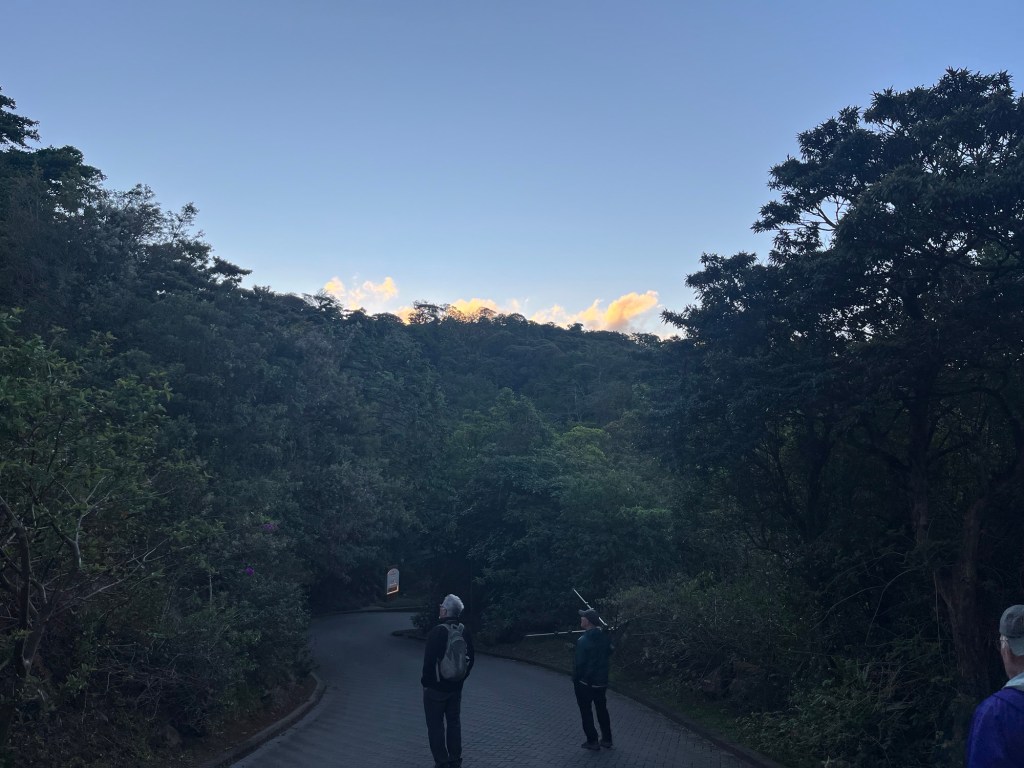
But this trip we’ve only had a fleeting glimpse of them — very disappointing.  In fact, one of our travel companions, Denise, an animal lover, was quite upset and worried that she would get back home never having seen a monkey.  And we were coming to the end of our visit. It was our last four days and we were now up near Monteverde in the Cloud Forest. Desperation time!

Early morning birding near Curi-Concha Reserve, but no monkeys

We had an easy solution.  We’d been told by our favorite birding guide, Adrian Mendez, [adrianmendez@hotmail.com] if you want to see the white-faced monkeys, go to Stella’s, a local coffee shop. You’ll definitely see them there busily trying to steal food from unsuspecting patrons eating outside.  It reminded us of our first encounter years ago when they tried to grab our backpacks in Manual Antonio National Park. The park now bans tourists from bringing in any food because the monkeys got so used to human food they couldn’t feed themselves and died off during Covid when the park was closed for two years.  So we were all set to head to Stella’s for a lunch for our up close and personal encounter with monkeys.

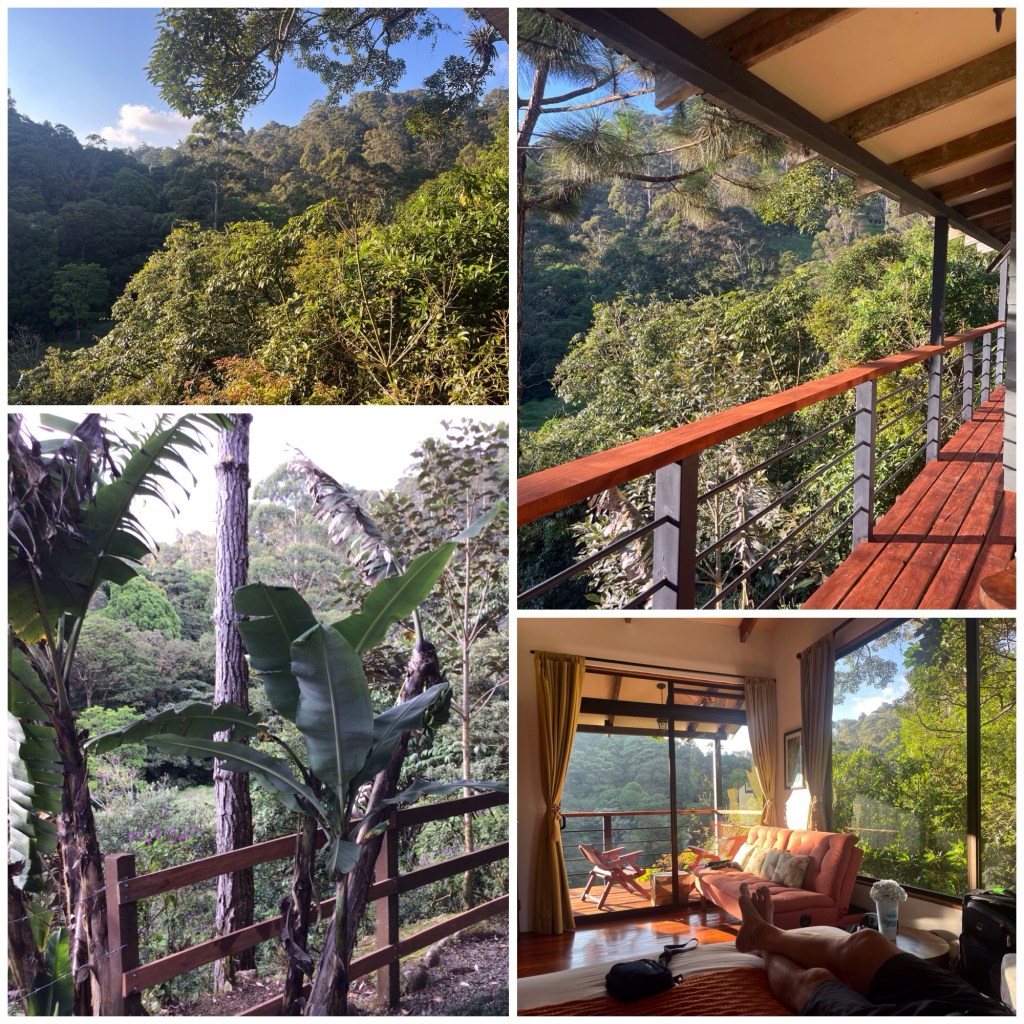
But as luck would have it, we didn’t have to leave our vacation rental at all. We had booked a lovely rental outside of Santa Elena.  Beautiful serene setting, lovely views of trees complete with a stream just below our house, and surrounded by the Cloud Forest jungle.  We could sit on our wrap around  balcony and bird watch from armchairs. 

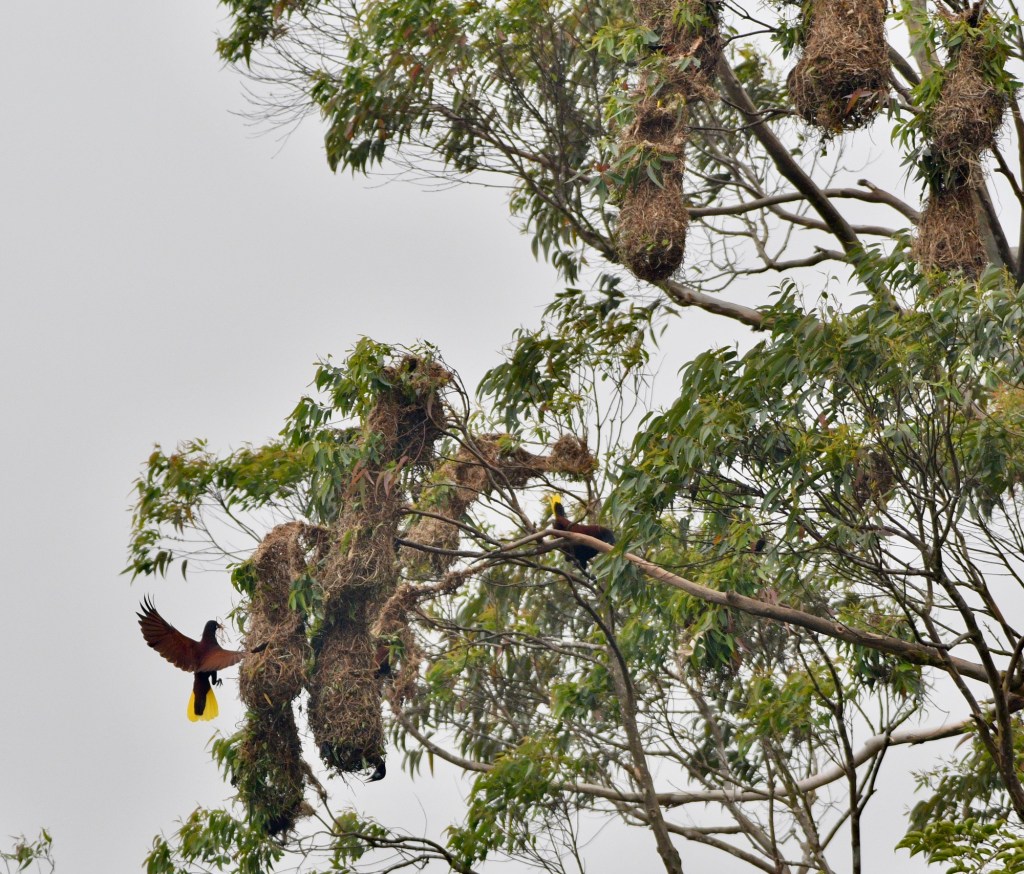
Nearby there was a large colony of Montezuma oropendolas. It is a spectacularly beautiful bird with a very unpleasant, noisy call.  The birds build large hanging nests high up trees—an amazing feat of engineering given the high winds in this region. 

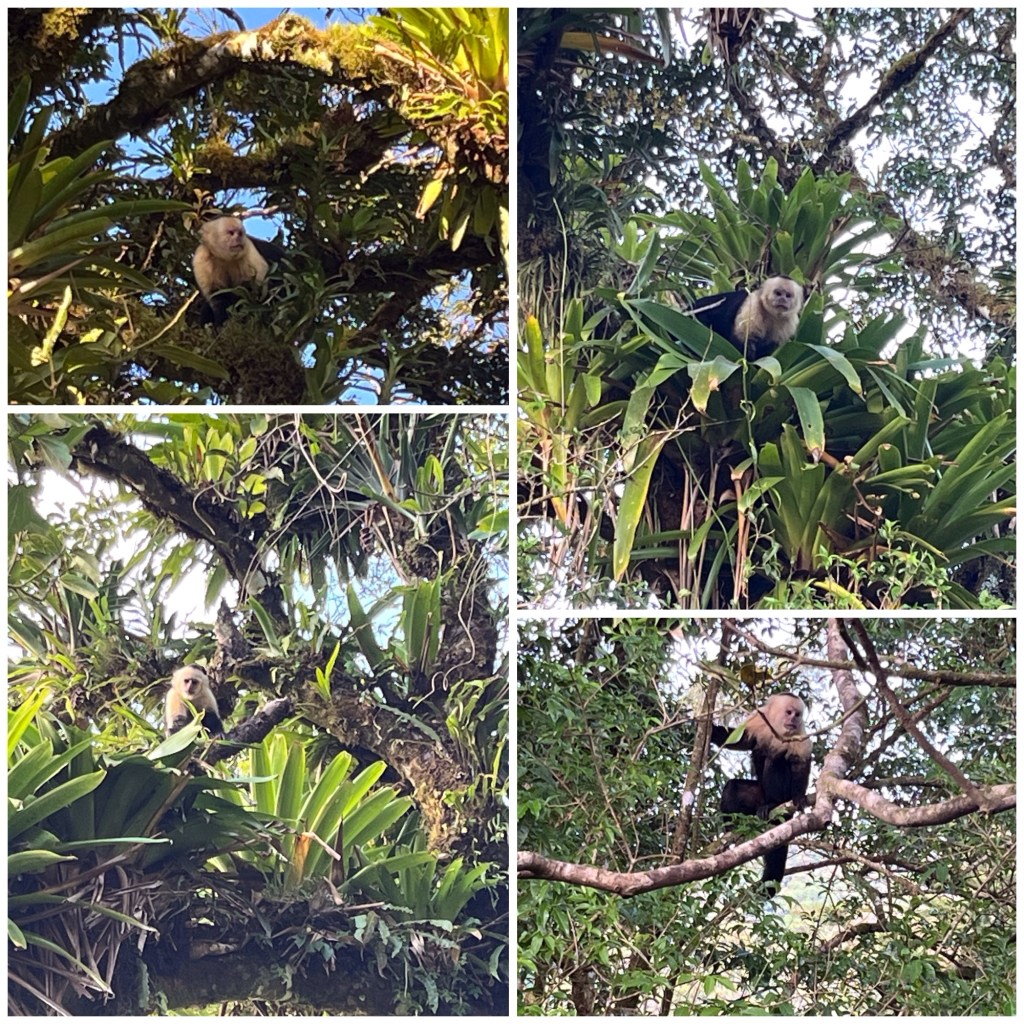
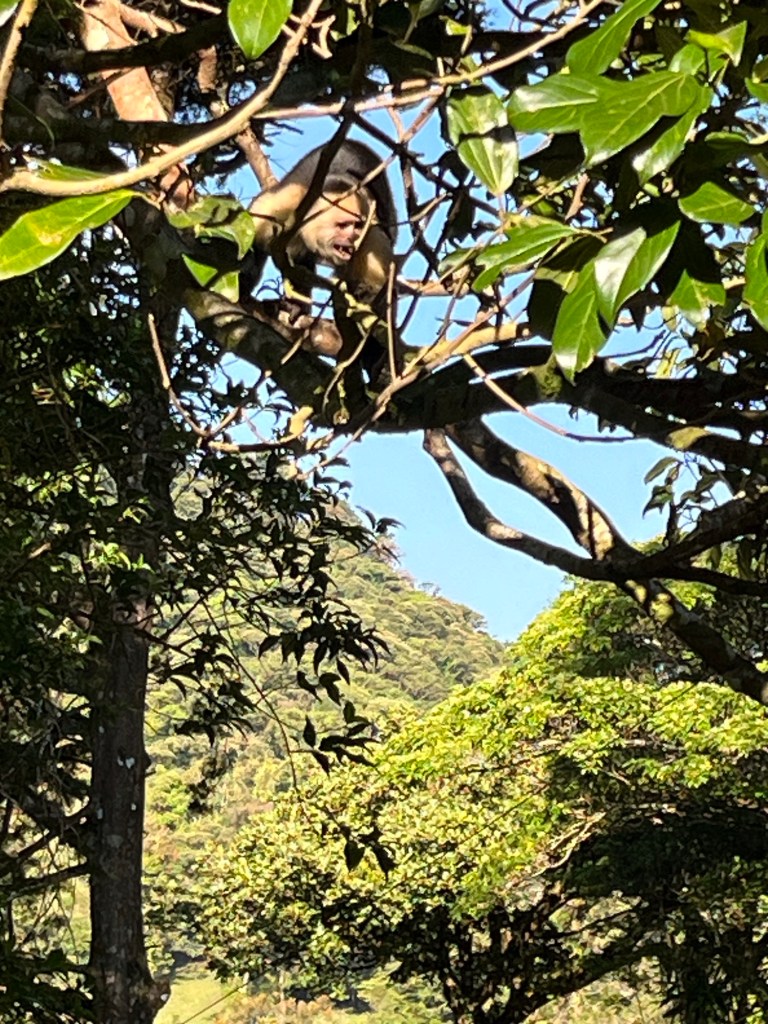
Peter was outside watching the oropendolas when he yelled “Monkeys!” “Denise, come quick!”  We all grabbed our cameras and phones and ran outside.  From the yard we could see several white-faced monkeys, snapping off the bromeliads in the trees and eating the juicy base of each plant.  Cute.  So cute. 

We keep moving around to get a better look—first outside the house under the trees and then on to the balcony as the monkeys got closer and closer. 

Now we realized there weren’t just several monkeys, but a lot of monkeys. 

They rip off the bromeliads and eat the base of each plant

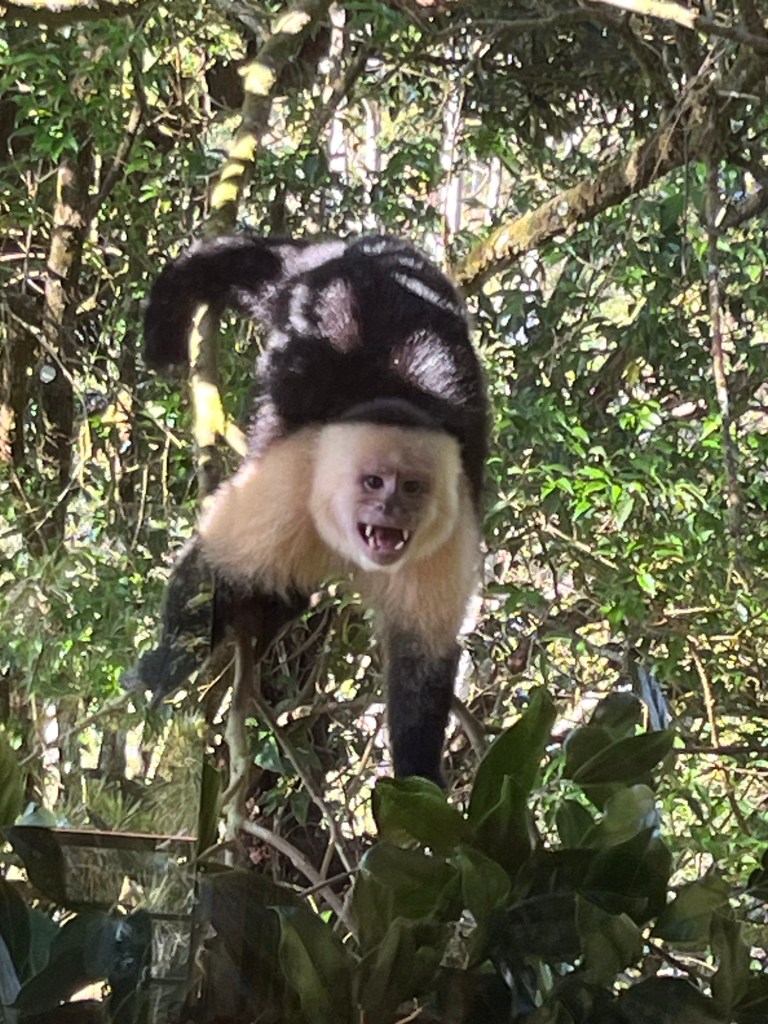
We were happily snapping photos and taking videos when we saw a large male getting closer and closer.  He was focused on us.  Maybe even glaring at us.  We just kept taking pictures of the cute ones.

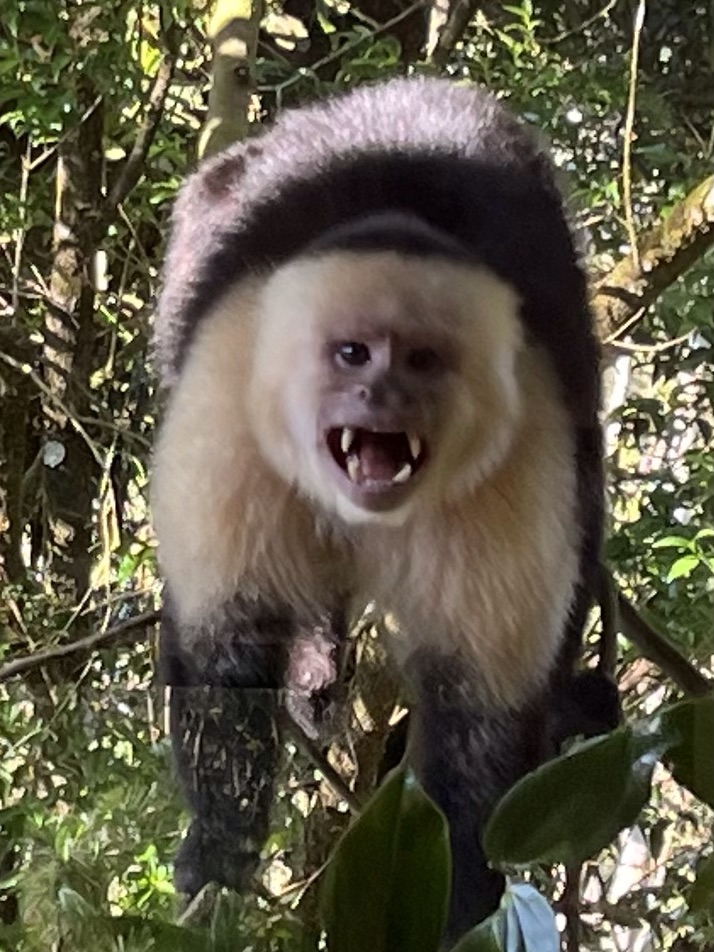
And he kept moving closer until he was on a branch just ten feet or so from our balcony viewing point.  We continued taking pictures. Obviously, we missed his message.  The fangs came out, the snarling began.  He started charging up and down the branch very excitedly now only a few feet from us. 

Wisely, we quickly retreated inside, closed and locked the sliding glass door, and watched from a  large bedroom window. He glared at us through the window, and then for emphasis he snapped a large branch off and threw to the ground. 

But as a final parting gesture, he turned around, pointed his ass at us, and shit.  Yes, we did indeed get the message.  

About a half an hour later, we were in the kitchen retelling the story when he showed up again outside the sliding glass door, snarling at us. He broke another branch off an ornamental tree. And then with special emphasis grabbed the lid off the recycle bin and tossed to the ground looking straight at us! So there! Just in case we hadn’t received the earlier message. We locked the kitchen sliding glass door, and every other door and window in the house. 

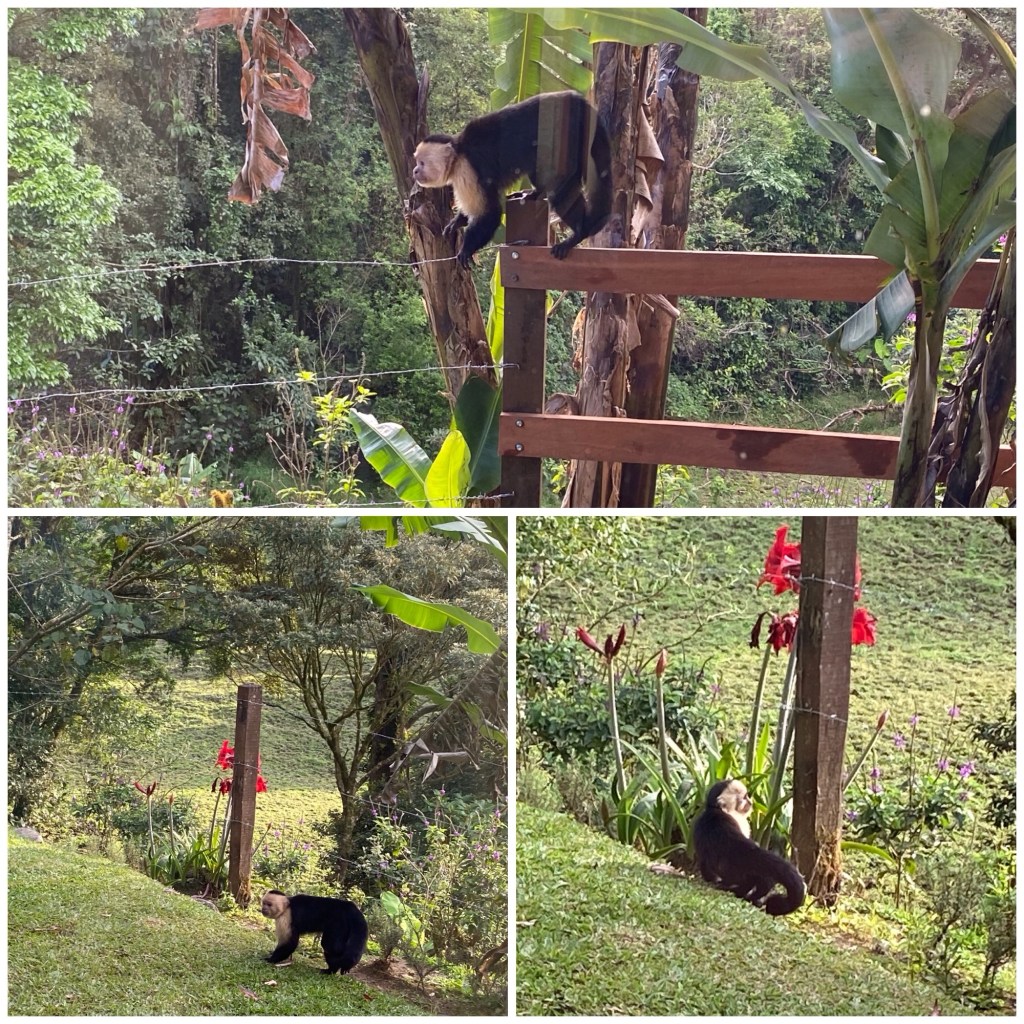
Sitting in the living room, we watched the whole troop march by, babies and all, as though they were patrolling the perimeter of their territory.

We worried. Could we make it to the car to go to dinner? As we left that evening we were startled to see a white faced monkey sitting by the car.  Was it him?  Waiting in ambush?  The monkey ran to the other side of the car. We drew straws to see who had to go out first.  

That night Denise didn’t sleep very well.  Every unidentified sound might be a monkey trying to break in.  

But she had seen her monkeys.  

Changes

Change is good, right?  Progress is important, right?   New is better, right?  

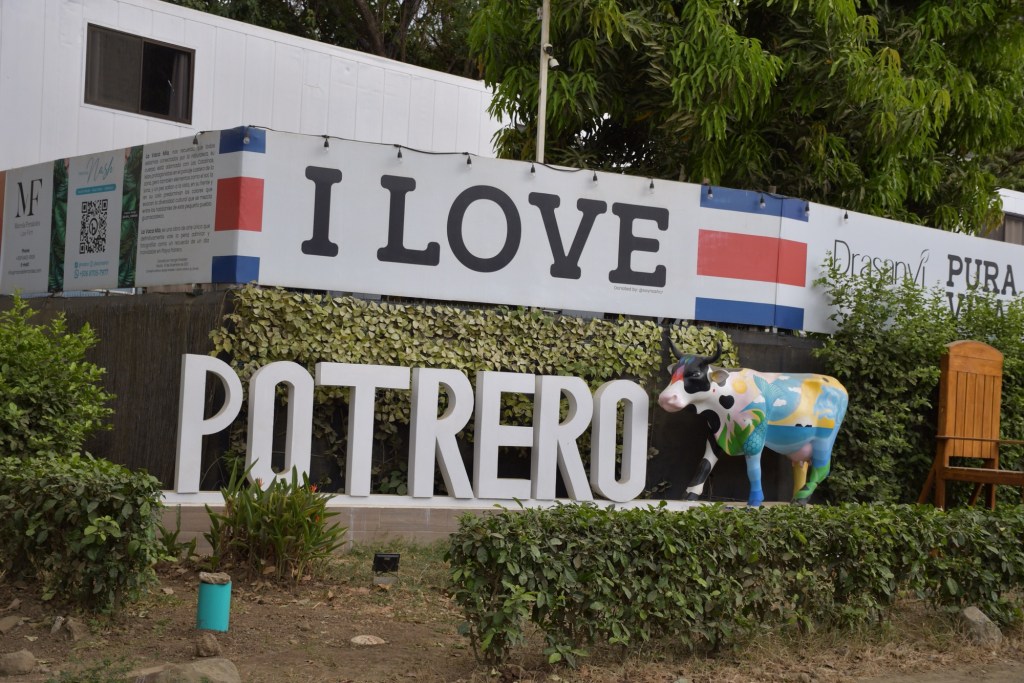
Coming back to our favorite corner of Costa Rica, Potrero and Playa Flamingo on the Nicoya Peninsula for the fifth time in eight years, we’re not so sure.  Maybe.  

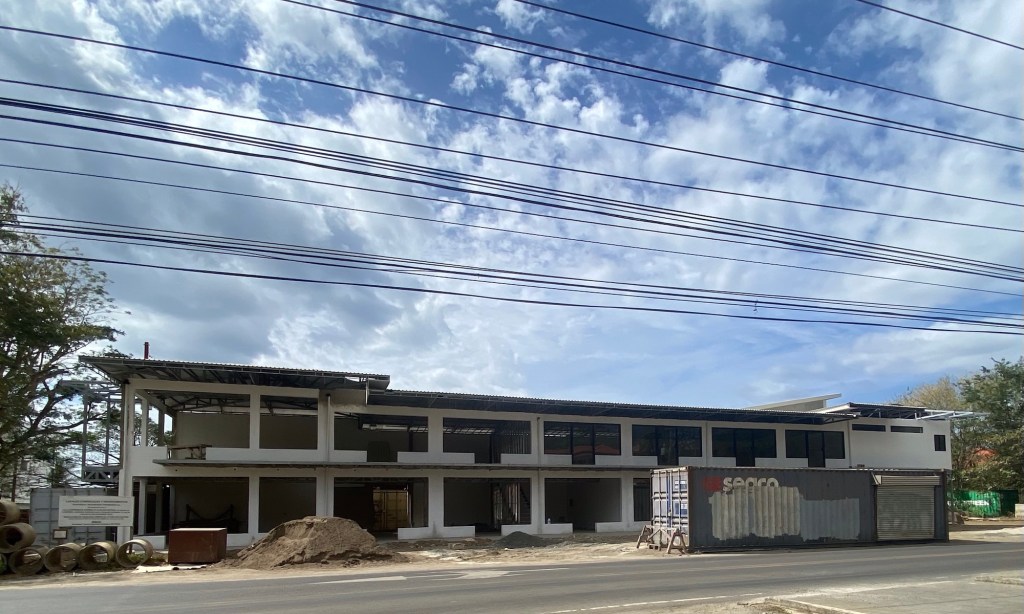
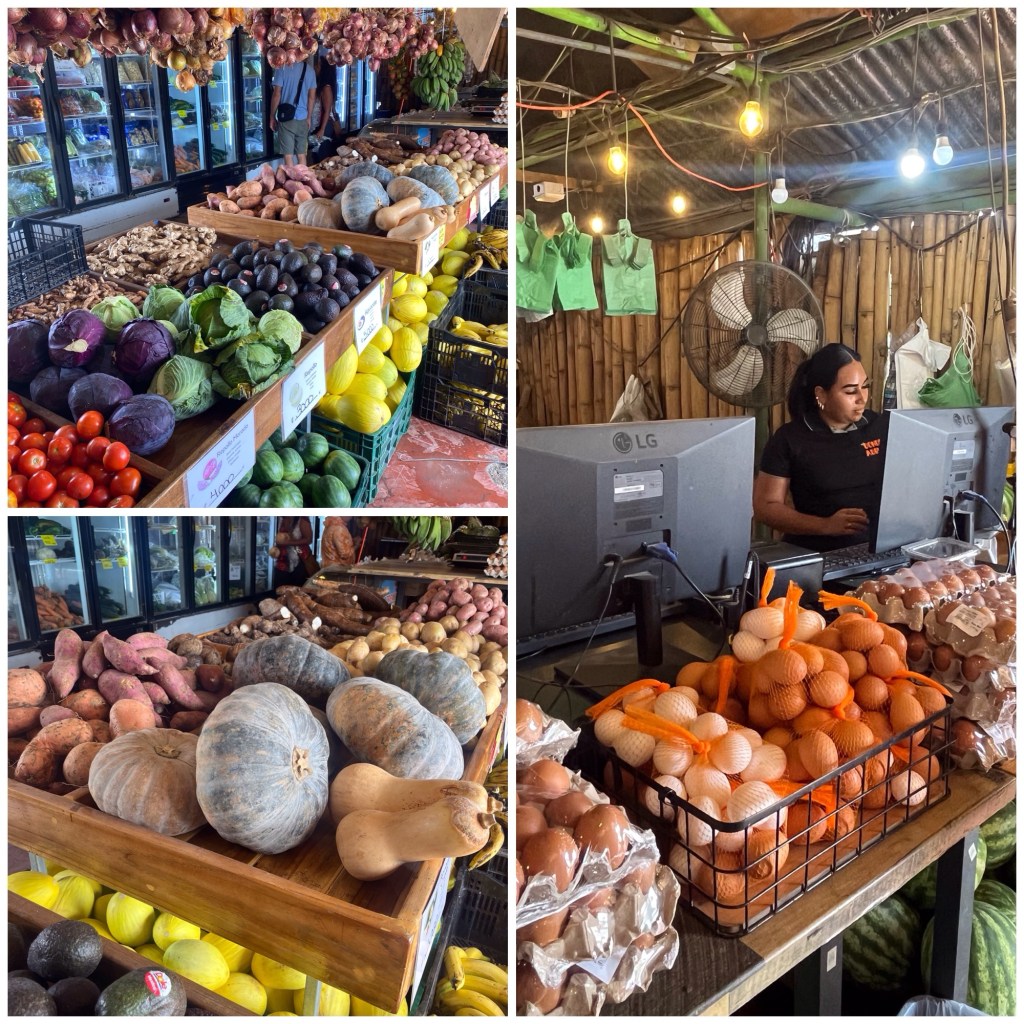
Gone are the two little funky stands where we bought our wonderful fresh fruits and vegetables.  One is being replaced by a modern office complex.  The other is permanently closed.  

Our favorite little fruit stand used to be here. 

Now we have to drive 20 minutes south to the closest produce stand.

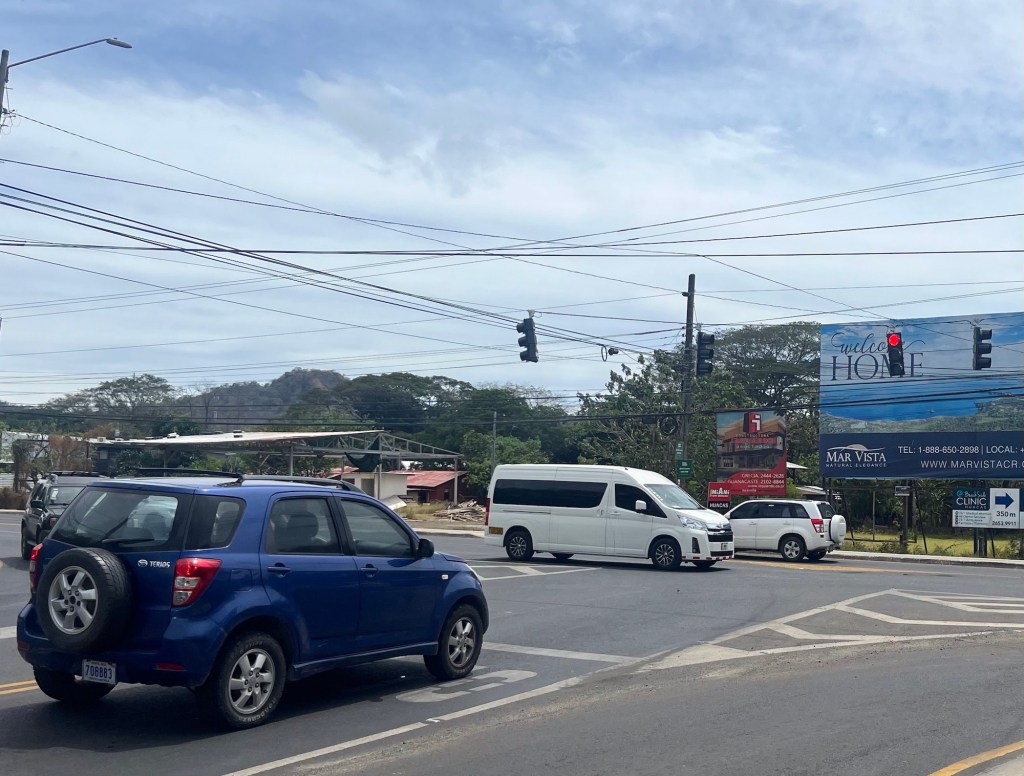
Why did the local fruit stands close? Why did several of the smaller soda restaurants we liked disappear?  Probably the land was too valuable for mom and pop businesses. New homes, office complexes, storage units, medical facilities, and a huge new gas station have sprung up in the last year.  We even have the first ever stop light in the region in nearby Huacas!  And God knows, with the increase in traffic that was one change that was really needed.  

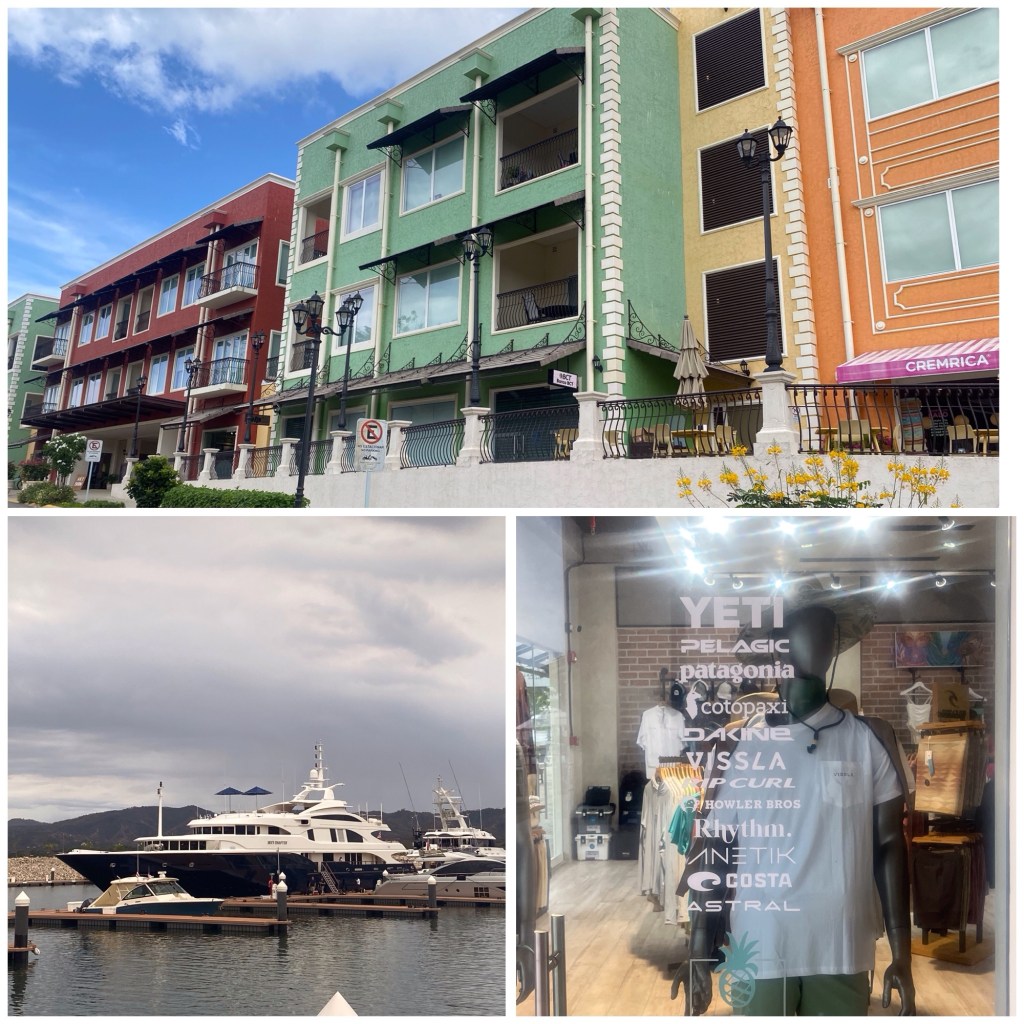
The very upscale Playa Flamingo Marina is finally open with an elegant collection of shops and restaurants, and, yes, a helicopter pad that seems quite busy ferrying in guests. 

The new Marina which will be doubled in size in a year or two with even more upscale products for tourists and the yacht crowd

When we first came eight years ago, the bay was filled with humble pangas and a few fishing charters—all moored on buoys.  Now there are a few mega yachts and dozens of smaller yachts in the new marina. The super mega yachts are too big for the marina and have to drop anchor in the bay and send their tenders in. We have seen a few of those lately, including Starbuck’s Howard Schultz’s 254 ft yacht Pi. But no worries, there are plans in the near future to provide super mega yacht moorage, double the size of the marina’s commercial space and add a 200 “key” hotel (not 200 rooms because apparently the each unit will have several rooms).

Just today the first ever cruise ship, The World,  pulled into Potrero Bay—it’s a luxury residential ship where “condos” start 2.3 million.  But no where to dock…yet.  

“The World” a floating condo in Potrero Bay

And with the all the new development, prices have risen accordingly.  A casado plate (the typical Costa Rican meal of rice, beans, some protein, plantains and a salad) in a local soda, a small family run restaurant, was $4-$6 dollars a few years ago is now typically $8-10.  A regular restaurant meal with a drink was $10-15 is now $20-25. Yes, still a bargain compared to our hometown Seattle prices—but not the incredible deal it used to be. And should you go to a “tourist” restaurant you will be paying nearly Seattle prices.

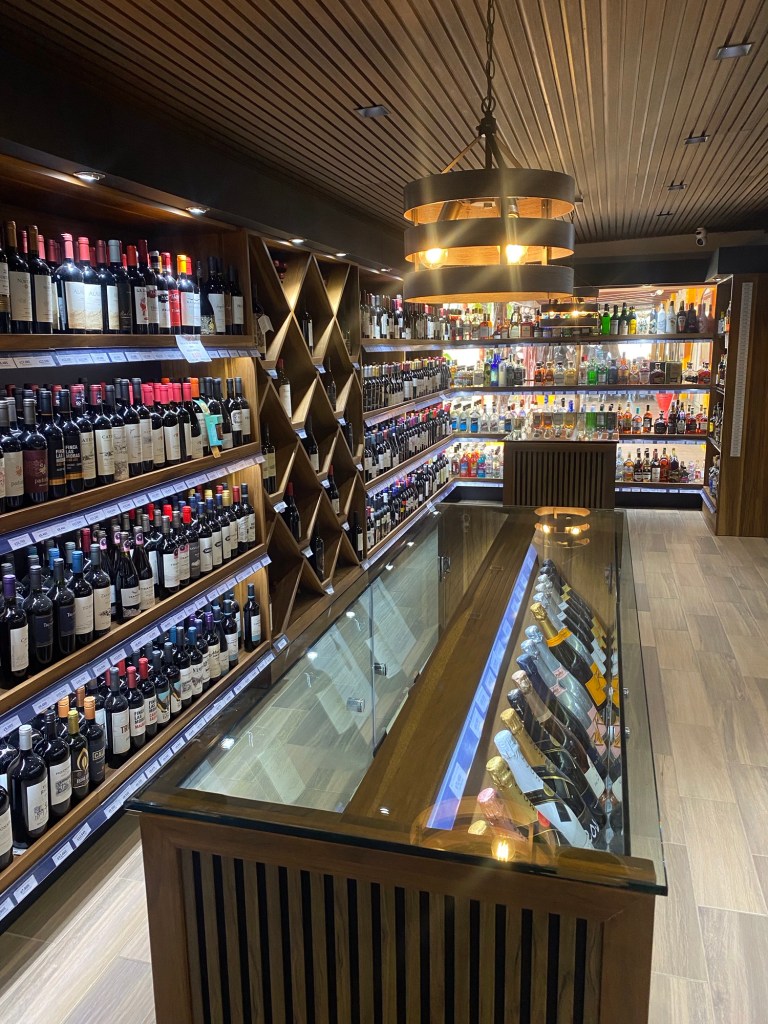
Our local grocery, the Massai Market always catered to the gringo crowd, but we also saw a fair number of Ticos as well. Now gringos dominate. The market has been upscaled and has a new, large refrigerated wine and spirits room—the selection would rival most U.S. stores.  Single malt whiskies, pricey bourbons, expensive grand cru wine, champagnes.  All at US prices. 

There is also another brand new grocery store — this one away from most of the new development and closer to the Tico area of town. It’s clientele is mainly locals so the changes aren’t just for the gringo crowd.

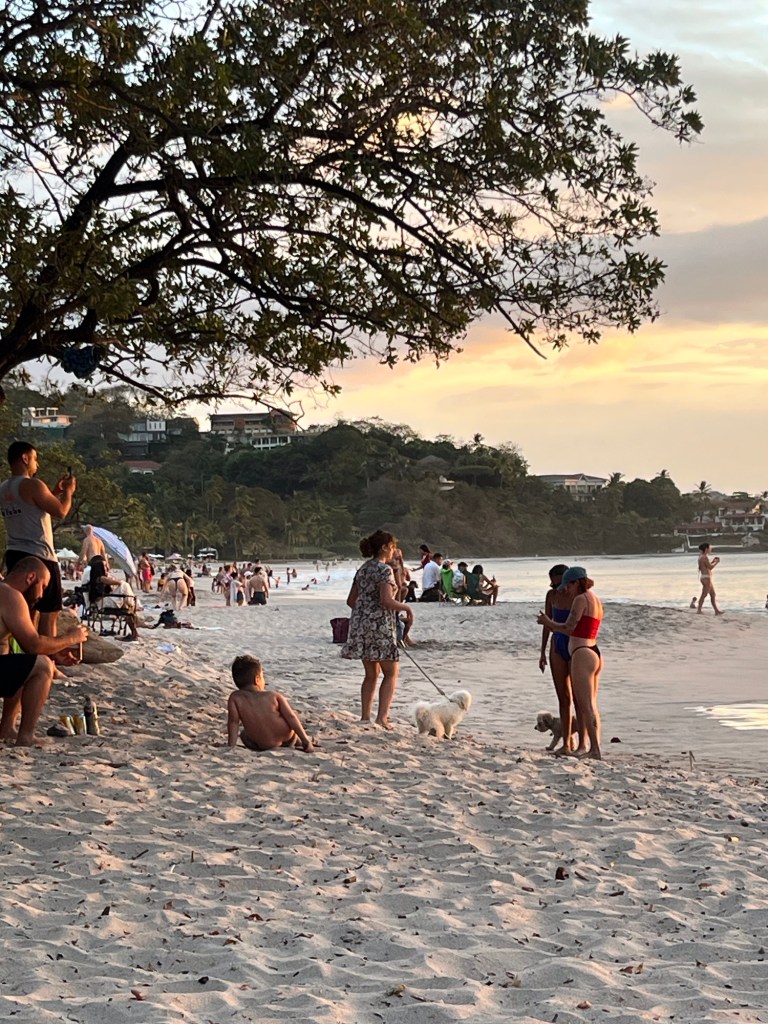
Maybe the good news is that despite all that is changed, much has remained as it always was.  The beaches are still uncrowded, particularly for our morning walks. We watch the sunset from the beach surrounded by locals—nary a gringo in sight. 

The Ticos are still warm, friendly people, the food is great, and the natural beauty of the area still awes. 

We also know that while we maybe missing the quaintness of mom and pop fruit stands, sodas, and a bay filled with pangas bobbing on mooring buoys, the Ticos here see more jobs, better pay, better infrastructure, better housing.  The biggest source of foreign income in Costa Rica is tourism.  Since we’ve been coming here we’ve seen a dramatic improvement the roads, cell coverage and internet. All huge pluses for the locals.  

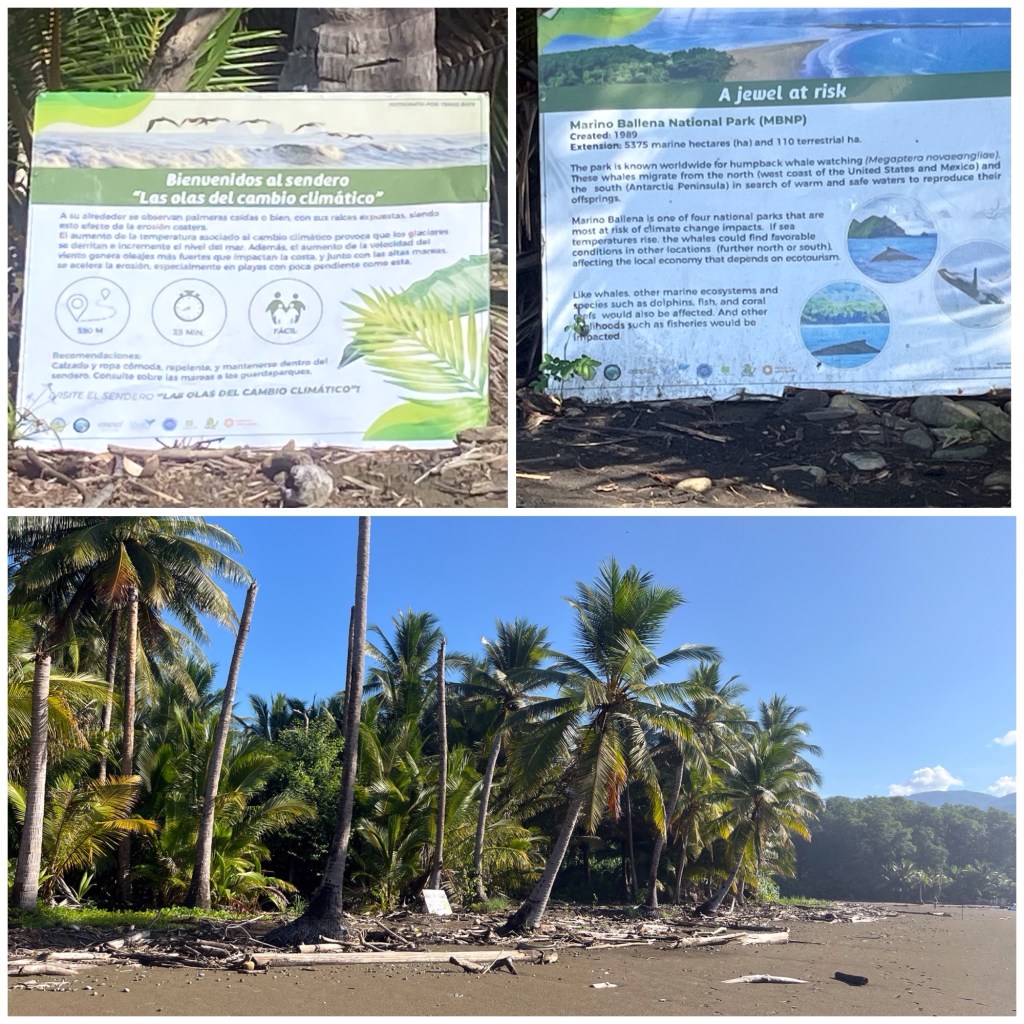
One change that is not welcome by the locals and the tourists alike is climate change.  On our way up to Potrero and Playa Flamingo, we stopped in Uvita at the Ballena Marine Park.  Along the beach there were signs in Spanish and English warning that rising seas were threatening pristine coastal areas and swaths of coconuts trees that lined the shore showed the damage.

Warning in Spanish about the “waves of climate change” and in English about the risk to the beaches while the damage to the trees is evident.

In Potrero last November, it rained for 21 straight days, causing massive flooding and cutting off whole communities for weeks.  Tourism came to grinding halt—causing a number of businesses to fold. The climatic forces that created the Cloud Forest are out of balance, potentially leading to loss of this precious ecosystem. Our guide in Santa Elena this year told us “summer” came just two days before we got here. And every year we come, Potrero seems to be a degree or two hotter.  The beaches here show the signs of high tides and storms eating into the headlands.  

Will we come back to Playa Flamingo and Potrero?  Probably.  Our thinking now is that we will continue to make forays into different parts of Costa Rica next year, looking for a bit of what captivated us on our first trip here and has lured us back again and again.  

Traveling on Our Stomachs

It was a tragedy in Madrid! We were catching the train to Valencia and Peter had packed our chef knives in his suitcase. We travel with our own knives—most rentals understandably have cheap sets. Dangerously dull. We had flown everywhere with this set, including a train ride in the EU just a year ago. But apparently laws and security have changed. Peter was pulled aside after his bags went through a metal detector. An officious security employee held each knife and the scissors up to a poster on the wall that showed an outline of a tiny pocket knife. He carefully measured each one—surprise, our knives were way too big. Our precious set was tossed into a locked metal bin never to be seen again. We had to muddle through at our rental home with the miserable set provided. Our knife sharpener could do little to improve them

Yes, we do travel on our stomachs. We often begin a visit to a new city or region with a food tour. And a great part of the enjoyment of any trip is hitting the open air markets, buying some produce and fixing a dinner. Any AirBnb we rent must have a good kitchen. It gives us a reason to linger as we walk through the food stalls. It opens up conversations with locals when you ask for advice on how to cook something we don’t see at home. Everyone in a food market loves food and most are eager to talk about it.

But even shopping European supermarkets brings us joy. Do you know how many different cuts of meat are available outside of the US? Whole chickens grouped by age, not packaged away in matching sets of pieces and sealed in uniform plastic trays. Beef cheeks (delicious when slowly braised in red wine with onions, garlic and some tomatoes), lamb breast or pork collar! Sure, you can hunt these cuts down in the US, but our local stores, as great as they are, rarely carry them.

The best souvenirs we bring home are food related — our cataplana from Portugal, chopstick rests from China, a special bottle of Spanish olive oil, an old cheese straining pot we found in a flea market in Provençe for less than a dollar.

So how do we pack for a trip where home cooking is going to be big part of the fun. First, a good knife set, (chef’s knife, a paring knife and a serrated blade) assuming you are traveling by plane or car. Lacking a good knife set, or for future train travel in the EU, a knife sharpener. A small meat thermometer and wine opener are essential. As room allows: a small hand grater, and a vegetable peeler.

Spices and seasonings are very important as well. Yes, we often bring some of our own. We think about where we’re going and what kinds of foods we will likely find. Whether the rental has a grill or an oven. What food items will be easy or impossible to acquire once we’re settled in. For years a small metal candy box served as the spice kit, filled with small plastic cups of our favorite spices. The box suffered damage on the last trip. So now we are using glass vials Costco sold vanilla beans in—wrapped in a kitchen towel because most rental kitchens have only one or two towels. We also use small plastic condiment cups with lids saved from our favorite take-out spots or purchased at our local restaurant supply store.

We never packed liquids until this year. In Spain last fall we were given home pressed olive oil in a glass bottle. We had to get it home safely. Cut up a yoga mat, wrap the bottle, put it in a cardboard tube. Presto! Problem solved. So on our trip to Costa Rica a small bottle of fish sauce went in that tube, and along with some other spices and some added cushioning; it arrived just fine. We knew the good produce available in Costa Rica would lend itself to Asian cuisine — stir frys, Asian salads skewers of chicken and pork. Interestingly, we found Costa Rican brands of soy sauce and other Asian seasonings in most grocery stores!

Knowing we have some basic spices, we start with a very flexible shopping list, grouping food items based upon recipes or dishes we want to cook. If a critical ingredient isn’t to be found, the recipe gets tossed. We were going to make a Thai dish with ground chicken, coconut milk, lime peel and a few other things. No ground chicken. Flipped the recipe to chicken lettuce wraps, using whole chicken breasts we minced. You have to be flexible. Yesterday I found some handmade tortillas for sale at a produce stand! Street tacos for dinner tonight!

And, of course, some destinations are easier than others. In France? Ou la la! Grab pastry dough at the supermarket, local goat cheese at the fromagerie, and zucchini or mushrooms or sweet peppers from the farmers market. Viola! A vegetable, cheese tart. Add some lettuce tossed with a vinaigrette. A fabulous dinner. It’s a little tougher in other areas where farmers’ markets are few and the supermarkets are less grand. But still doable. As long as you have WiFi or cell reception, you don’t need to pack a cookbook. And we have downloaded a recipe app that allows us to take our old reliable recipes on the road.

Meals can be super simple — some charcuterie, some cheese, a jar or two of artichoke or tapenade, a loaf of bread and some olives or pickled vegetables from the market.

On the other hand, our evening’s entertainment is opening a bottle of local wine, fixing a dinner with the local ingredients and enjoying the comforts of our rental home. It all fits in with our mode of travel — go slow, eat good food and soak in the ambiance.

We just have to be sure to walk a lot so we can fit in our clothes on the way home.