Monkey Wars

So, so cute!  Really, who couldn’t love monkeys?

They are definitely part of the Costa Rican nature experience.  Every other time we’ve been to Costa Rica we’ve encountered them.  In nature preserves and national parks, next to our rentals, near restaurants, hanging on the power lines.  Even watched them from an infinity pool on the Osa peninsula.   They are everywhere. We’ve seen three of the four species in the country—howlers, white-faced, and spiders. The only one we haven’t seen is the very rare squirrel monkey.

But this trip we’ve only had a fleeting glimpse of them — very disappointing.  In fact, one of our travel companions, Denise, an animal lover, was quite upset and worried that she would get back home never having seen a monkey.  And we were coming to the end of our visit. It was our last four days and we were now up near Monteverde in the Cloud Forest. Desperation time!
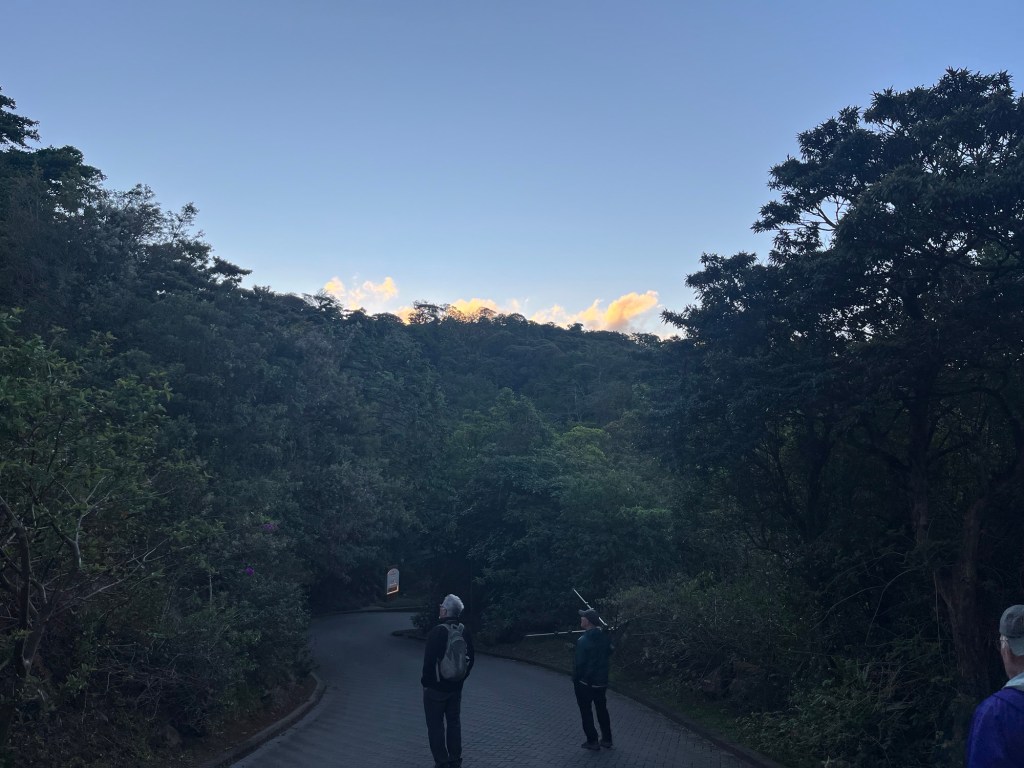
Early morning birding near Curi-Concha Reserve, but no monkeys

We had an easy solution.  We’d been told by our favorite birding guide, Adrian Mendez, [adrianmendez@hotmail.com] if you want to see the white-faced monkeys, go to Stella’s, a local coffee shop. You’ll definitely see them there busily trying to steal food from unsuspecting patrons eating outside.  It reminded us of our first encounter years ago when they tried to grab our backpacks in Manual Antonio National Park. The park now bans tourists from bringing in any food because the monkeys got so used to human food they couldn’t feed themselves and died off during Covid when the park was closed for two years.  So we were all set to head to Stella’s for a lunch for our up close and personal encounter with monkeys.

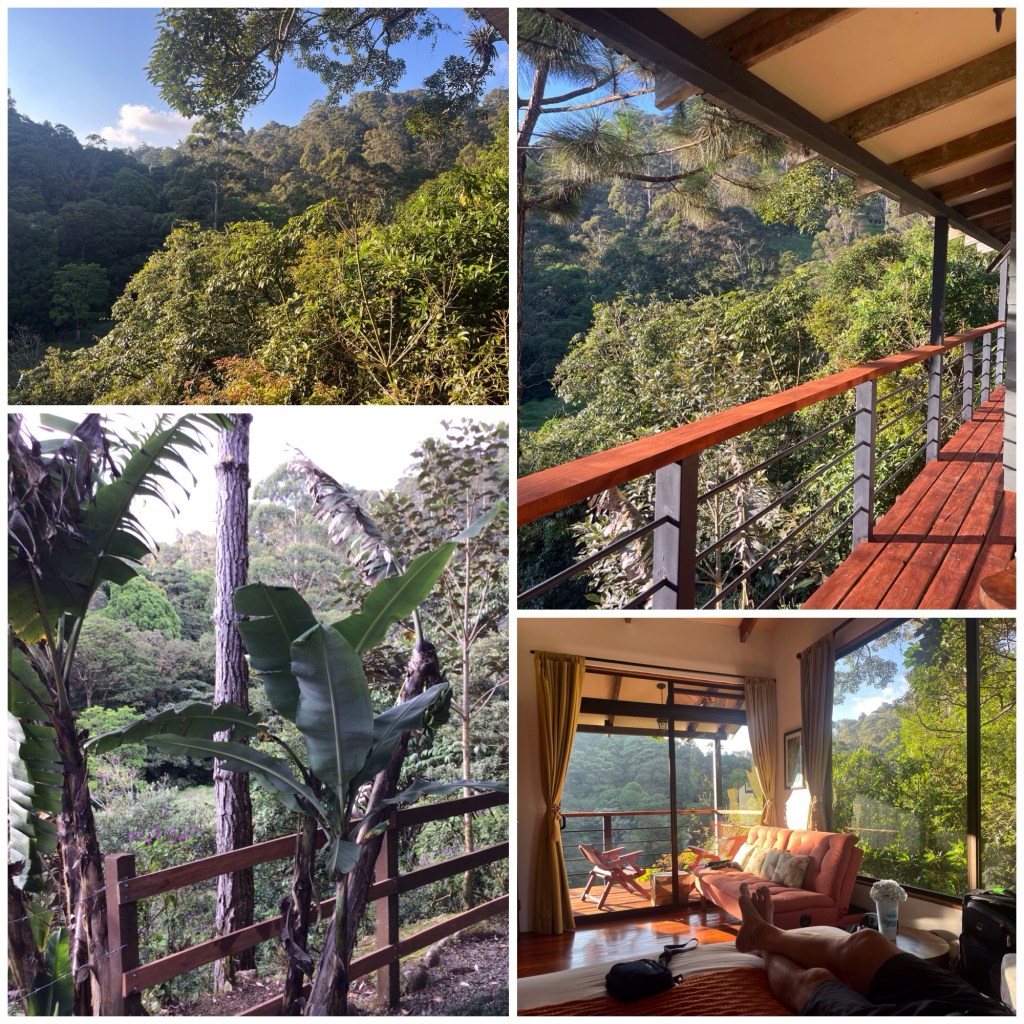
But as luck would have it, we didn’t have to leave our vacation rental at all. We had booked a lovely rental outside of Santa Elena.  Beautiful serene setting, lovely views of trees complete with a stream just below our house, and surrounded by the Cloud Forest jungle.  We could sit on our wrap around  balcony and bird watch from armchairs. 
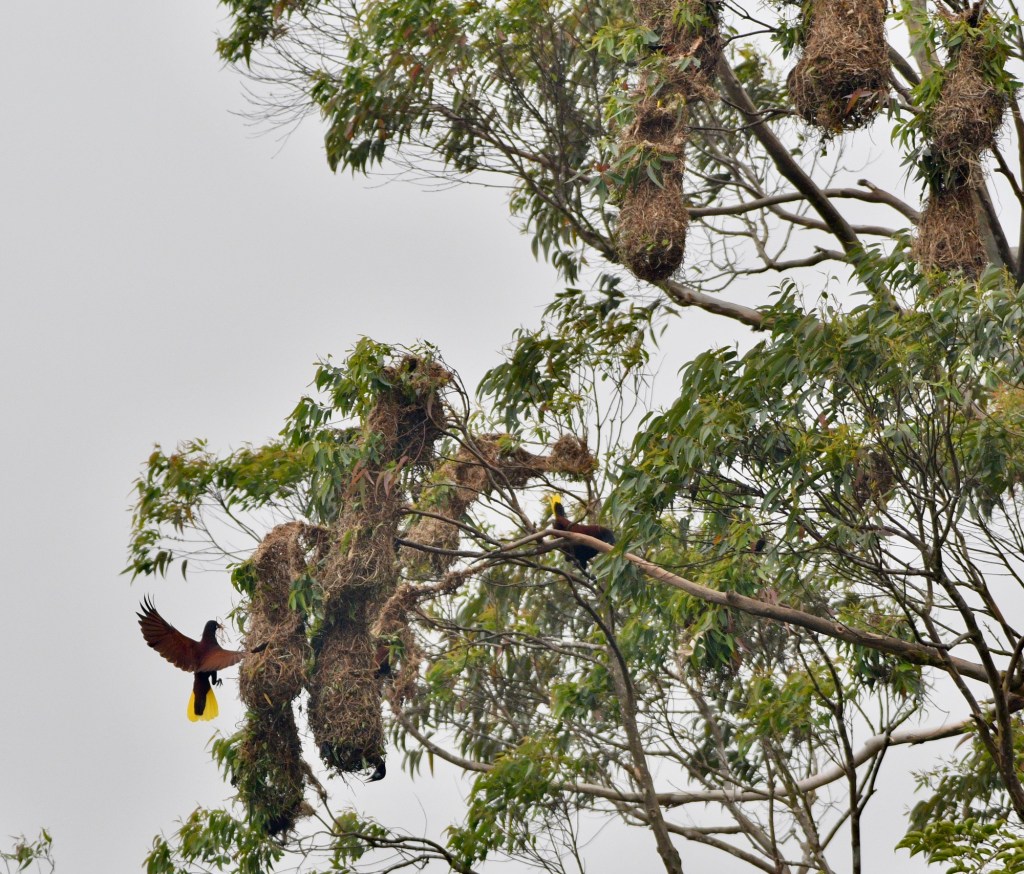
Nearby there was a large colony of Montezuma oropendolas. It is a spectacularly beautiful bird with a very unpleasant, noisy call.  The birds build large hanging nests high up trees—an amazing feat of engineering given the high winds in this region. 
Peter was outside watching the oropendolas when he yelled “Monkeys!” “Denise, come quick!”  We all grabbed our cameras and phones and ran outside.  From the yard we could see several white-faced monkeys, snapping off the bromeliads in the trees and eating the juicy base of each plant.  Cute.  So cute. 

We keep moving around to get a better look—first outside the house under the trees and then on to the balcony as the monkeys got closer and closer. 

Now we realized there weren’t just several monkeys, but a lot of monkeys. 
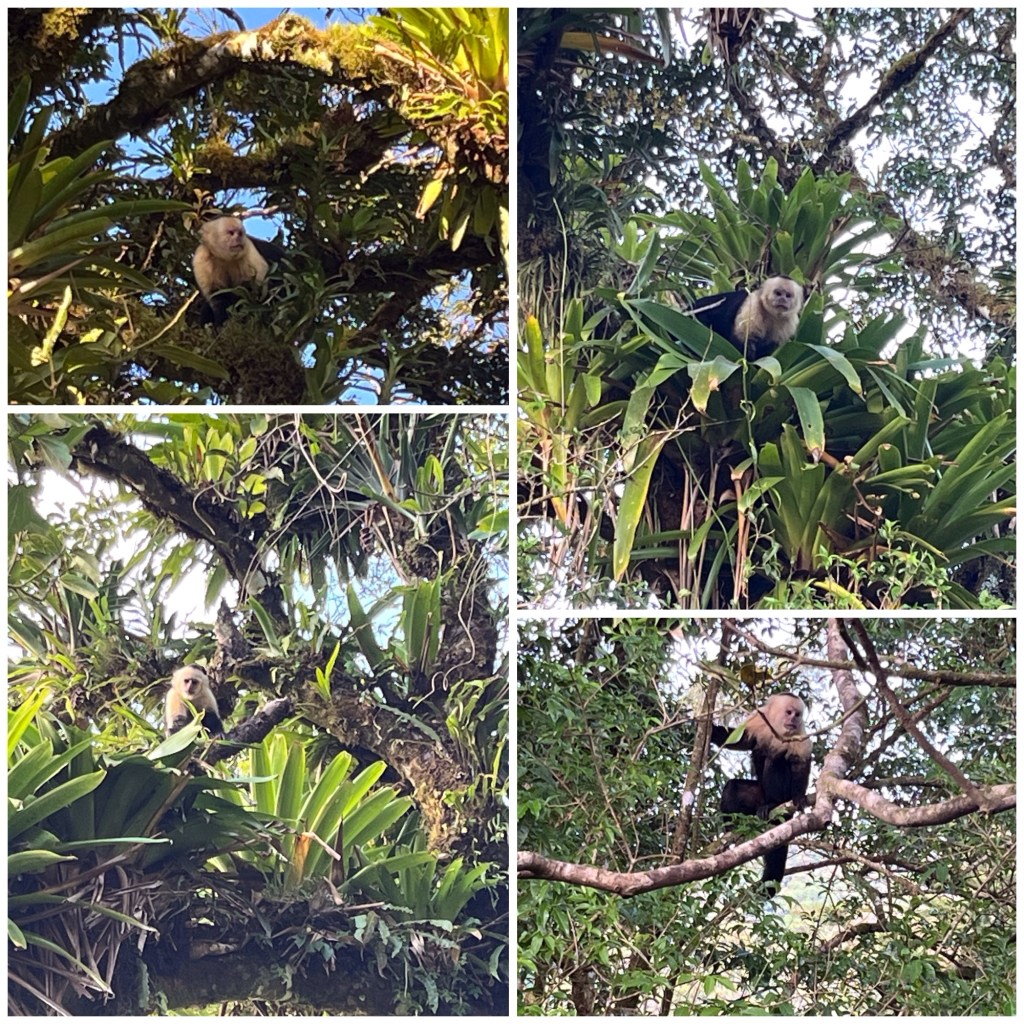
They rip off the bromeliads and eat the base of each plant

We were happily snapping photos and taking videos when we saw a large male getting closer and closer.  He was focused on us.  Maybe even glaring at us.  We just kept taking pictures of the cute ones.
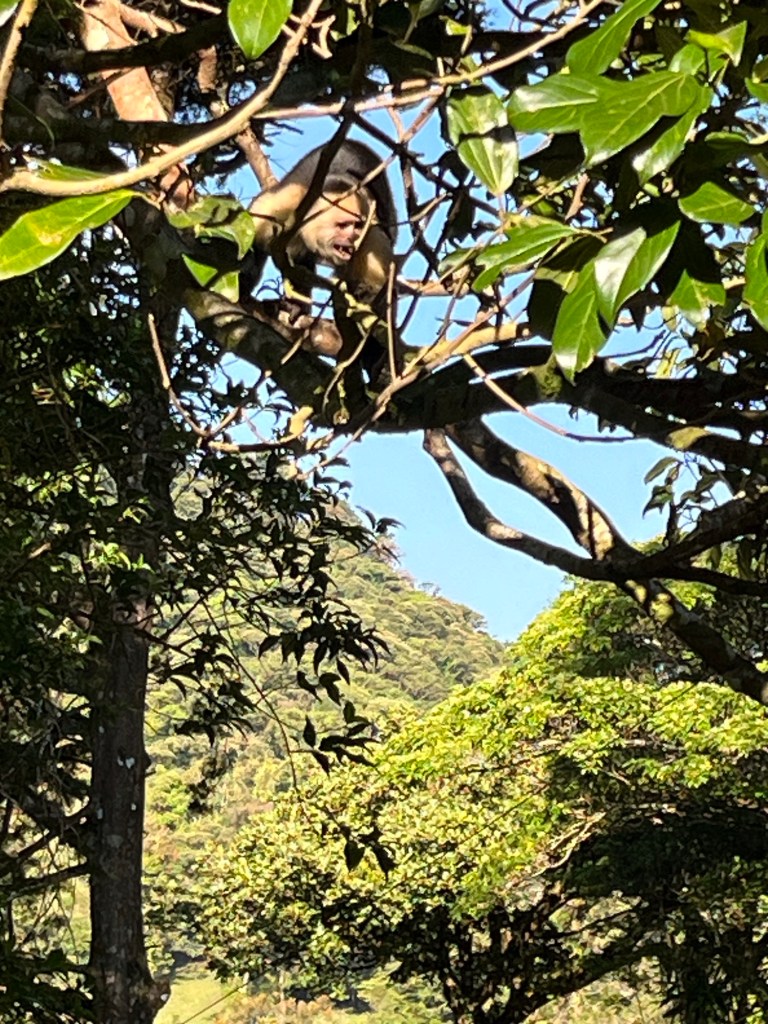
And he kept moving closer until he was on a branch just ten feet or so from our balcony viewing point.  We continued taking pictures. Obviously, we missed his message.  The fangs came out, the snarling began.  He started charging up and down the branch very excitedly now only a few feet from us. 
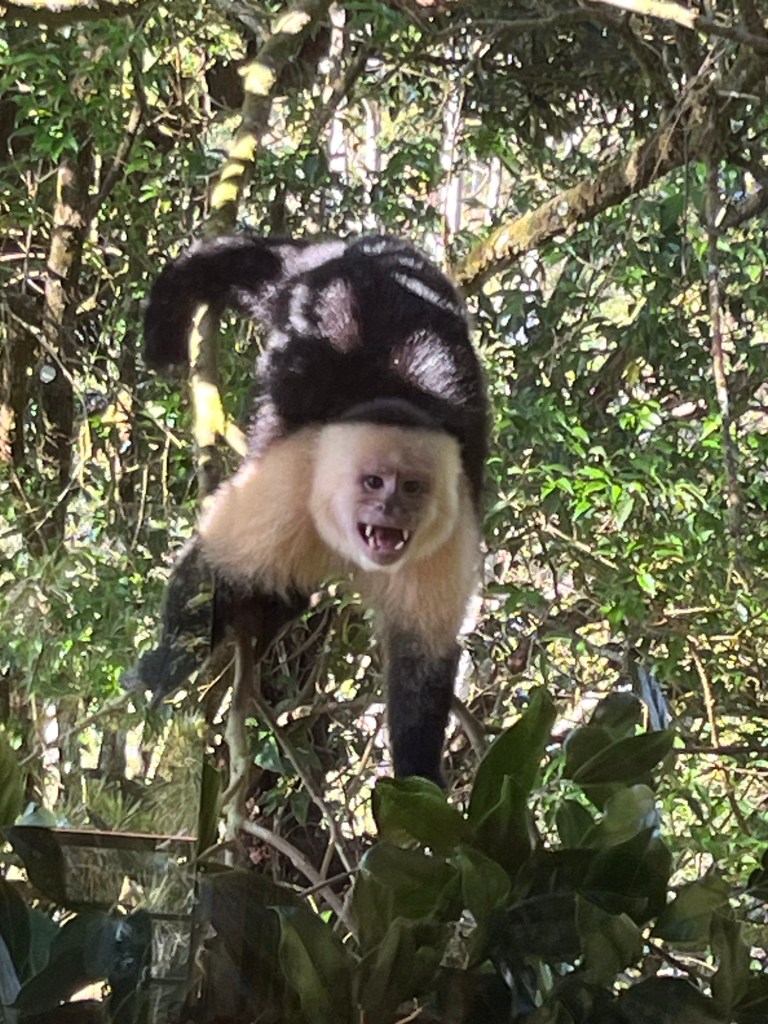
Wisely, we quickly retreated inside, closed and locked the sliding glass door, and watched from a  large bedroom window. He glared at us through the window, and then for emphasis he snapped a large branch off and threw to the ground. 
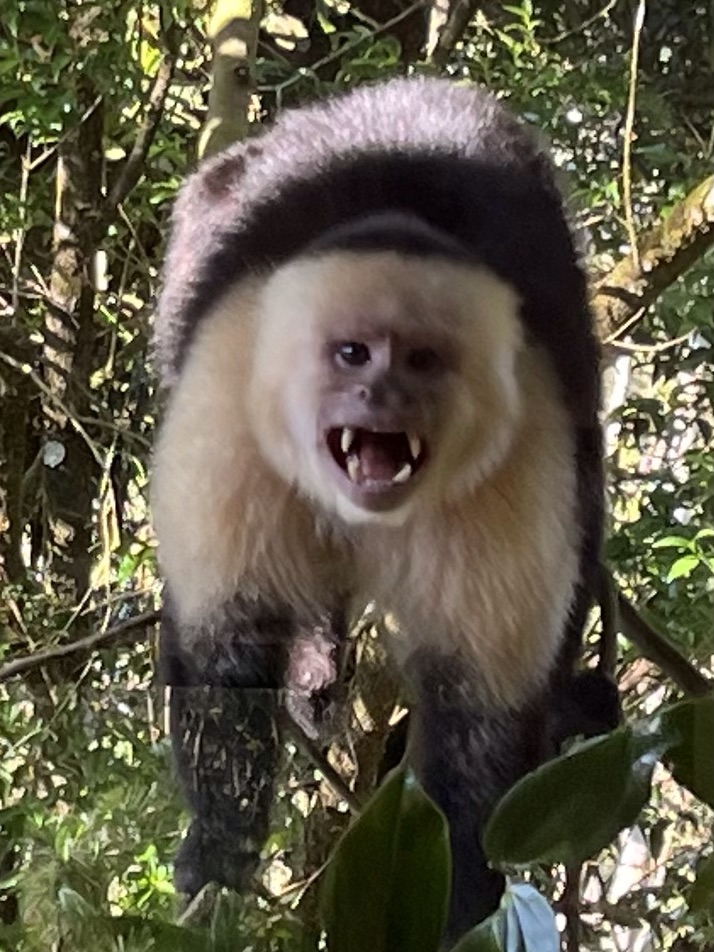
But as a final parting gesture, he turned around, pointed his ass at us, and shit.  Yes, we did indeed get the message.  

About a half an hour later, we were in the kitchen retelling the story when he showed up again outside the sliding glass door, snarling at us. He broke another branch off an ornamental tree. And then with special emphasis grabbed the lid off the recycle bin and tossed to the ground looking straight at us! So there! Just in case we hadn’t received the earlier message. We locked the kitchen sliding glass door, and every other door and window in the house. 
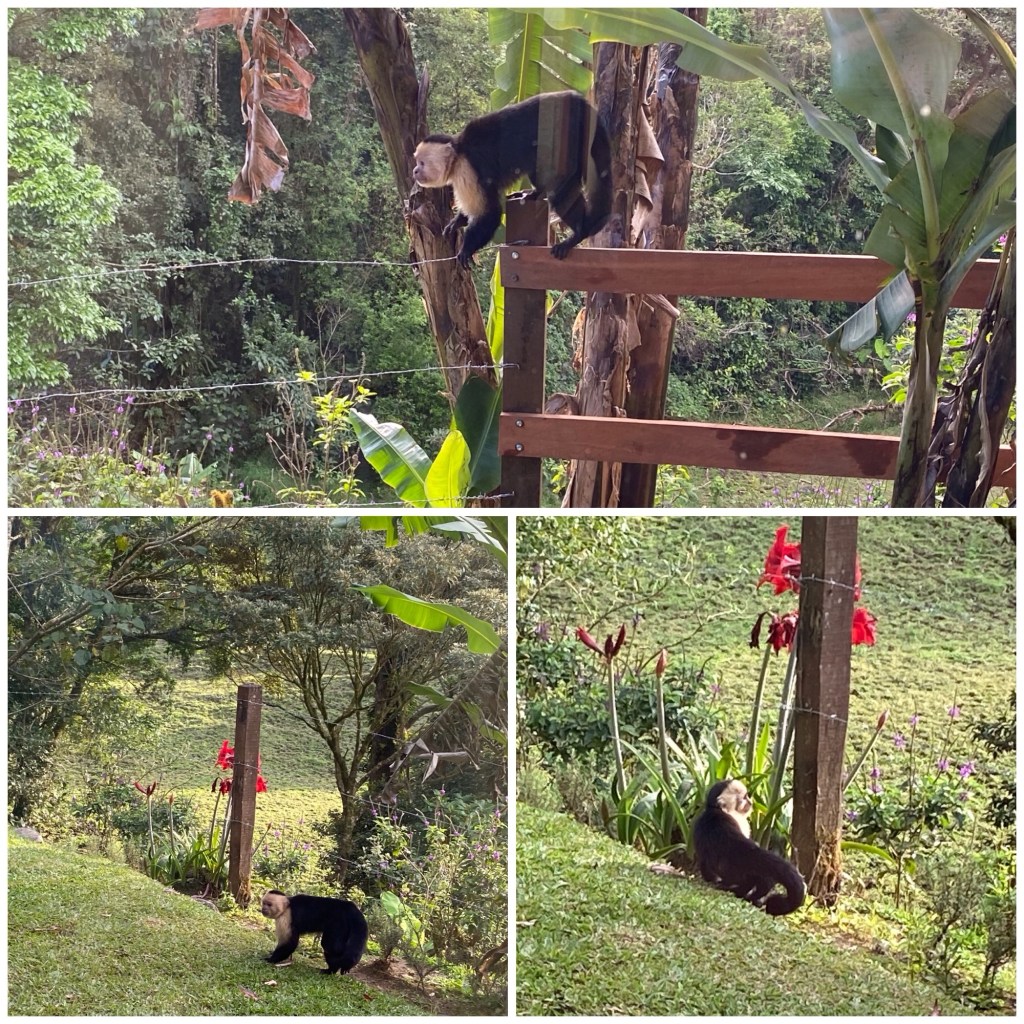
Sitting in the living room, we watched the whole troop march by, babies and all, as though they were patrolling the perimeter of their territory.

We worried. Could we make it to the car to go to dinner? As we left that evening we were startled to see a white faced monkey sitting by the car.  Was it him?  Waiting in ambush?  The monkey ran to the other side of the car. We drew straws to see who had to go out first.  

That night Denise didn’t sleep very well.  Every unidentified sound might be a monkey trying to break in.  

But she had seen her monkeys.  
Changes

Change is good, right?  Progress is important, right?   New is better, right?  

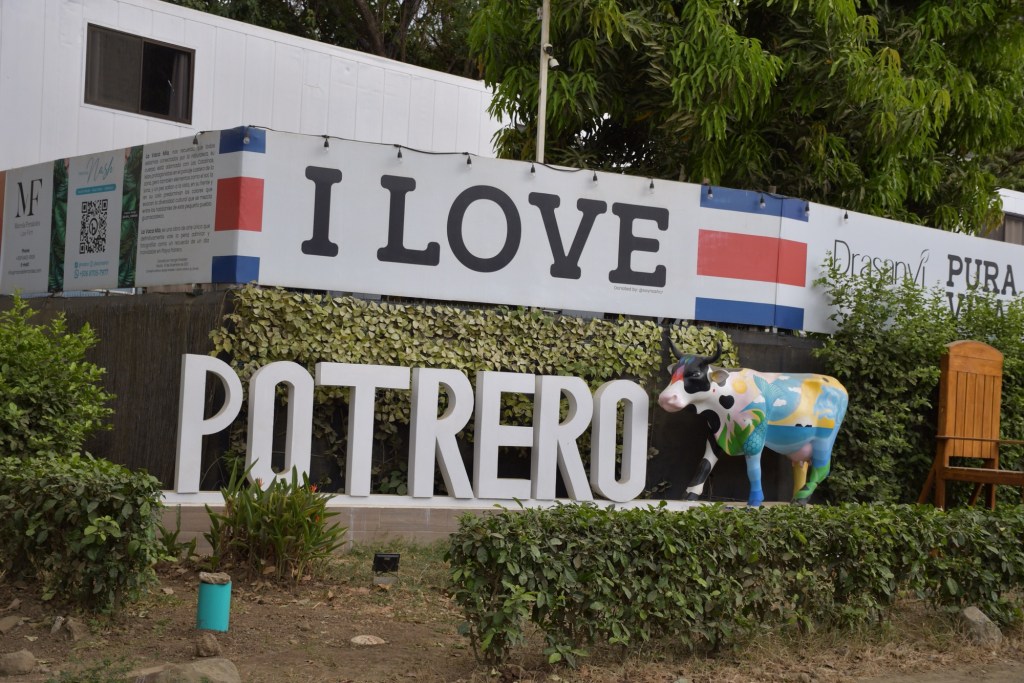
Coming back to our favorite corner of Costa Rica, Potrero and Playa Flamingo on the Nicoya Peninsula for the fifth time in eight years, we’re not so sure.  Maybe.  

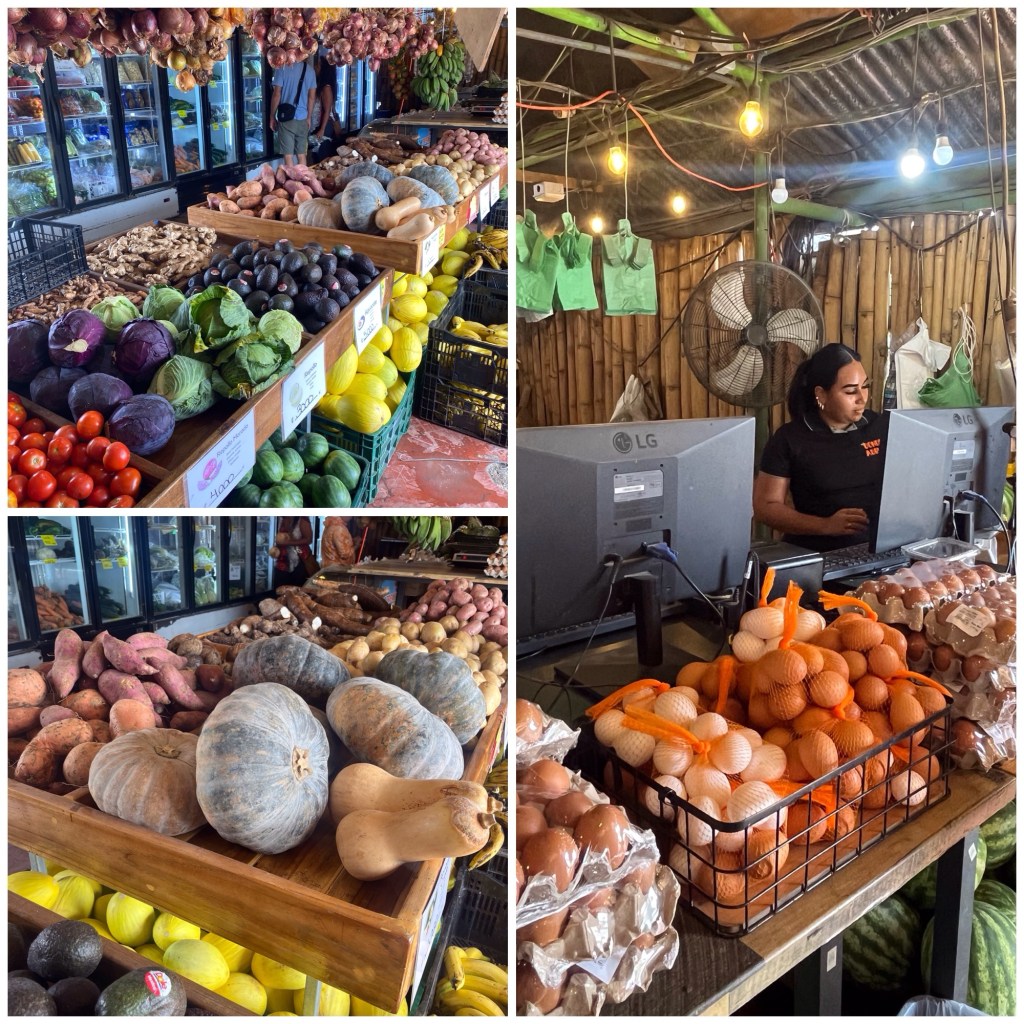
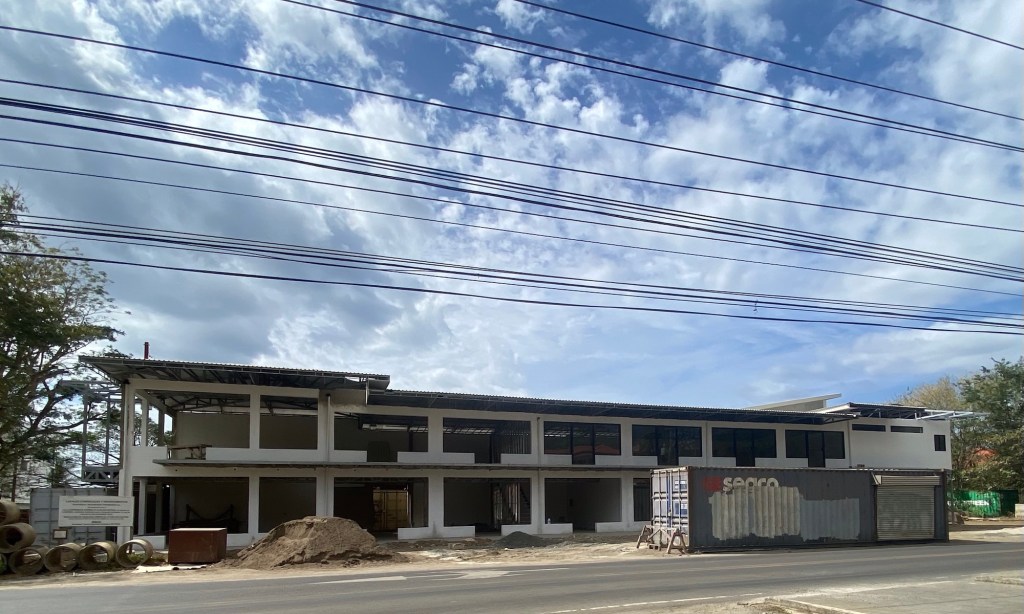
Gone are the two little funky stands where we bought our wonderful fresh fruits and vegetables.  One is being replaced by a modern office complex.  The other is permanently closed.  

Our favorite little fruit stand used to be here. 

Now we have to drive 20 minutes south to the closest produce stand.

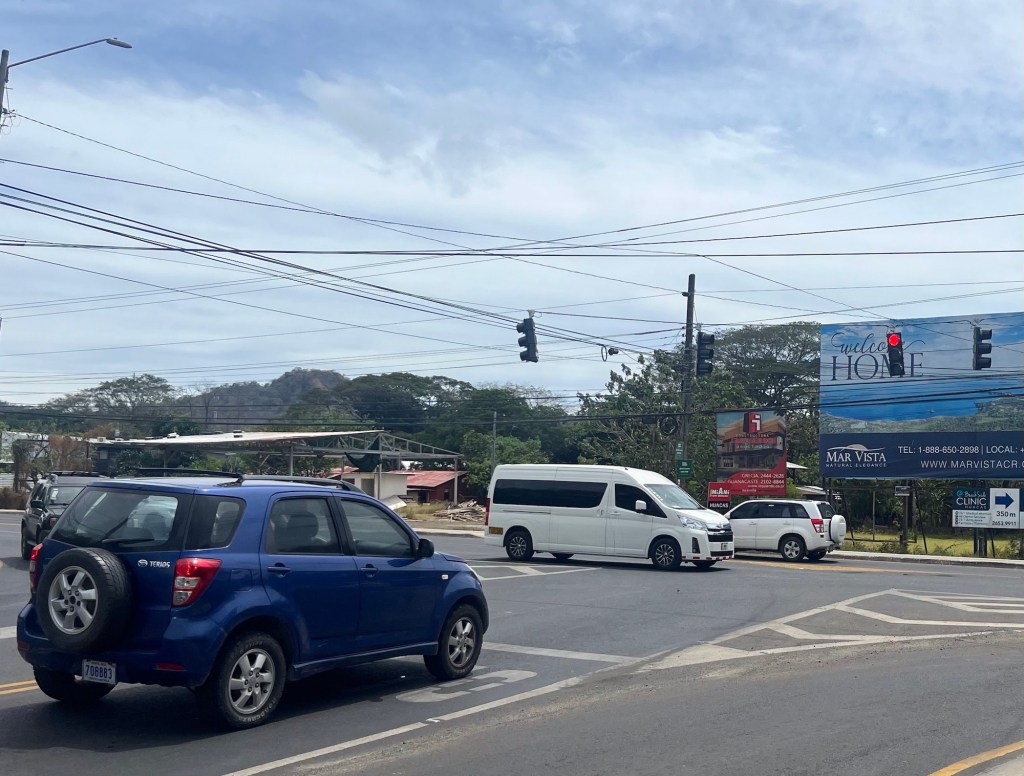
Why did the local fruit stands close? Why did several of the smaller soda restaurants we liked disappear?  Probably the land was too valuable for mom and pop businesses. New homes, office complexes, storage units, medical facilities, and a huge new gas station have sprung up in the last year.  We even have the first ever stop light in the region in nearby Huacas!  And God knows, with the increase in traffic that was one change that was really needed.  

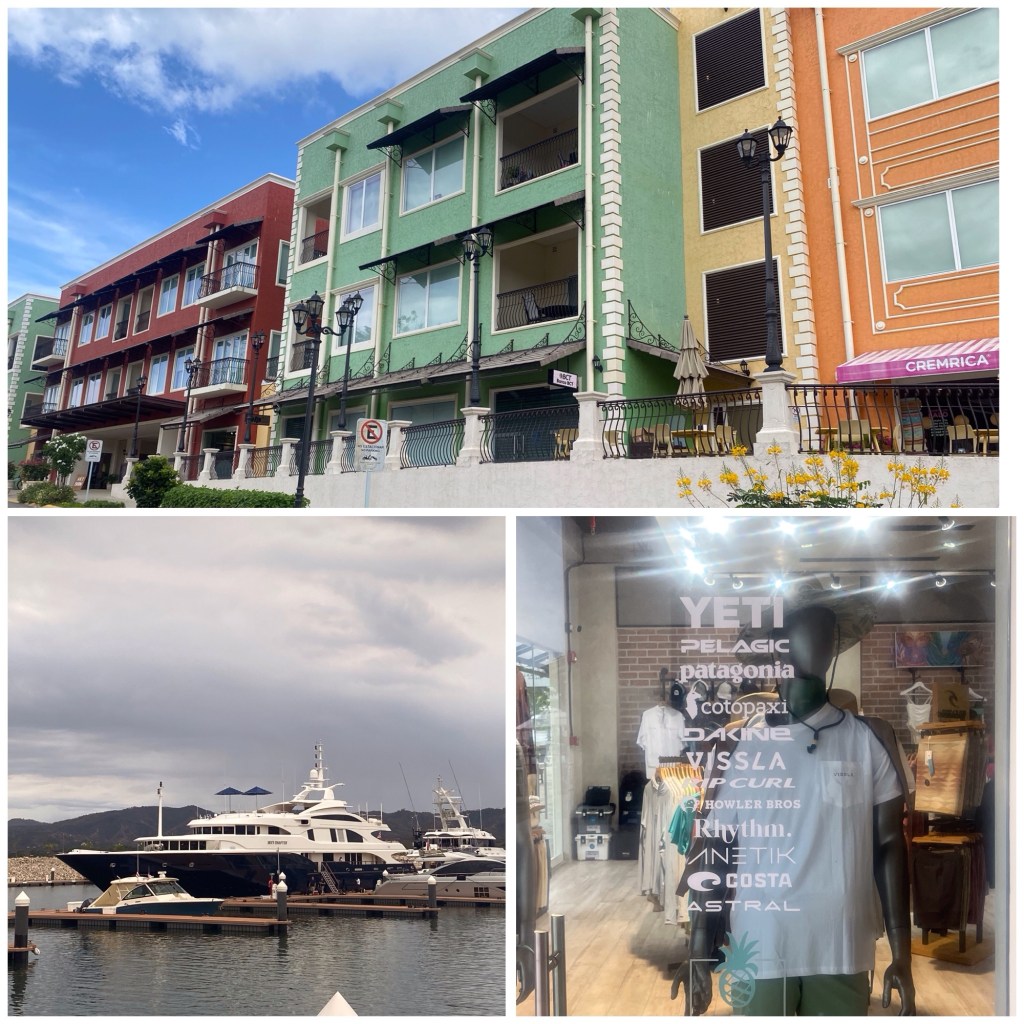
The very upscale Playa Flamingo Marina is finally open with an elegant collection of shops and restaurants, and, yes, a helicopter pad that seems quite busy ferrying in guests. 

The new Marina which will be doubled in size in a year or two with even more upscale products for tourists and the yacht crowd

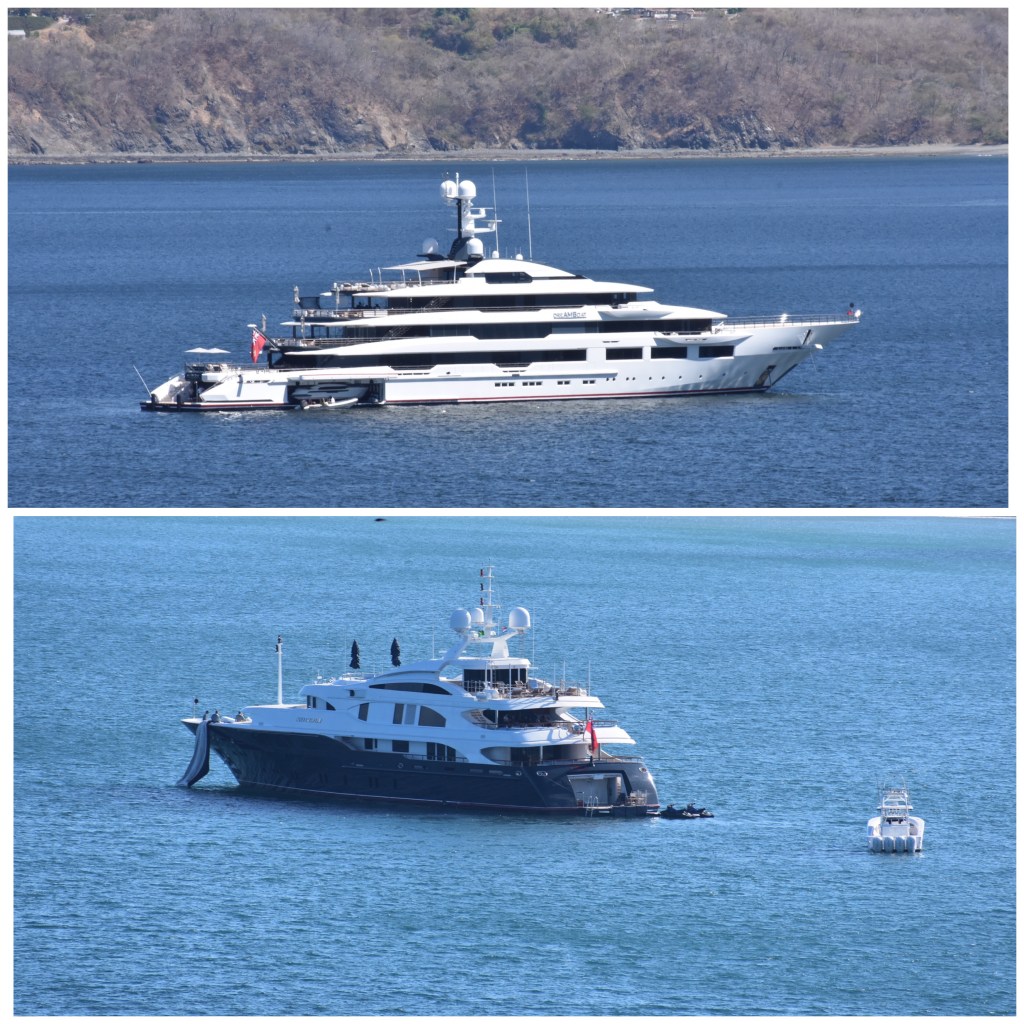
When we first came eight years ago, the bay was filled with humble pangas and a few fishing charters—all moored on buoys.  Now there are a few mega yachts and dozens of smaller yachts in the new marina. The super mega yachts are too big for the marina and have to drop anchor in the bay and send their tenders in. We have seen a few of those lately, including Starbuck’s Howard Schultz’s 254 ft yacht Pi. But no worries, there are plans in the near future to provide super mega yacht moorage, double the size of the marina’s commercial space and add a 200 “key” hotel (not 200 rooms because apparently the each unit will have several rooms).

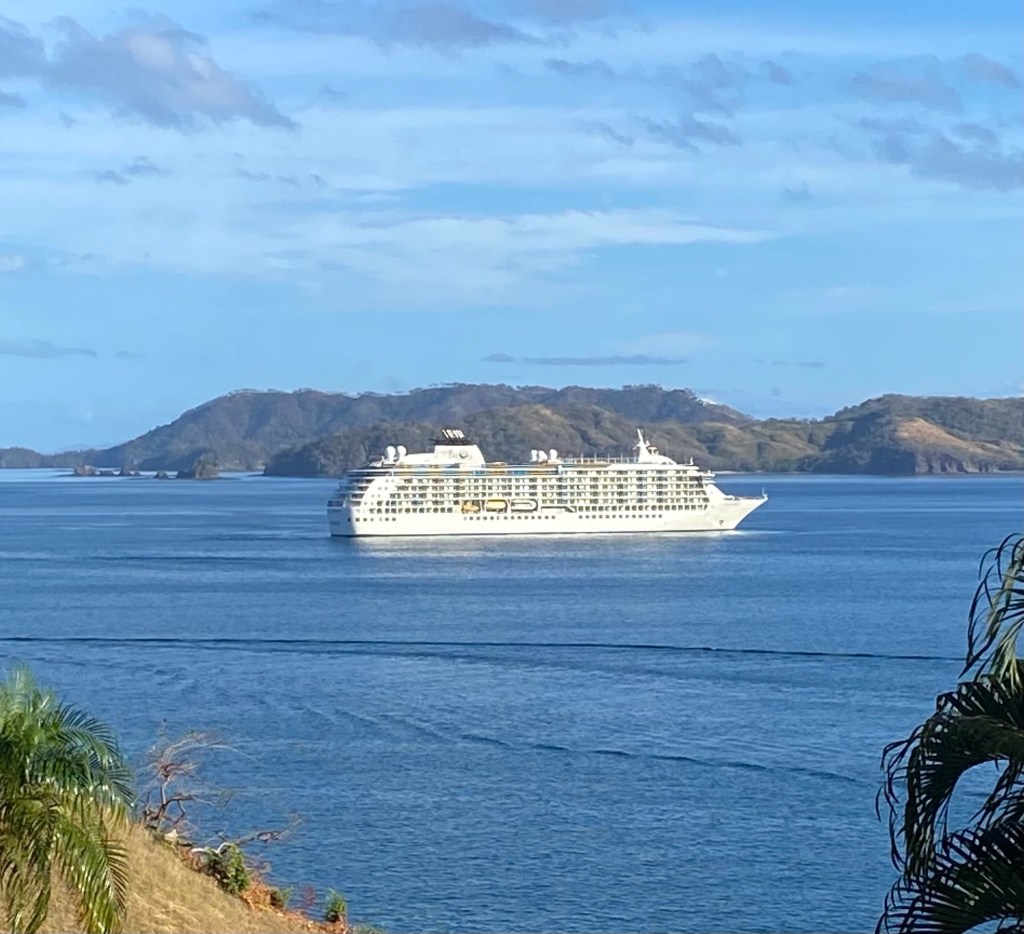
Just today the first ever cruise ship, The World,  pulled into Potrero Bay—it’s a luxury residential ship where “condos” start 2.3 million.  But no where to dock…yet.  

“The World” a floating condo in Potrero Bay

And with the all the new development, prices have risen accordingly.  A casado plate (the typical Costa Rican meal of rice, beans, some protein, plantains and a salad) in a local soda, a small family run restaurant, was $4-$6 dollars a few years ago is now typically $8-10.  A regular restaurant meal with a drink was $10-15 is now $20-25. Yes, still a bargain compared to our hometown Seattle prices—but not the incredible deal it used to be. And should you go to a “tourist” restaurant you will be paying nearly Seattle prices.

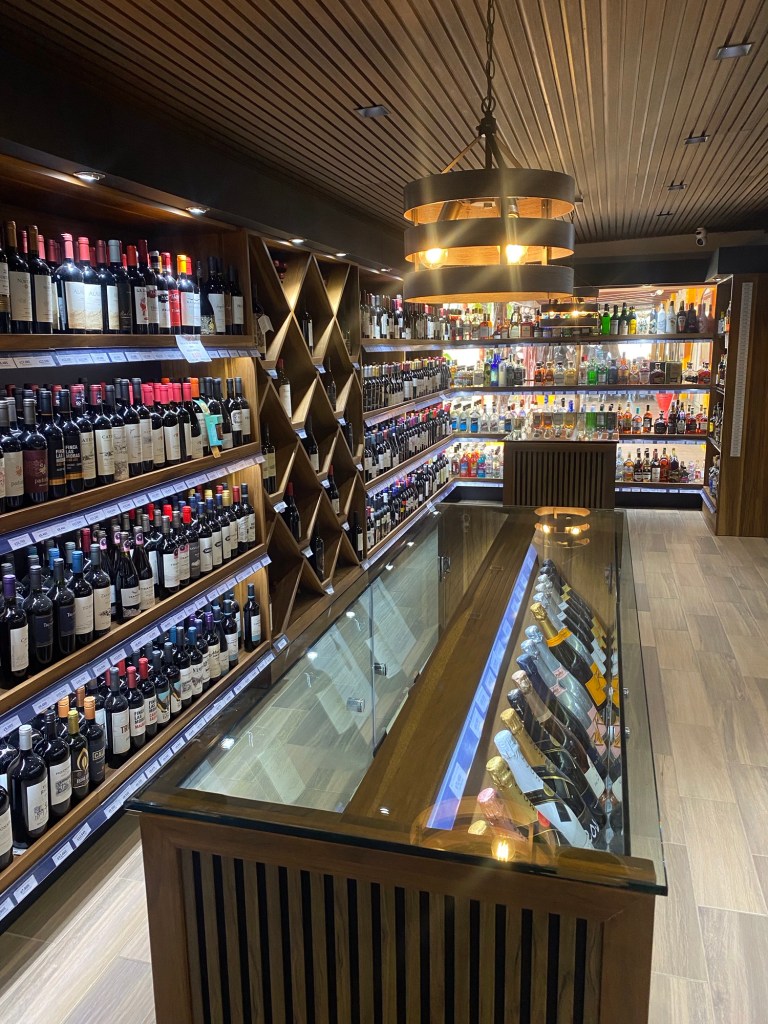
Our local grocery, the Massai Market always catered to the gringo crowd, but we also saw a fair number of Ticos as well. Now gringos dominate. The market has been upscaled and has a new, large refrigerated wine and spirits room—the selection would rival most U.S. stores.  Single malt whiskies, pricey bourbons, expensive grand cru wine, champagnes.  All at US prices. 

There is also another brand new grocery store — this one away from most of the new development and closer to the Tico area of town. It’s clientele is mainly locals so the changes aren’t just for the gringo crowd.

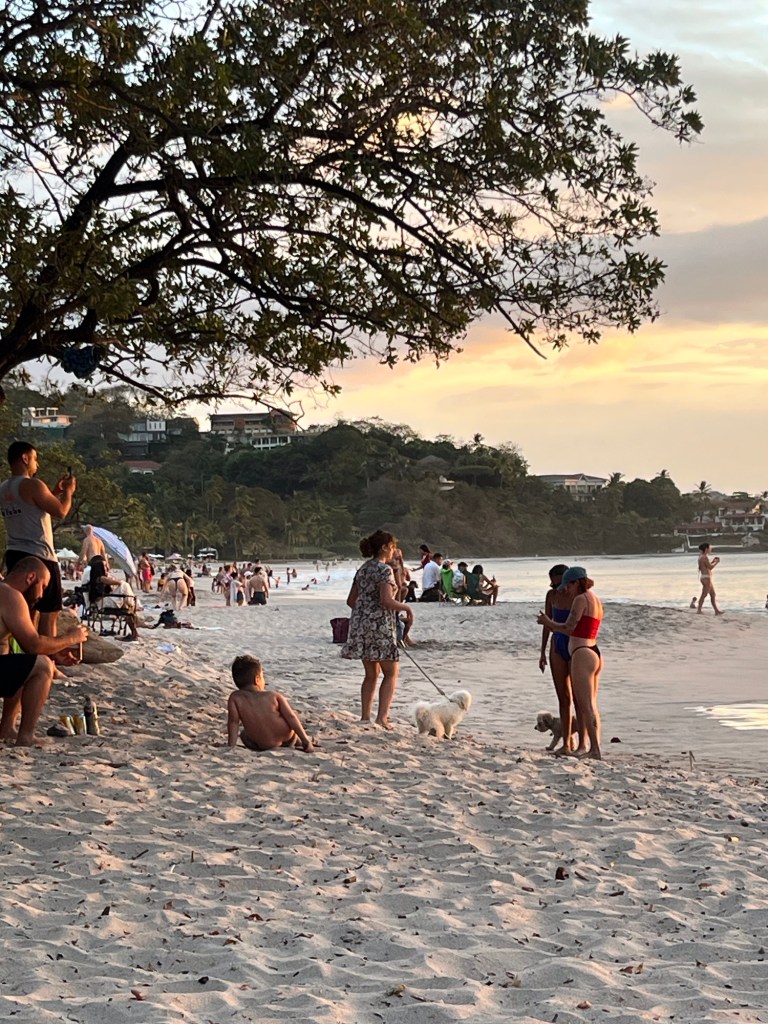
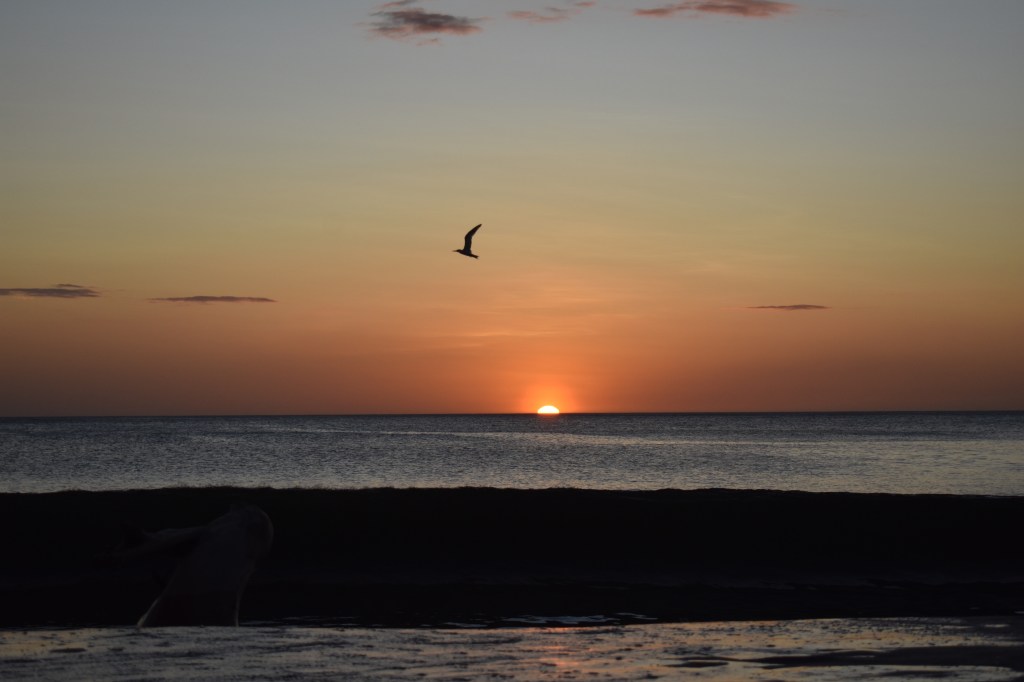
Maybe the good news is that despite all that is changed, much has remained as it always was.  The beaches are still uncrowded, particularly for our morning walks. We watch the sunset from the beach surrounded by locals—nary a gringo in sight. 

The Ticos are still warm, friendly people, the food is great, and the natural beauty of the area still awes. 

We also know that while we maybe missing the quaintness of mom and pop fruit stands, sodas, and a bay filled with pangas bobbing on mooring buoys, the Ticos here see more jobs, better pay, better infrastructure, better housing.  The biggest source of foreign income in Costa Rica is tourism.  Since we’ve been coming here we’ve seen a dramatic improvement the roads, cell coverage and internet. All huge pluses for the locals.  

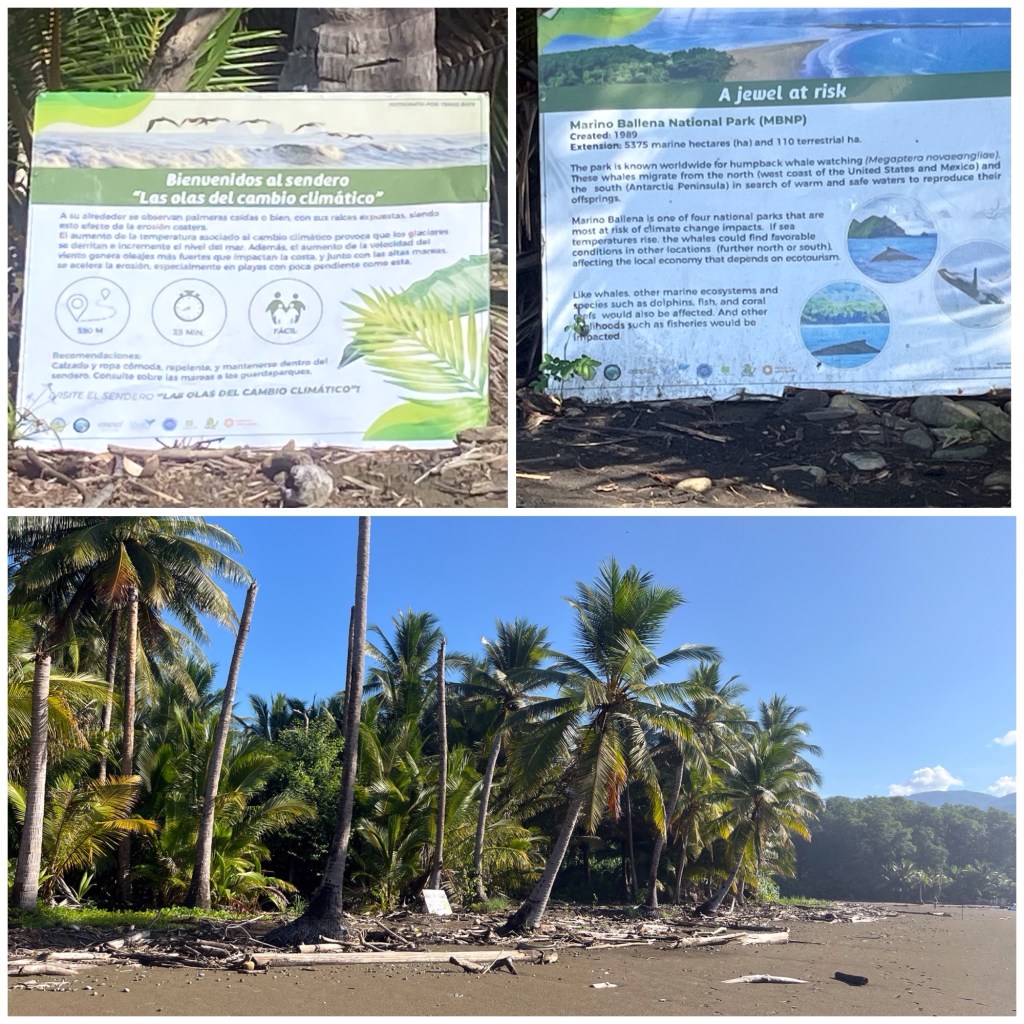
One change that is not welcome by the locals and the tourists alike is climate change.  On our way up to Potrero and Playa Flamingo, we stopped in Uvita at the Ballena Marine Park.  Along the beach there were signs in Spanish and English warning that rising seas were threatening pristine coastal areas and swaths of coconuts trees that lined the shore showed the damage.

Warning in Spanish about the “waves of climate change” and in English about the risk to the beaches while the damage to the trees is evident.

In Potrero last November, it rained for 21 straight days, causing massive flooding and cutting off whole communities for weeks.  Tourism came to grinding halt—causing a number of businesses to fold. The climatic forces that created the Cloud Forest are out of balance, potentially leading to loss of this precious ecosystem. Our guide in Santa Elena this year told us “summer” came just two days before we got here. And every year we come, Potrero seems to be a degree or two hotter.  The beaches here show the signs of high tides and storms eating into the headlands.  

Will we come back to Playa Flamingo and Potrero?  Probably.  Our thinking now is that we will continue to make forays into different parts of Costa Rica next year, looking for a bit of what captivated us on our first trip here and has lured us back again and again.  

New Horizons in Costa Rica

We wrote a blog several years ago about how comforting it was to travel back to the familiar.  You know the stores, restaurants, the roads.  What to see, what to avoid.  And yet we also usually find something or some place new to explore.  This was our fifth trip to Costa Rica and again, we were planning on spending part of our time in Potrero, our home base, on the Nicoya peninsula on the Pacific side.   Lovely beaches, decent tourist infrastructure, but not over taken by souvenir shops  Then a few days in Monteverde chasing birds. But this time we would add a trip down south to the Osa Peninsula.  A new horizon. 

What is stunning about Costa Rica is how many completely different climatic and geographic regions are packed into a small country.  Dry, almost desert on the North Pacific coast, tropical rain forest on the mid Pacific coast, even more dense, hot tropical forests further south, the temperate central valley, the cool Cloud Forest in the mountains, the Caribbean lowlands, and the high southern mountains. 

Osa is a long drive from San Jose. Even longer because you inevitably find lots of construction zones and a very slow truck or two to follow for tens of miles. So we decided to stop in Uvita on the central Pacific coast along the way to break up the trip.  

Some suggest our first stop, Uvita, is an alternative to the more touristy Quepos and Manuel Antonio, just a bit further down the road. It’s a town with no main square or center, and has one main attraction—the Ballena Marine national park. This very unusual park has a huge sand spit that from above looks exactly like a whale’s tail.  Unfortunately we were there at high tide; no whales tail but a gorgeous beach.

It was also prime time for the humpback whale migration so dozens of small whale watching boats were being launched through the rough, heavy surf, occasionally dumping a tourist or two into the water.

We spent two days there exploring the national park, looking for monkeys, watching birds and walking the beautiful local beaches. A good stop along the way to the Osa Peninsula.

The Osa Peninsula is one of the more remote parts of Costa Rica—very different than where we’ve been before. We read that this area was less developed, less touristed than our previous haunts. It’s in the far south, super tropical, on the Golfo Dulce (the only tropical fjord in the northern hemisphere). The peninsula is almost entirely a national park, the Corcovado National Park, and mostly inaccessible except by boat or long hikes, as in three and four day long hikes with a ninety minute boat ride from Puerto Jimenez before you even start to walk. Spectacular wildlife—birds, monkeys, sloths, tapirs, jaguars, and snakes—lots of snakes.  One of the real natural treasures of the world—it said to be the most biodiverse place on the planet. 

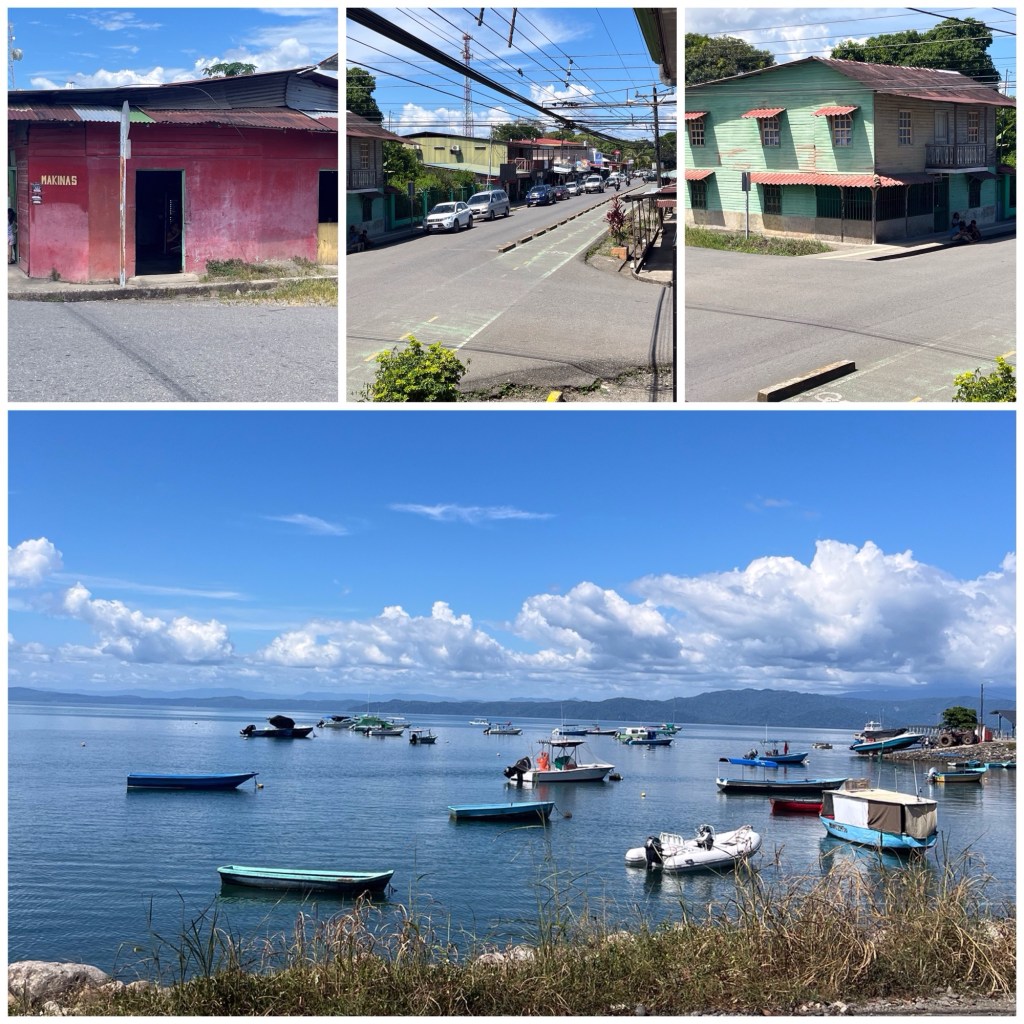
Fortunately, it is possible to drive down the eastern side of the peninsula to Puerto Jimenez, a little run down village of mostly Ticos, some expat hippy/yoga types, and a few serious eco tourists/birders/hikers. You can drive further south on a dirt road with multiple stream crossings to Carate, but we wisely chose to end our drive at Puerto Jimenez. The town houses the main information center for the national park and you book your tours there—you must have a guide to get into the park.  There is also a small airstrip with flights from San Jose, Liberia and Quepos should you not want to make the long drive.  It was little disconcerting when we were sitting at a local restaurant at the port when a small plane buzzed by seemingly inches over our heads.  We noticed none of the locals flinched.

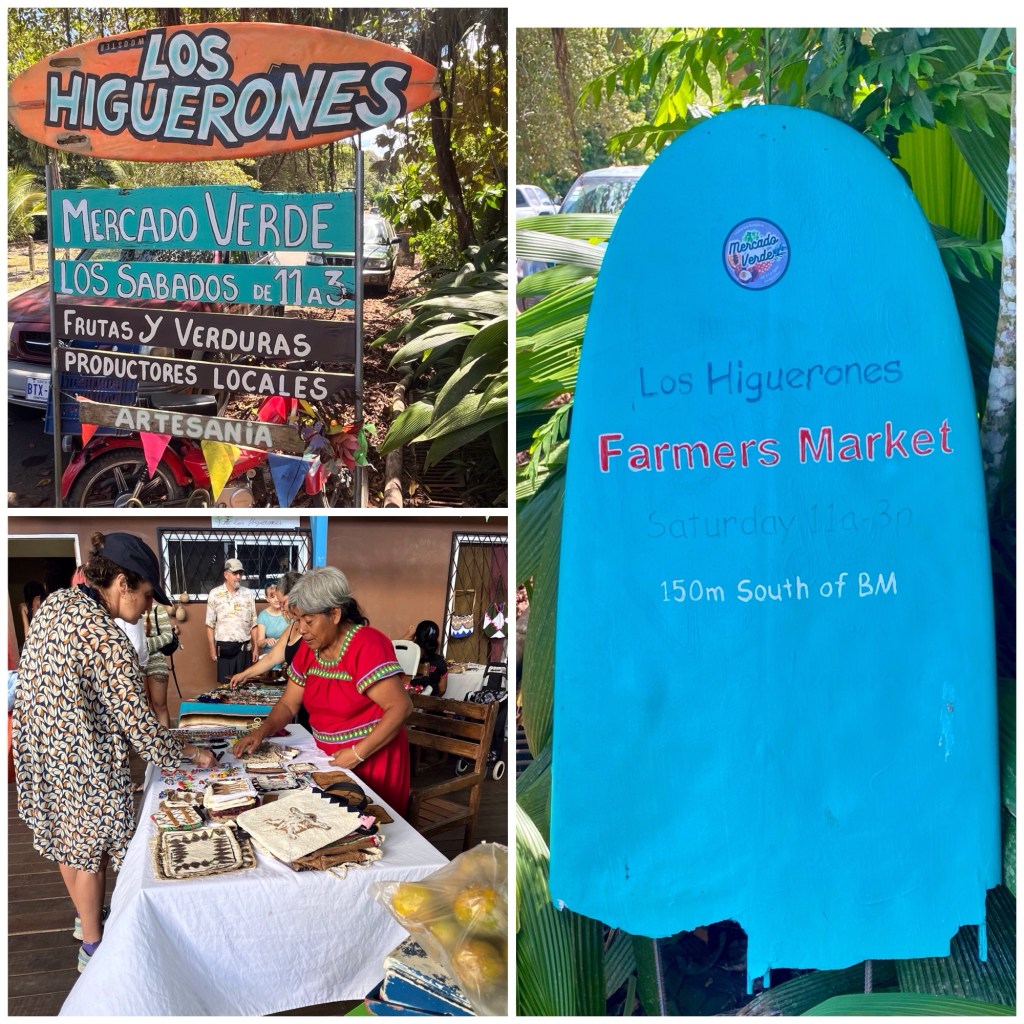
There’s not much else to the town. A few restaurants, couple of yoga studios, a gas station, a BM grocery store, and a heavily advertised Saturday farmers market that takes five minutes to see but includes some indigenous people’s crafts..

Just a few but very rugged miles outside of town is another of Costa Rica’s gorgeous beach’s—Playa Preciosa. From here you can almost see Panama.

Part of Osa’s charm is its lack of serious tourist infrastructure.  So we had a hard time finding a place to stay except for a few very upscale eco resorts.  We wound up in the Corcovado Private Villas.  We think it might have been an eco resort that fell on hard times in during Covid. We had been warned a four-wheeled vehicle was required. The website gave us a GPS waypoint that took us up a steep dirt road that reinforced the idea we needed four wheels.  Unfortunately when the GPS announced “you have arrived”  we were in front of nothing but a barbed wire fence.  So, of course we drove on, using all four wheels on our car, as the road became progressively worse.  Back home we would have called it a mountain logging road. Luckily, a kind local on a motorbike recognized we were somewhere we didn’t belong and led us back to civilization.  Of course, this part of Costa Rica lacks reliable cell reception as in we had no “bars”.   We had to backtrack several miles to get cell service and a new set of directions — different but only slightly better.  We finally arrived.  Our traveling partner in the backseat had her eyes closed most of the way up to resort, muttering occasionally “oh my goodness.”  The “check in” guy, Esteban, listened rather calmly to our annimated story about getting lost and told us he too had gotten lost a few days before using the original directions.  We suggested that maybe they might want to delete those directions from their website.  

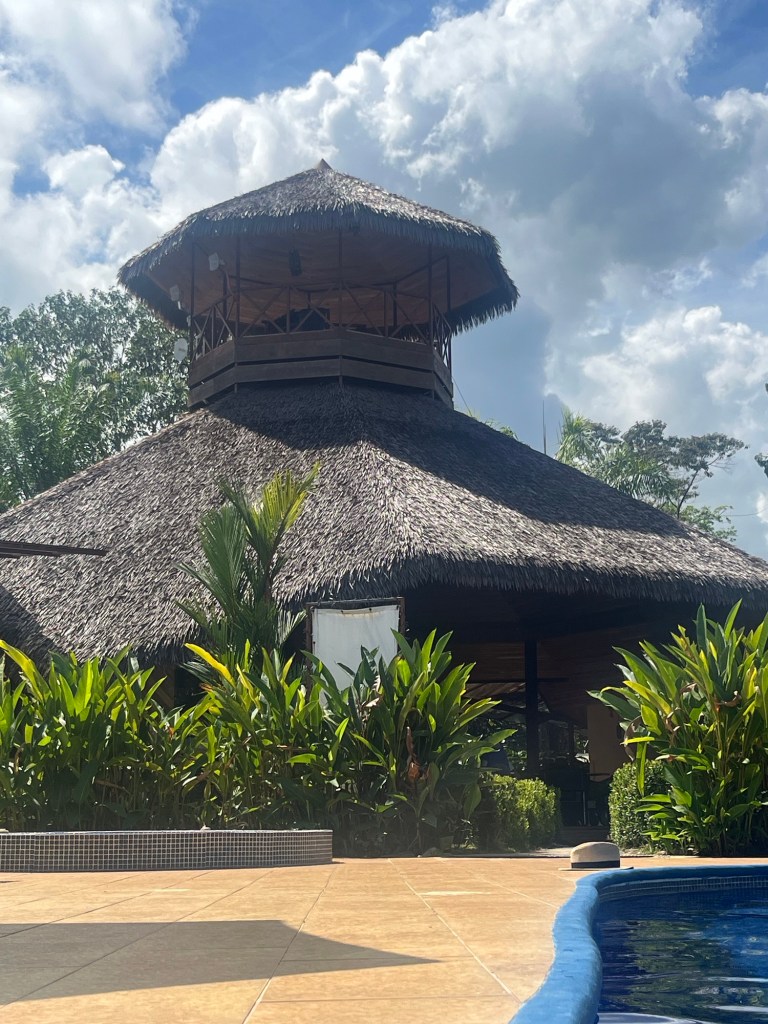
The complex consisted of a dozen or so separate units spaced some distance from each other along the steep trail to the top of the hill. There we found the pool, hot tub and “restaurant”  which served an inclusive breakfast and you could order a dinner in advance with a very limited  menu.  Oh, and the whole stay was cash only and it was very unclear who you paid and when. Nobody seemed to be in charge but we figured somebody, sometime, somewhere would take our money.

The villas themselves were a bit run down, with few amenities, but very serviceable.  And with gorgeous views of the green jungle teeming with birds and a few monkeys just a few feet from our balcony.

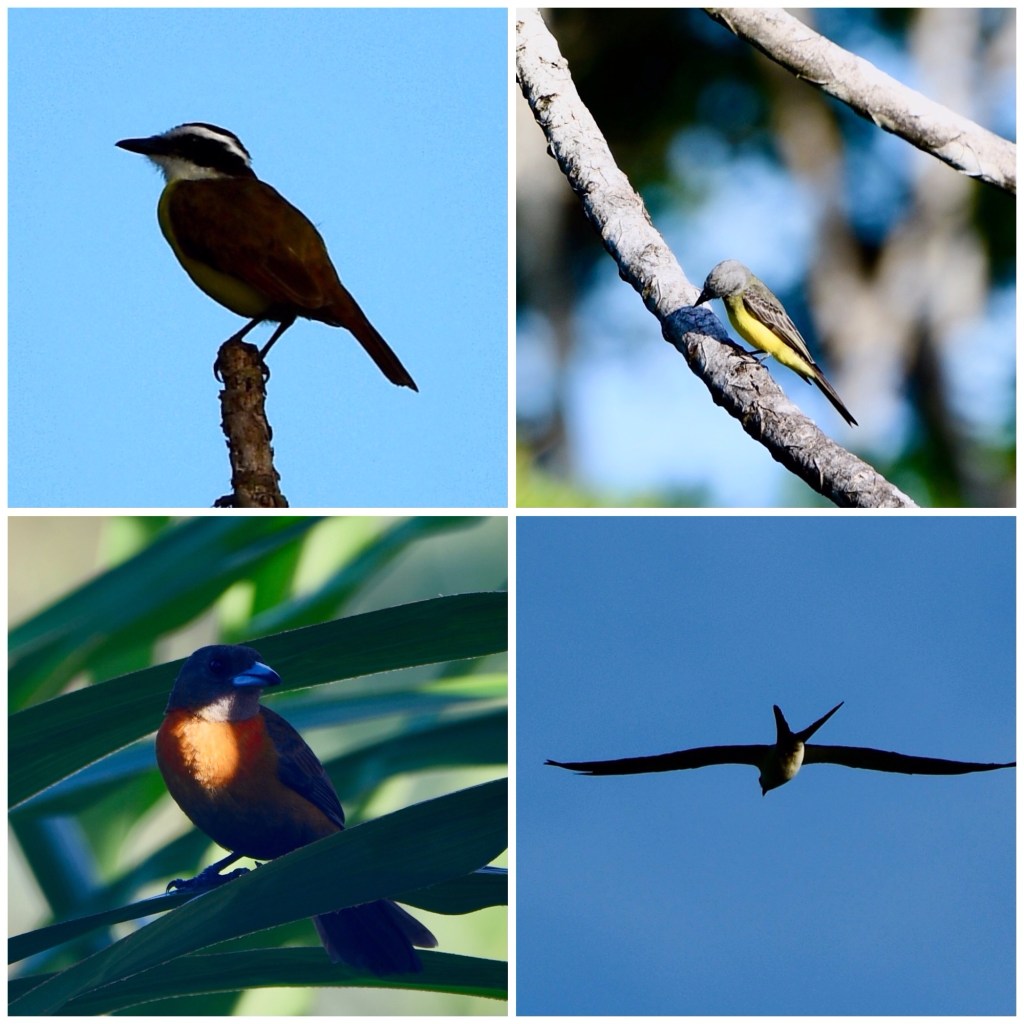
The upside, and it was a huge upside: the 70 acres of amazing tropical forest right adjacent to the national park.  Some of reviews said the wildlife here was better than what they saw in the park.  While we are not truly serious birders, what we experienced in the few days on the property could change our minds.  Toucans, fiery billed arcaries, multiple varieties of parrots, lineated woodpeckers, and dozens more.  At least several new life birds for us. 

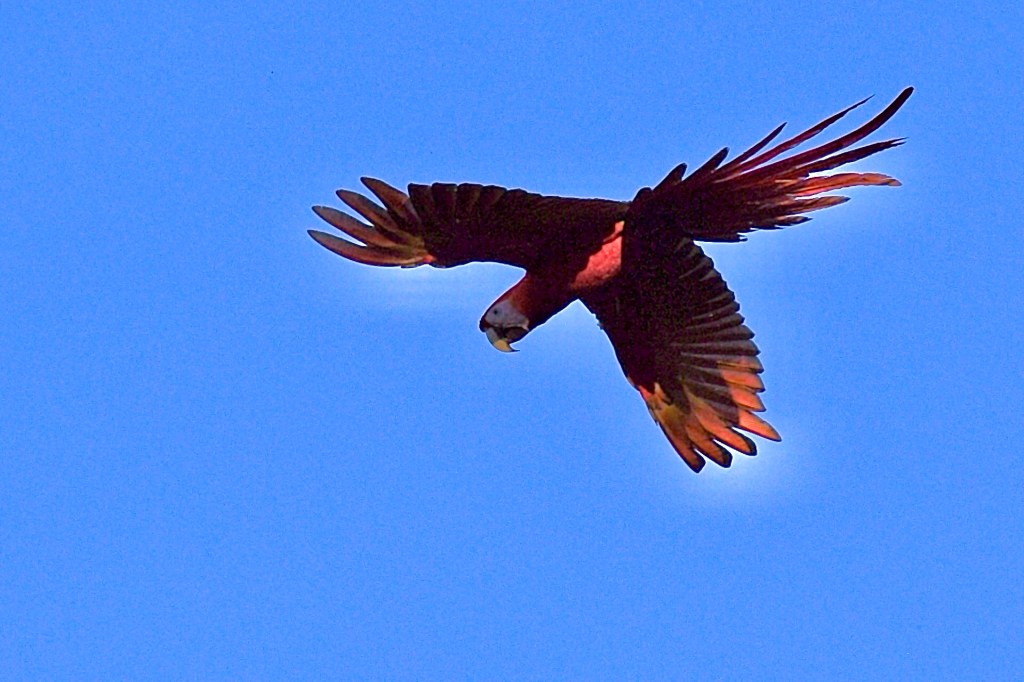
But the star attraction were the scarlet macaws—a very large bright red, yellow, blue parrot with the most awful loud sqwauk of a call which you could hear for miles.  Our villa and common area seemed to be a macaw freeway with birds flying over all day, stopping to rest in the nearby trees.  What a show.  A very loud show.

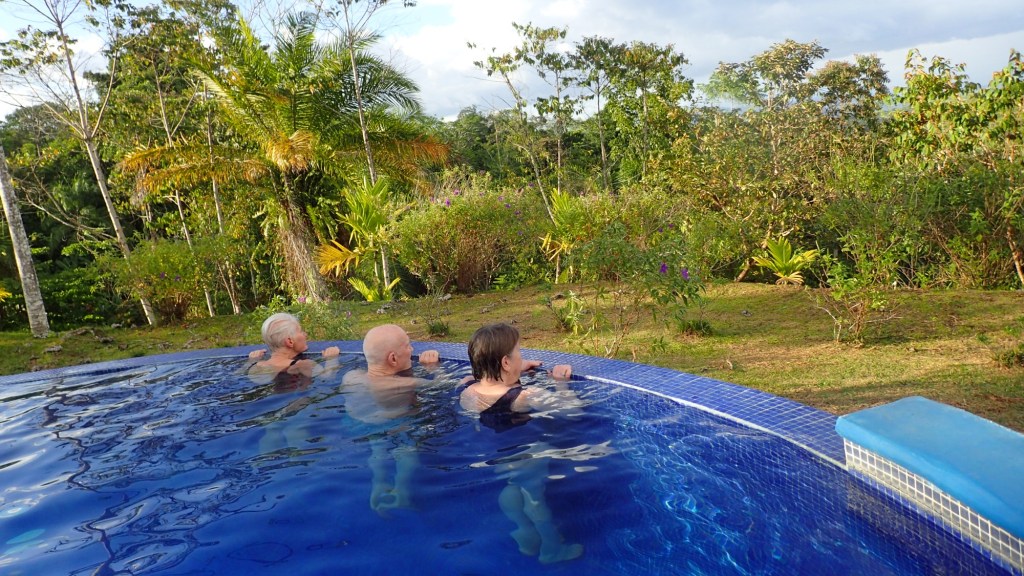
And you could see most of this from a magnificent infinity pool at the top of the property.  In one 45 minutes stint in the pool, we saw white faced monkeys, yellowed throated toucans, green parrots and, of course, lots of scarlet macaws, plus monkeys just a few yards away peeking through the foliage. Pool birding was a new experience for us. As we said, we aren’t serious birders. 

And the dinner, humble as it was (arroz con pollo) was very good. However, the parting comment from our young server as we walked home to our villa was a little disturbing, “Be careful of the snakes.”  We walked with all four iPhone flashlights focused on the ground.

Yes, the property needs work and serious investment.  But if they ever upgraded to a high-end eco resort, we probably couldn’t afford it.  By the way, while writing this in our villa some white-faced monkey is having a shit fit not far away.

The Osa Peninsula surprised us by living up to its reputation — a natural wonder, still largely pristine, a biodiverse sanctuary, and one Costa Rica’s many different climatic and geographic regions. It’s also a great example of Costa Rica’s commitment to preserving natural habitats by setting aside huge areas as national and provincial parks.  

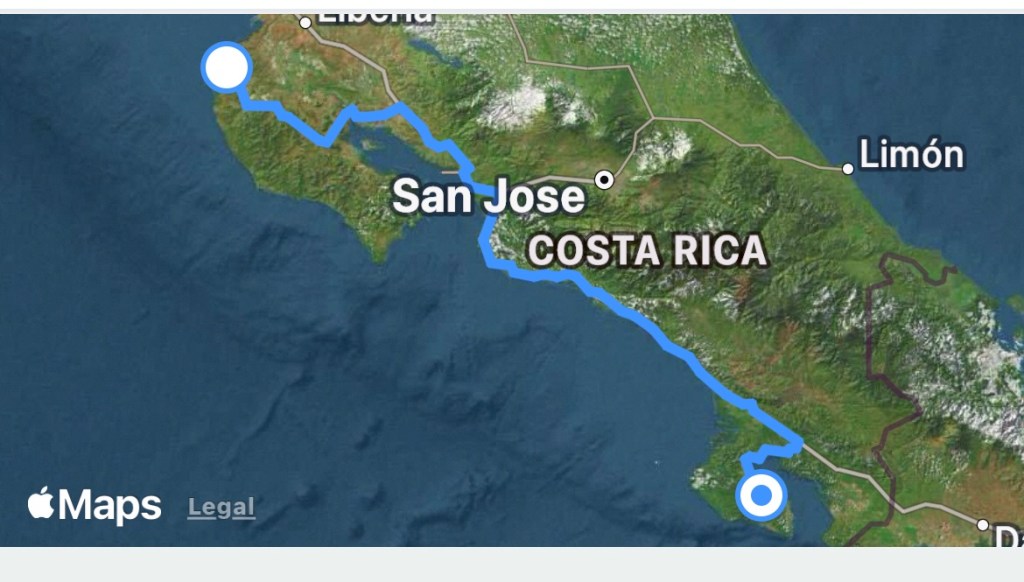
It gave us a lot to think about on the 10 hour drive back north to Potrero— basically nearly the entire length of the country.

For the Birds

Our third trip to the Cloud Forest in Costa Rica was probably our best. Maybe because we were ready for a break from the unseasonably hot weather on the Pacific Coast. Maybe because the roads were familiar, and now much improved from earlier trips. Maybe it was simply because the area is so gorgeous.

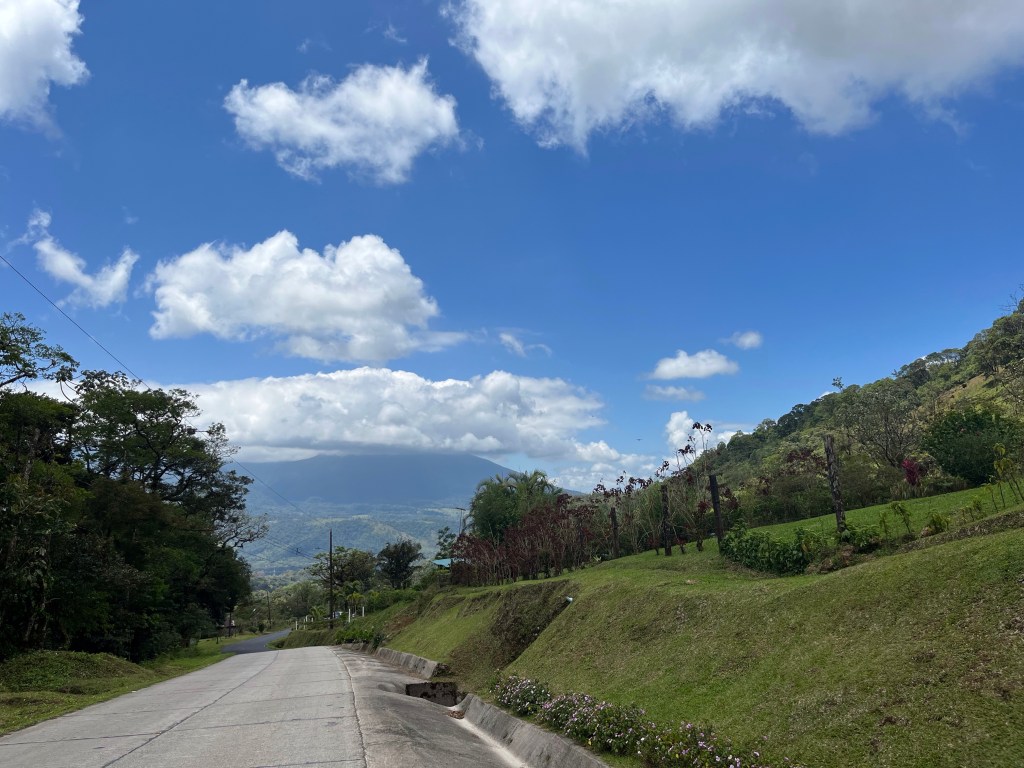
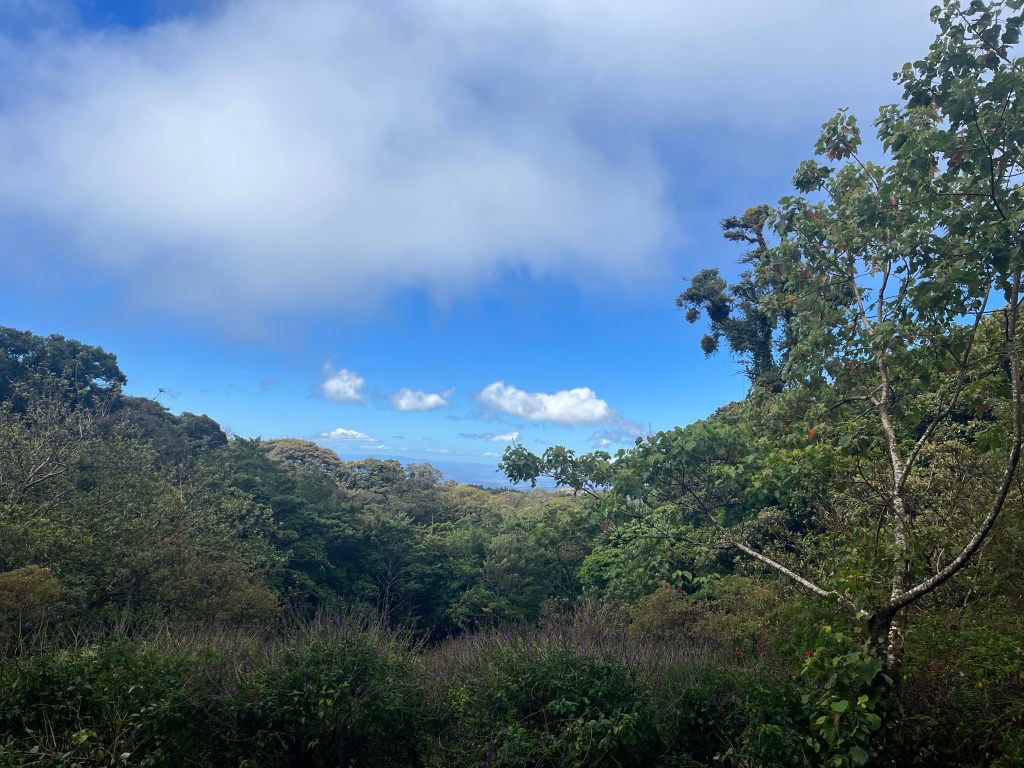
The Cloud Forest is special even for nature-rich Costa Rica. The wind from the warm Caribbean side blows the clouds up and over the continental divide, keeping the jungle below cool and wet. The clouds just hang on the mountain tops.

There was a 30 degree temperature difference between the Cloud Forest and the lowlands a few miles away when we were there this year. 98F vs 68F. We heard that climate change and the rising sea temperatures are changing this pattern a bit, meaning less rain fall in the mountains and more on the costal plains. It is worrisome—so much flora and fauna are dependent on the very specific micro climates of the Cloud Forest.

The big draw in the Cloud Forest are birds! Birders from all over the world flock here (pardon the awful pun). Situated between North and South America, Costa Rica is known for its incredible biodiversity and the amazing number of different birds reflects that richness. 918 at last count.

A disclaimer—we aren’t really serious birders. A passionate birder friend gradually sucked us in years ago when we traveled together. At first, we saw birding as an excuse to take a walk in the woods, green belts, or seashores. Then we began keeping track of the birds we saw. Technology, of course, made it easier with finger tip accessibility to information on birds and help identifying them. We were hooked. Now where ever we travel, we try to take a walk and look for birds. But in a place like Costa Rica’s Cloud Forest, you don’t need a book or a life list. Just grab a pair of binoculars and enjoy.

Seven years ago we birded in the Monteverde National Reserve, the most famous of the many Cloud Forest sites. We hired Adrian Menendez, an outstanding local guide. We haven’t been back to that park since, but have reconnected with Adrian. He’s led us up remote mountain roads, through other regional reserves and into private parks.

Over two mornings with Adrian this year, we saw nearly a hundred different species!

Of course, we would see very few birds without him. Not only does he know the sounds of birds and can locate them primarily by sounds, he also knows where the different species hang out. These mountains have been his birding territory for 31 years. He knows where an owl hangs out, or under what bush you’ll find the shyest of birds or where the wild avocado trees are found that the Resplendent Quetzal likes to eat.

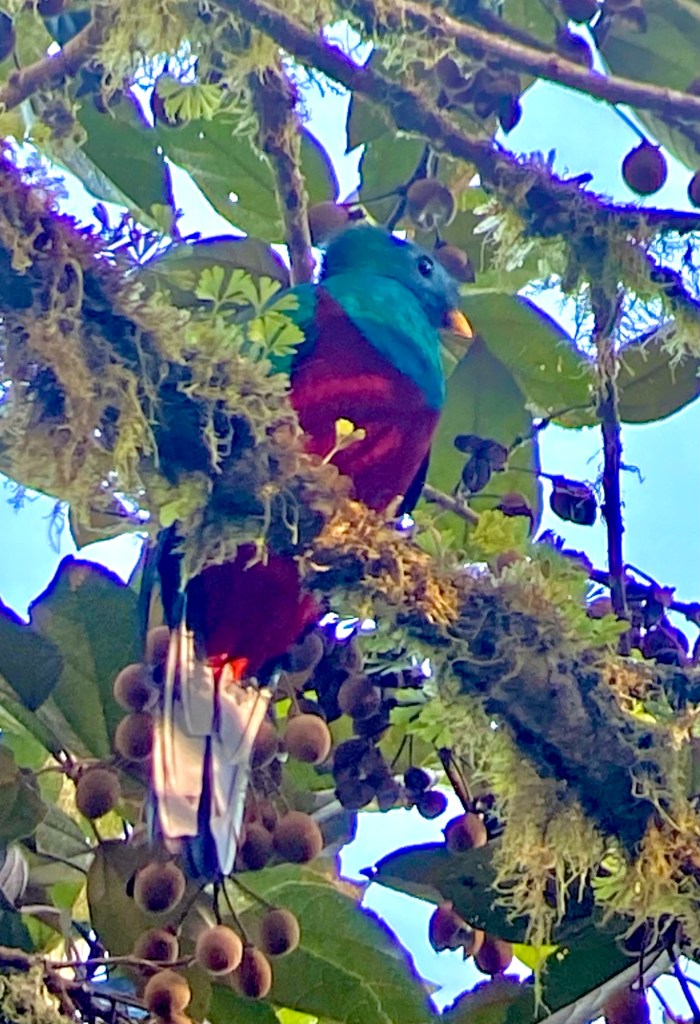
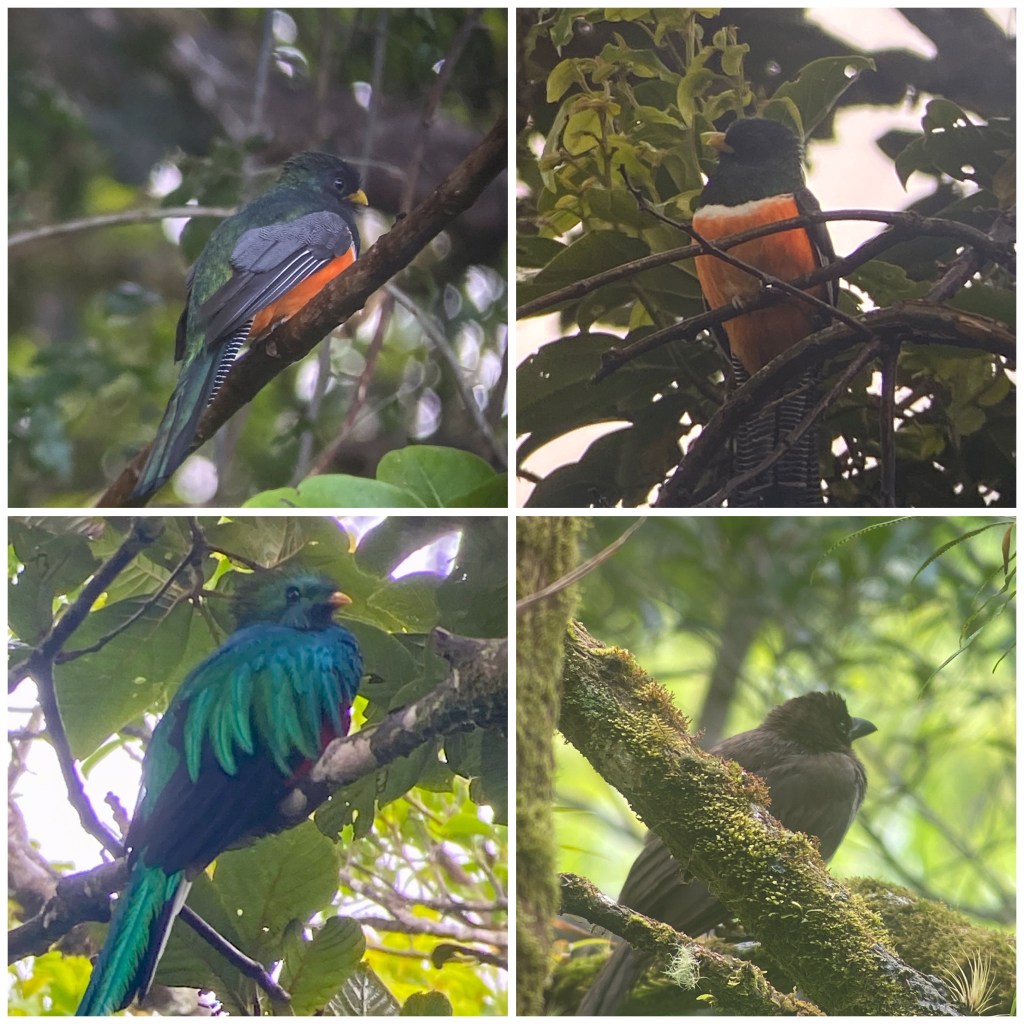
On our first day, we drove just barely over the continental divide and walked along a mountain road not far from the Santa Elena Reserve. And there was a Resplendant Queztal just waiting for us. And the Red-faced Spinetail with its precarious hanging nest. And 39 other species!

Red-faced Spinetail and its nest

From there we went into the Reserva Bosque Nuboso, where many of the paths were paved to allow handicapped access. And benches are provided for seniors. It was later in the day so fewer birds were active. At the highest point we were 5608 feet above sea level, roughly the same elevation as Paradise on Mount Rainier. No wonder there was a bit of huffing and puffing!

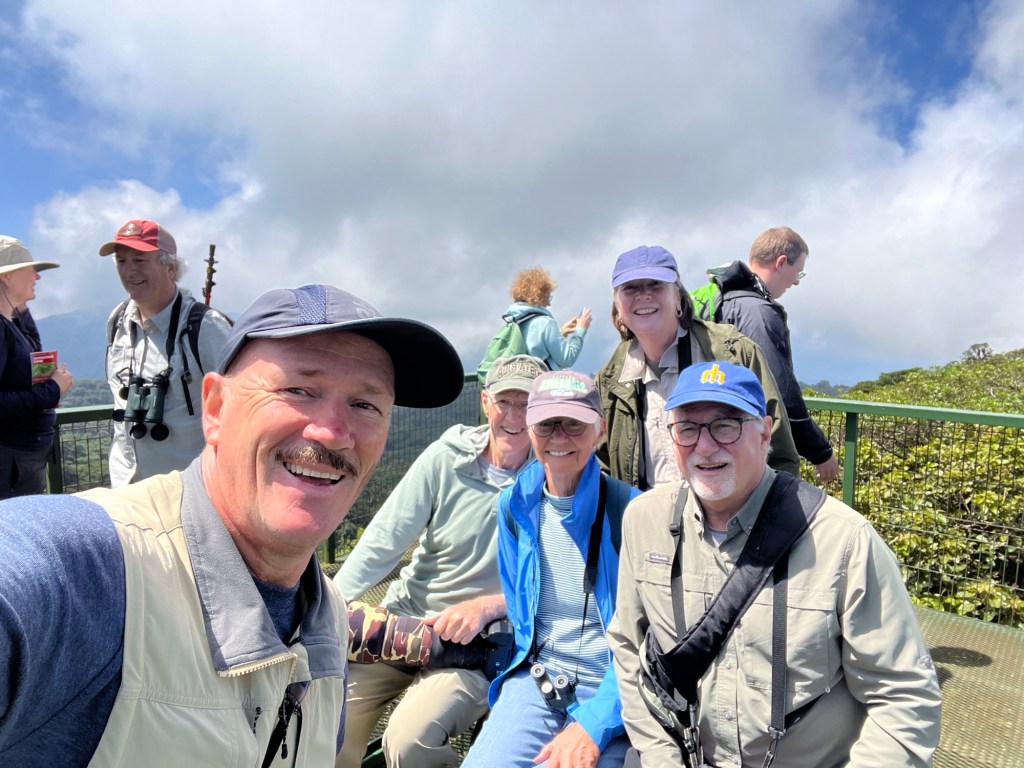
Sitting on top of the world with Arenal Volcano behind the clouds

The highlight of the day came when an Ornate Hawk Eagle flew over head followed by the American Swallowtail Kite, on its migration north. From a platform tower we could see several of Costa Rica’s volcanoes, including Arenal which last erupted in 2010 (because of the threat of another potential eruption, all cars are required to back into parking spots to expedite an emergency exit — not a comforting thought)

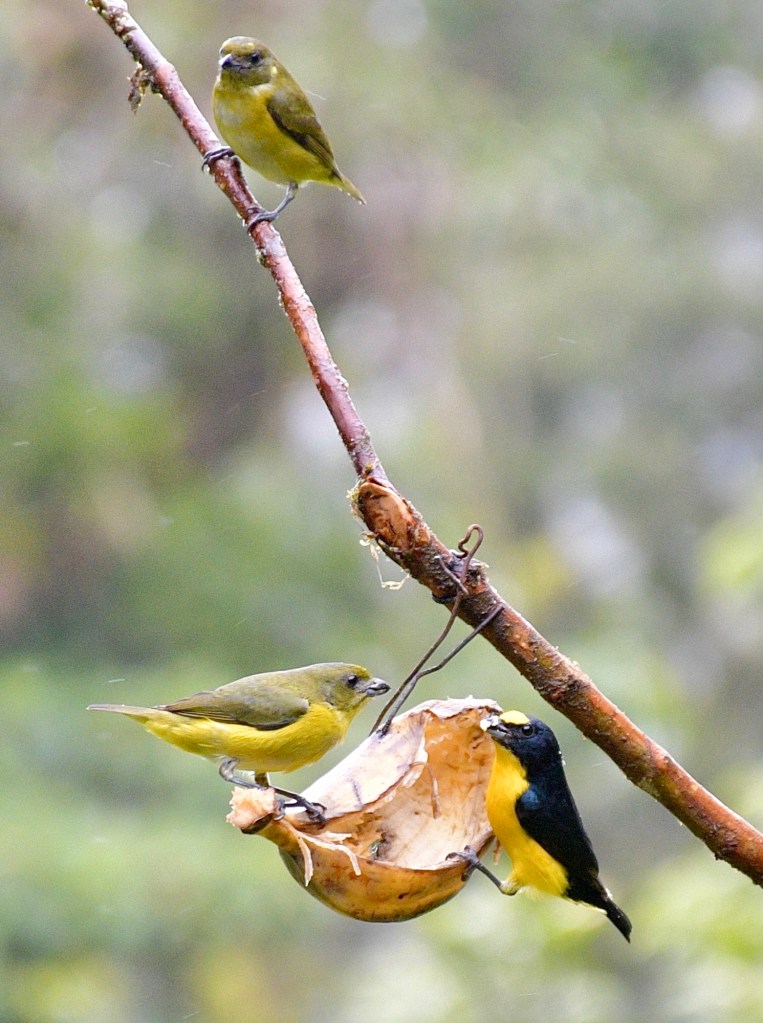
We woke up the second day to fierce winds and rain. Not a good day for birding. Adrian, however, had a plan. We drove about 20 minutes south of Santa Elena and a bit lower on the western slopes of the mountains to Finca Ecológica San Luis, a private reserve run by Adrian’s cousins. Some birding purists might scoff at the feeding stations around the reserve that lures the wild birds in. We didn’t care. We appreciated sitting in rustic shelters, dry, and up close and personal with our avian friends.

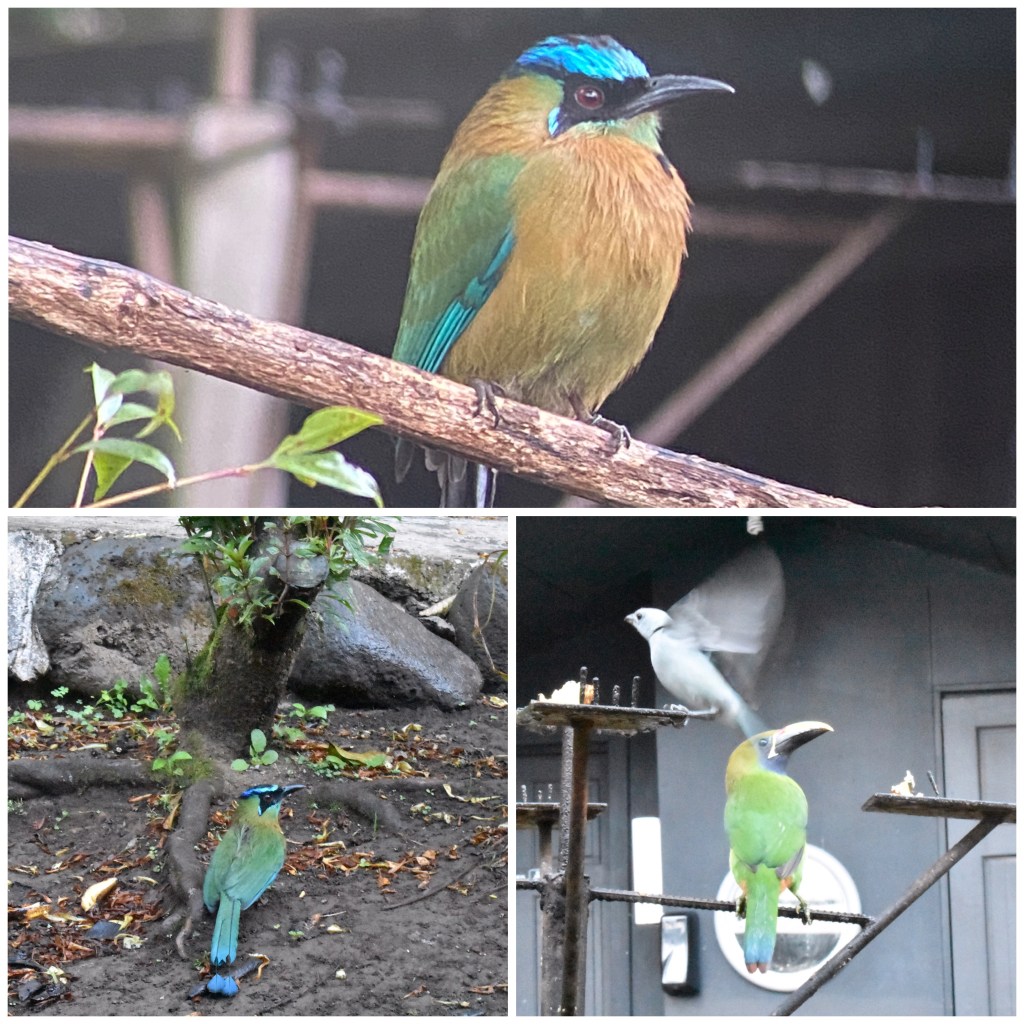
Some of the birds we had seen before — White-fronted Parrot, Chachalaca, Montezuma Orependola, Baltimore Oriole.

But most of the birds we were seeing for the first time — Lessen’s Motmot, Broadwinged Hawk. Gartered Trogon, and the big draw of the area—the unusual looking Three-wattled Bellbird with a song that sounded either like a brass gong or an ET alien that could be heard a half a mile away.

The Cloud Forest is truly one of the world’s magical places whether you’re there for the birds or simply for a walk in the woods. And that’s why we keep coming back.

[Full disclosure: we have to share photo credits for this post with Malcolm and Adrian.]

A soda is not a soft drink…in Costa Rica

Sometimes we’re a little slow. Well, maybe a lot slow.

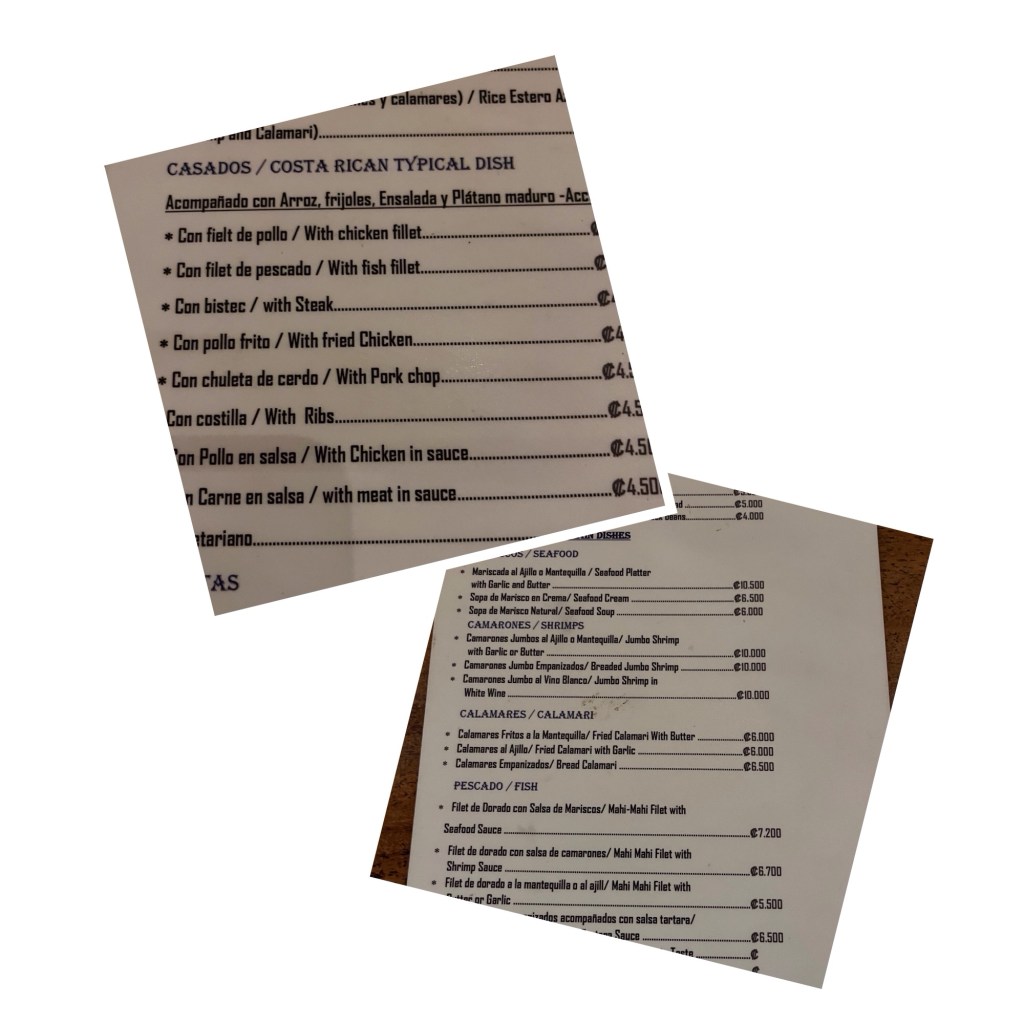
The first time we were in Costa Rica seven years ago we kept driving by modest roadside establishments with signs advertising “soda” this or “soda” that. Of course, we thought they were selling local soft drinks to thirsty Ticos and tourists. Only, when by chance, we actually stopped to get a cold soda, did we realize that a “soda” was actually a restaurant—more specifically, a small family run restaurant with a limited local menu. And we soon found out these “sodas” were often gems of local cuisine serving great food at ridiculously cheap prices. Yes, the menu is limited. Yes, the ambience is sometimes is missing (but not always—we’ve eaten in sodas on the beach with sand under foot and up in the mountains with stunning views of volcanos). But you are likely eating with locals, maybe being served by someone whose grandma is cooking in the back.

And the food! Almost always fresh local ingredients, always prepared to order. The limited menus in most sodas usually features Costa Rica’s star menu item—the casado plate (which translates as “the husband’s plate” or “married plate”). Rice, beans, plantains, salad, maybe some fresh fruit and a choice of protein—fish, pork, or chicken. The protein can be grilled, stewed, or braised. Big portions meant to serve the very hungry.

The typical price is between 2000 CRC and 4000 CRC or $4 to $8. And most sodas take US dollars in addition to Costa Rican colones, and many accept credit cards. A few only take cash. Other local dishes include arroz con pollo, (rice and chicken, sometimes in a tomato sauce), gallo pinto (rice and beans), ceviche. Almost all serve the local beer (Imperial), sodas (Fanta orange soda is ubiquitous), and fruit juices. Whether is a result of widespread tourism or simply the influence of North American culture on the locals, hamburgers and margaritas are often on the menu as well.

You will almost always be eating outside on a covered patio with a kitchen tucked in a small space in the back. No air conditioning here. Most will be filled with locals. Often there are small children playing near by, and an occasional dog or two strolling through the soda. Once, up in the mountains, as we ate, the waitress called a dozen or so children playing in the field next to the soda to serve them their lunch on paper plates which they promptly ran off with to eat under a nearby tree, dodging the local cattle as they went.

The owners of one soda, in a very, very remote area up in the mountains when we were staying on a small coffee plantation across the dirt road, would wait until we drove by their home on the long driveway, then run down from their home to the soda to open up just for us. We were clearly their only business for the night. Mom would cook and her young daughter would happily sit at the next table, coloring. The food was absolutely amazing—and as you can imagine, cooked to order. Best pollo y arroz ever! We ate there three times and, despite the language barrier, began to feel like part of the family.

You’ll never have to worry about finding sodas in Costa Rica—they are everywhere. Really, everywhere. Big towns, small villages, remote rural areas, industrial zones. In the more upscale resort communities such as Playa Flamingo or Samara on the Pacific coast, they are often located just outside the town centers on the roads that lead into to town or in the nearby little Tico villages.

Recently we were in Samara on the Nicoya Peninsula in a beautiful AirBnB in the hills above the town. Our wonderful hosts recommended a number of local restaurants. They were all lovely beachfront establishments with spectacular sunset views, music, and tropical cocktails. But the food was very ordinary and at US prices $20-40 for an entrée. The clientele was almost exclusively gringos—not surprising for a tourist town. And, yes, of course, we are in fact gringo tourists. So we fit right in.

The next night we were off in search of a soda….pura vida!

Taking the Waters

We’re not strangers to Costa Rica, nor are we experts — not at all. We’ve traveled here for a month or so four times in recent years. We’ve found areas that draw us back year after year (around Potrero, in Guanacaste and Monteverde). And we visited areas that we enjoyed — just not enough to return to year after year when there is so much more to be seen. For such a small country, Costa Rica has so much variety.

This trip we decided to spend a few days in La Fortuna on the base of the volcano, Arenal. We had passed through the area five years and been intrigued.

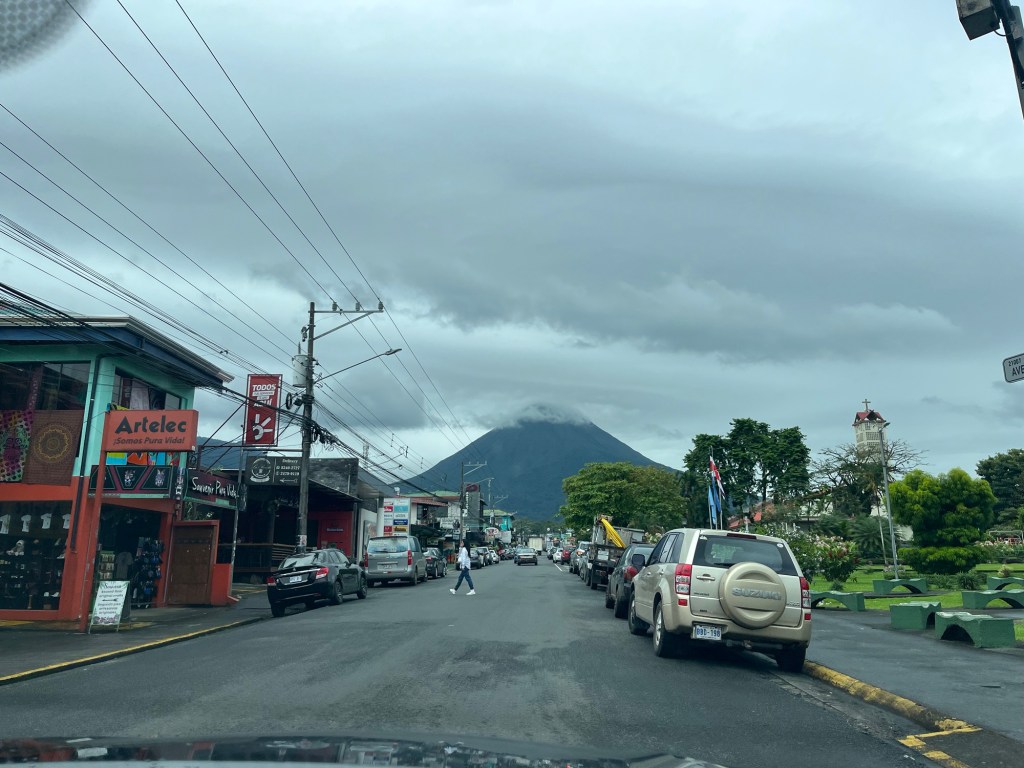
La Fortuna is the most heavily touristed areas of Costa Rica, according to the guide books. The main attraction is Arenal, the volcano. Before 1968 the town was just another agricultural crossroads and then the volcano erupted, putting on a show until 2010 for the tourists who soon arrived. The town isn’t much to look at today, except almost everywhere you look, you see the big cone.

And where there are volcanoes, there are often hot springs. Today, along with the main attraction, hiking, zip-lining, horse back riding and various water sports lure tourists. No zip lines or horses for us — we were there for the hot springs spas. The roads in and out of La Fortuna are filled with everything from modest to ultra-swanky to middle of the pack spas like the one we found — Los Lagos.

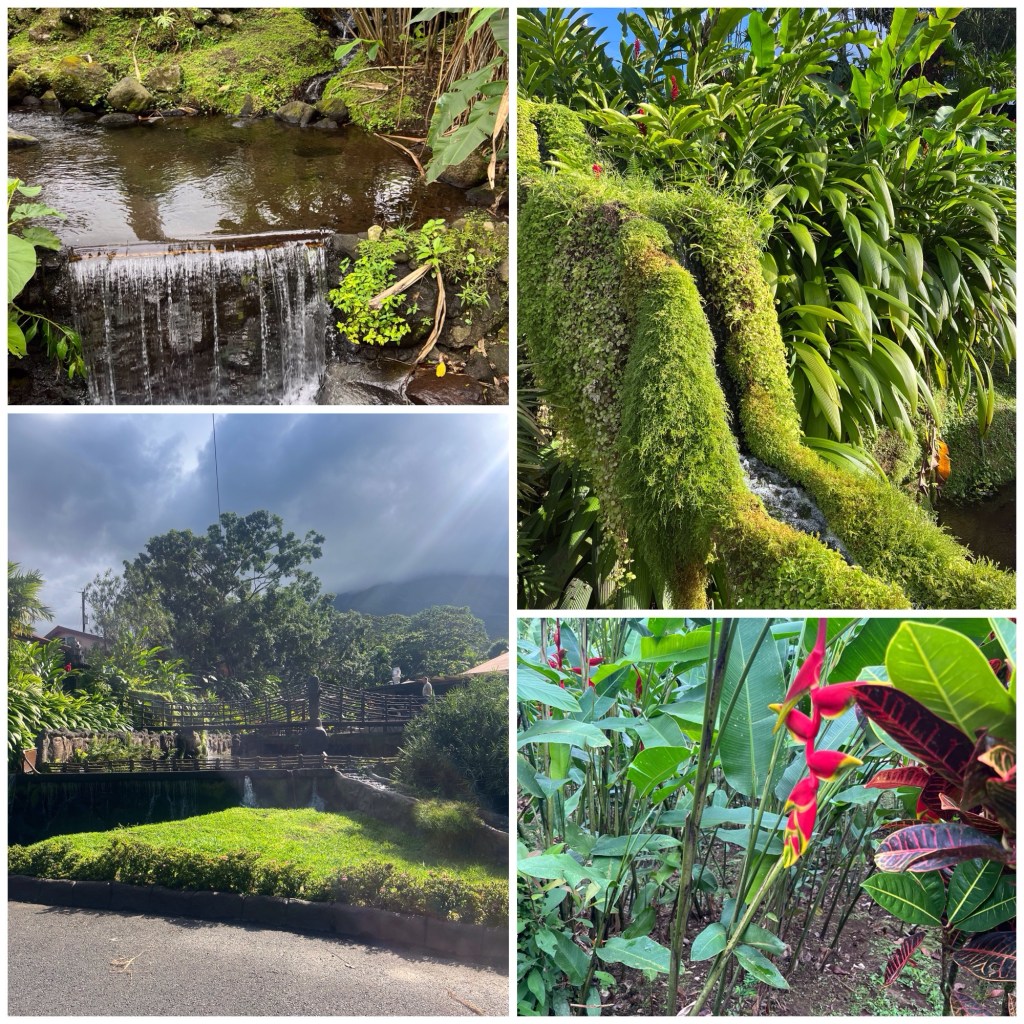
Our initial impression of Los Lagos Hot Springs Spa and Resort was simply “wow.” An impressive entry, lush vegetation, streams crisscrossing the grounds and cascading small waterfalls. A restaurant, a swim up bar adjacent to the largest of the hot springs pools, a spa and a series of walking paths through a “jungle.” The resort also has lockers and changing rooms for day visitors. The hotel rooms are a little dated—you have real keys to open the doors—and are need some upgrading. But still very nice.

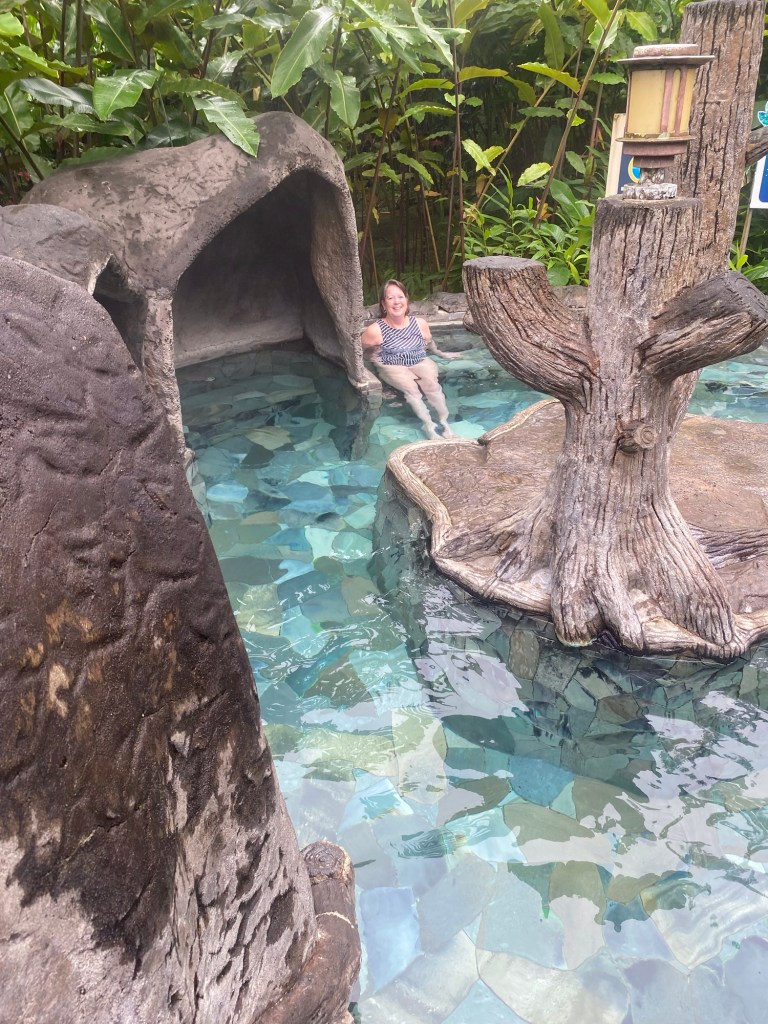
Our primary focus was the hot springs. While a little cheesy with their faux rock appearance, the pools did not disappoint. Varied in temperature from a cool mid-70’s to almost too hot for us—100+. Each hot springs pool had a sign indicating water depth and temperature.

Some pools were built for two. Most were bigger. A few had jacuzzi jets and reclining couches built in.

We started at the top and wandered from pool to pool down the hill until we, like Goldilocks, found the pool that was just right for us. Most of the time, we had the pools almost to ourselves. Our fellow soakers were largely locals; gringos seemed outnumbered.

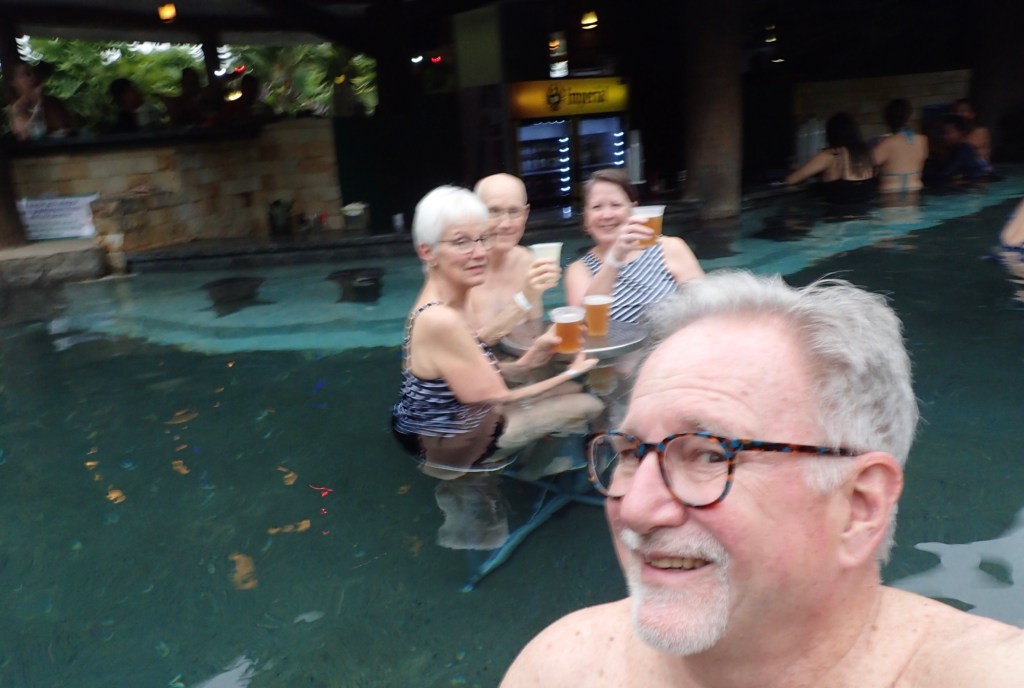
Of course, we had to try the swim up bar. Yes, tacky, but still great fun. Sitting on the submerged stools was harder than it looked, but highly entertaining. And in this family friendly pool, the water was cool enough for the kids to enjoy.

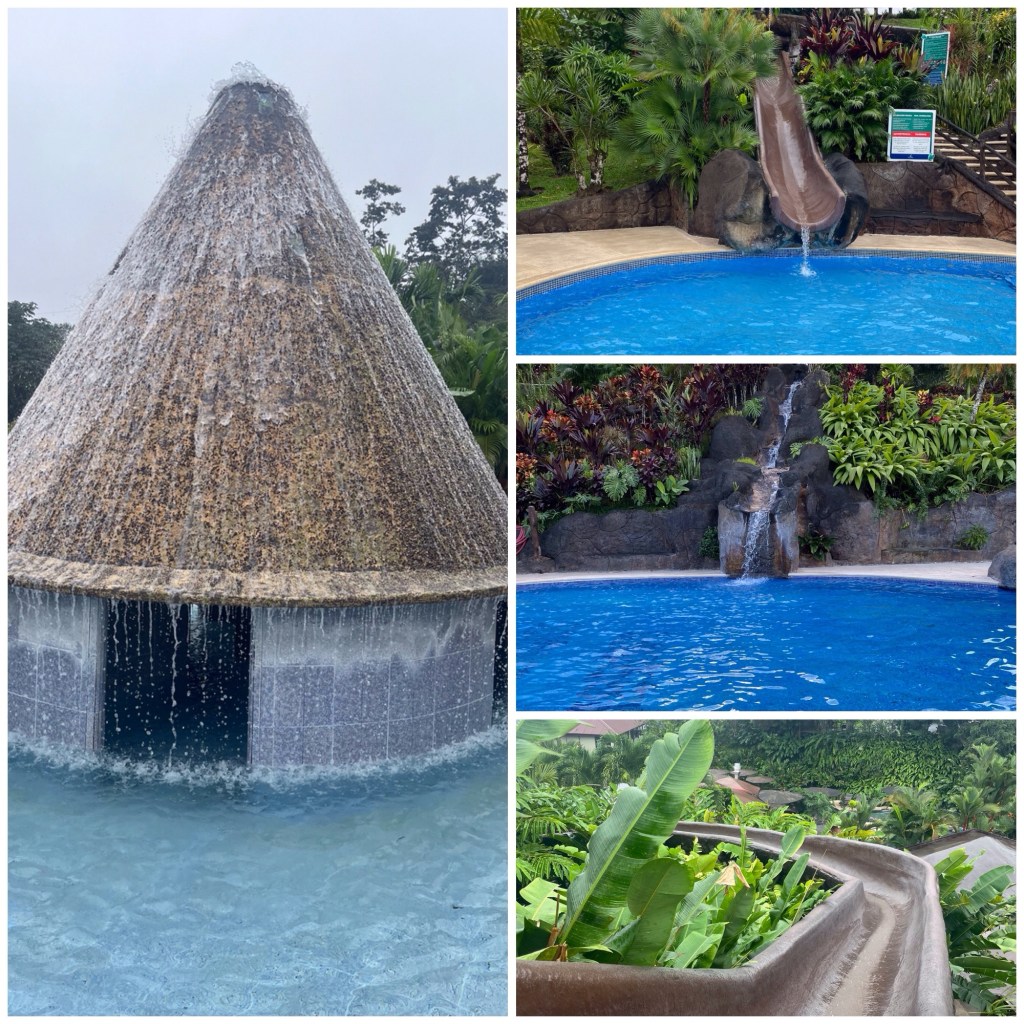
The resort also had a couple regular swimming pools (fed from natural spring water, the resort info said) with water slides for the kids and a wading pool for the littlest with a fountain shaped like a volcano.

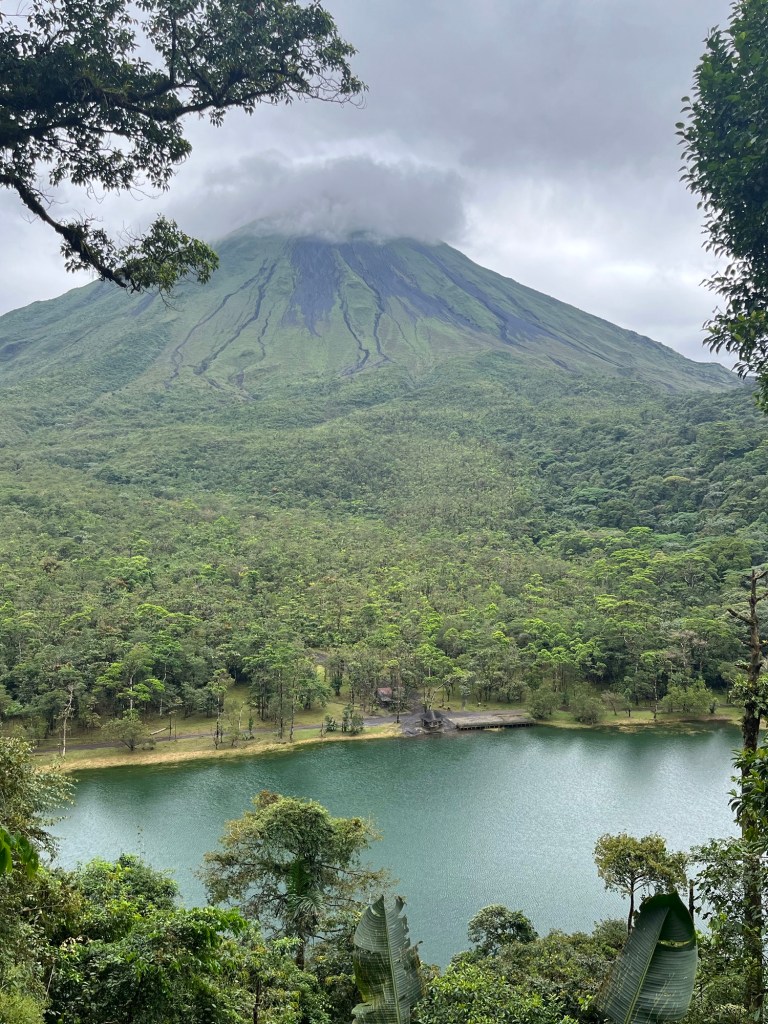
We drove to the upper reaches of the resort to the lookout point and we almost saw the top of Arenal. Apparently, you can be here weeks, even months, and never see the top of Arenal.

From that high view point there are a series of zip lines, and we saw folks harnessed in for the ride, and watched them end their trip zipping along above the swimup bar far below.

We certainly enjoyed our indulgent dips into the hot springs. With more time, we might have found the energy to explore more of what the area has to offer. Next time. But then, those hot springs are awfully tempting.

Driving in Costa Rica

We’re pretty fearless when it comes to driving in foreign countries. Costa Rica tested our resolve. We did survive all three trips here and learned a few lessons about driving around this captivating country — or maybe almost anywhere outside of your home territory. And in Costa Rica having a car is essential—most of the country has limited public transport and some of the best spots are pretty remote.

First, buy a good map. The various online guides — Google Maps, Waze, or the in car navigation systems have real limitations. They only show you a small section of the route at a time. When reception is spotty, they can be slow or slightly out of sync with your actual location. BUY A GOOD PAPER MAP. Use your map with the online line assist. We set the route looking at the map and then confirmed it with Waze and used Waze for turn by turn directions. The few times we went to Google, it misled us—in one case taking us over a road more suitable for a tractor when there was a shorter, paved alternative.

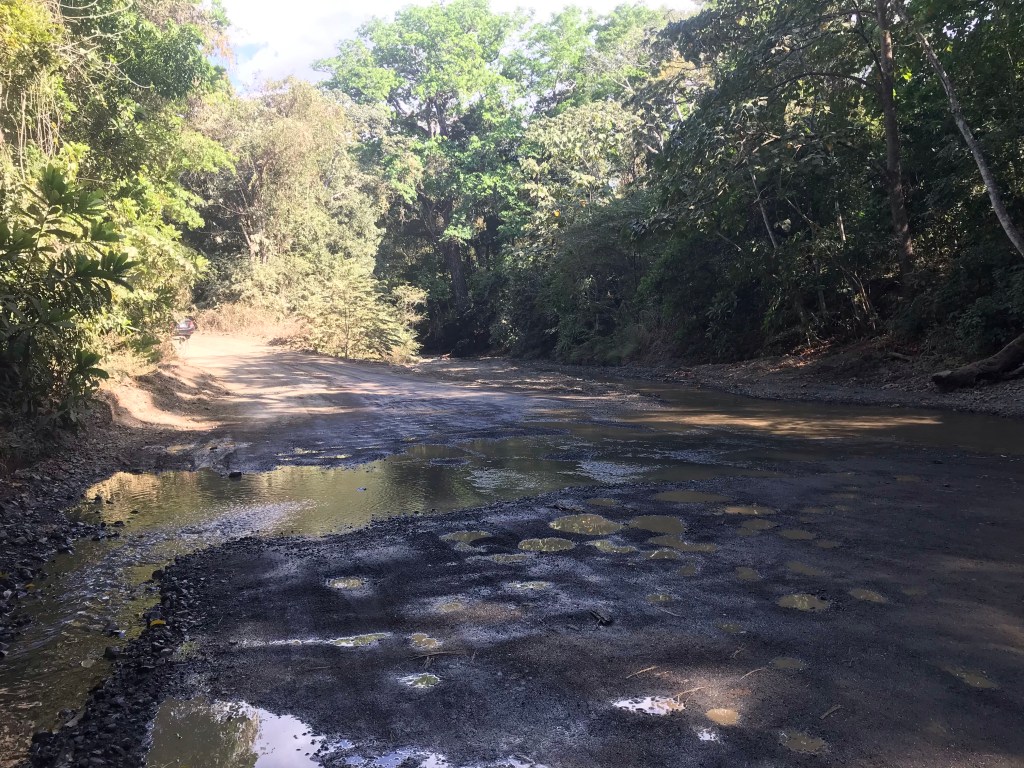
The road Google took us on.

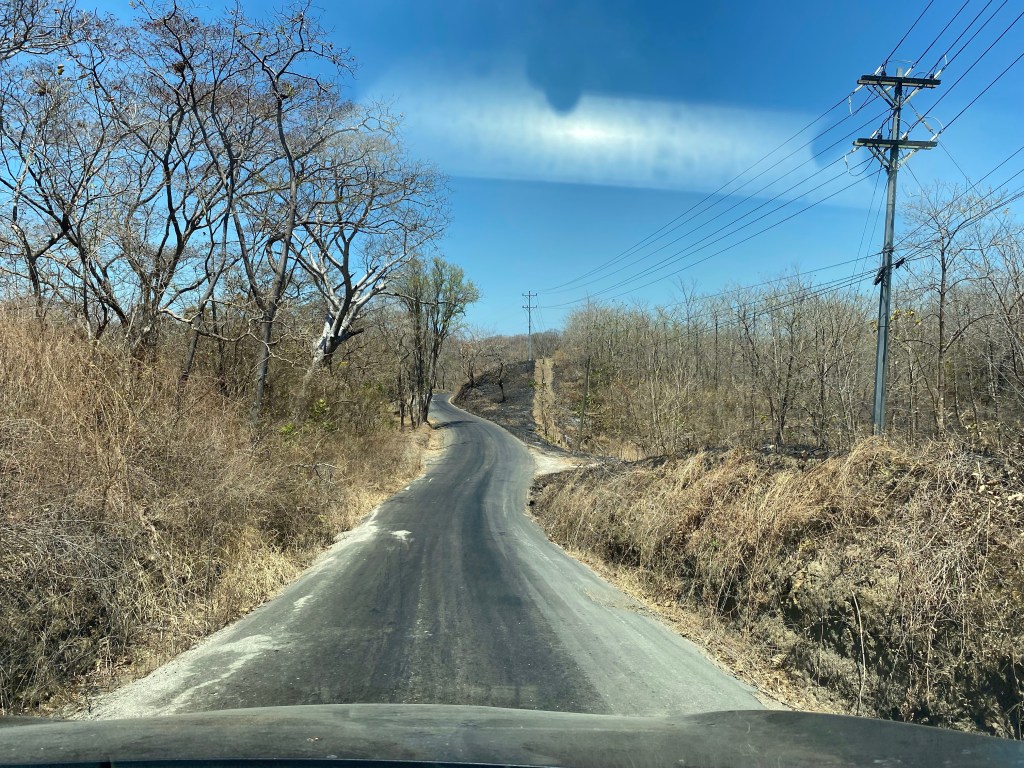
Second, rent a car with high clearance and preferably, four-wheel drive. (Side note: be aware that in Costa Rica when you rent a car, insurance is mandatory — your US insurance or credit card coverage will not cover a significant portions of the insurance. This is not a scam by the rental agency, but a matter of law. An advertised $500 dollar car month long rental will likely cost &1500-2000 with the mandatory insurance.). There’s a reason why you see so many jeeps and such in Costa Rica. The map may indicate you’re on a good road, but we learned even the major roads between major towns could descend into a series of landmine-like potholes or gravel and dirt. We referred to the best of these as Costa Rican car massages. The worst of them caused the driver and the navigator to full alert and slowed us to a crawl.

By far the biggest threat are the Tico drivers. Speed limits are mere suggestions; many locals drive much faster. It seems to be a sport! Passing the slower car in front of you seems to be the national pastime — on either side of the car, around corners or when your vision is restricted. Motorcycles think nothing of carving a third lane down the middle of the road, often carrying more than two passengers.

There are the inevitable slows downs and traffic backups. When most of the main highways are only two lane, a construction site or accident can cause huge delays. The worst for us was accidentally finding ourselves in the middle of a national bike race on one of the main north-south roads. Three hours to go six miles.

A well traveled road from Guanacaste coast to Liberia (There is also a better, longer route)

Many bridges are one lane affairs. Even on most two-lane roads. On one side of the bridge or the other, signs indicate when you must yield to on coming traffic. Once you get the hang of it, the system works just fine. Ten to twenty yards before the bridge on more traveled roads, be prepare for a speed bump. Sometimes they’re marked by a sign saying “reductor;” sometimes they are painted yellow, but not always. Hitting one of those at full speed is a tooth loosening experience. And sometimes there is no bridge at all. Then you wind up fording a stream or small river—a very sketchy prospect in a low clearance sedan.

Note the slow speed as we hit the potholes at the far end of the bridge

Be alert to pedestrians, bicycles, parents with baby strollers walking along the edge of the road. Vendors sell fruit and juices, rosaquillos (kind of donut) and even the local home brew, coyol, along the roads—anywhere there’s enough traffic, almost enough space for a car to pull off the road, or a speed bump to slow folks down. Sidewalks are scarce. Along many roads shoulders are non-existent or there are deep, steep and wide ditches often with small bridges connecting driveways and farm access points to the road. Running into one of these ditches would definitely ruin your day. In heavily touristed areas golf carts are road approved, and occasionally come without headlights. Yikes!

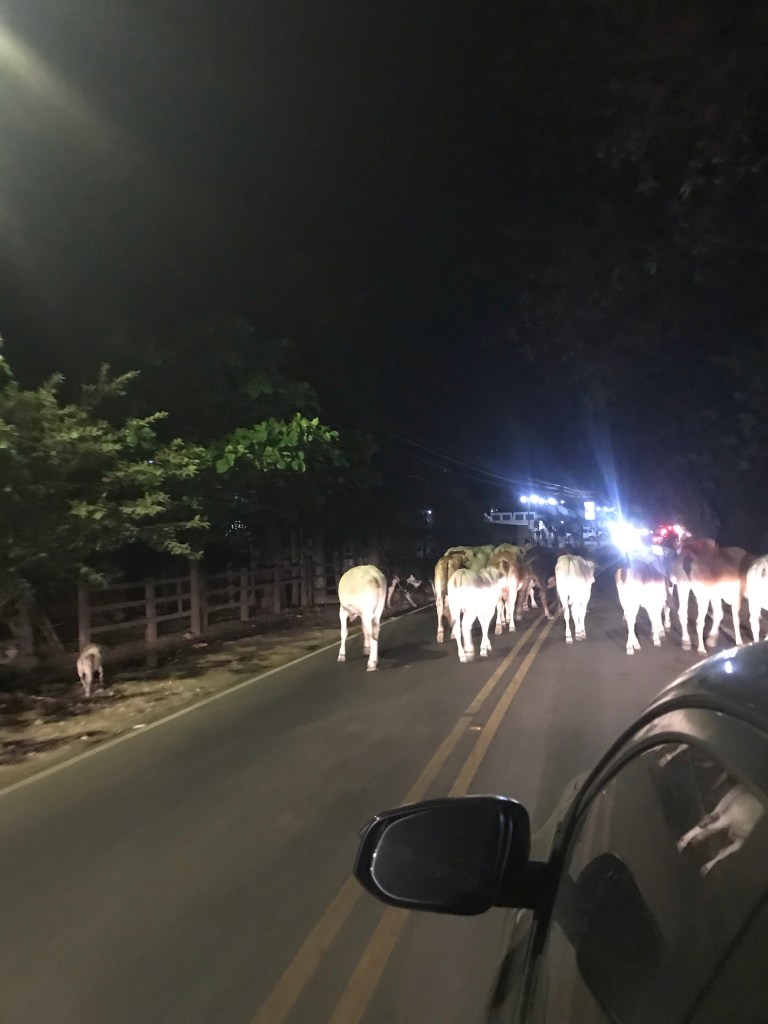
Watch out for the stray cow or two grazing along the roads.

Tico cowboys also move whole herds on the same roads you drive on. A small herd of water buffalo followed by a cowboy on a horse caused a delay in our drive near the Tempisque River. Such pastoral views aren’t limited to the countryside. We even saw an oxen drawn cart on the Inter-American highway!

Once you’re off the main roads, most lack the yellow center lines. Doesn’t really matter because Tico drivers often ignore the center line. When avoiding potholes, we followed their example and crossed to the other lane to find the smoothest path, praying a local driver didn’t coming bombing down the road at us. Mind you these same roads are used by truckers — a lot of truckers as Costa Rica has no railroads to ship goods. Be prepared for dust blackouts when driving behind trucks on the many dirt roads.

Despite the condition of the roads, we also found Tico drivers to be pretty courteous, often pausing to let you into the flow of traffic, waving you ahead at four-way stops. They may not follow the rules of the road that we are used to, but they also are not generally aggressive jerks. The basic Pura Vida of the locals shines through even in traffic.

Is Costa Rica too dangerous for North American drivers? Not really. While we focused here on the challenges, many of the roads are in good shape, not unlike country roads in rural parts of the US. And it’s really the best way to experience the variety that the country offers. At least for our style of travel (staying in Airbnb’s and trying to get a feel for the local community) it’s the best way. Maybe in bigger resorts taxis are available, but we saw few of them where we were. Public transportation consists mainly of buses with somewhat limited routes. The lack of public transportation is probably why we saw so many bikes and pedestrians on the roads. Your other option is hiring guides or drivers which is pretty much what you would have to do without a car. And they are readily available and reasonably priced.

We’ll rent a car again next time we visit. And we’ll remember to be vigilant, and that travel times may be greater than they might be back home. We’ll remind ourselves to exercise more caution than we might at home and keep our sense of humor! We’re on vacation after all!

In Praise of the Familiar

We travel for many reasons—adventure, broadening horizons and having new cultural experiences, relaxing, socializing—to name a few. That often means exploring new places, traveling to new countries or new regions in countries already visited. But once in awhile it’s really great to go back to some place you’ve been to several times. That’s why we’re back in Potrero, Costa Rica.

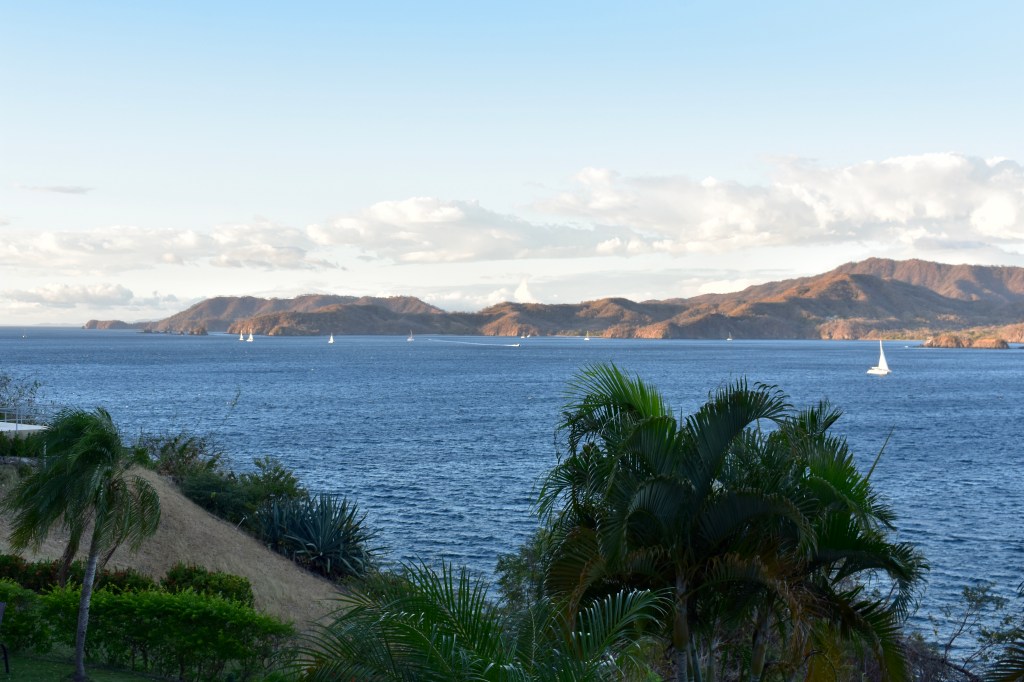
Potrero Bay

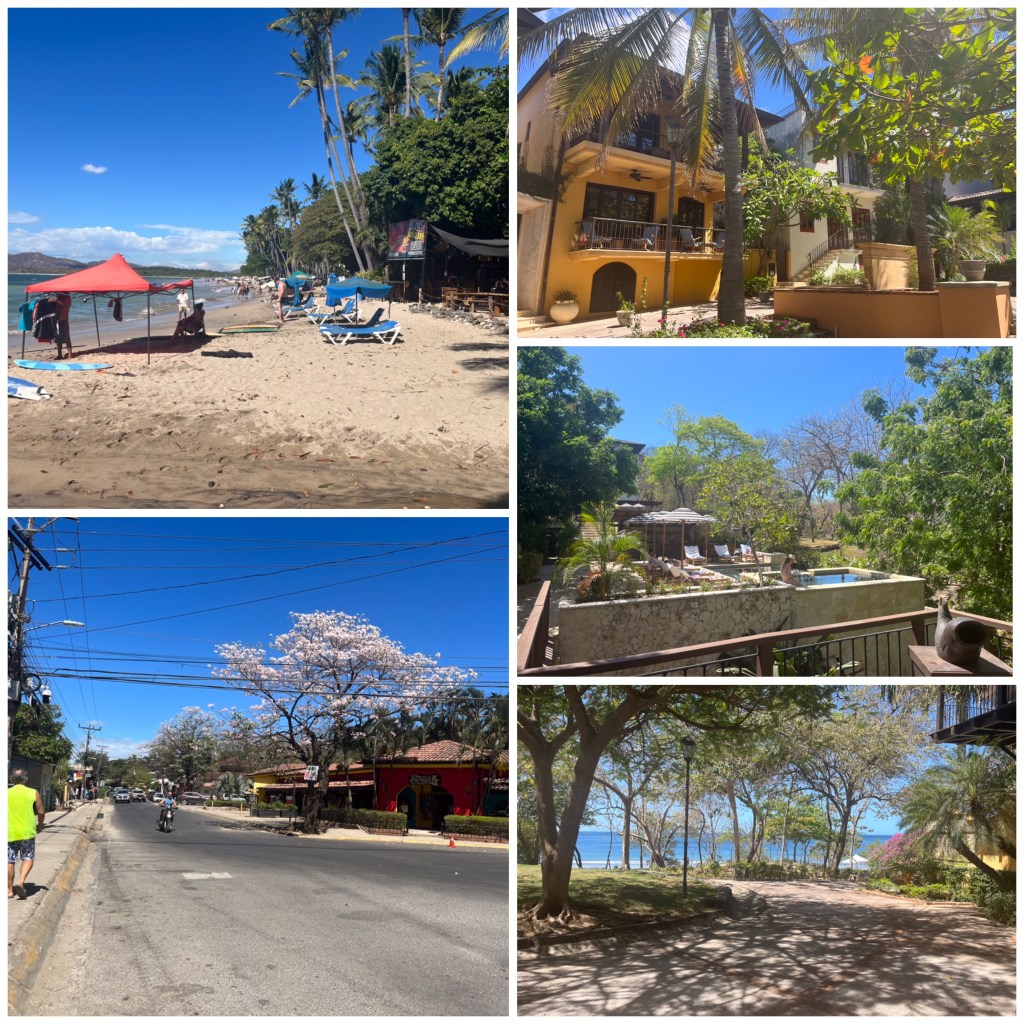
There isn’t really much to do in Potrero—other than enjoying the gorgeous beaches. There are no mega resorts, only a few “fancy” restaurants. The area is mix of locals (Ticos) and ex-pats/tourists—largely Canadians. No zip lines, no white water kayaking, no extreme mountain biking. We have seen a few ATV tours. Playa Flamingo nearby has a few more amenities, a couple of resorts, snorkel and dive options, sunset catamaran and deep sea fishing tours. A brand new marina complex will add more options. And now there is a super fancy huge development about five miles away, Las Catalinas, modeled on an Italian Cinque Terre village. If you want the full tourist and surfing dude experience, Tamarindo is 40 minutes away.

Tamarindo on the left and Los Catalinas on the right — worlds apart

We’ve visited this area now for the third time. For us, it’s been an alternative to Hawaii—relatively easy to get to, cheaper, and just as beautiful. Each time we come here we make new discoveries, find new “secret” places. But we also have the comfort of knowing where to find the best fruit stands, the fish market, locals’ grocery stores and the ones stocked to North American tastes. We know the best “sodas” (family run Tico restaurants) and there are still a couple we have yet to try. And where the ATM’s are located — always a good thing.

Twice we’ve had minor medical issues and we found an excellent local clinic (fluent English spoken). By the way, last year, one exam, two follow-up visits and a course of antibiotics—$80. Probably less the insurance copays at home. This year’s trip cost just slightly more for doctor visit, lab work and prescription.

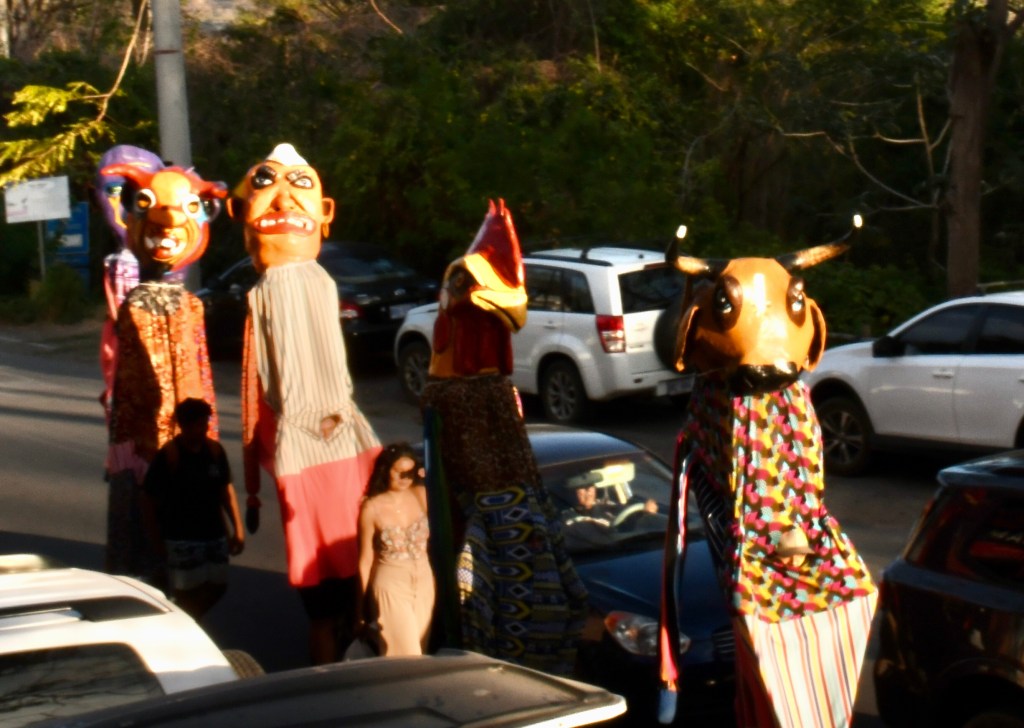
We knew this year to watch for the annual Madri Gras parade — a purely local extravaganza that lasts 15 minutes. There are no signs posted to alert you of this funky event. We found out about it from repeat visitors who clued us in last year. So this year we passed along the information to other newbies. The kids loved the candy that was thrown.

Mardi Gras Parade
The Mardi Gras pirate

And we’ve found some very helpful resources here—our local “fixer” Jennifer and an outstanding local guide, Graven—resources that we use again and again. Jennifer runs a great taco bar restaurant www.amigostacosybeer.com/in Playa Flamingo, rents golf carts, and has local contacts among guides and tourist services http://rentagolfcartcostarica.com/.

We e-mailed her a few weeks before our trip and she lined up a birding trip on the Tempisque River with Graven that we had done before and loved. This year’s tour was just as much fun as we remembered, and because we were dealing with unpredictable nature, we saw more monkeys this year and different birds. Next time we may try one of Graven’s hikes or other tours.

We’ve also learned to let our mood and the weather determine which beaches we walk in the mornings and where to go to catch the sunset in the evening.

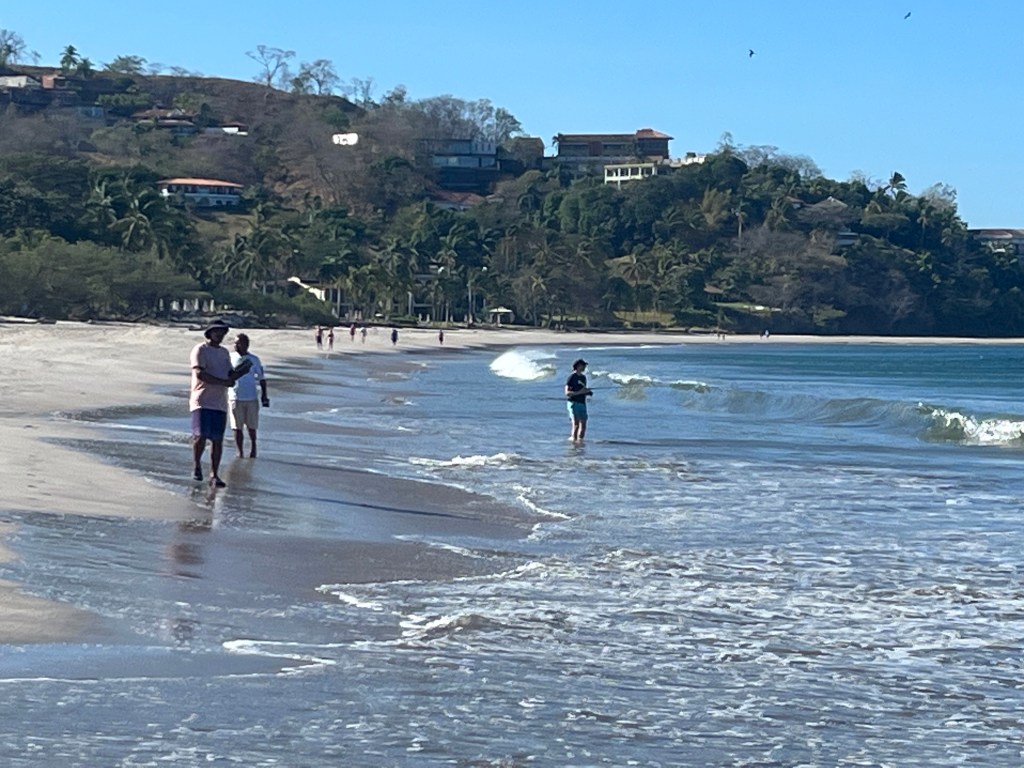
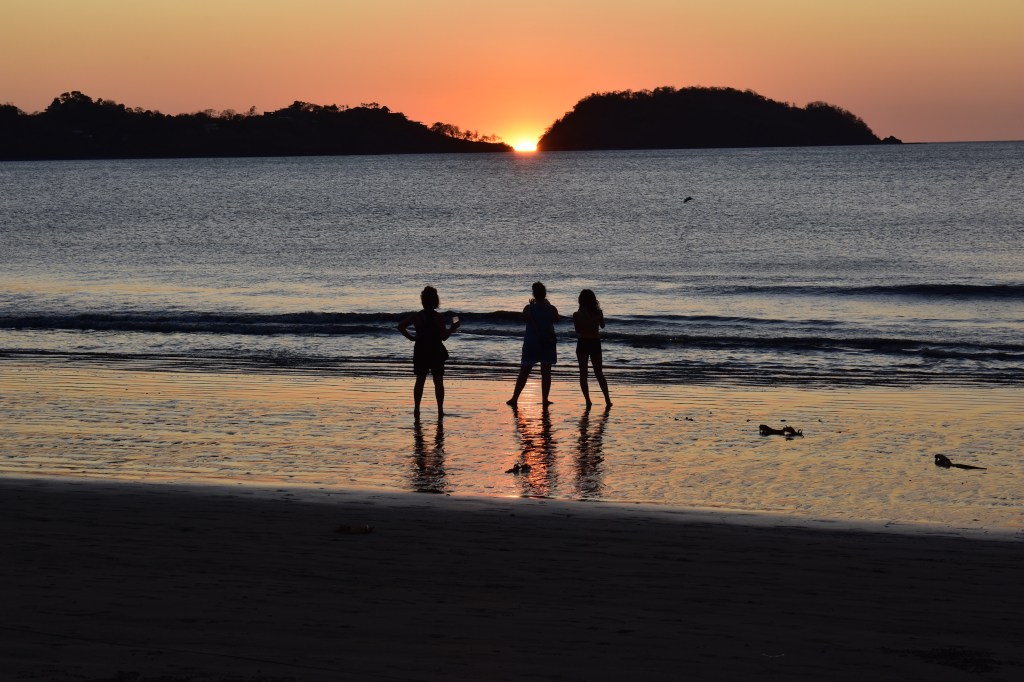
Playa Flamingo is the most touristed beach with two of the largest hotel complexes, a long whiteish sand crescent with hawkers selling tents and chairs for a couple twenty dollar bills (all negotiable). At midday the beach can be crowded. When the tides are right Ticos are out with fishing poles or even just fishing line, catching tuna and jack fish in the surf. At sunset, we sat among locals and no gringos within sight.

Locals fishing from the beach at Playa Flamingo

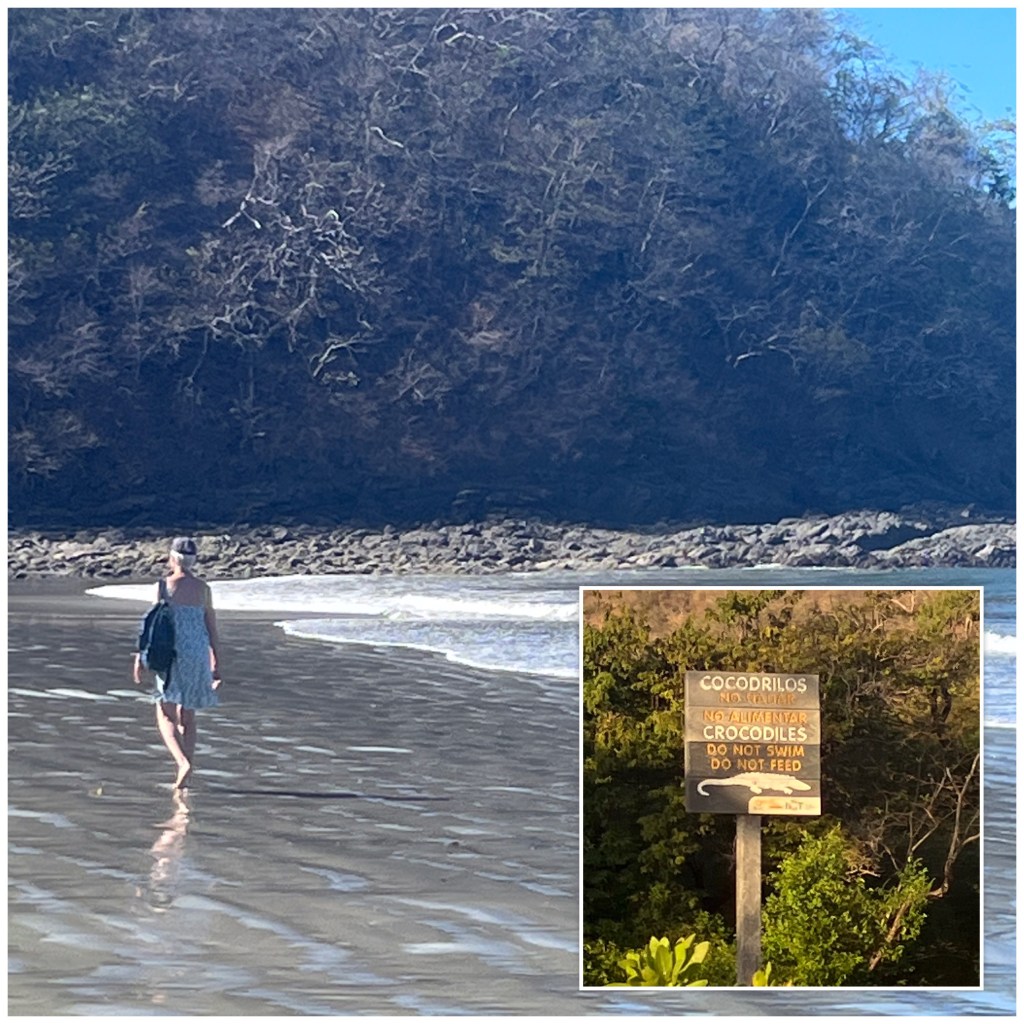
To escape the wind (which was wild this year), we walk Prieta Beach, a short white sand beach, often all by ourselves. It’s located north of town, down a steep and somewhat intimidating dirt road. No signs, almost impossible to find. We were lucky to stumble on it last year and it is now our favorite. It’s seems almost like our own private paradise. On the weekend, the beach attracts a few locals. Snorkeling is marginal there, but Prieta is still a spectacular place to swim and play in the waves. A short walk connects to another lovely, slightly more crowded beach, Penca (and a sign warning of crocodiles in the lagoon behind the beach).

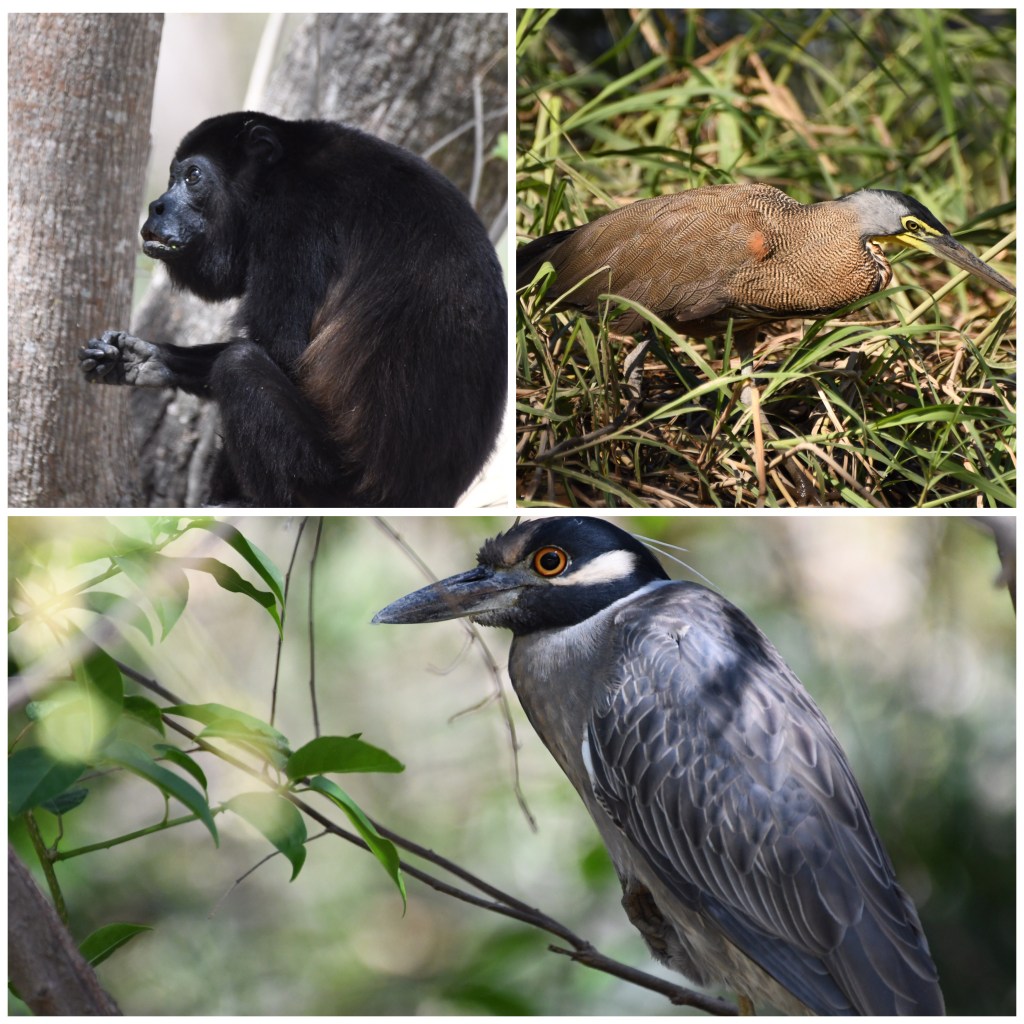
Looking for a beachside restaurant? We go to Playa Potrero. The bay itself is less inviting here—darker sand, a little muddy—but it’s a great beach to walk and watch the sunset. Several small places offer decent margaritas and basic food. These places attract mainly tourists, but our attitude when we eat there is, hey — we’re tourists! Las Brisas, at the far end of the bay, has become our traditional first night in Potrero dinner! The evening dinner is often punctuated with Howler monkeys howling behind the restaurant.

Of course, when we go back to a place several times, we can’t help but make comparisons. The roads seem in better shape this year — fewer potholes. But as a consequence, more traffic, more wild Tico drivers, and fewer golf carts (which are street legal here). Some of our favorite restaurants have closed. New ones have opened. Prices are higher, but still low for what we’re getting. The pandemic has disrupted the local economy here as much as back home—marginal businesses struggled. But recovery seems to be in full swing. Lots of construction and we worry that bit by bit Potrero may go the way of some of our former favorite places.

Another big change is the presence of mega yachts — Howard Schultz of Starbucks 100+ foot yacht was here, plus Arthur Blank (one of Home Depot’s founders — the liberal, not the current right-wing owner) even bigger yacht, and another yacht that charters for $325,000 a day plus expenses. Strange, because as we said, there’s not much here to attract that crowd. We never saw those big boats the first two times we were here. Sign of today’s economy?

Upper boat is registered to Arthur Blank of Home Depot fame and the other is available for charter at $325,000 a week plus expenses.

Yes, there is something very comforting about the familiar. It takes a while to know a place and each return visit adds new layer of understanding and new finds. We hope to return again next year to escape the northern hemisphere cold and make some new discoveries.

Guiding Lights

For years we scoffed at hiring a guide when we traveled, figuring we could read the books, or ask around and figure out most stuff about sights on our own. We looked at groups in museums, massed before a work of art and listening to a guide drone on and on about the artist, the symbolism, the technique …. and we winced. Probably we were scarred by many trips to the old Soviet Union and their pedantic guides.

But in recent years, we have learned to hire a guide to get a really good overview of a city, or when we want a deep dive into the details of a site. We learned on our Zimbabwe safari that without the guides we would have missed a lot, even giraffes standing right in front of us among the trees. In Costa Rica, we would never have seen a spider monkey or identified it’s call. In Spain, we might have missed the Griffon vultures—one of the biggest birds on the planet. Yep, a good guide, particularly a private guide or small group guide is usually worth every penny you pay.

We’re casual bird watchers — we don’t get up at the crack of dawn to visit sewage treatment ponds or horribly remote locations. Our life lists are pretty hit and miss. But we do enjoy stopping on a walk to look at a bird. Our identification skills are pretty lame, so when we’re in a nature lover’s paradise, we hire a guide. Case in point: Monteverde in Costa Rica.

Six years ago we had booked a birding tour through a kiosk at a hostel/backpacker hotel/cafe in St. Elena. The guide turned out to be fabulous. So for our latest trip we hunted him down online (luckily Peter had recorded his name in our journal from our trip six years ago).

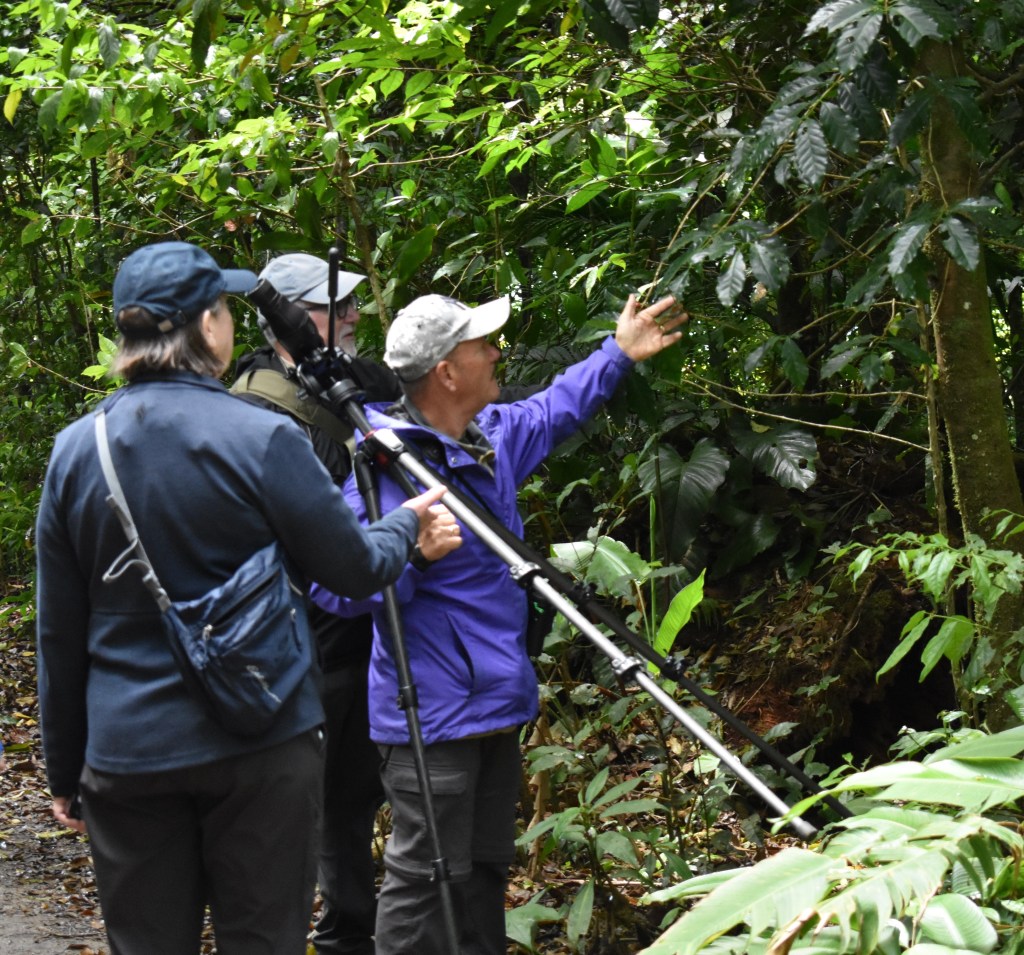
Adrian is exactly what you want in a guide. First and foremost, he is wildly enthusiastic. He leaves you with the impression that he not only loves his job, but he simply enjoys a walk looking for birds. When we spotted a rare one, he was more excited than we were. “Oh! Oh! Oh!” He would say, grabbing his spotting scope and trotting off with us closely following, “This one is special.”

With 30 years of experience, he knew every sound, every nook and cranny in the Curi Cancha Reserve. We were surprised that he wasn’t taking us back to the more famous Monteverde Reserve just down the road where we had been six years ago. But as he explained, Monteverde had become way too crowded and had imposed too many restrictions on visitors and guides. Another advantage of a great guide, we thought, as we toured Curi Cancha, most of the time by ourselves.

First question he asked us before we took off? “Who is keeping the list.” For each bird we saw, he patiently and deliberately repeated the name several times, even spelling it if needed. He did complain that they kept changing the official names of birds which made his job challenging at times. His upbeat demeanor carried us through the less than ideal weather. After all, it’s called the Cloud Forest for a reason.

When the other guides zigged, he zagged, leading us into quieter parts of the forest. He knew where the owl generally hung out (it didn’t show for us) and where to find the spectacular resplendent quetzal, the star attraction of the Cloud Forest. But as the other groups gathered in front of the tree where the quetzals pick fruit, he took us back into the woods where it would sit to digest it’s meal. In short, he knew the ropes and had a few tricks up his sleeve! In the end, we saw 48 different species in four hours!

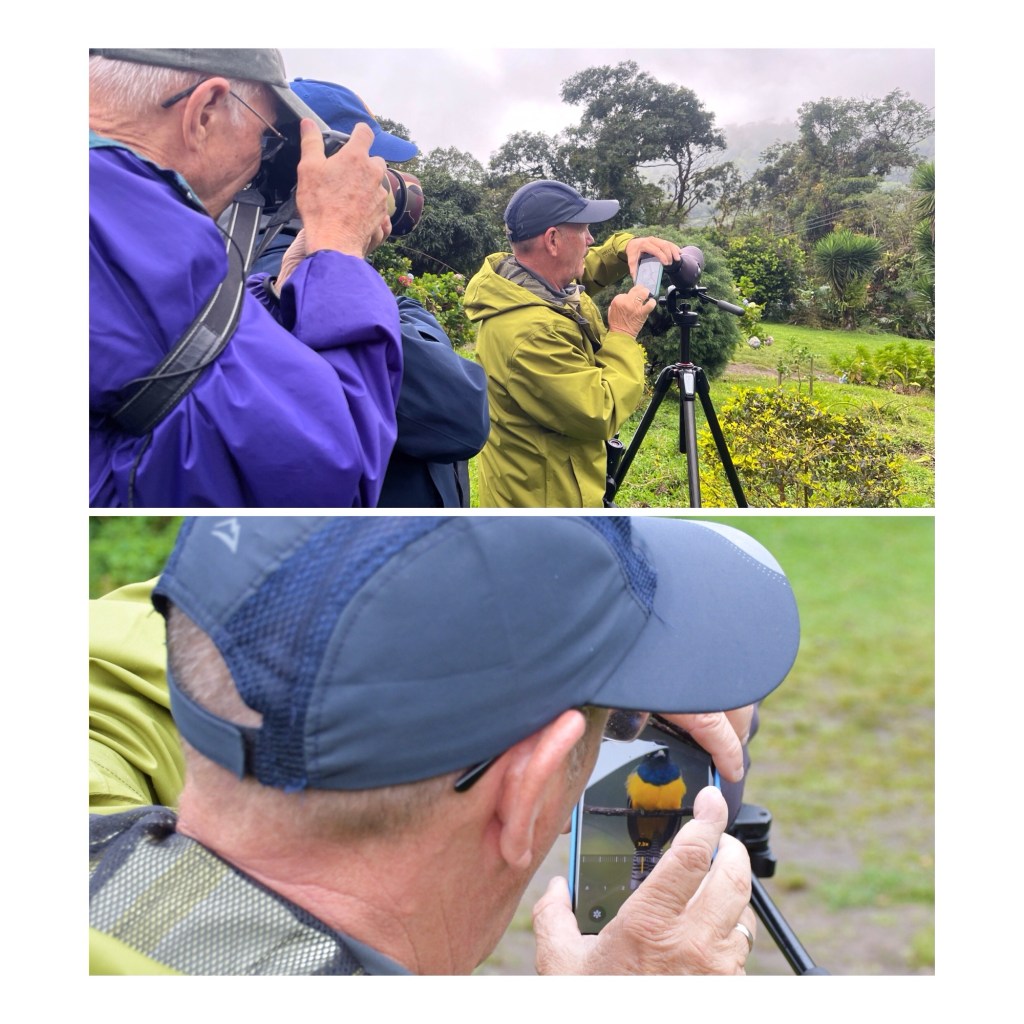
When he spotted a bird, he quickly set up his spotting scope, lined up the bird and stood back so we could take a look. If we wanted, he used the scope and our smartphones to capture dramatic pictures of the birds. When the birds moved too quickly, he used a green laser, pointing just below the bird, careful not to hit it with the light, so we could find it with our binoculars. He also knew which birds would fly away from the light and used the laser very judiciously.

And since we aren’t purists, we didn’t care that some of our bird sightings happened at a cafe with bird feeders. We enjoyed the mid-tour break for coffee almost as much as we enjoyed seeing the birds clustered around the feeders.

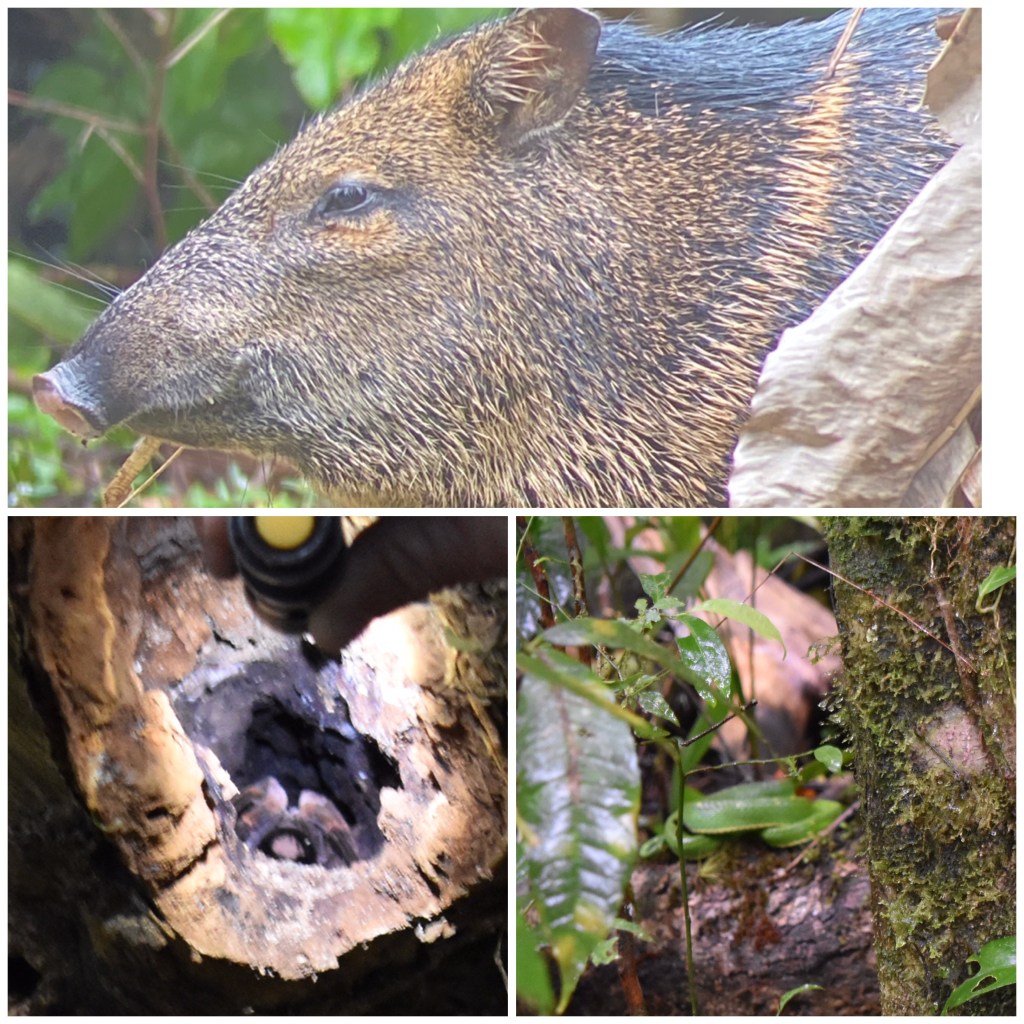
He didn’t just talk about the birds, we also got a lesson in the plants around us and the evolution of eco-tourism in Costa Rica. The wild pigs, known as peccaries, are new to Curi Cancha and were originally shy, but have learned that within the park they have nothing to fear — until the pumas choose to return, too. Adrian made us sure we saw the tarantula, and poisonous Green Pit Viper. These guides are all trained, many with college degrees in ecology or environmental studies.

But the great guides don’t just show you the sights, they also give you a glimpse into their community. Of course, we talked about the pandemic and it’s impact on his life, how a frugal lifestyle meant he had money in savings to survive. He had suffered a medical scare two years ago that brought him closer to his family and helped reorder his priorities. But he also shared how the Costa Rican medical system worked for him. He now takes more days off and limits the number of tours per week. And he gave us a clue to one aspect of how the tourist industry works when he told us next time to contact him directly for a better price on the tour. (adrianmendezc@hotmail.com)

As we ended our day the sun came out and we said to Adrian, “see you next year!”

No More Monkey Business

We’re back in Costa Rica for the third time. The first time was six years ago and then again in 2022 when we were first traveling as the pandemic became more manageable. We planned this year’s trip to take us to some new places and revisit our favorite “been there & done that’s.” The repeat visits generated comparisons — Is the traffic worse here? Are the prices higher this year?

Probably making such comparisons is inevitable and probably largely guesswork. But without a doubt the pandemic left it’s mark on Costa Rica.

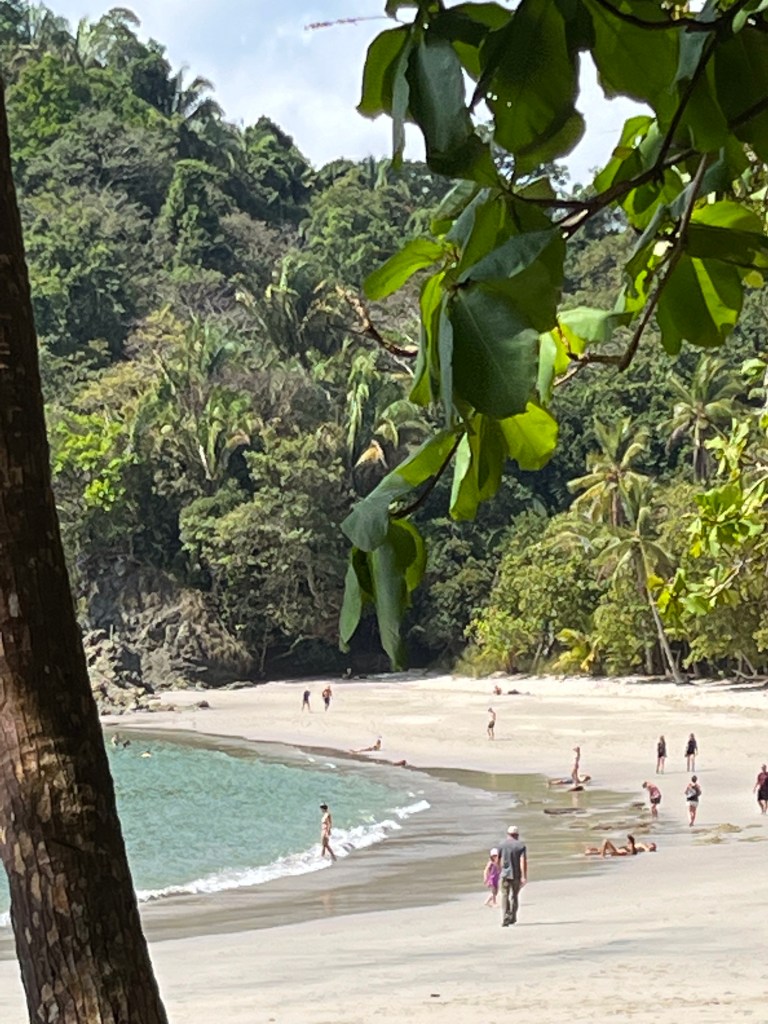
One of Costa Rica’s biggest tourist attractions — Manuel Antonio National Park — is not the biggest park in Costa Rica, but sits reasonably close to the capital with gorgeous beaches. Six years ago, the beaches in the park were packed with families and tourists — and outnumbering the human visitors were the ever vigilant White-faced Monkeys (also known as Capuchin). Notoriously clever thieves, they were constantly on the lookout for bags or purses that might contain food. We were warned never to set our bags down as the monkeys were lightening fast at stealing them — often carrying them up into a tree and disdainfully throwing down all the non-edible items inside. As we walked the paths, we stepped around and over the mama monkeys and their babies. You had to get dozen of yards away from the beach and the picnickers to get a sense of the real park. On our visit this year, we struggled to see even one White-faced Monkey.

Why the change? The pandemic. The park was closed that first year. The park naturalists noticed monkeys began dying from starvation. Many of them had lost the ability to forage for food when there were no tourist backpacks to raid. This triggered a re-examination of park procedures. Now entry is limited and requires a reservation. Visitors are checked at the entry gates to make sure they don’t bring in any food that might attract the monkeys. As a result, the park is less crowded and is cleaner and, most importantly, the monkeys have reverted to their more natural state.

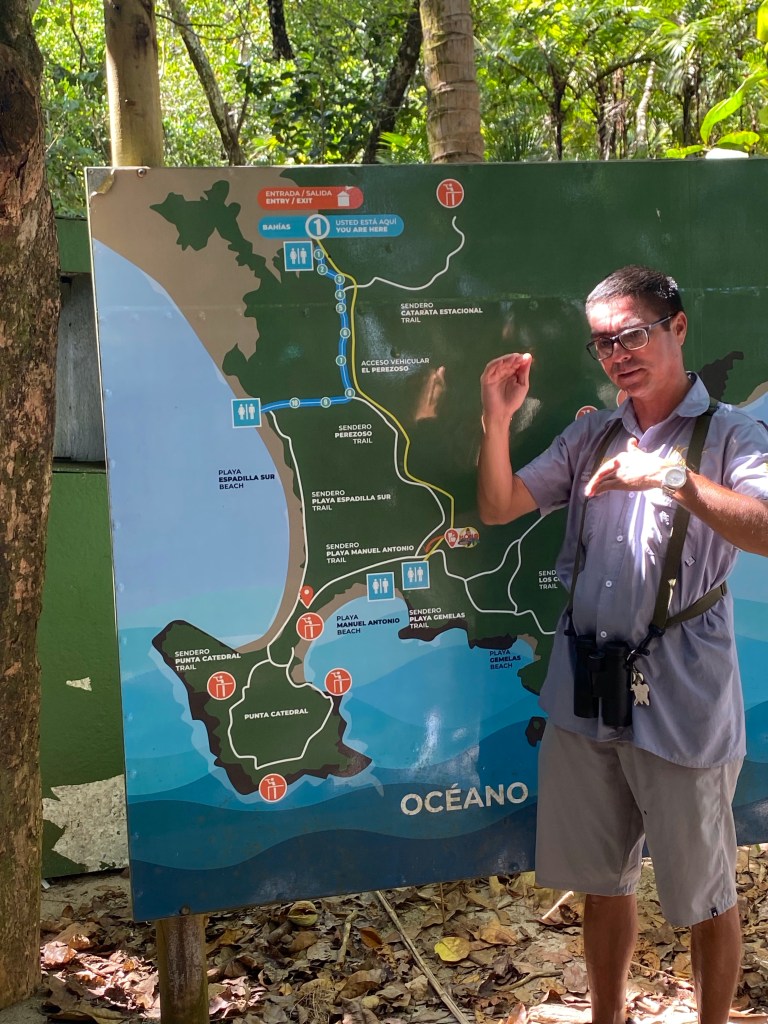
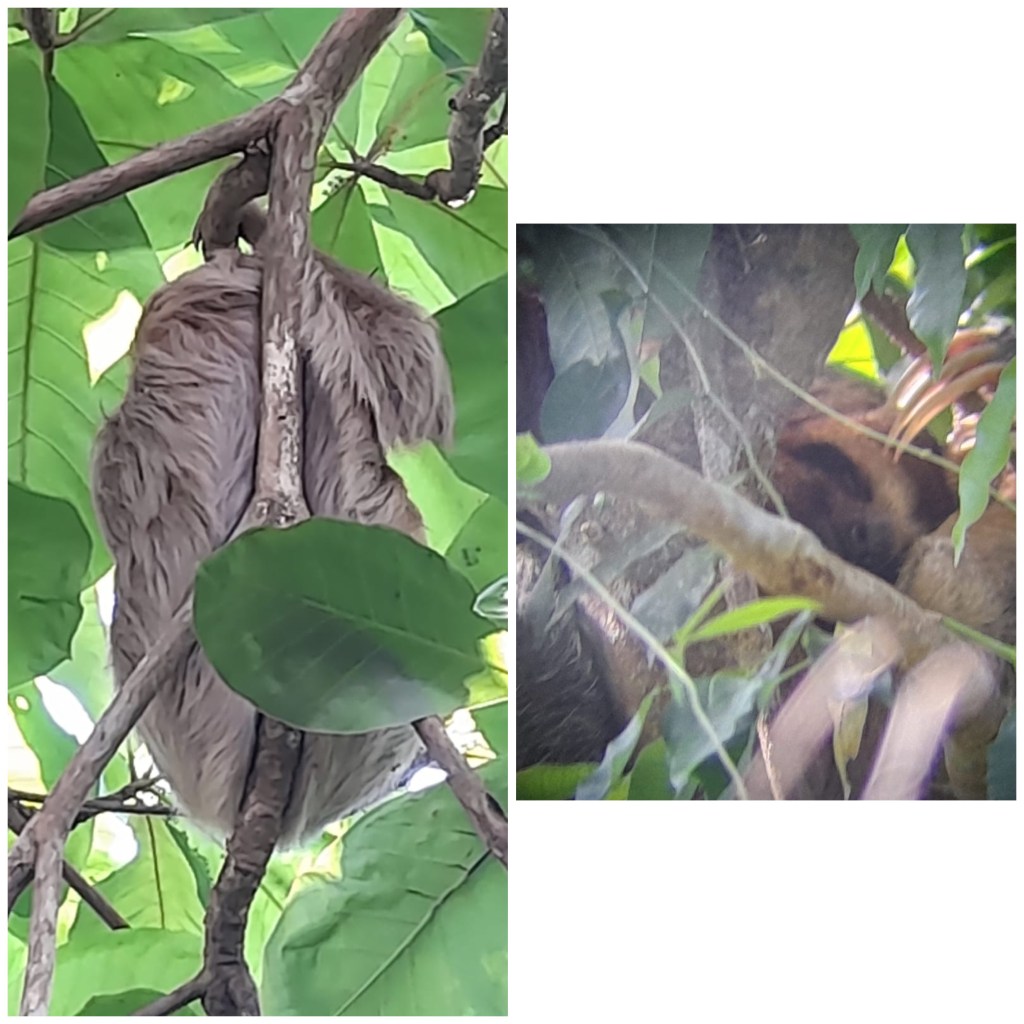
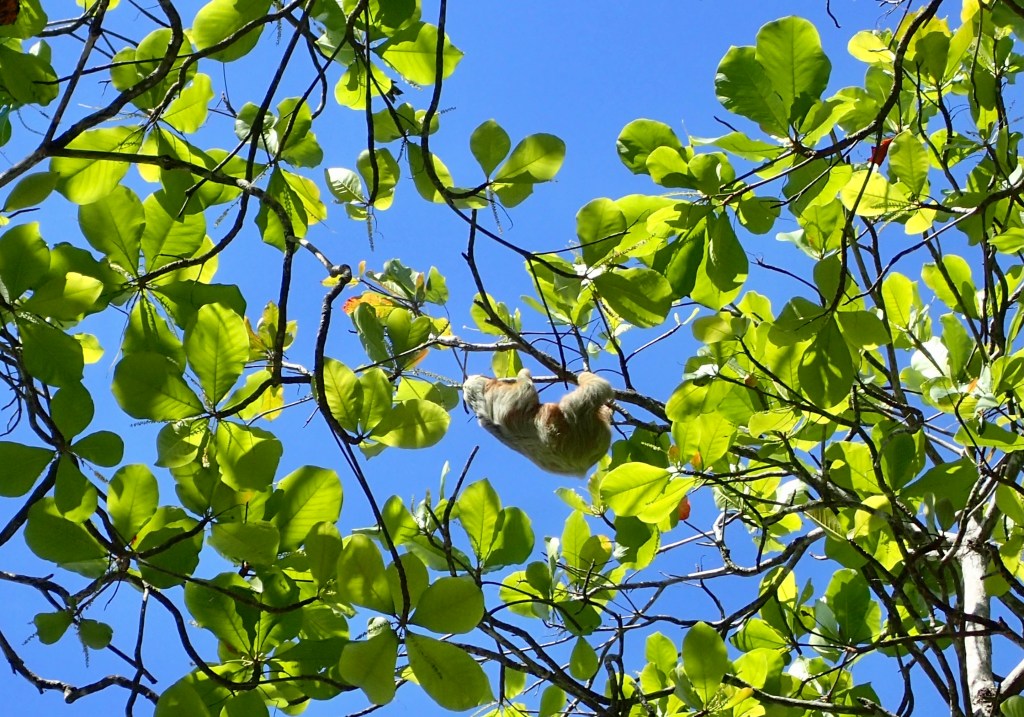
Without the monkeys lurking about, and with the help of our guide, we were able to focus on the other critters of the park. An immature sloth sleeping in a tree with mama watching from not too far away.

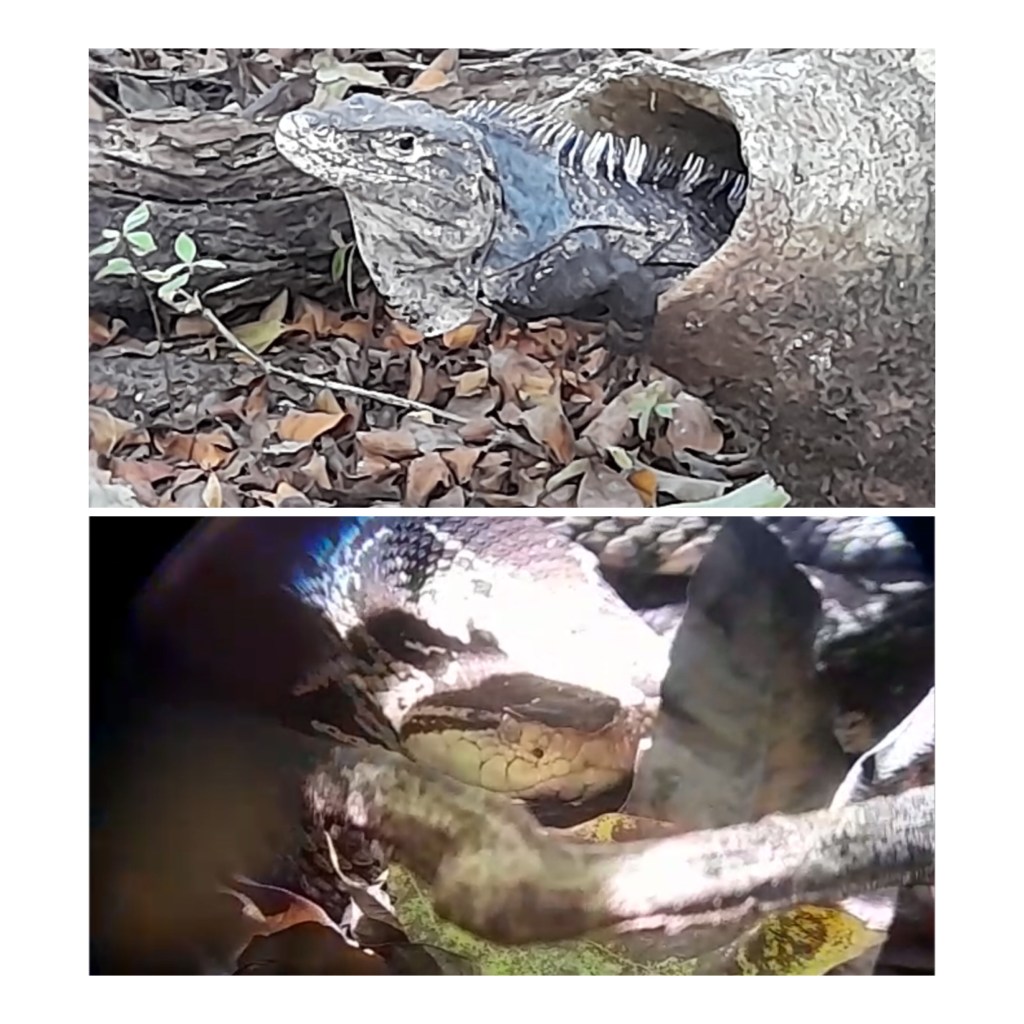
A lizard and a Fer de Lance snake patiently waiting for their meals to wander by.

An agouti mom and her two little ones, playing in the underbrush.

Anyone planning a trip to Manuel Antonio needs to remember the park is closed one day a week for repairs, cleaning and to give nature a chance to rebound — unless, of course, you can pay $36,000 as film production crews (scenes from The Castaway with Tom Hanks were filmed here) and the famous (Steven Spielberg, and Will Smith to name a few) do in order to have the beaches to themselves.
Costa Rica takes its natural beauty seriously. Roughly 28% of the country’s total land is set aside as national parks or nature reserves. School tour groups get in the parks free and we were told by our guide that annual visits to the park are a routine part of the curriculum to build a national sense of pride and consensus to preserve the bio-diversity.
Yes, it is different here now after the pandemic but some of the changes are definitely better for both tourists and the animals. Pura Vida!