For the Birds

Our third trip to the Cloud Forest in Costa Rica was probably our best. Maybe because we were ready for a break from the unseasonably hot weather on the Pacific Coast. Maybe because the roads were familiar, and now much improved from earlier trips. Maybe it was simply because the area is so gorgeous.

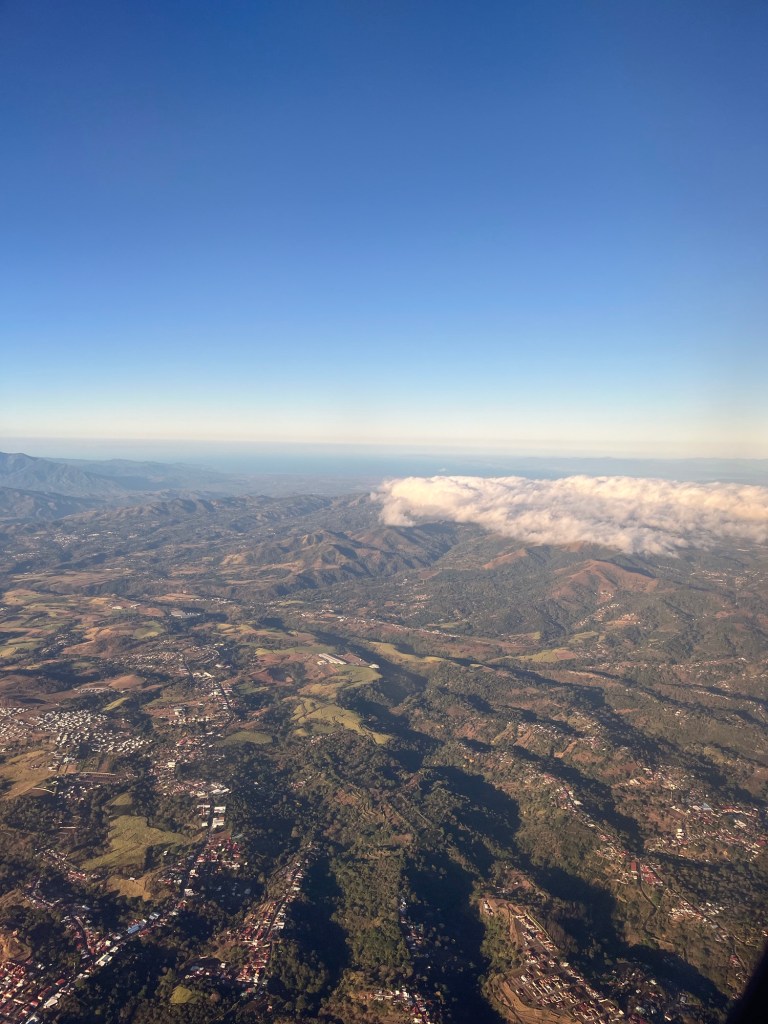
The Cloud Forest is special even for nature-rich Costa Rica. The wind from the warm Caribbean side blows the clouds up and over the continental divide, keeping the jungle below cool and wet. The clouds just hang on the mountain tops.

There was a 30 degree temperature difference between the Cloud Forest and the lowlands a few miles away when we were there this year. 98F vs 68F. We heard that climate change and the rising sea temperatures are changing this pattern a bit, meaning less rain fall in the mountains and more on the costal plains. It is worrisome—so much flora and fauna are dependent on the very specific micro climates of the Cloud Forest.
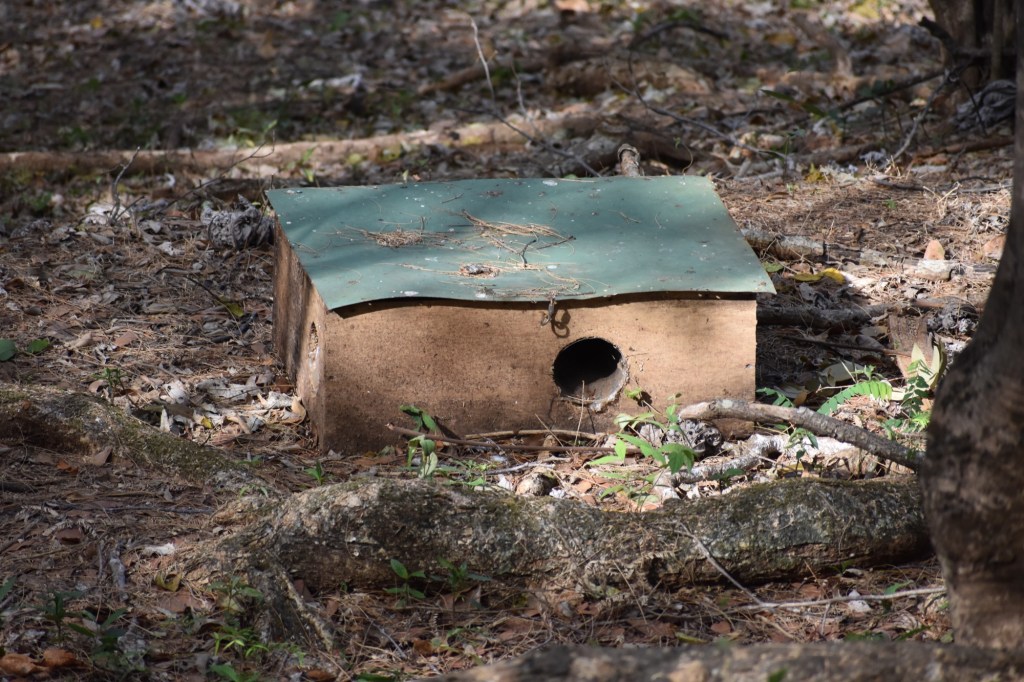
The big draw in the Cloud Forest are birds! Birders from all over the world flock here (pardon the awful pun). Situated between North and South America, Costa Rica is known for its incredible biodiversity and the amazing number of different birds reflects that richness. 918 at last count.

A disclaimer—we aren’t really serious birders. A passionate birder friend gradually sucked us in years ago when we traveled together. At first, we saw birding as an excuse to take a walk in the woods, green belts, or seashores. Then we began keeping track of the birds we saw. Technology, of course, made it easier with finger tip accessibility to information on birds and help identifying them. We were hooked. Now where ever we travel, we try to take a walk and look for birds. But in a place like Costa Rica’s Cloud Forest, you don’t need a book or a life list. Just grab a pair of binoculars and enjoy.

Seven years ago we birded in the Monteverde National Reserve, the most famous of the many Cloud Forest sites. We hired Adrian Menendez, an outstanding local guide. We haven’t been back to that park since, but have reconnected with Adrian. He’s led us up remote mountain roads, through other regional reserves and into private parks.

Over two mornings with Adrian this year, we saw nearly a hundred different species!

Of course, we would see very few birds without him. Not only does he know the sounds of birds and can locate them primarily by sounds, he also knows where the different species hang out. These mountains have been his birding territory for 31 years. He knows where an owl hangs out, or under what bush you’ll find the shyest of birds or where the wild avocado trees are found that the Resplendent Quetzal likes to eat.

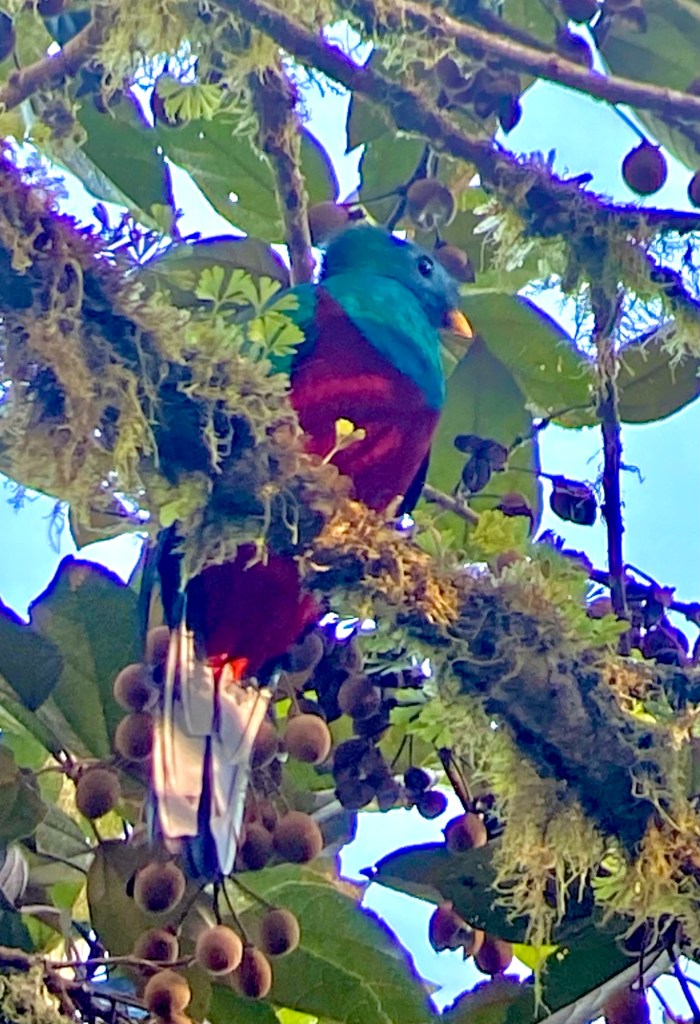
On our first day, we drove just barely over the continental divide and walked along a mountain road not far from the Santa Elena Reserve. And there was a Resplendant Queztal just waiting for us. And the Red-faced Spinetail with its precarious hanging nest. And 39 other species!

Red-faced Spinetail and its nest

From there we went into the Reserva Bosque Nuboso, where many of the paths were paved to allow handicapped access. And benches are provided for seniors. It was later in the day so fewer birds were active. At the highest point we were 5608 feet above sea level, roughly the same elevation as Paradise on Mount Rainier. No wonder there was a bit of huffing and puffing!

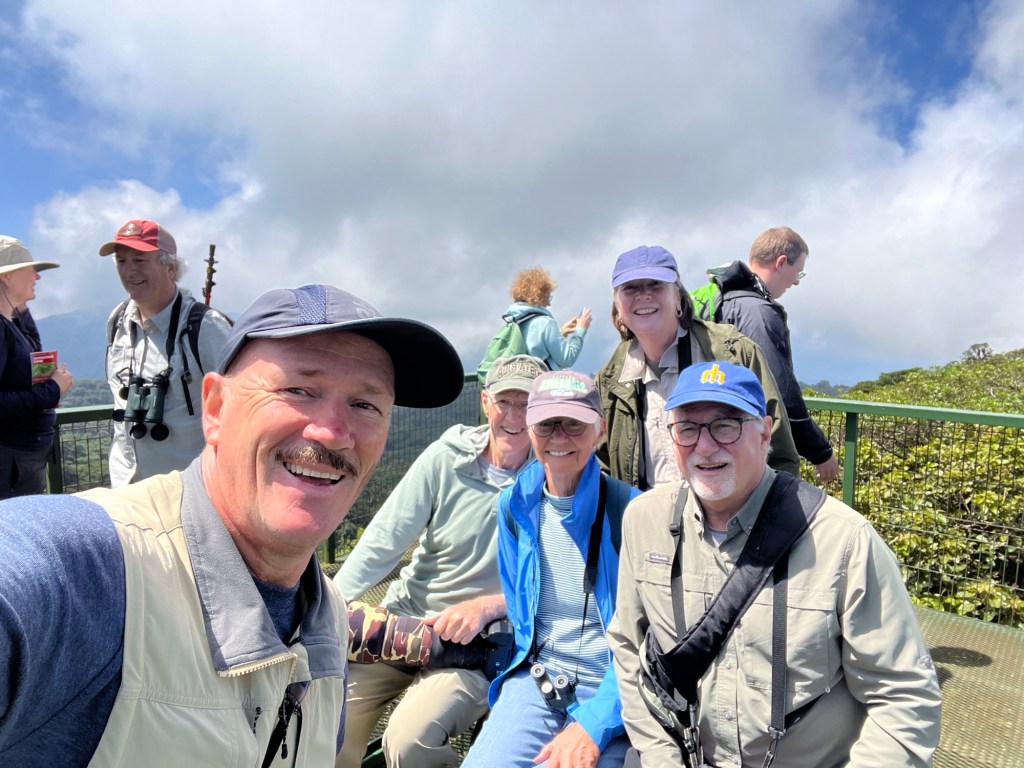
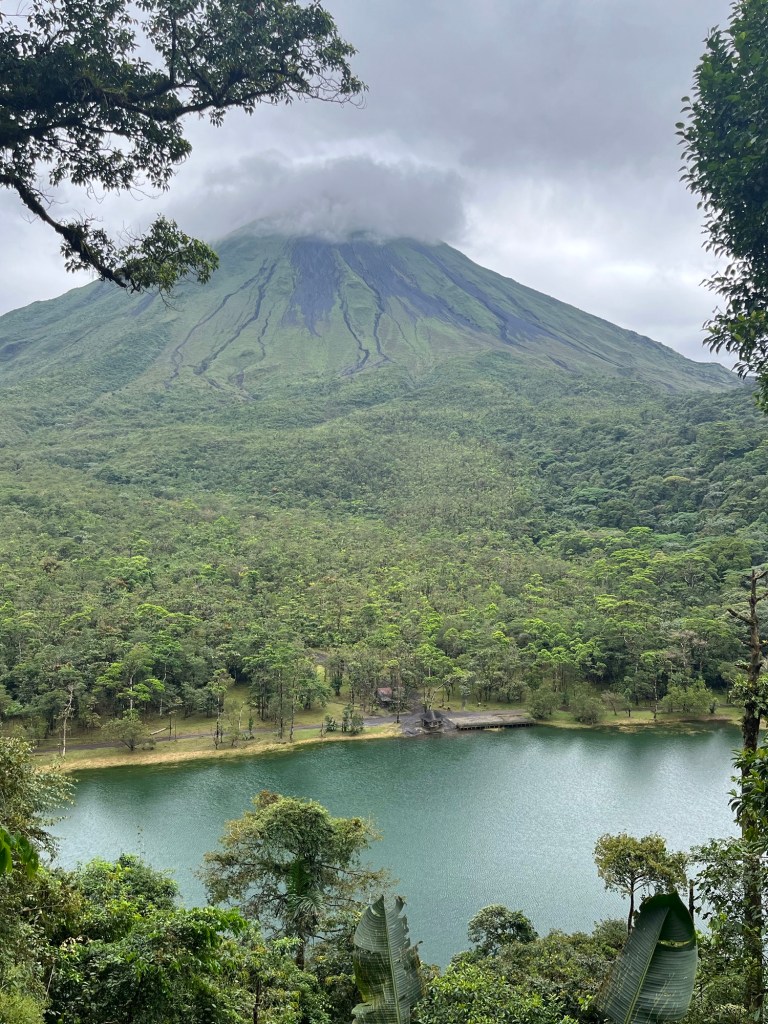
Sitting on top of the world with Arenal Volcano behind the clouds

The highlight of the day came when an Ornate Hawk Eagle flew over head followed by the American Swallowtail Kite, on its migration north. From a platform tower we could see several of Costa Rica’s volcanoes, including Arenal which last erupted in 2010 (because of the threat of another potential eruption, all cars are required to back into parking spots to expedite an emergency exit — not a comforting thought)

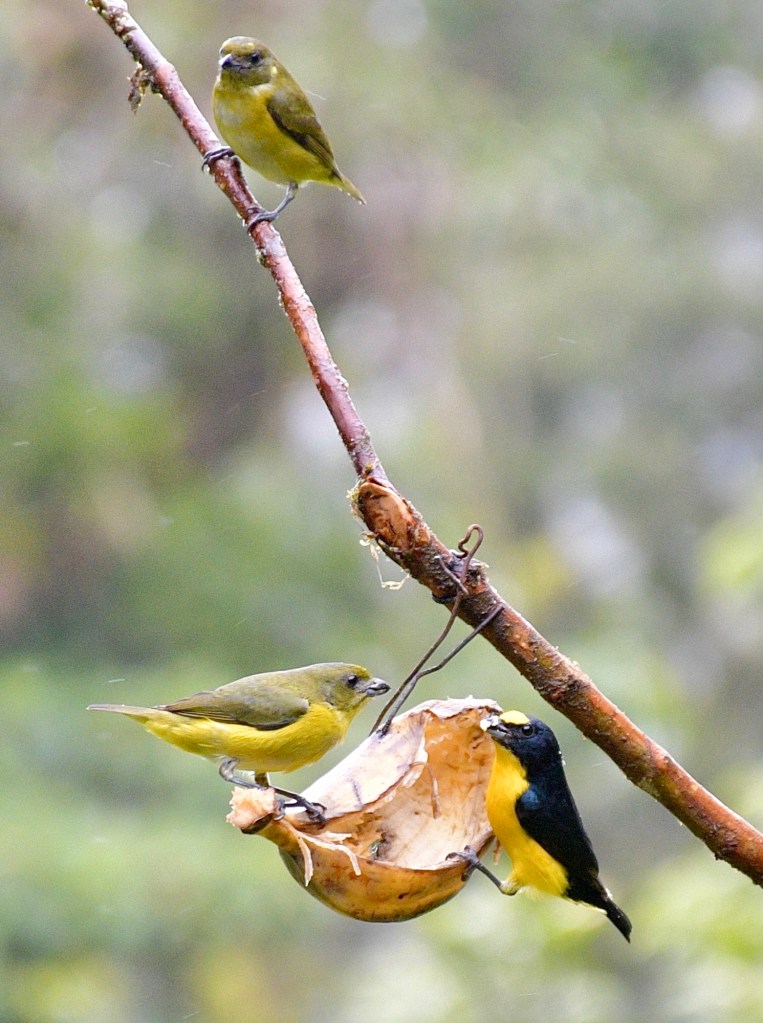
We woke up the second day to fierce winds and rain. Not a good day for birding. Adrian, however, had a plan. We drove about 20 minutes south of Santa Elena and a bit lower on the western slopes of the mountains to Finca Ecológica San Luis, a private reserve run by Adrian’s cousins. Some birding purists might scoff at the feeding stations around the reserve that lures the wild birds in. We didn’t care. We appreciated sitting in rustic shelters, dry, and up close and personal with our avian friends.

Some of the birds we had seen before — White-fronted Parrot, Chachalaca, Montezuma Orependola, Baltimore Oriole.

But most of the birds we were seeing for the first time — Lessen’s Motmot, Broadwinged Hawk. Gartered Trogon, and the big draw of the area—the unusual looking Three-wattled Bellbird with a song that sounded either like a brass gong or an ET alien that could be heard a half a mile away.

The Cloud Forest is truly one of the world’s magical places whether you’re there for the birds or simply for a walk in the woods. And that’s why we keep coming back.

[Full disclosure: we have to share photo credits for this post with Malcolm and Adrian.]

Parroting

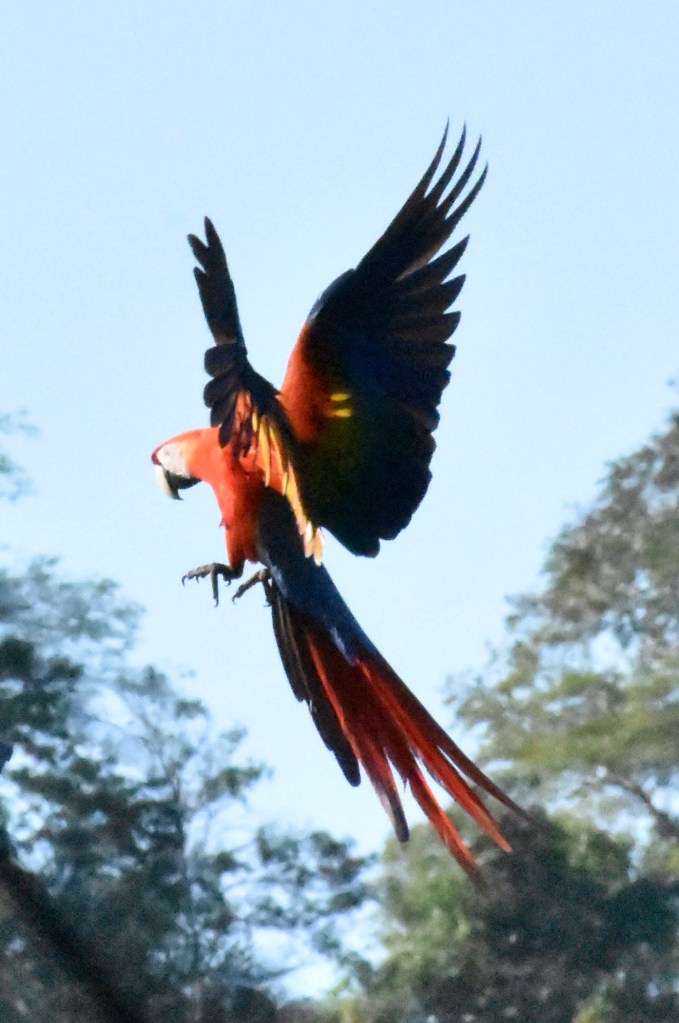
We first saw scarlet macaws seven years ago on the Oso Peninsula in Costa Rica sitting in wild almond trees beside a lagoon. Last year when we were staying near Manuel Antonio Park, we spent a lot of time watching these magnificent tropical birds fly by our balcony.

Scarlet Macaw near Quepos, Costa Rica

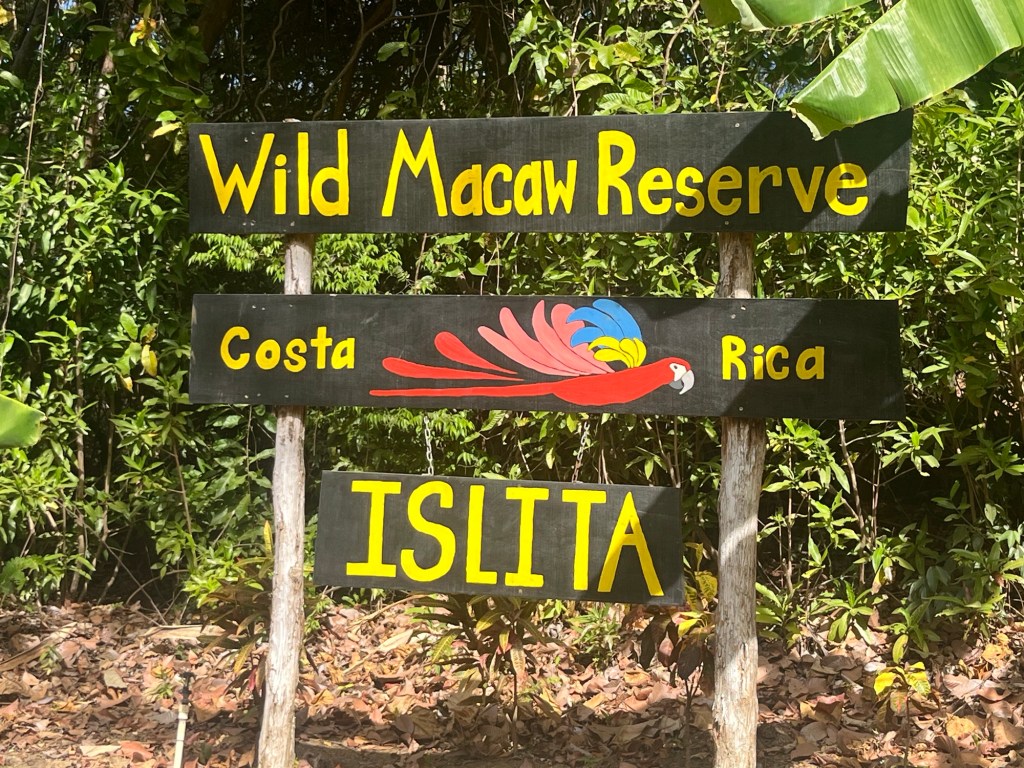
This year a went a bit further north to the Macaw Recovery Network south of Sámara at Islita on the Nicoya Peninsula. And what a show—up close and personal with the birds.

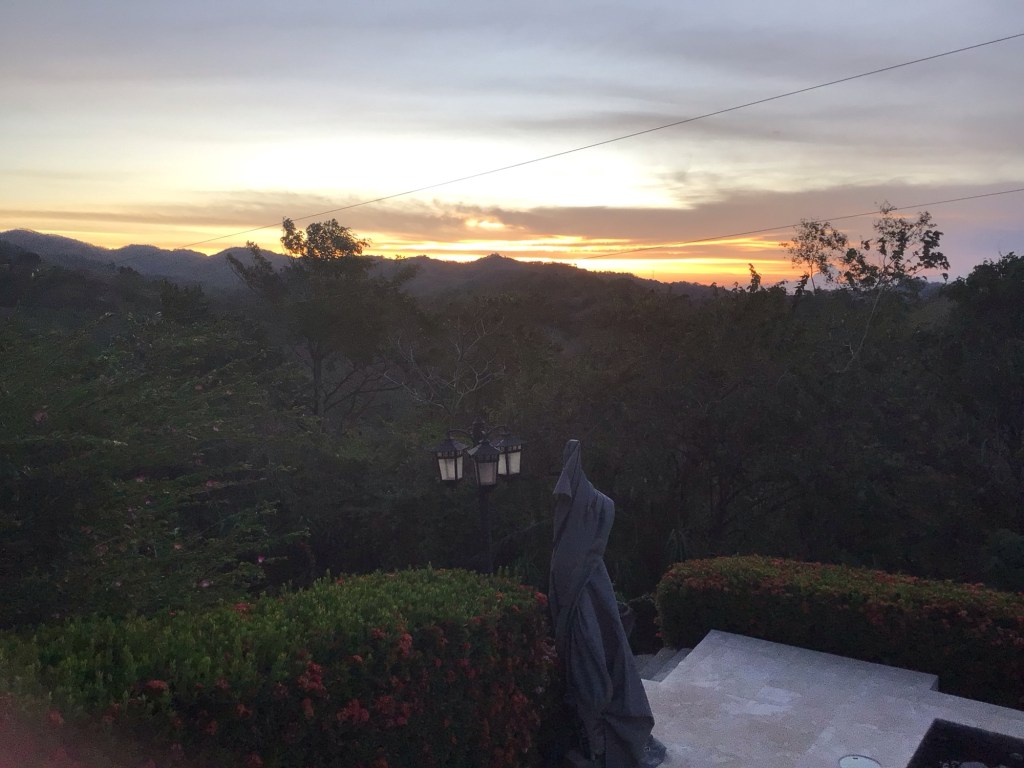
The reserve offers tours but only takes a limited number of people, 12-15, twice a day, early mornings or late afternoons. Reservations are required (but easy to do and pay for online). We opted for the early morning session which meant up in time to see the sunrise and a 45 minute drive to make the 7:30 feeding.

It was a bit of a harrowing drive — much of it a roller coaster of rather heavily traveled dirt roads. Can’t imagine how anyone can find the place without GPS — we had three devises tracking the way using both Google maps and Waze which, for once, agreed with each other. We still took a wrong turn. (Over and over again we were encouraged by locals to use Waze— old Google habits die hard.)

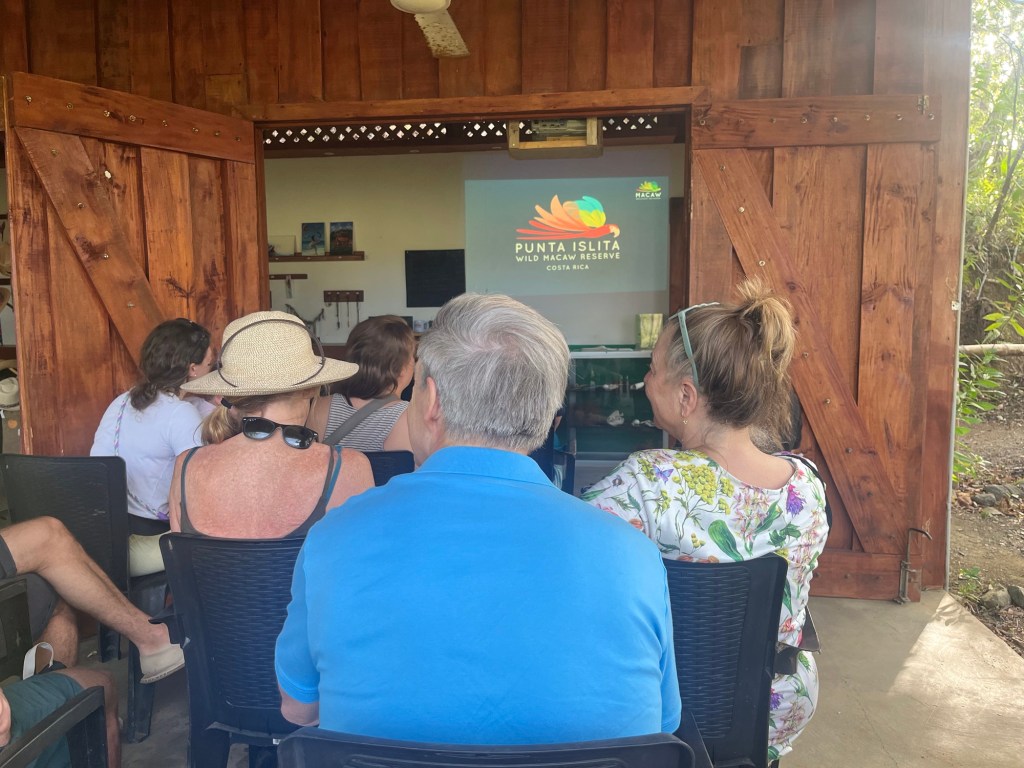
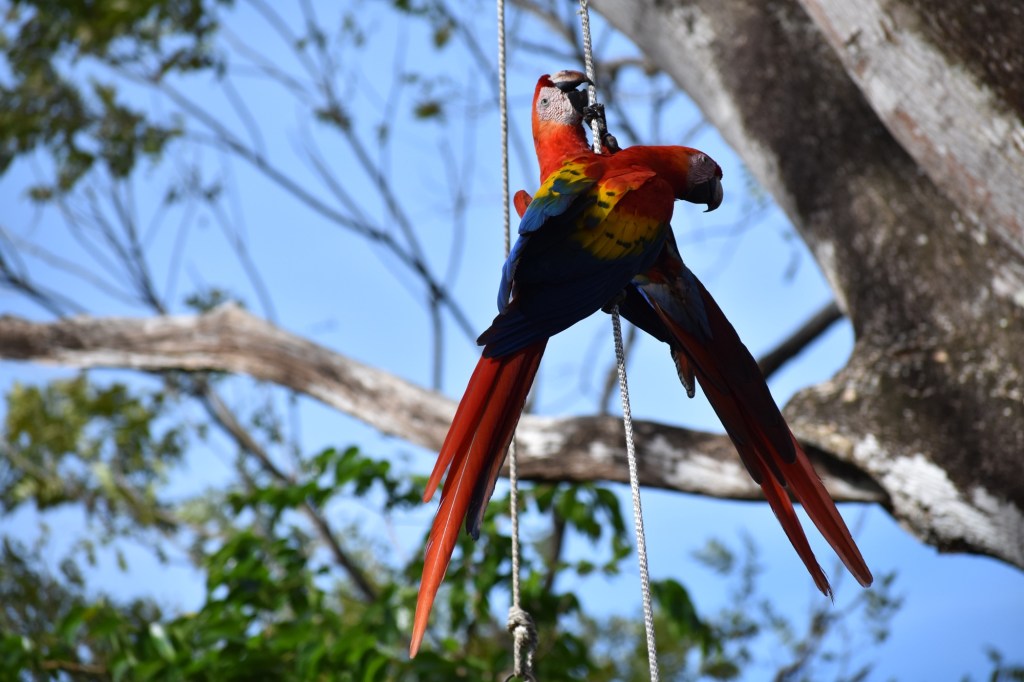
A modest open air structure served as reception area, a gift shop, and auditorium for the video. Several scarlet macaws posed for us around the edges of the building, waiting to be fed. Apparently, after being being trained how to survive in the wild and released, some birds stay near the reserve for a year or two until they are comfortable fending for themselves. After snapping a few pictures, we settled into the back row, more interested in spending time watching the birds than a video. Nonetheless, we were impressed.

In addition to working to restore the bird populations (macaws were extinct in the Islita region 30 years ago) the Network also works to restore habitat and educate Costa Ricans about conservation.

The Network raises scarlet and the even rarer green macaws to be released to the wild. Currently, they believe only four thousands scarlet macaws exist in Costa Rica and only three hundred green macaws. Even fewer Yellow-napped Parrots which the refuge is just starting to breed. With the results of several years of breeding scarlet macaws, 64 banded birds have been released and had produced offspring “naturally” —bringing the total birds in this area to over 100. Impressive, given that macaws were extinct in the Islita region 30 years ago. This year the Network will release the green macaws in the north eastern part of Costa Rica for the first time.

Not surprising in the animal kingdom, the birds have dominant and submissive members, so two feeding stations are filled — one for the big guys and gals — females as well as males display aggressive behaviors — and a second to give the other birds a chance. Incidentally, the sex of these birds can only be determined by a blood test, we were told.

Sometimes fights break out as the birds feed. But mainly they seemed to move around, slide up and down the pulley lines and take turns feeding.

The groups of birdwatchers are limited to minimize the stress on the feeding birds. This is breeding season and while we could hear but not see the pairs, the staff was particularly interested in keeping those birds calm. The breeders are fed as the same time as the wild birds and created quite a cacophony.

The iguanas also come out at feeding time, waiting for bits of fruit and nuts to be dropped on the ground by the birds.

Snakes pose a danger to the breeding program, particularly boa constrictors. The reptiles love to feed on the baby chicks. So traps are set around the grounds to lure boas in with the scent of wood chips used in the breeding nests. We were told the trapped snakes are then released into the wild some distance away. Some in our group were skeptical — or maybe hopeful the snakes met a different fate.

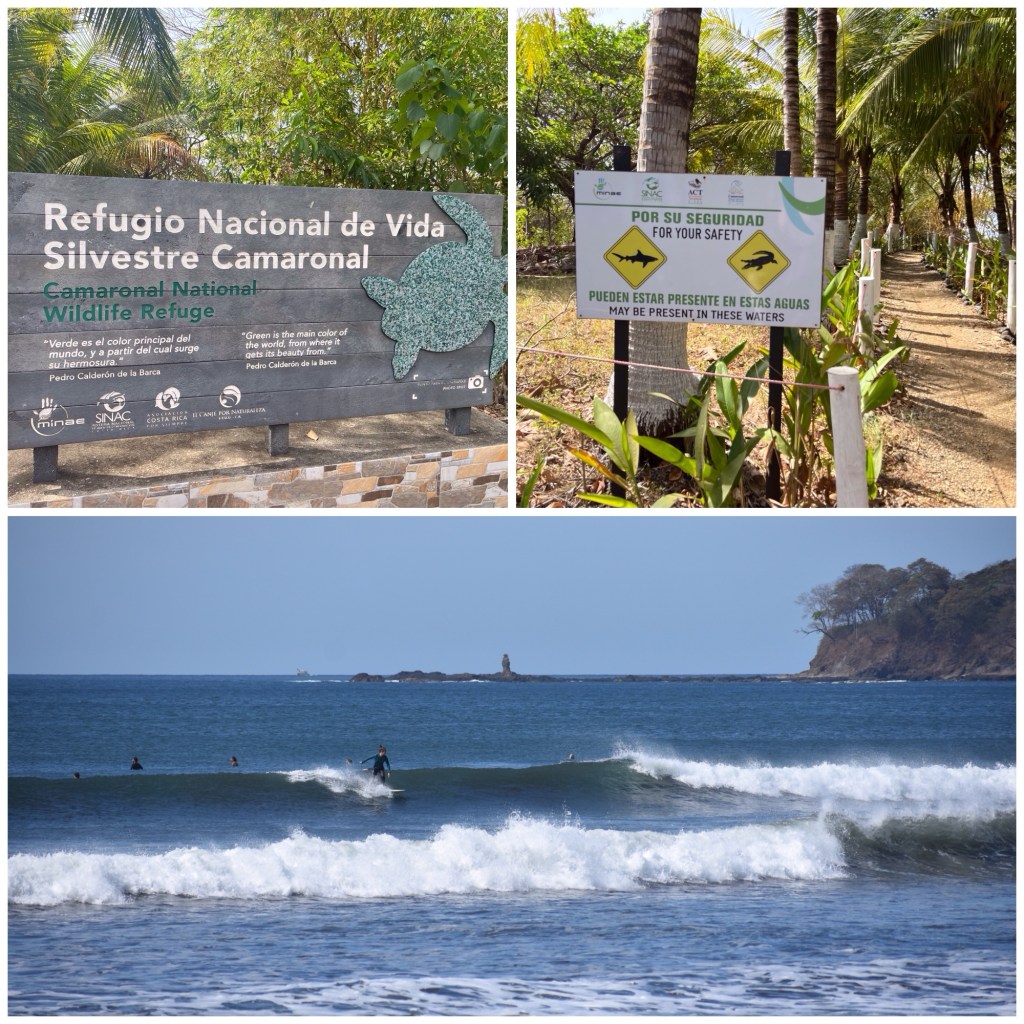
On our way home there were signs along the road indicating where nesting pairs of macaws had taken up residence. A clear indication of the success of the program. We also stopped by another nature reserve adjacent to a beautiful beach— Costa Rica is filled with reserves. While there were plenty of signs warning about crocodiles and sharks, we only saw surfer dudes, discussing the quality of the waves, clearly not worried about the danger.

A soda is not a soft drink…in Costa Rica

Sometimes we’re a little slow. Well, maybe a lot slow.

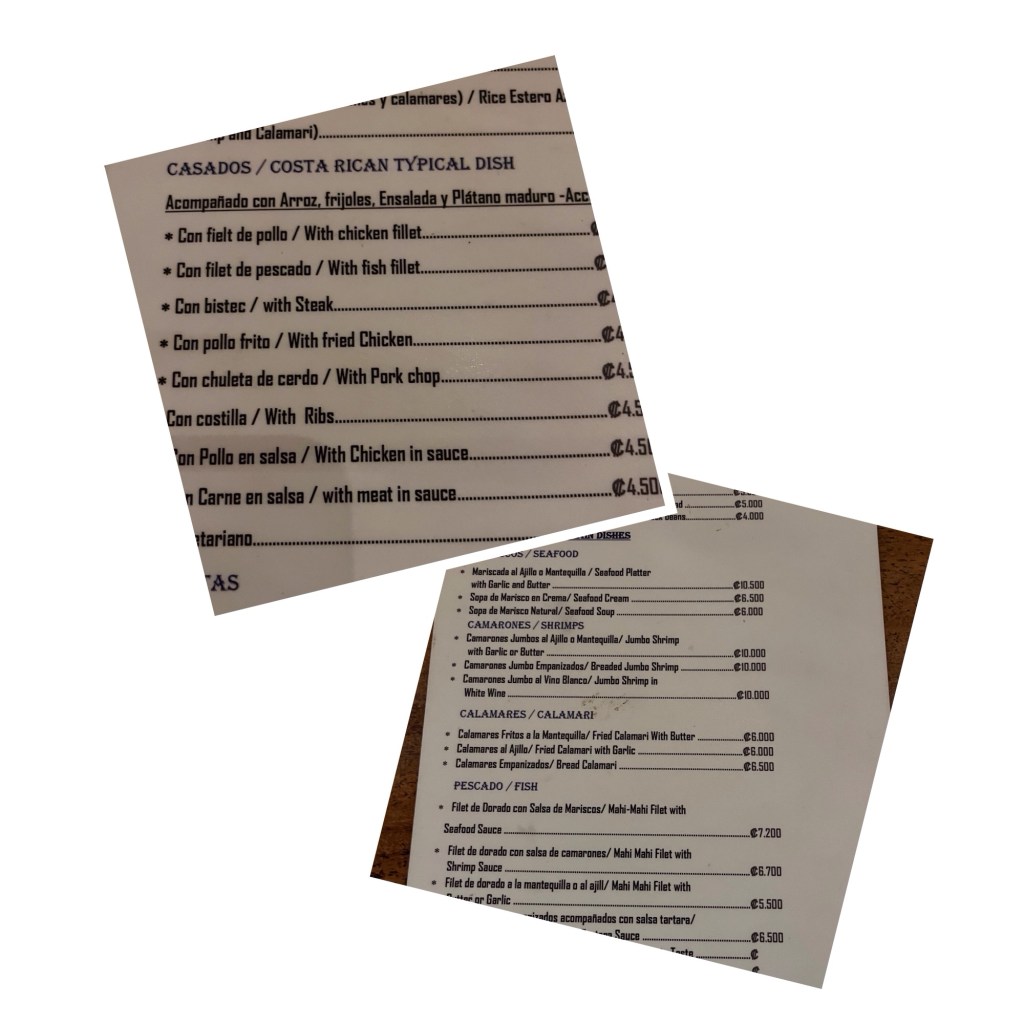
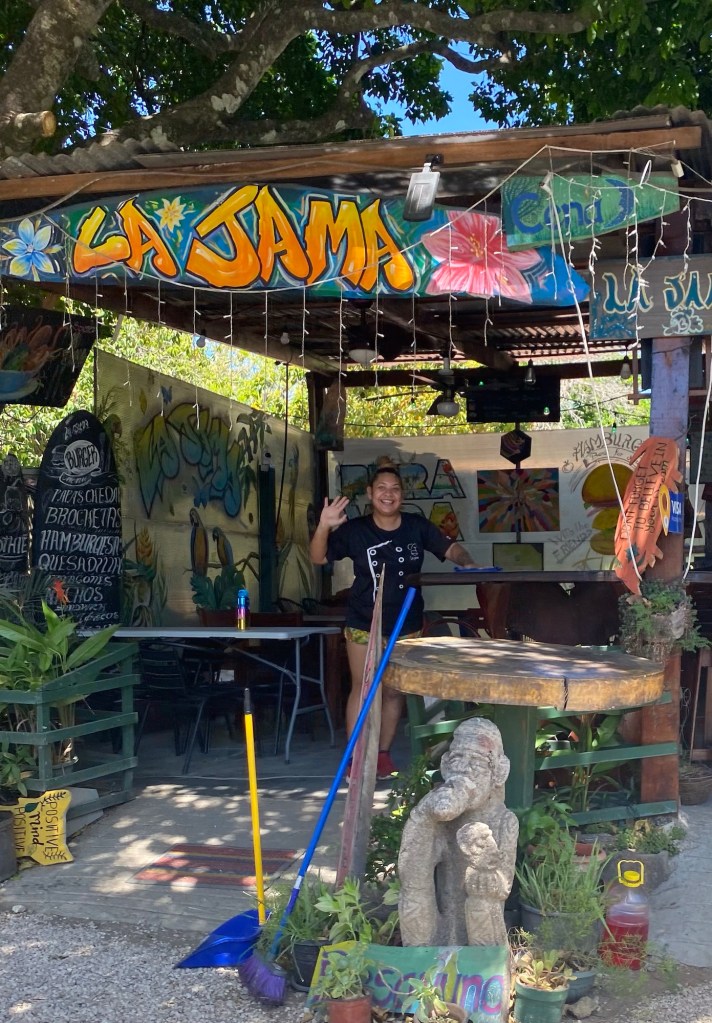
The first time we were in Costa Rica seven years ago we kept driving by modest roadside establishments with signs advertising “soda” this or “soda” that. Of course, we thought they were selling local soft drinks to thirsty Ticos and tourists. Only, when by chance, we actually stopped to get a cold soda, did we realize that a “soda” was actually a restaurant—more specifically, a small family run restaurant with a limited local menu. And we soon found out these “sodas” were often gems of local cuisine serving great food at ridiculously cheap prices. Yes, the menu is limited. Yes, the ambience is sometimes is missing (but not always—we’ve eaten in sodas on the beach with sand under foot and up in the mountains with stunning views of volcanos). But you are likely eating with locals, maybe being served by someone whose grandma is cooking in the back.

And the food! Almost always fresh local ingredients, always prepared to order. The limited menus in most sodas usually features Costa Rica’s star menu item—the casado plate (which translates as “the husband’s plate” or “married plate”). Rice, beans, plantains, salad, maybe some fresh fruit and a choice of protein—fish, pork, or chicken. The protein can be grilled, stewed, or braised. Big portions meant to serve the very hungry.

The typical price is between 2000 CRC and 4000 CRC or $4 to $8. And most sodas take US dollars in addition to Costa Rican colones, and many accept credit cards. A few only take cash. Other local dishes include arroz con pollo, (rice and chicken, sometimes in a tomato sauce), gallo pinto (rice and beans), ceviche. Almost all serve the local beer (Imperial), sodas (Fanta orange soda is ubiquitous), and fruit juices. Whether is a result of widespread tourism or simply the influence of North American culture on the locals, hamburgers and margaritas are often on the menu as well.

You will almost always be eating outside on a covered patio with a kitchen tucked in a small space in the back. No air conditioning here. Most will be filled with locals. Often there are small children playing near by, and an occasional dog or two strolling through the soda. Once, up in the mountains, as we ate, the waitress called a dozen or so children playing in the field next to the soda to serve them their lunch on paper plates which they promptly ran off with to eat under a nearby tree, dodging the local cattle as they went.

The owners of one soda, in a very, very remote area up in the mountains when we were staying on a small coffee plantation across the dirt road, would wait until we drove by their home on the long driveway, then run down from their home to the soda to open up just for us. We were clearly their only business for the night. Mom would cook and her young daughter would happily sit at the next table, coloring. The food was absolutely amazing—and as you can imagine, cooked to order. Best pollo y arroz ever! We ate there three times and, despite the language barrier, began to feel like part of the family.

You’ll never have to worry about finding sodas in Costa Rica—they are everywhere. Really, everywhere. Big towns, small villages, remote rural areas, industrial zones. In the more upscale resort communities such as Playa Flamingo or Samara on the Pacific coast, they are often located just outside the town centers on the roads that lead into to town or in the nearby little Tico villages.

Recently we were in Samara on the Nicoya Peninsula in a beautiful AirBnB in the hills above the town. Our wonderful hosts recommended a number of local restaurants. They were all lovely beachfront establishments with spectacular sunset views, music, and tropical cocktails. But the food was very ordinary and at US prices $20-40 for an entrée. The clientele was almost exclusively gringos—not surprising for a tourist town. And, yes, of course, we are in fact gringo tourists. So we fit right in.

The next night we were off in search of a soda….pura vida!

Taking the Waters

We’re not strangers to Costa Rica, nor are we experts — not at all. We’ve traveled here for a month or so four times in recent years. We’ve found areas that draw us back year after year (around Potrero, in Guanacaste and Monteverde). And we visited areas that we enjoyed — just not enough to return to year after year when there is so much more to be seen. For such a small country, Costa Rica has so much variety.

This trip we decided to spend a few days in La Fortuna on the base of the volcano, Arenal. We had passed through the area five years and been intrigued.

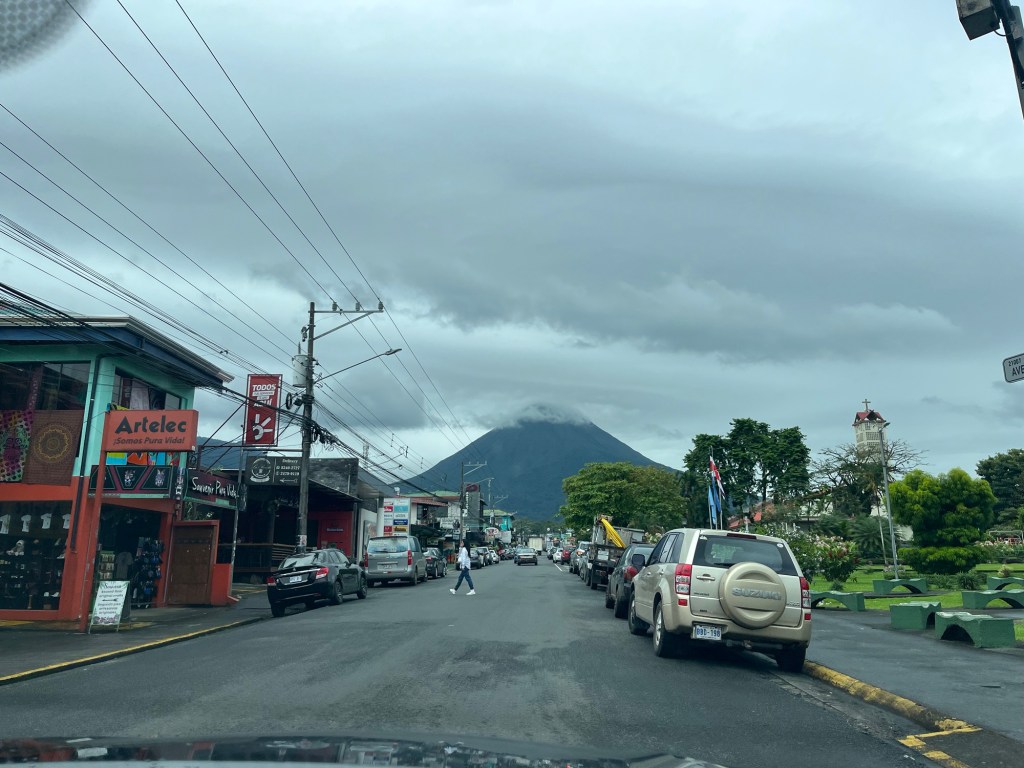
La Fortuna is the most heavily touristed areas of Costa Rica, according to the guide books. The main attraction is Arenal, the volcano. Before 1968 the town was just another agricultural crossroads and then the volcano erupted, putting on a show until 2010 for the tourists who soon arrived. The town isn’t much to look at today, except almost everywhere you look, you see the big cone.

And where there are volcanoes, there are often hot springs. Today, along with the main attraction, hiking, zip-lining, horse back riding and various water sports lure tourists. No zip lines or horses for us — we were there for the hot springs spas. The roads in and out of La Fortuna are filled with everything from modest to ultra-swanky to middle of the pack spas like the one we found — Los Lagos.

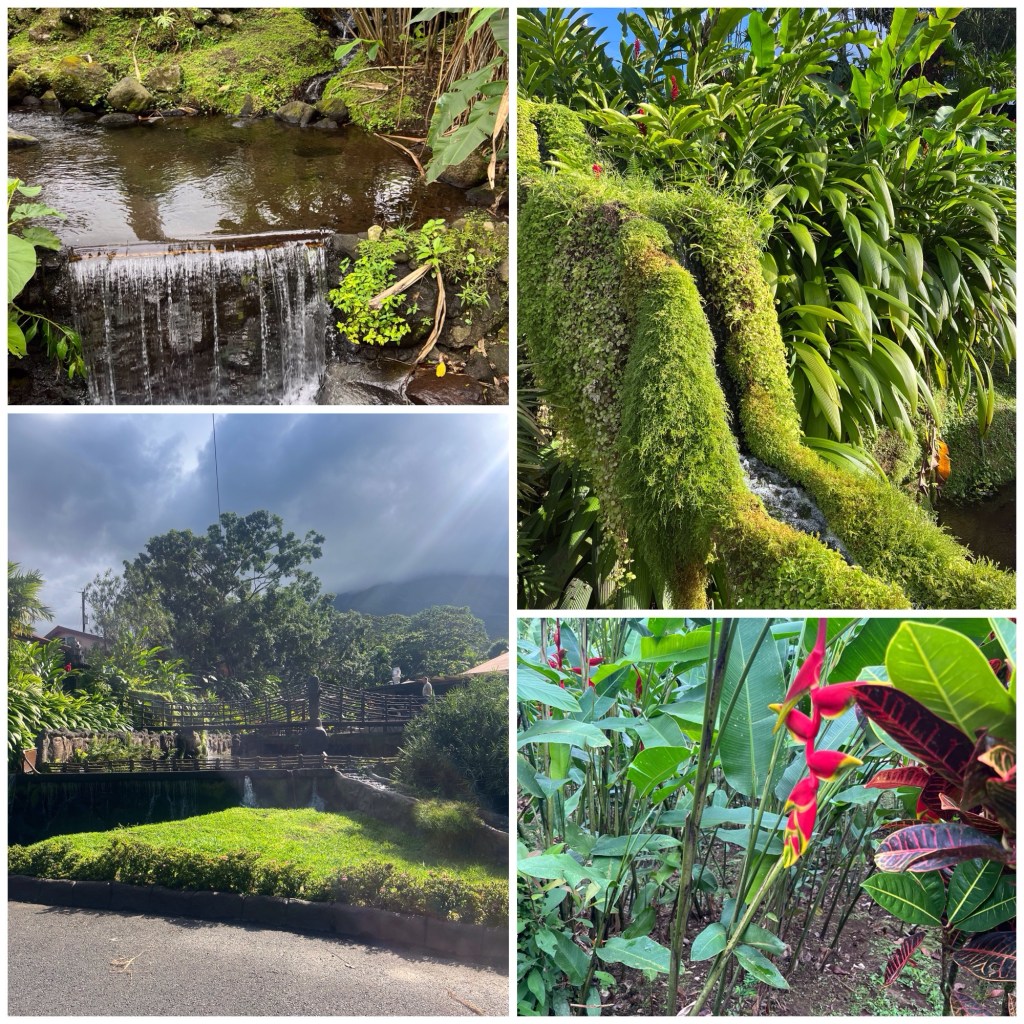
Our initial impression of Los Lagos Hot Springs Spa and Resort was simply “wow.” An impressive entry, lush vegetation, streams crisscrossing the grounds and cascading small waterfalls. A restaurant, a swim up bar adjacent to the largest of the hot springs pools, a spa and a series of walking paths through a “jungle.” The resort also has lockers and changing rooms for day visitors. The hotel rooms are a little dated—you have real keys to open the doors—and are need some upgrading. But still very nice.

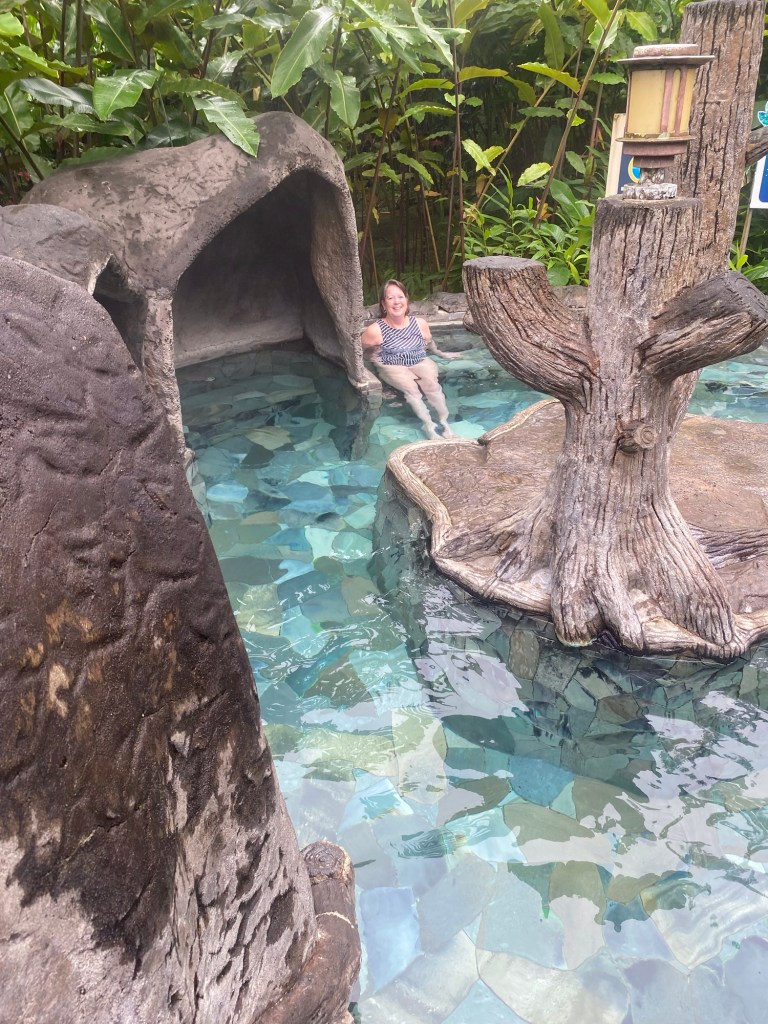
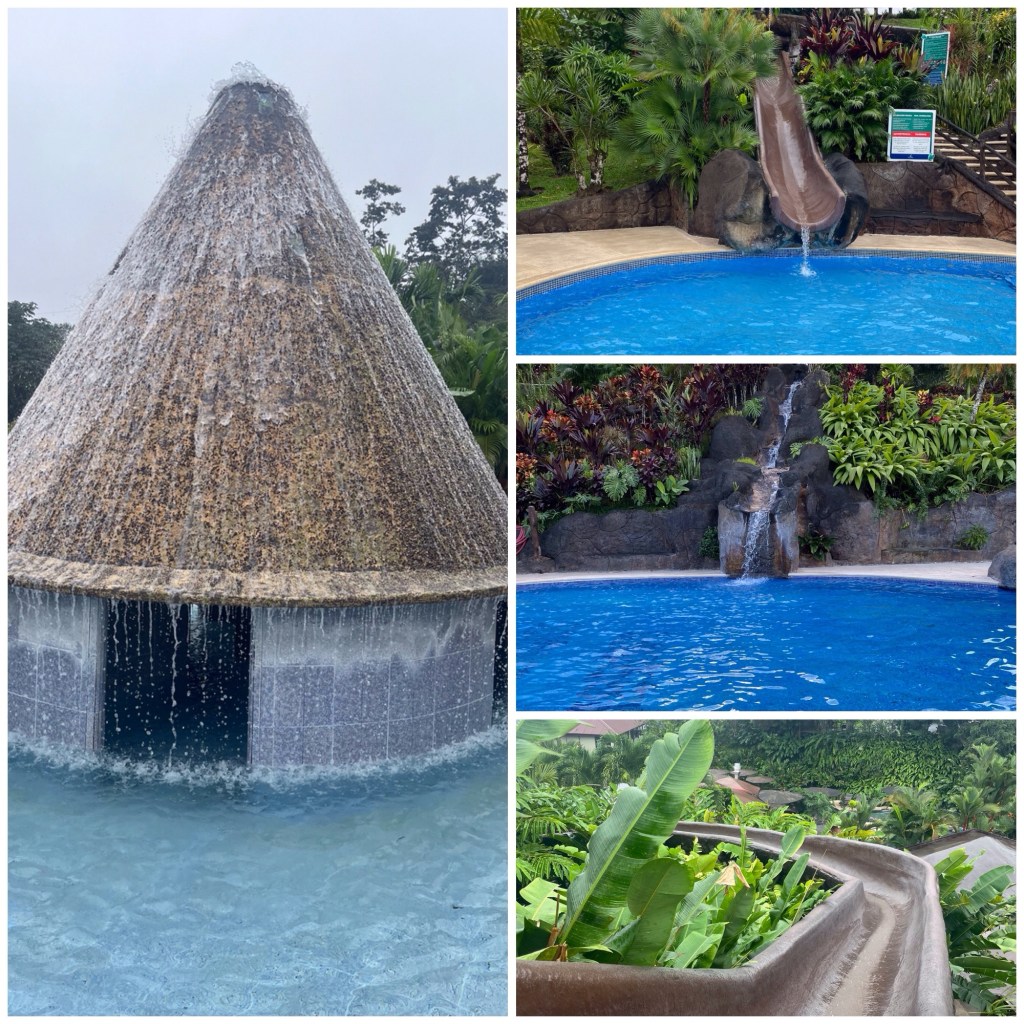
Our primary focus was the hot springs. While a little cheesy with their faux rock appearance, the pools did not disappoint. Varied in temperature from a cool mid-70’s to almost too hot for us—100+. Each hot springs pool had a sign indicating water depth and temperature.

Some pools were built for two. Most were bigger. A few had jacuzzi jets and reclining couches built in.

We started at the top and wandered from pool to pool down the hill until we, like Goldilocks, found the pool that was just right for us. Most of the time, we had the pools almost to ourselves. Our fellow soakers were largely locals; gringos seemed outnumbered.

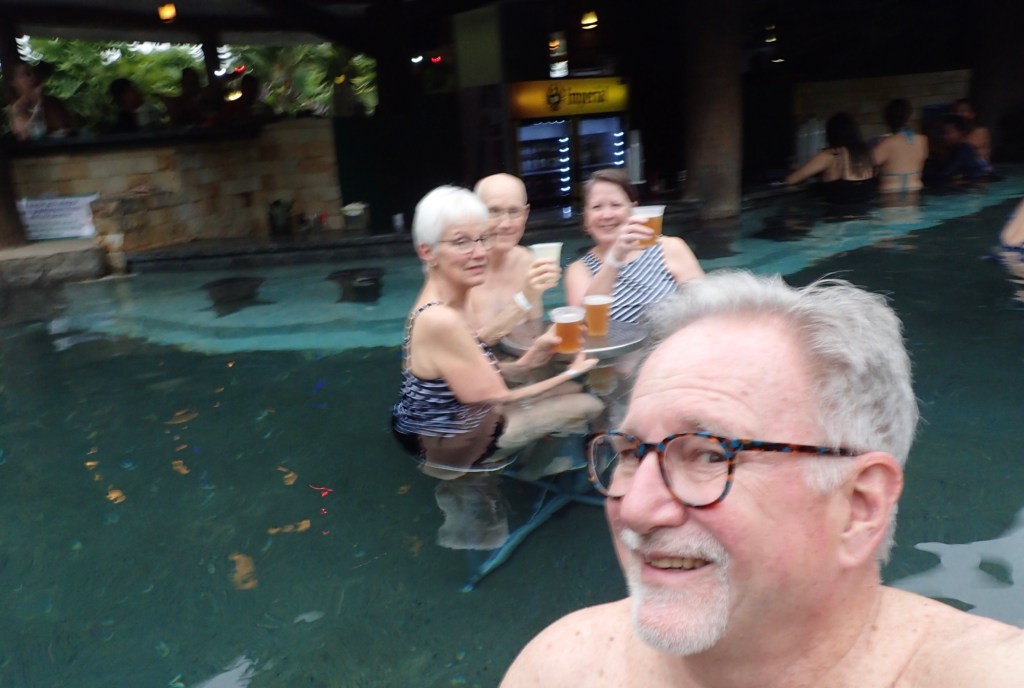
Of course, we had to try the swim up bar. Yes, tacky, but still great fun. Sitting on the submerged stools was harder than it looked, but highly entertaining. And in this family friendly pool, the water was cool enough for the kids to enjoy.
The resort also had a couple regular swimming pools (fed from natural spring water, the resort info said) with water slides for the kids and a wading pool for the littlest with a fountain shaped like a volcano.

We drove to the upper reaches of the resort to the lookout point and we almost saw the top of Arenal. Apparently, you can be here weeks, even months, and never see the top of Arenal.

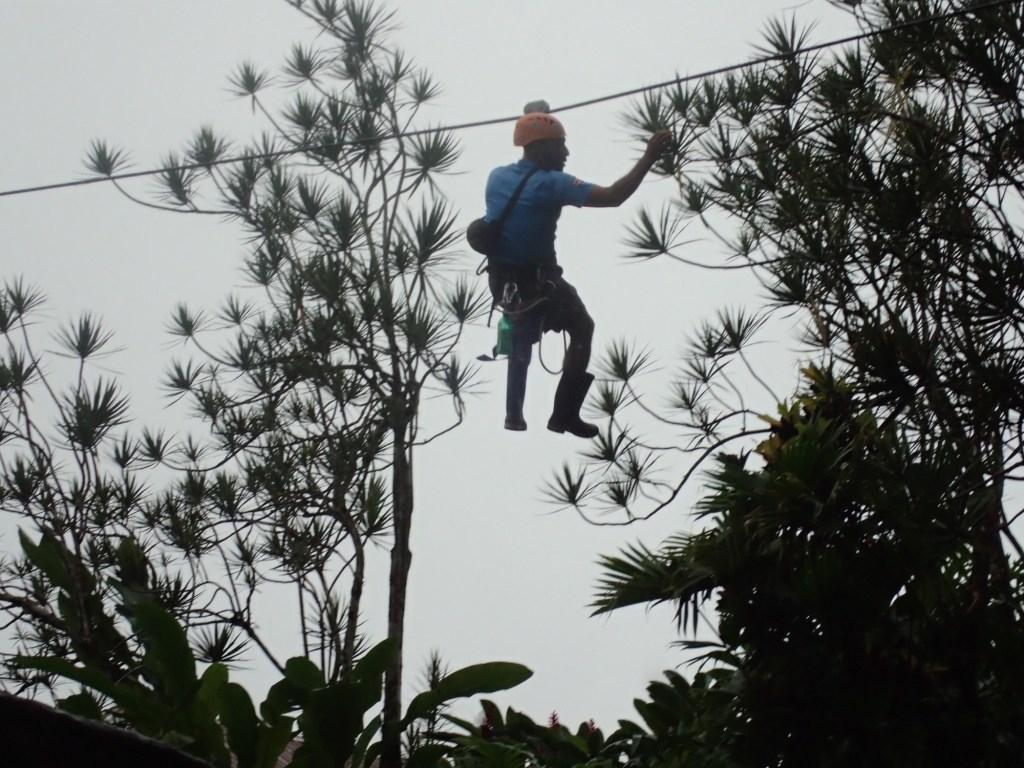
From that high view point there are a series of zip lines, and we saw folks harnessed in for the ride, and watched them end their trip zipping along above the swimup bar far below.

We certainly enjoyed our indulgent dips into the hot springs. With more time, we might have found the energy to explore more of what the area has to offer. Next time. But then, those hot springs are awfully tempting.

Au Revoir – leaving France again

When we left Spain, almost exactly a year ago, we wrote a blog about what surprised us in Spain and what delighted us. As we were wrapping up this year’s trip to France over the last few days, we our conversation veered into the same direction. Not shocking that there were fewer surprises — we’ve been to France several times before. Nonetheless, certain things stand out in our minds.

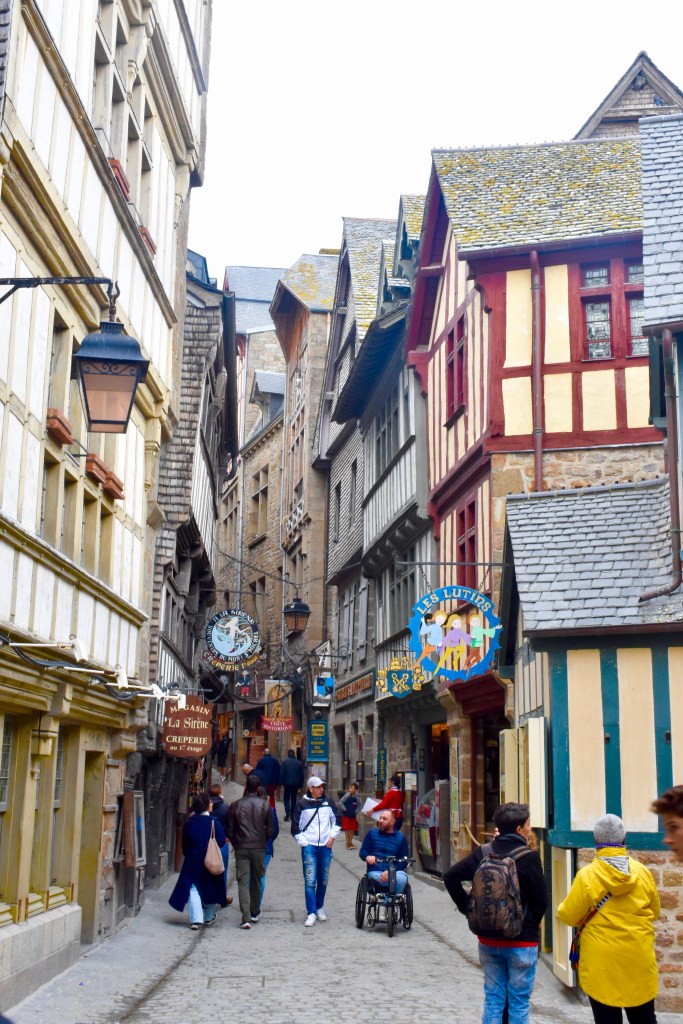
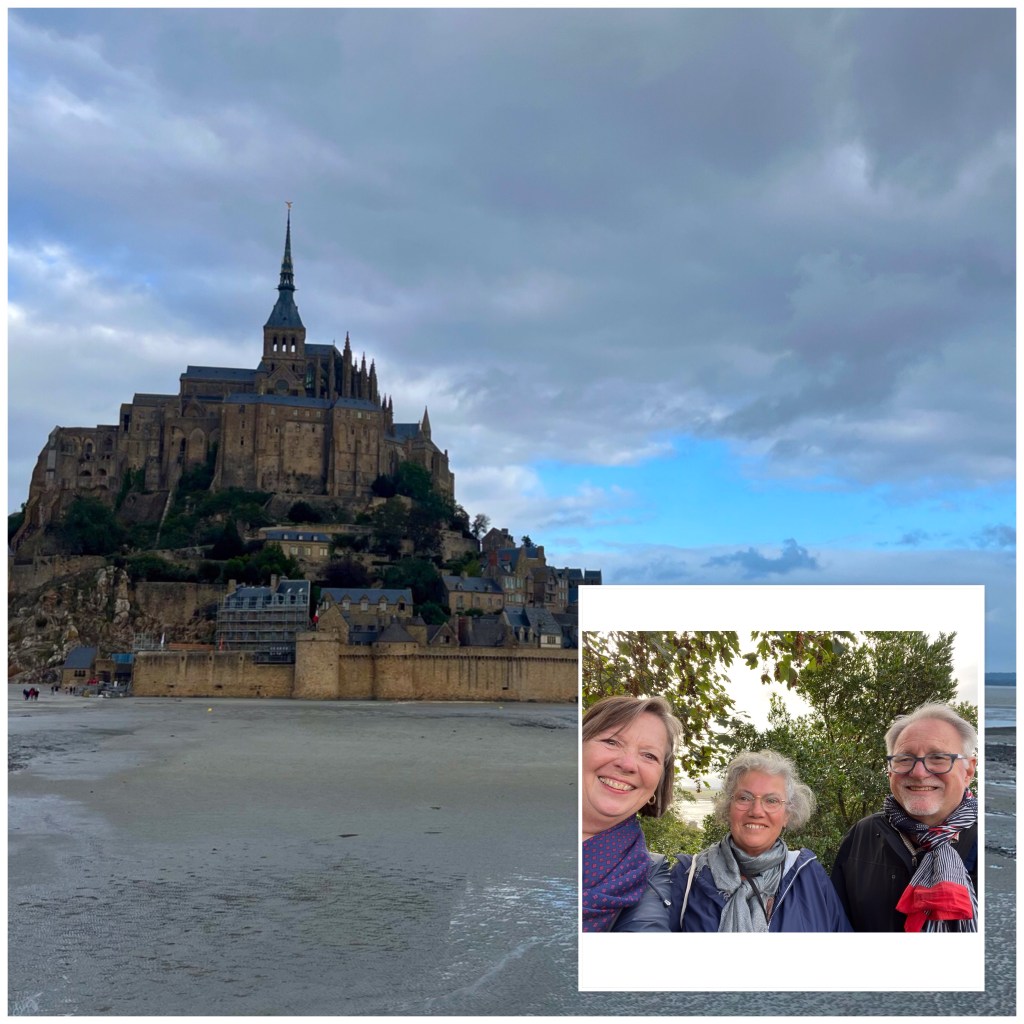
A good guide makes all the difference in the world. We’ve written before about the value of a guide. Our trip to Mont St Michel, our tour guide reinforced that opinion. Anne-Isabelle [anne,isabelle.gendrot@gmail.com] greeted as just as the tour buses started to roll from the huge parking lot three kilometers from the actual village (you definitely want to get to Mont St Michel early).

Without her guidance, we might have not have been able to look past the Disney-esque appearance of the village, beyond the trinket shops and flashy restaurants, to actually appreciate the history, the architecture and the beauty of the place.

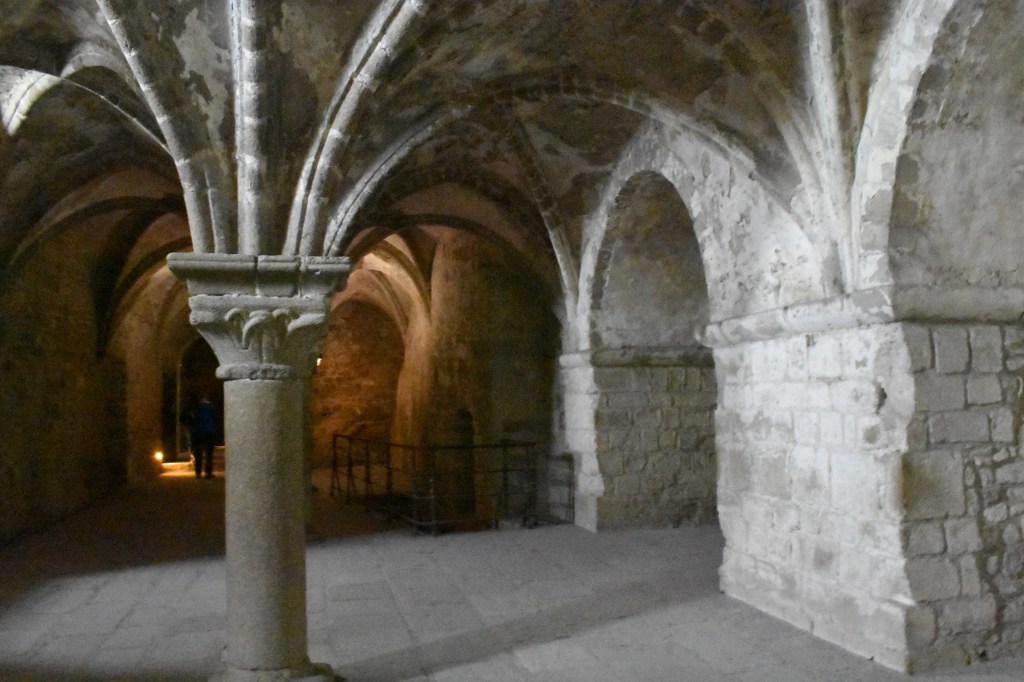
A passageway in the Abbey

She set the record straight, separating myth from fact. Her energy and enthusiasm helped us up the all the steps (and there’s a lot of them). And as a good guide does, she shared with us much more than what we could have read in a good guidebook — a couple sharp rebukes to the Norman flag flying alone over the monument when the Bretons helped pay for the restoration, the local legends that were largely fantasies, and to the Nazi’s use of Mont St. Michele as their vacation playground during the occupation.

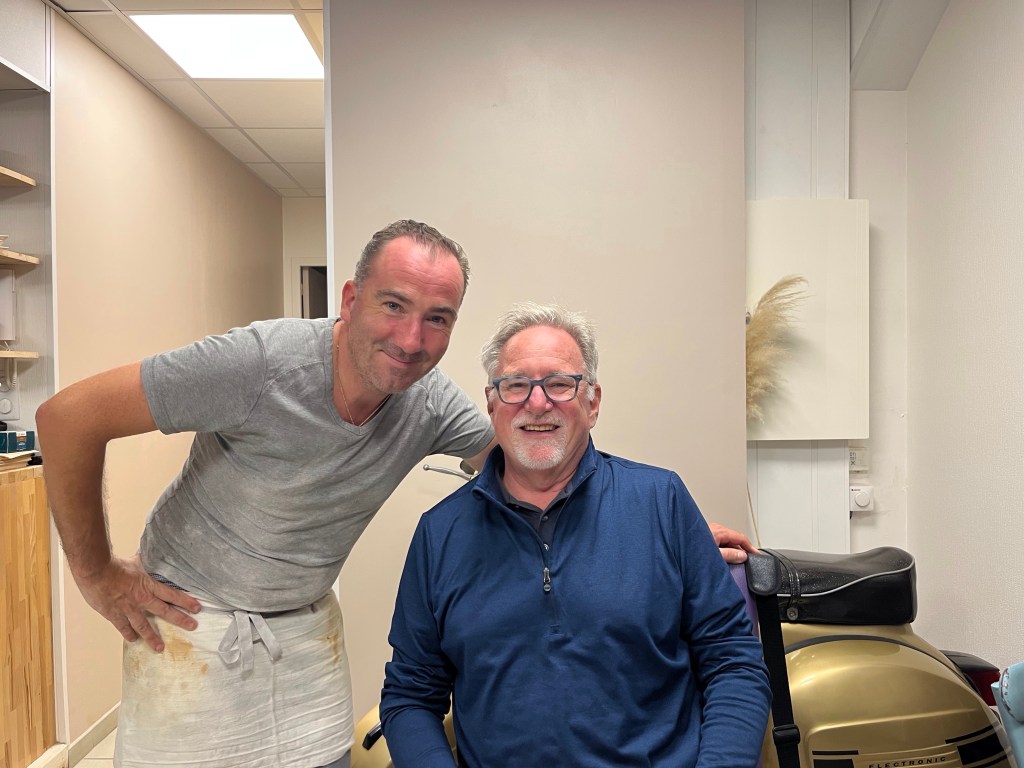
This trip reminded us to forget the silly notion of French rudeness. Everywhere we went, locals went out of their way to be helpful. We needed the help of almost every clerk in the post office to mail a package home and everyone smiled as we fumbled our way through the process. Or when we were assigned to nonexistent train seats and needed the help of strangers to figure it all out. In a pizza joint, the owner/baker almost joined us at the table, stopping by to chat in a mixture of French and English any time he had a minute or two. And the staff in the restaurants, those snooty French waiters? Amazingly patient with us and often stretched their English to explain the menus. Perhaps Paris and crowded cities are different. In the Dordogne and Brittany friendliness ruled.

It is easy from a distance to forget France is a multicultural country. Up close it becomes self-evident. The Basque, Occitane, Breton, Corsican, and other cultures are alive and well, particularly in the far corners of France. France is a former colonial power, the people on the streets visually represent that history. It is also a country of immigrants. Our tour guide in Nantes was a native of Peru who has lived and worked in France for ten years.

In Brittany particularly, but maybe elsewhere, too, there is a sense of place and belonging that is deeply rooted in the local culture and a source of pride. An acquaintance who has lived in Brittany for 30 years, laughed when we suggested she was almost a native. Oh no, she was still a newcomer. Our guide Anne-Isabelle described how happy she was to discover that as a resident of St. Malo for years, she uncovered the fact her grandmother was born there — which made her a Malouin, a real citizen of St. Malo.

Regional differences matter. That’s a big reason why we head back to France. From food, to architecture, to the countryside, it’s hard to get bored when Brittany is so different from the Dordogne which is so different from Provence, which is different again from the Loire Valley. Vive la difference!

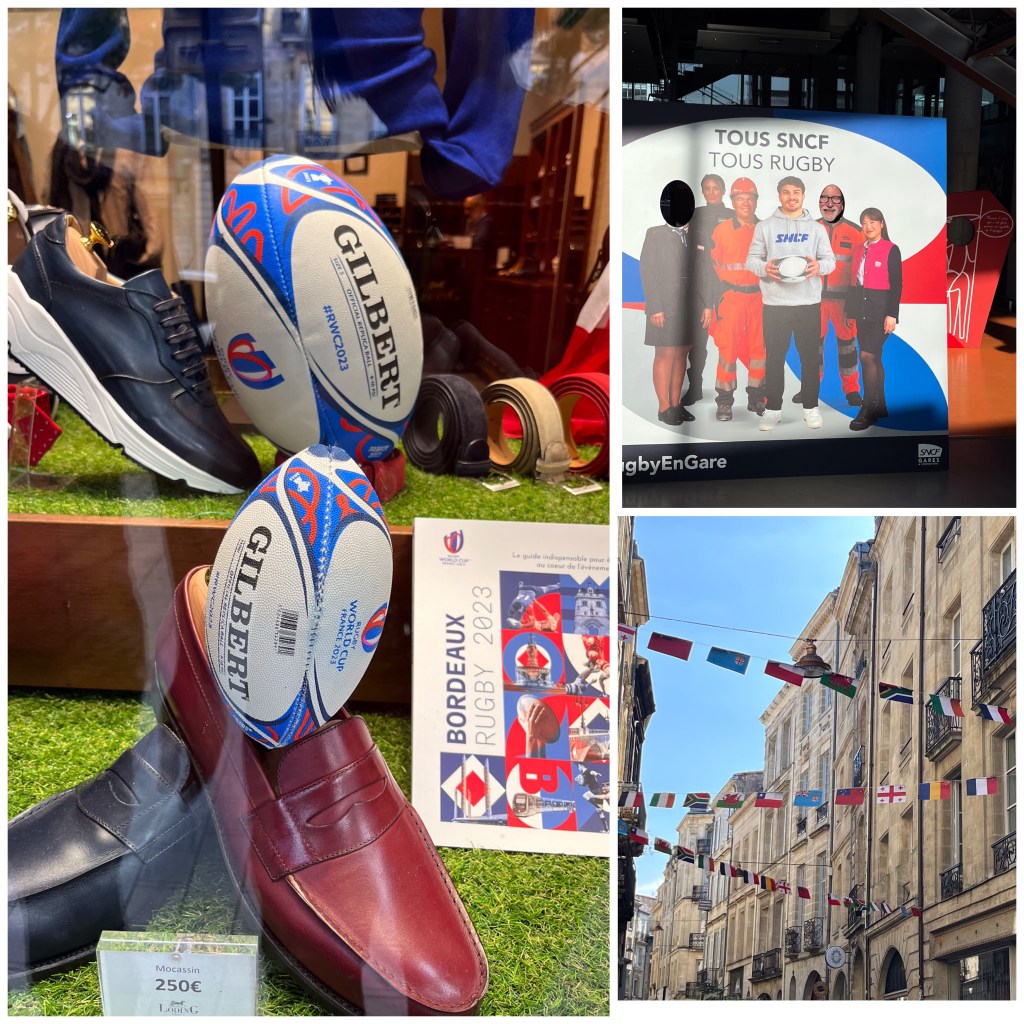
Part of the fun of returning to a place you have been before is the new discoveries. We knew soccer (or football as it is called here) was a big sport, but we were amazed to discover how many French fans were following the Rugby World Cup. Rugby? Really? In France? Most towns where ever we were had store windows celebrating the local team. Grocery stores had displays right next to the wine. Tourist shops sold memoribilia. And the flags and banners were everywhere. When we stopped in Bordeaux, one of the many sites for the regional matches, our first restaurant was packed with Australian fans and a few Welsh, too. Who knew?

And that’s why we travel.

Brittany on Our Stomachs

Anybody that know us, or reads this blog, knows we are always interested in food, first and foremost. So as we started this trip over five weeks ago with a food tour in Bordeaux, we ended the trip with a food tour in St. Malo, Brittany.

Our guide was from Normandy, whose specialty was, not surprisingly, the beaches of Normandy. He said he was happy do our food tour, one he loves, but doesn’t get to do that often. We then proceeded to go on a whirlwind shopping trip with him.

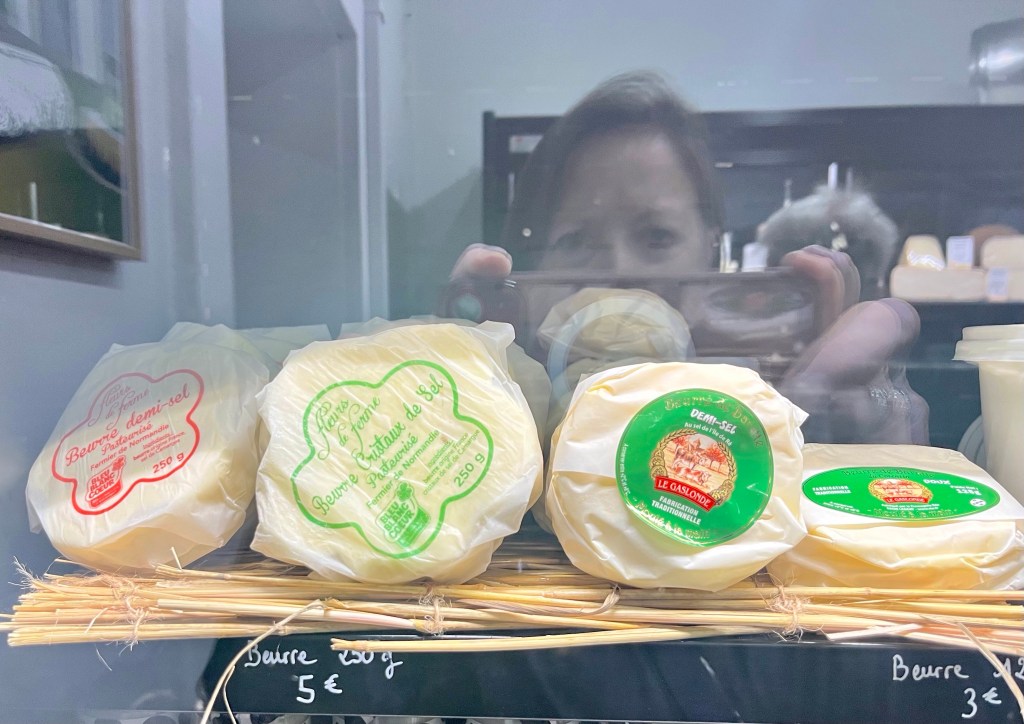
First stop was a cheese and butter store [http://www.lesfromagersmalouins]. Brittany is known for its butter, crammed with as much richness and salt as possible. We had tasted good Breton butter from a supermarket in St Cyprien. Definitely better than anything at home, including the Amish butter we splurge on during the holidays. Unfortunately the store in St. Malo was out of Breton butter so we had to settle for Norman butter. The staff asked me if we wanted deux butter (little salt) semi-sel or regular and nodded approvingly when we bought the entire inventory of “full salt” butter — 2 packages to take home to savor.

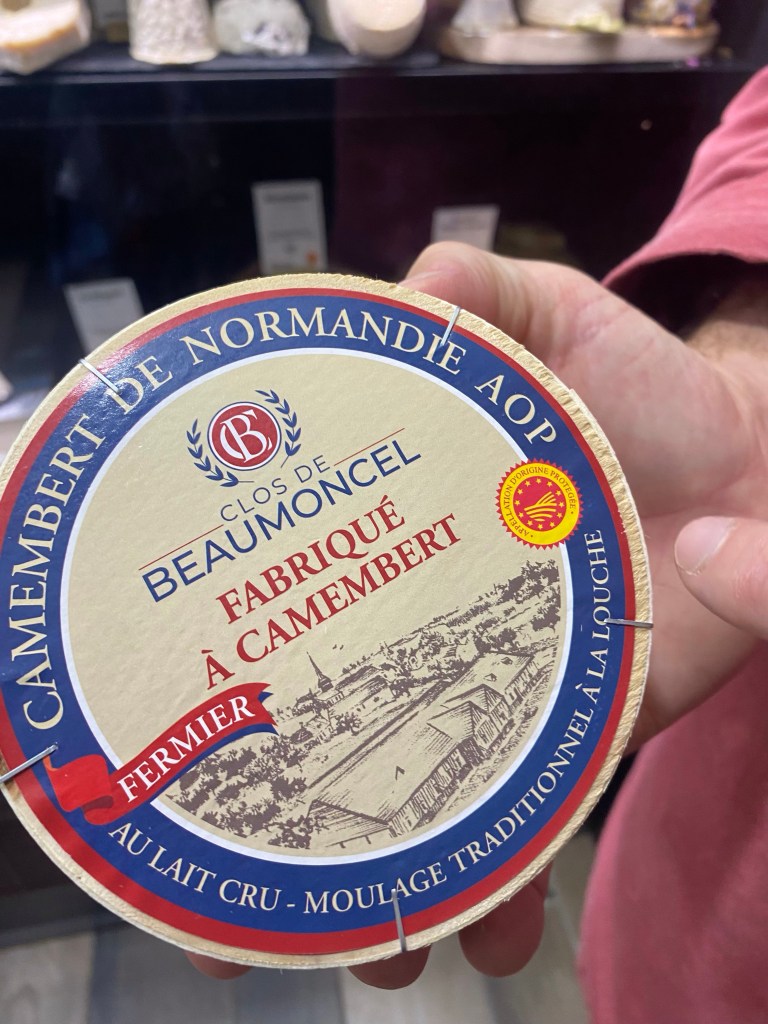
He also guided us to try several cheeses to eat with a baguette and espresso before we continued the tour — a brie (with a layer of a curry spice mix that started as a medicinal remedy. Unfortunately, our quest to find the spice was unsuccessful despite checking in several shops). Then a Timanoix (a semi- soft cheese with an edible rind washed in a walnut liqueur) and finally, a Camembert, again a Norman cheese. Did we detect a cultural bias?

We also opted the take some cheese home to enjoy later — a great Roquefort, some more of the Timanoix and the curry Brie.

Fortified with espresso and a “light” breakfast we headed to a spice shop. St. Malo has always been a trading center and home to privateers and pirates, and unfortunately slave traders.

Window display in an antique shipping crate

It was the center the East India Company’s continental trading post. Epices Roellinger, started by a retired 3 star Michelin chef and now run by his family offered a mind boggling assortment of spices. The selection of peppers alone — Vietnamese, Cambodian, multiple Indian, Sichuan and many more overwhelmed us. All with a different degree of heat and different tastes. We bought a red black pepper from Cambodia simply because it seemed the most unusual, but still fit within the foods we cook at home.

The choices of a dozen or so different vanilla beans (we smelled several and were amazed at the differences) blended curries, shelf after shelf of other spices and variety of dried herbs were too much to take in. We needed hours here to take full advantage of the options.

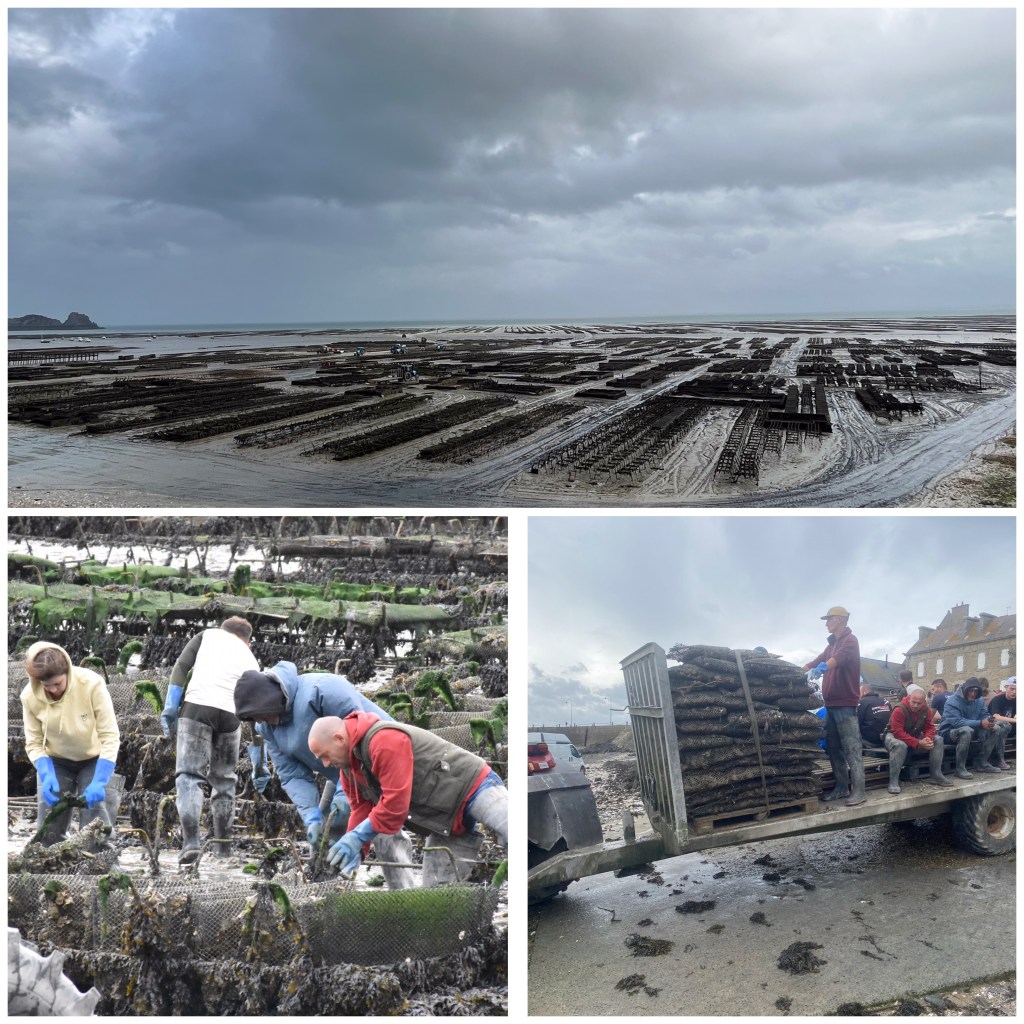
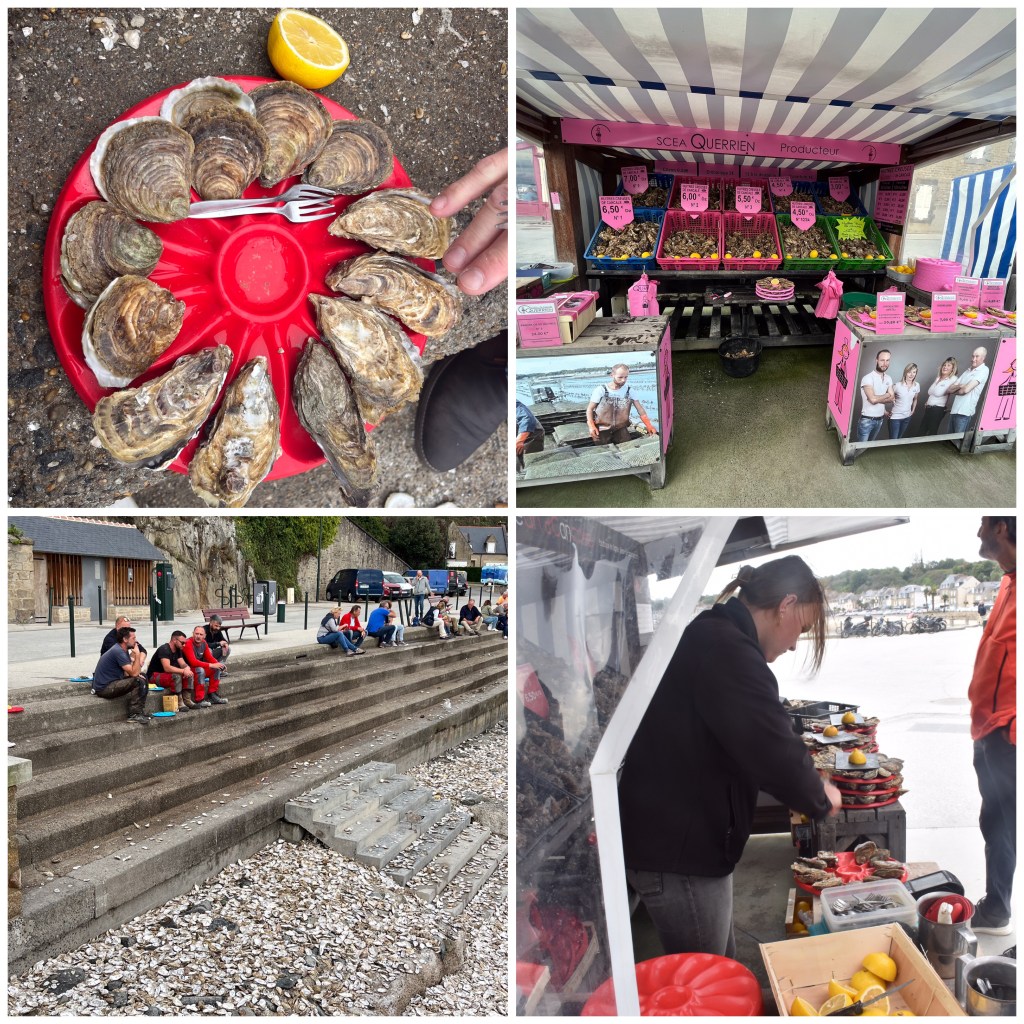
Of course, Brittany is famous for its oysters. We have been sampling them since we arrived in Nantes almost two weeks ago. But the size of the operation in Cancale — just one of many such operations along the Brittany coast — was astonishing.

The bags of oyster are cleared of seaweed, loaded onto trailers and moved into different areas for exposure to different parts of the sea, we were told.

Just above the oyster beds, a collection of striped tents offered local oysters for sale, shucked right in front of us. Of course, we had to share a plate of oysters — a variety pack. Unlike at home, the smaller oysters are considered a rip-off (too little meat for the price) and French connoisseurs prefer the four year old #4’s. Actually the #4’s were pretty small and delicate. We joined the workers on the steps by the beach, slurping away and tossing the empty shells for the seagulls.

Then we headed across the street to lunch.

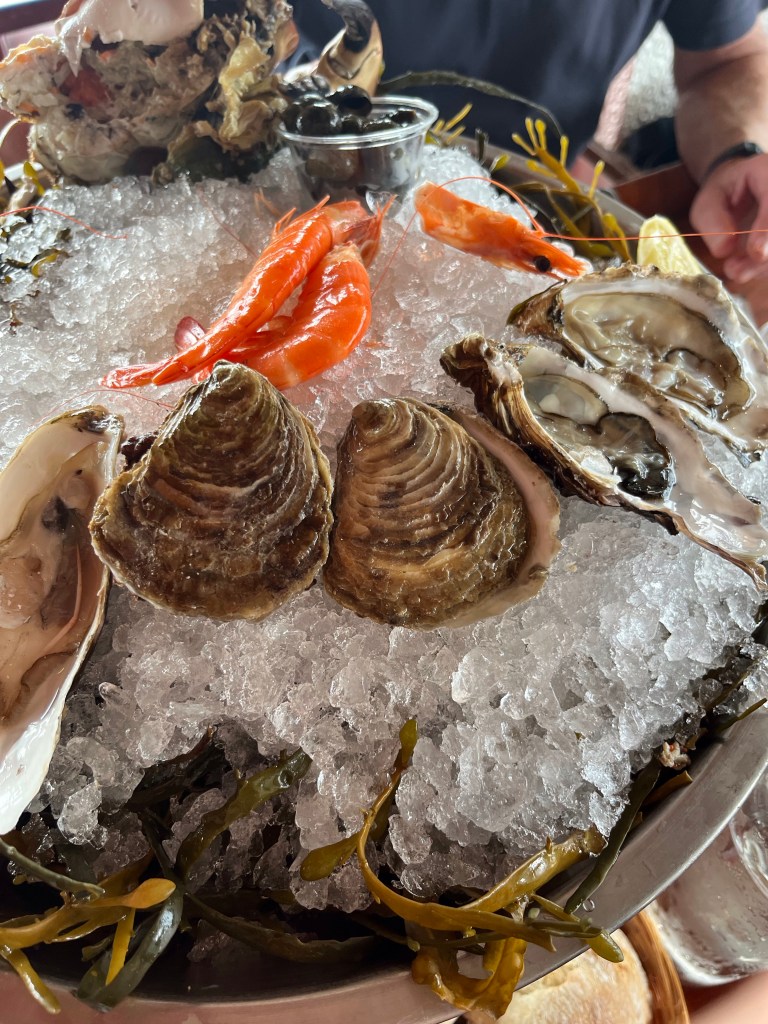
Unfortunately we had half devoured the platter before we remembered to take a picture — langoustines, more oysters, a local crab, periwinkles, cockles and more.

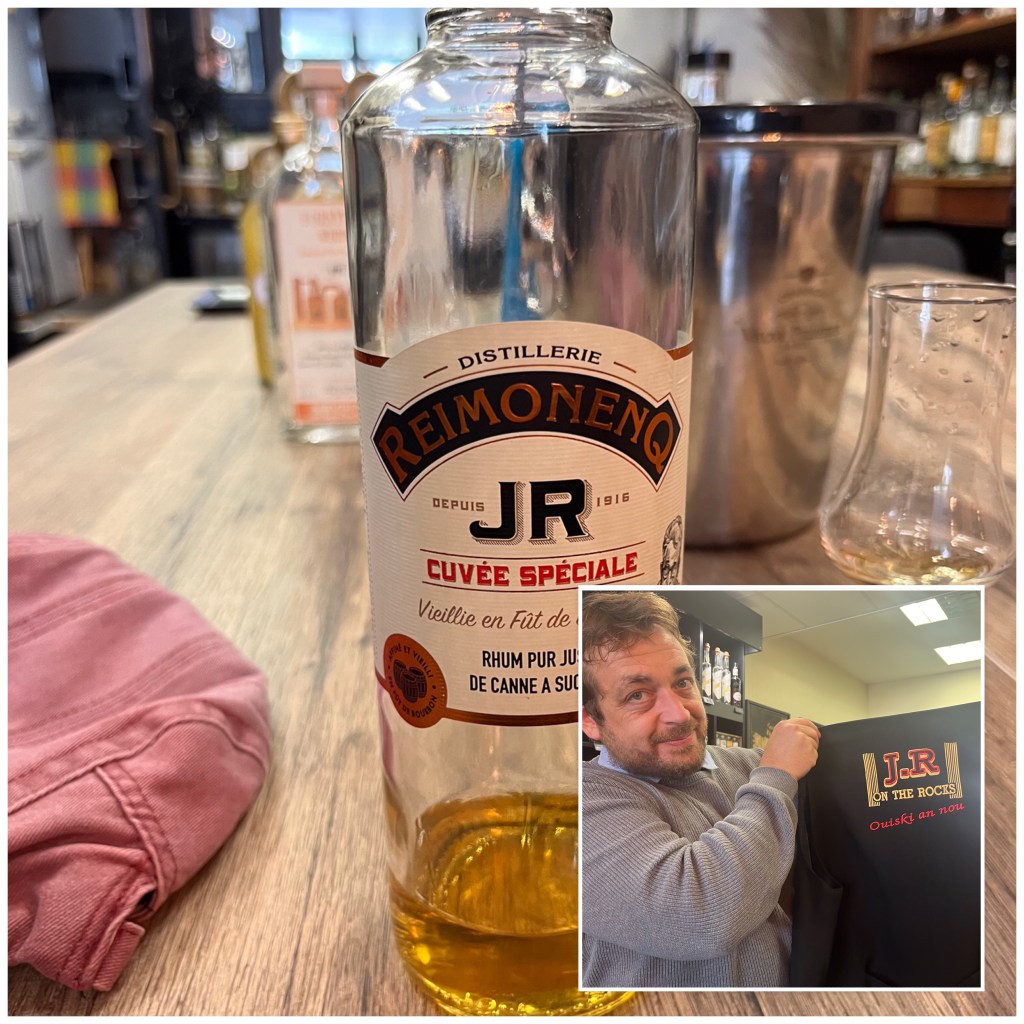
Stuffed from a platter of fresh seafood, we headed for a rummery. Yes, a rum store—filled with artisanal rum from the French West Indies.[https://www.officinearhum.fr/]. What we didn’t expect was a lesson in rum tasting (quite different from wine tasting) and a locally produced sipping rum named after the character JR from the TV show Dallas. We had to buy a bottle. Wish we had more time to talk more with the owner-distiller whose shop resembled a science lab with hand labeled specimen bottles stored in an old apothecary cabinet. Several small casks of spirits being aged. A delightful man with a clear passion for rum! If you’re ever in St Malo, look him up.

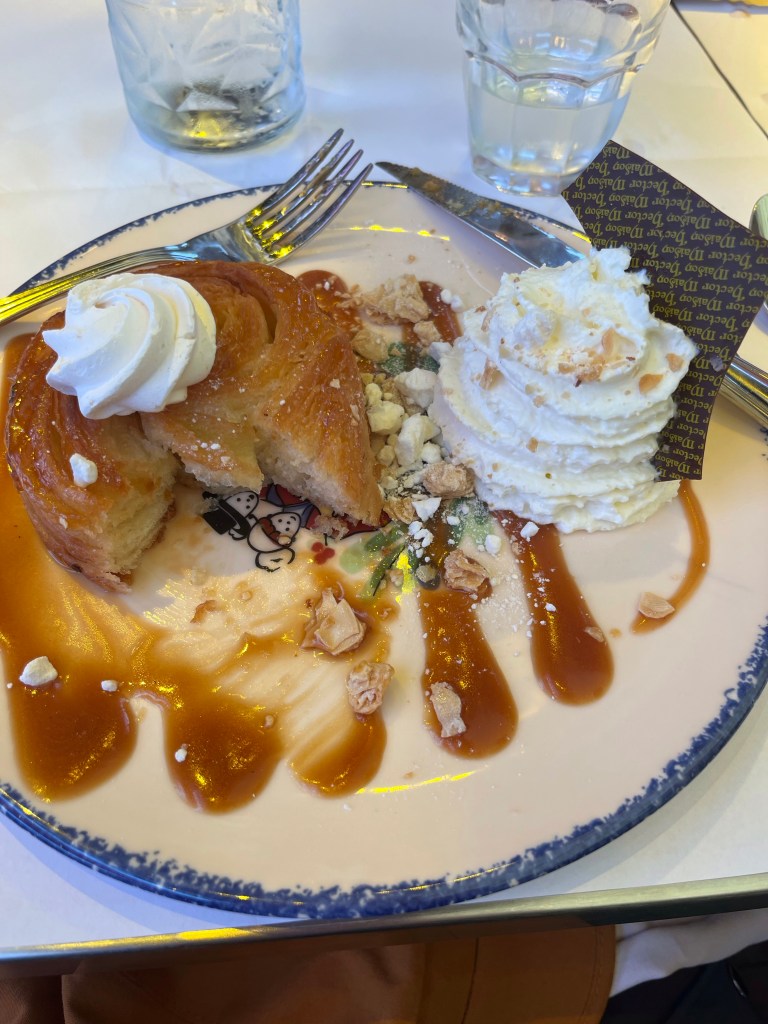
With full stomachs and a bit of rum, we were ready for a nap. But we had one more stop on our food tour. We had read about a Breton specialty, Kouign-amann. Butter and carmelized sugar — what’s not to love. Again, the food tempted us before we remembered to record its beauty. A cross between puff pastry, a croissant and a cinnamon roll.

Needless to say, we skipped dinner that night.

Between these various treats we learned a lot about the region and France. Our guide, a former teacher, proudly told us about his one daughter studying at a vocational school to become a jockey and horse trainer. His other daughter was on track to become a dancer or a veterinarian! Typical eleven year old anywhere! He also provided a historical context to the towns we had visited — St Malo, Cancale, Dinard — which were all largely destroyed like much of the Breton sea coast after the allied landing at Normandy. Their pre-war appearance was largely replicated in the postwar era. And, of course, we talked politics — he’s no fan of Macron, France’s president, and politicians in general, except for DeGaulle. In turn, he wanted to know more about tenure for teachers and how our schools worked. [https://www.normandytour.fr]. He had learned his English as an exchange student in the California and on several subsequent trips to the US.

That’s one of the things we like about a food tour — as much as the food itself — talking while you share food and sometimes a meal gives you a chance to build some mutual cultural understanding.

Our Town — St Cyprien

It barely gets a passing mention in the Michelin green guide and no stars at all. Rick Steves doesn’t say a word about it, though he raves about its Dordogne neighbors—Sarlat, La Roque-Gageac, and Beynac. It doesn’t have any great attractions—no museums, no castles, no great cathedrals, no magnificent châteaus, and no prehistoric caves. It does have a very large, rather drab, old abbey. But it’s our town, St. Cyprien, in the heart of the Dordogne.

Safe to say we’ve kind of fallen in love with this place.

What drew us to St. Cyprien was first it’s location—perfect for day trips and outings. And kayaking down the Dordogne.

Two castle/chateaus are within a 15 minute drive—Chateau Beynac and Castlenaud. These two great impressive fortresses sit high up on rock cliffs on opposite sides of the Dordogne River—staring at each other. On the front lines of the Hundred Years War, they changed hands between the English and the French frequently. Brooding Chateau Beynac is part of the story of the great Eleanor of Aquitaine and her son Richard the Lionhearted. Castlenaud offers a fine collection of medieval weaponry and armor, including a number of siege machines. A kilometer or two down the river is the another spectacular chateau, Les Milandes, formerly owned by the Josephine Baker, American dancer and singer, resistance fighter in WWII, and civil rights activist. The chateau is now a museum to her incredible life, complete with many of the costumes she wore in her Paris reviews in the 20’s and 30’s.

Open any guidebook, and you’ll find a dozen more chateaus or castles in the area. But nothing in St Cyprien.

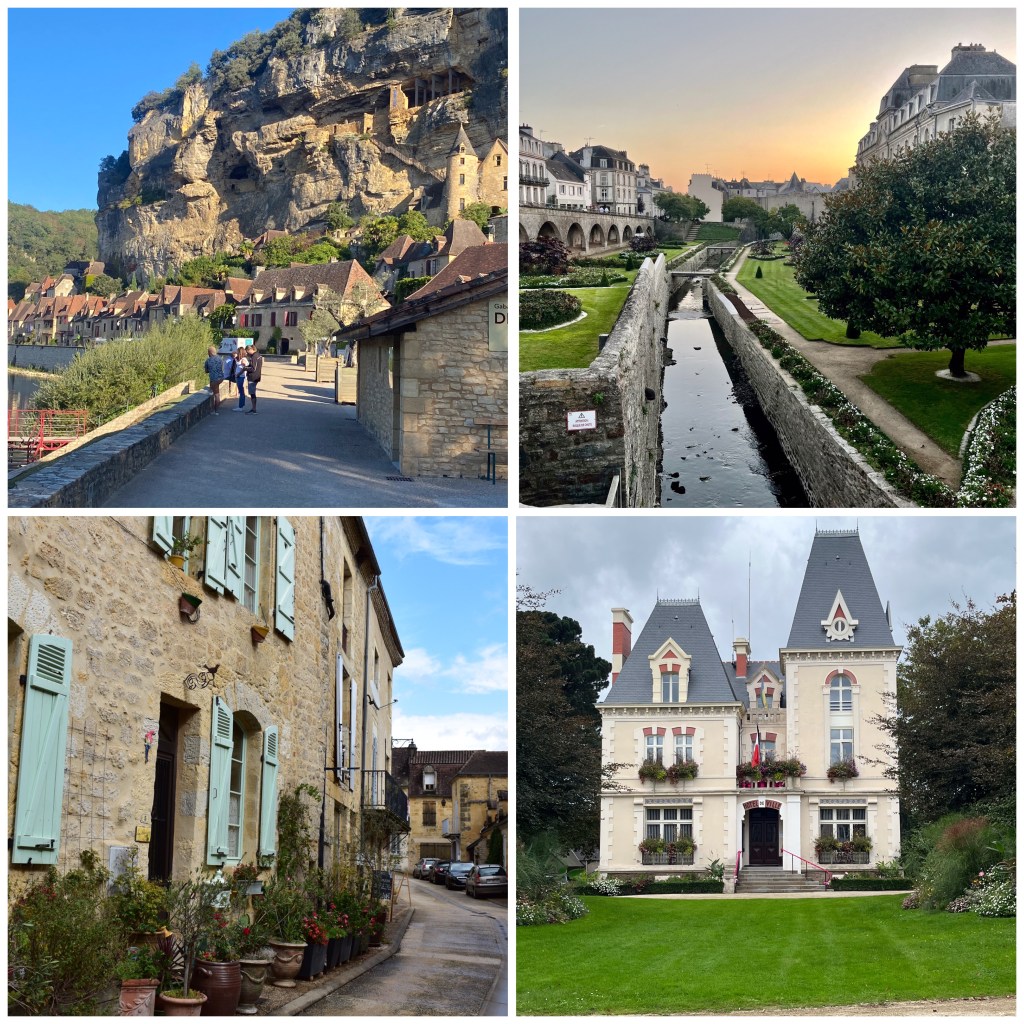
The valley is peppered with insanely cute towns and villages, among the most beautiful in France, most much prettier and more touristed than our St. Cyprien. La Roque-Gageac, Sarlat, Beynac, Rocamadour, St. Leon de Vezere, just to name a few. And the big towns of Bergerac and Perigueux are close by as well.

And the prehistoric sites! If you’re a fan of Neanderthals, cave paintings, and prehistory, this is ground central. There’s Lascaux 4 with its perfectly recreated cave (the Sistine Chapel of prehistoric art), Font de Gaume, the only real cave you can visit with polychrome paintings, and the prehistory museum in Les Eyzies, with its fabulous collection of ancient artifacts. And again, open any guide book, dozens more. Enough to make you an amateur archeologist. St Cyprien has only one cave above the city where it’s hermit and source of the town name once hung out.

The second thing that drew us to St. Cyprien (well, it might have been the first) is the food and the wine. In the Dordogne, fois gras, duck, walnuts, and truffles are the stars on the food side; Montebazillac (sweet Sauterne style white) and Pecharmant (a Bordeaux style red) on the wine side.

And the markets! Every day there is a farmers market somewhere that would put to shame anything we have in the US. We were lucky—one of the best and biggest was the Sunday market in St. Cyprien.

Specialty shops are everywhere. In St. Cyprien, we had several boulangeries, boucheries, a fabulous cheese shop, a wine store, two coffee shops, and one store specializing in fois gras and duck related products— one of the few places where we could buy goose fois gras in Dordogne (most of it is exported). And this is not a tourist town.

Excellent restaurants are nearby—from local pub food to Michelin starred establishments. And the prices are crazy cheap by US standards.

And finally, it’s easy to find beautiful accommodations, particularly if you want to rent a home or villa. It seems every French person or British expat (and there’s lots of those) are renting homes, villas or apartments. We were lucky and found a magnificent house near the abbey.

Walking down the main street of St. Cyprien, particularly on a non market day, you’d think nothing special here. Kinda dull. But spent a few days here or a few weeks as , you get to know a place—the lady at the boulangerie with her preppy “bon jour” every morning, the cats and dogs we see regularly, the rugby practices on a Sunday morning, the pouty waitress at the local bar, and the same locals walking their kids to school everyday. And the out of the way corners of the town with roses and historic timbers.

St. Cyprien—our town.

Steampunk Nantes and much more

Travel is full surprises and curiosities. Little did we know when we were on our way to Nantes, France, that we’d be staying across the street from a collection of phantasmagorical mechanical creatures right out of 19th century, including one very, very large mechanical elephant. It’s one of Nantes biggest tourist attractions—Les Machines de I’lle. Years ago, the city of Toulouse turned down the opportunity to house the exhibit—thinking it too kitschy. Poor decision.

Les Machines de I’lle complex is huge, located on the site of the old shipyards. There are still remnants from the old shipbuilding days—dry docks, a massive crane, ramps where the newly constructed ships slid into the murky Loire, now a park of sorts.

The menagerie of mechanical creatures is housed in the Gallerie des Machines. It’s a monstrous old warehouse with dozens of creatures — a giant spider, a heron, sloth, caterpillar, hummingbirds. All move. All are created out of old metal parts with a very steampunk look. Most animals take a few riders from the audience as part of the show put on by the guides. Unfortunately for us, the “show” was in French. But no matter—the excitement on the children’s faces and the squeals of laughter was the universal language.

But the star attraction is the giant elephant. It is free range. Standing three stories high, and carrying up to 50 passengers, the elephant walks around the grounds bellowing and spraying water at unsuspecting tourists.

The complex also includes two retro carousels, one that revolves around a three story aquarium of mechanical sea creatures.

You had a sense that all of this might have been inspired by late 19th century science fiction writers like Jules Verne, and, well, turns out he was a native of Nantes. There is a Jules Verne museum in the city—a house where he once lived overlooking the Loire river and the Machines de I’lle. For us, it was a little disappointing. Not much to see. A few books, some posters from the movies made from his books. A few half-hearted displays.

Jule Verne museum

The rest of the Isle de Nantes, across the Loire from the city center, was once dominated by the shipyards and waterfront with warehouses and rail lines for moving goods. You can still see where ships once tied up. Today it’s the site of a massive building project to create a new medical center and home to several schools, as well as the Temple of Justice and Commerce Center and an architectural school and university, punctuated by sculptures and art.

Île de Nantes

What makes the community really different, however, is the planning that is going into the new residential five and six story buildings. We were told by the owner of a fabulous oyster bar (https://www.lelieujaune.fr/) that the new structures must include ground floor store fronts, a certain percentage of low income homes as well as office space and high end units — all to create a mixed community. All very progressive, he said. We liked that. But it is certainly different than the old Nantes on the right bank of the river.

Nante and the Loire River was also played a role in the slave trade. That history is marked by memorial along the right bank of the river, where the ships could very well have tied up.

Memorial to slave trade

The historic center of Nantes isn’t all that old. It really came into its own with the Industrial Age and all that shipbuilding which led to a building boom. The old buildings largely had to be rebuilt after a massive bombing by the Allies in the fall of 1944 near the end of World War II.

Amazingly, photographs of the bombed city show the main fountain in the square somehow avoided destruction. We aren’t sure if the display around that fountain to World War II is a permanent exhibit, but it certainly offers a grim view of this city’s destruction.

There is a small medieval quarter in Nantes, Bouffay, close to the Ducs de Bretagne royal palace. Beautiful narrow, winding cobblestone streets, old churches, atmospheric squares filled with dozens of restaurants of every ethnicity. The royal palace itself is worth a stroll through, and grounds and the ramparts walk are free. It sits next to where the Loire River used to pass, before its diversion to its current flow. We hired a private guide (a Peruvian who has lived in France for 10 years and is also a jewelry maker https://instagram.com/stories/piedraspreciosas81/3206317892185479660?igshid=MzRlODBiNWFlZA==) for two hours to walk us through this area, point out a few of the remaining bits of medieval history and introduce us to the Jardin des Plantes, a beautiful botanical garden across from the main train station.

As only a local can, he tipped us off to a good option for a dinner of mussels and fries, as well as helping us master the tram system.

Steampunk Nantes was quite a surprise and definitely more than what we expected. And the city itself is delightful and well worth a visit.

Driving in Costa Rica

We’re pretty fearless when it comes to driving in foreign countries. Costa Rica tested our resolve. We did survive all three trips here and learned a few lessons about driving around this captivating country — or maybe almost anywhere outside of your home territory. And in Costa Rica having a car is essential—most of the country has limited public transport and some of the best spots are pretty remote.

First, buy a good map. The various online guides — Google Maps, Waze, or the in car navigation systems have real limitations. They only show you a small section of the route at a time. When reception is spotty, they can be slow or slightly out of sync with your actual location. BUY A GOOD PAPER MAP. Use your map with the online line assist. We set the route looking at the map and then confirmed it with Waze and used Waze for turn by turn directions. The few times we went to Google, it misled us—in one case taking us over a road more suitable for a tractor when there was a shorter, paved alternative.

The road Google took us on.

Second, rent a car with high clearance and preferably, four-wheel drive. (Side note: be aware that in Costa Rica when you rent a car, insurance is mandatory — your US insurance or credit card coverage will not cover a significant portions of the insurance. This is not a scam by the rental agency, but a matter of law. An advertised $500 dollar car month long rental will likely cost &1500-2000 with the mandatory insurance.). There’s a reason why you see so many jeeps and such in Costa Rica. The map may indicate you’re on a good road, but we learned even the major roads between major towns could descend into a series of landmine-like potholes or gravel and dirt. We referred to the best of these as Costa Rican car massages. The worst of them caused the driver and the navigator to full alert and slowed us to a crawl.

By far the biggest threat are the Tico drivers. Speed limits are mere suggestions; many locals drive much faster. It seems to be a sport! Passing the slower car in front of you seems to be the national pastime — on either side of the car, around corners or when your vision is restricted. Motorcycles think nothing of carving a third lane down the middle of the road, often carrying more than two passengers.

There are the inevitable slows downs and traffic backups. When most of the main highways are only two lane, a construction site or accident can cause huge delays. The worst for us was accidentally finding ourselves in the middle of a national bike race on one of the main north-south roads. Three hours to go six miles.

A well traveled road from Guanacaste coast to Liberia (There is also a better, longer route)

Many bridges are one lane affairs. Even on most two-lane roads. On one side of the bridge or the other, signs indicate when you must yield to on coming traffic. Once you get the hang of it, the system works just fine. Ten to twenty yards before the bridge on more traveled roads, be prepare for a speed bump. Sometimes they’re marked by a sign saying “reductor;” sometimes they are painted yellow, but not always. Hitting one of those at full speed is a tooth loosening experience. And sometimes there is no bridge at all. Then you wind up fording a stream or small river—a very sketchy prospect in a low clearance sedan.

Note the slow speed as we hit the potholes at the far end of the bridge

Be alert to pedestrians, bicycles, parents with baby strollers walking along the edge of the road. Vendors sell fruit and juices, rosaquillos (kind of donut) and even the local home brew, coyol, along the roads—anywhere there’s enough traffic, almost enough space for a car to pull off the road, or a speed bump to slow folks down. Sidewalks are scarce. Along many roads shoulders are non-existent or there are deep, steep and wide ditches often with small bridges connecting driveways and farm access points to the road. Running into one of these ditches would definitely ruin your day. In heavily touristed areas golf carts are road approved, and occasionally come without headlights. Yikes!

Watch out for the stray cow or two grazing along the roads.

Tico cowboys also move whole herds on the same roads you drive on. A small herd of water buffalo followed by a cowboy on a horse caused a delay in our drive near the Tempisque River. Such pastoral views aren’t limited to the countryside. We even saw an oxen drawn cart on the Inter-American highway!

Once you’re off the main roads, most lack the yellow center lines. Doesn’t really matter because Tico drivers often ignore the center line. When avoiding potholes, we followed their example and crossed to the other lane to find the smoothest path, praying a local driver didn’t coming bombing down the road at us. Mind you these same roads are used by truckers — a lot of truckers as Costa Rica has no railroads to ship goods. Be prepared for dust blackouts when driving behind trucks on the many dirt roads.

Despite the condition of the roads, we also found Tico drivers to be pretty courteous, often pausing to let you into the flow of traffic, waving you ahead at four-way stops. They may not follow the rules of the road that we are used to, but they also are not generally aggressive jerks. The basic Pura Vida of the locals shines through even in traffic.

Is Costa Rica too dangerous for North American drivers? Not really. While we focused here on the challenges, many of the roads are in good shape, not unlike country roads in rural parts of the US. And it’s really the best way to experience the variety that the country offers. At least for our style of travel (staying in Airbnb’s and trying to get a feel for the local community) it’s the best way. Maybe in bigger resorts taxis are available, but we saw few of them where we were. Public transportation consists mainly of buses with somewhat limited routes. The lack of public transportation is probably why we saw so many bikes and pedestrians on the roads. Your other option is hiring guides or drivers which is pretty much what you would have to do without a car. And they are readily available and reasonably priced.

We’ll rent a car again next time we visit. And we’ll remember to be vigilant, and that travel times may be greater than they might be back home. We’ll remind ourselves to exercise more caution than we might at home and keep our sense of humor! We’re on vacation after all!

No More Monkey Business

We’re back in Costa Rica for the third time. The first time was six years ago and then again in 2022 when we were first traveling as the pandemic became more manageable. We planned this year’s trip to take us to some new places and revisit our favorite “been there & done that’s.” The repeat visits generated comparisons — Is the traffic worse here? Are the prices higher this year?

Probably making such comparisons is inevitable and probably largely guesswork. But without a doubt the pandemic left it’s mark on Costa Rica.

One of Costa Rica’s biggest tourist attractions — Manuel Antonio National Park — is not the biggest park in Costa Rica, but sits reasonably close to the capital with gorgeous beaches. Six years ago, the beaches in the park were packed with families and tourists — and outnumbering the human visitors were the ever vigilant White-faced Monkeys (also known as Capuchin). Notoriously clever thieves, they were constantly on the lookout for bags or purses that might contain food. We were warned never to set our bags down as the monkeys were lightening fast at stealing them — often carrying them up into a tree and disdainfully throwing down all the non-edible items inside. As we walked the paths, we stepped around and over the mama monkeys and their babies. You had to get dozen of yards away from the beach and the picnickers to get a sense of the real park. On our visit this year, we struggled to see even one White-faced Monkey.

Why the change? The pandemic. The park was closed that first year. The park naturalists noticed monkeys began dying from starvation. Many of them had lost the ability to forage for food when there were no tourist backpacks to raid. This triggered a re-examination of park procedures. Now entry is limited and requires a reservation. Visitors are checked at the entry gates to make sure they don’t bring in any food that might attract the monkeys. As a result, the park is less crowded and is cleaner and, most importantly, the monkeys have reverted to their more natural state.

Without the monkeys lurking about, and with the help of our guide, we were able to focus on the other critters of the park. An immature sloth sleeping in a tree with mama watching from not too far away.

A lizard and a Fer de Lance snake patiently waiting for their meals to wander by.

An agouti mom and her two little ones, playing in the underbrush.

Anyone planning a trip to Manuel Antonio needs to remember the park is closed one day a week for repairs, cleaning and to give nature a chance to rebound — unless, of course, you can pay $36,000 as film production crews (scenes from The Castaway with Tom Hanks were filmed here) and the famous (Steven Spielberg, and Will Smith to name a few) do in order to have the beaches to themselves.

Costa Rica takes its natural beauty seriously. Roughly 28% of the country’s total land is set aside as national parks or nature reserves. School tour groups get in the parks free and we were told by our guide that annual visits to the park are a routine part of the curriculum to build a national sense of pride and consensus to preserve the bio-diversity.

Yes, it is different here now after the pandemic but some of the changes are definitely better for both tourists and the animals. Pura Vida!